Clear aligners can correct many dental overbites, and for mild to moderate cases the evidence is solid. The catch is that "overbite" covers two very different problems, and the treatment path depends entirely on which one you have.
Here is the short version:
- Dental overbite (tooth position): Upper front teeth sit too far forward or too low relative to the lower teeth because of how the teeth erupted, not because the jaw bones are misaligned. Aligners work well here.
- Skeletal overbite (jaw relationship): The upper jaw itself protrudes or the lower jaw is set back. Aligners alone often cannot resolve this. Braces, temporary anchorage devices (TADs), or orthognathic surgery may be needed.
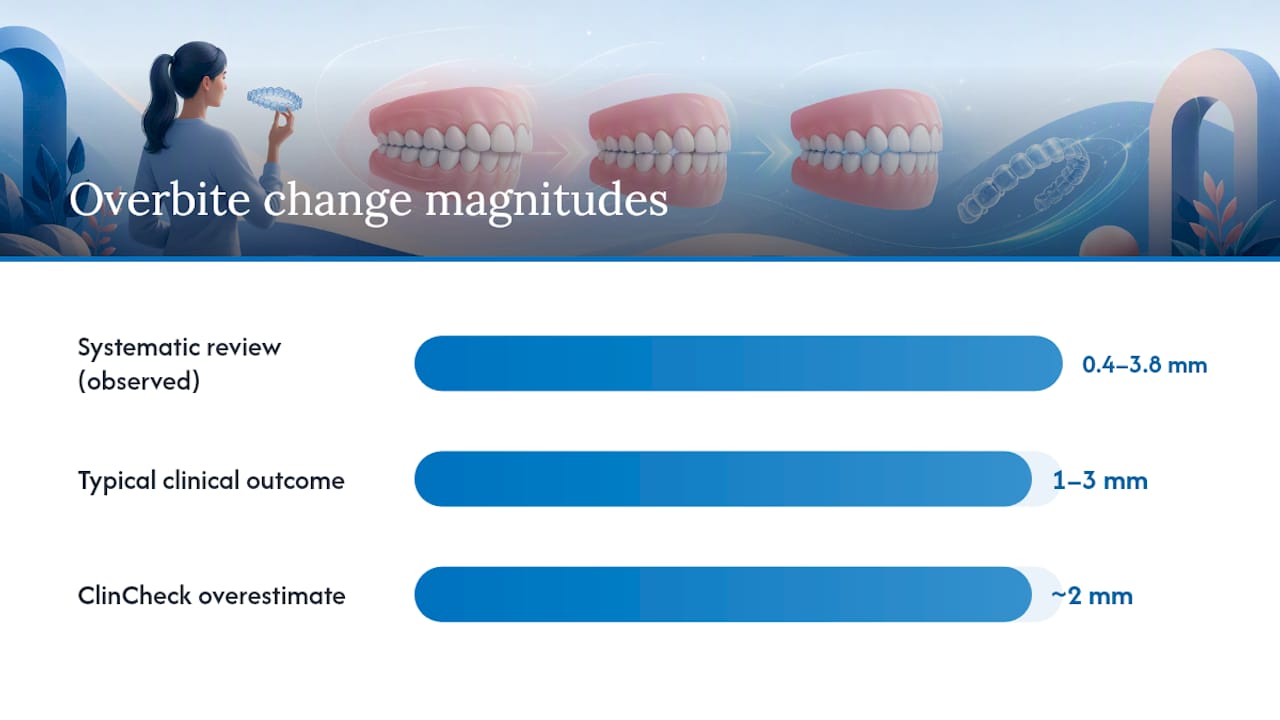
A systematic review published in Clinical Oral Investigations found that clear aligner therapy produces bite opening in the range of 0.4–3.8 mm, and that planned corrections routinely exceed what is actually achieved, which is why clinicians build in overcorrection from the start. The evidence quality overall is rated low, so realistic expectations matter. The right first step is an orthodontic evaluation with digital scans and bite records, not a self-diagnosis.
Key Takeaways
| Point | Details |
|---|---|
| Dental vs. skeletal overbite | Aligners work well for dental (tooth-position) overbites; skeletal cases often need braces, TADs, or surgery. |
| Expected improvement range | Clinical studies report bite opening of 0.4–3.8 mm; achieved results are consistently less than the digital plan predicts. |
| Refinements are normal | First-set accuracy averages ~37.6%; refinement sets drop to ~11%, so most correction happens early in treatment. |
| Retention is permanent | Overbites relapse without long-term retainer wear; nightly use indefinitely is the standard recommendation. |
| Starboarddental | Offers digital-scan-based aligner evaluation in Kennebunk, ME, with individualized treatment planning and in-house follow-up. |
Table of Contents
- What is an overbite, and why does the cause change everything?
- How clear aligners move teeth to reduce an overbite
- Who is a good candidate for aligner overbite treatment?
- When aligners aren't enough: adjuncts and hybrid approaches
- What the treatment timeline actually looks like
- What clinical research shows about overbite correction with aligners
- How clear aligners compare with traditional braces for overbite correction
- What to ask and bring to your orthodontic consultation
- Aftercare and retention: how to keep your results
- A clinical perspective on treating overbites with clear aligners
- Starboarddental's clear aligner services for overbite correction
- Sources
What is an overbite, and why does the cause change everything?
An overbite, clinically called a deep bite, means the upper front teeth overlap the lower front teeth more than normal. A small overlap is healthy; the problem starts when the upper teeth cover too much of the lower teeth vertically, or when the upper teeth jet forward horizontally (overjet).
The cause determines the treatment:
- Dental overbite: Caused by tooth position. The jaw bones are in a normal relationship, but the teeth themselves are tipped, over-erupted, or crowded in a way that creates excess vertical overlap. This is the category where aligners are effective for many mild to moderate cases.
- Skeletal overbite: Caused by the underlying jaw structure. The maxilla (upper jaw) may be too large, the mandible (lower jaw) too small, or both. Aligners move teeth, not bones, so a purely skeletal problem needs more than aligner therapy.
Why does correcting an overbite matter beyond aesthetics? Untreated deep bites can cause accelerated wear on the lower front teeth, gum trauma where upper teeth bite into the lower palate, and added stress on the temporomandibular joint (TMJ). Patients with deep bites sometimes report jaw pain or clicking that worsens over time.
How clear aligners move teeth to reduce an overbite
Aligners correct a dental overbite through a combination of controlled tooth movements, not a single mechanism. The main tools are:
- Anterior intrusion: The aligner applies gentle pressure to push the upper front teeth upward into the bone, reducing how far they drop over the lower teeth.
- Incisor proclination: Tipping the upper incisors slightly forward can reduce the vertical overlap.
- Posterior extrusion (limited): Opening the bite in the back of the mouth can help level the occlusal plane, but aligners are less reliable at extruding molars than at intruding incisors.
- Bite ramps: Small acrylic ramps built into the aligner's palatal surface prevent the lower teeth from biting down fully, which keeps the posterior teeth slightly apart and allows the anterior teeth to move.
- Precision attachments: Small tooth-colored composite bumps bonded to specific teeth give the aligner something to grip for more controlled movement.
- Elastics (rubber bands): Worn between upper and lower teeth through small hooks or cutouts in the aligner, elastics add a Class II corrective force that aligners alone cannot generate.
Clinicians also use a technique called frog staging, where the aligner sequence is designed so that posterior teeth are moved first to create space for anterior intrusion, rather than trying to do everything simultaneously. Case reports using this protocol describe larger rectangular attachments on premolars and canines, overcorrected final virtual setups, and treatment durations commonly around one and a half years.
Pro Tip: Overcorrection is intentional. Your orthodontist will often program the final aligner to move teeth slightly beyond the target position because the actual tooth movement typically falls short of what the digital plan predicts. This is not a mistake — it is standard clinical planning.
Who is a good candidate for aligner overbite treatment?
Not every overbite responds the same way to aligners. Here is a practical checklist to help you gauge where you stand before your consult.
Signs that favor aligner treatment:
- Mild to moderate vertical overlap (roughly 30–50% coverage of lower incisors by upper incisors).
- The overbite is dental in origin, not driven by a significant jaw size discrepancy.
- Good oral hygiene and healthy gums — active gum disease must be treated before orthodontic work begins.
- Strong compliance: you can commit to wearing aligners 20–about 20 to 22 hours per day.
- No significant crowding that would require complex tooth extraction mechanics.
- Skeletal growth is complete (adults) or nearly complete (older teens).
Red flags that suggest aligners alone may fall short:
- Significant jaw size discrepancy visible on a lateral cephalometric X-ray.
- Very deep bite where upper teeth nearly or fully cover the lower teeth.
- Severe crowding requiring extractions and complex space closure.
- Active temporomandibular dysfunction (TMD) that could be aggravated by bite changes.
- Prior orthodontic treatment with relapse, suggesting a skeletal component.
At your consult, ask for: intraoral digital scans, full-series clinical photos, a panoramic X-ray, and a lateral cephalometric X-ray with tracing. These records are not optional for overbite cases — they are what separates a guess from a diagnosis.
When aligners aren't enough: adjuncts and hybrid approaches
Aligners are a capable tool, but they have real limits for overbite correction. Knowing what gets added to the plan helps you ask better questions.
Common adjuncts:
- Elastics: The most frequently added component. Class II elastics run from the upper canine to the lower molar and add a forward force on the lower jaw that aligners cannot replicate on their own.
- Precision attachments: Rectangular attachments on posterior teeth improve the aligner's grip for intrusion and extrusion movements.
- Temporary anchorage devices (TADs): Small titanium mini-screws placed in the bone that serve as fixed anchor points. TADs allow forces that would otherwise move the wrong teeth.
- Fixed appliances in one arch: Some orthodontists place brackets on the lower arch only while using aligners on the upper, combining the predictability of braces for specific movements with the aesthetics of aligners elsewhere.
- Orthognathic surgery: For true skeletal overbites in adults, jaw surgery combined with orthodontics is often the only way to achieve a stable, functional result.
The predictability issue with refinements is worth understanding clearly. A retrospective study published in BMC Oral Health found that mean accuracy for overbite correction was about 37.6% after the first aligner set, and dropped to roughly 11% for the second set. Most of the clinically meaningful correction happens early. Refinements fine-tune the result, but they are less efficient at producing additional bite opening.
Pro Tip: If your treatment plan includes more than two refinement phases specifically for overbite correction, ask your clinician what is driving the continued need. It may signal that a hybrid approach with elastics or an adjunct appliance would be more efficient.
Consider a moderate dental overbite: a patient with a 4 mm deep bite and no skeletal discrepancy can often achieve meaningful correction with aligners plus Class II elastics over 14–18 months. A patient with the same bite measurement but a retrognathic mandible visible on ceph imaging is a different case entirely, and aligners plus elastics may improve the appearance without resolving the underlying jaw relationship.
What the treatment timeline actually looks like
Knowing the sequence prevents surprises. Here is a realistic step-by-step path from first appointment to retention:
- Initial consult: Clinical exam, bite assessment, and review of your dental and medical history. The clinician determines whether your overbite is dental or skeletal.
- Records appointment: Digital intraoral scans, clinical photos, panoramic X-ray, and lateral cephalometric X-ray. These take 30–60 minutes.
- Treatment planning: The orthodontist designs a digital treatment plan (similar to Invisalign's ClinCheck software) showing projected tooth movements. You review and approve it.
- First aligner set: You receive your first series of trays. Wear 20–about 20 to 22 hours per day, swapping trays weekly or every two weeks as directed. Invisalign estimates treatment time commonly ranges from several months up to a couple of years, depending on severity and compliance.
- Progress checks: Appointments every 6–10 weeks to verify teeth are tracking the plan. Attachments and elastics are added at this stage if needed.
- Refinements: After the first series, a new scan is taken. If overbite correction is incomplete, a refinement series is designed. Most overbite cases require at least one refinement phase.
- Retention: Once active treatment ends, retainers are fitted immediately. Skipping this step is the fastest way to lose your results.
Total active treatment for a mild dental overbite typically runs 12–18 months. Moderate cases with refinements often reach 18–24 months.
What clinical research shows about overbite correction with aligners
The honest summary: aligners work for dental overbites, but the gap between what the digital plan predicts and what actually happens is consistent across studies.
| Study / Review | Key Finding | Clinical Implication |
|---|---|---|
| Systematic review (Clinical Oral Investigations, 2025) | Bite opening range: 0.4–3.8 mm; evidence quality rated low | Plan for overcorrection; temper patient expectations |
| Retrospective study, 31 patients (PMC, 2025) | Significant overbite reduction achieved, but ClinCheck predictions exceeded results by ~2 mm in some measures | Digital predictions are optimistic; achieved results are real but smaller |
| Retrospective study (BMC Oral Health, 2024) | The first set accuracy is moderate but the second set accuracy is much lower | Most correction happens early; refinements have diminishing returns |
| Literature review (Seminars in Orthodontics, 2025) | Less than 50% of planned overbite reduction expressed; fixed appliances often achieve greater reduction | Braces may outperform aligners for severe deep bites |
A few practical takeaways from this evidence:
- A 1–3 mm improvement in bite depth is a realistic and clinically meaningful outcome for many dental overbite cases.
- The digital treatment plan will likely show more correction than you ultimately achieve. That is not a failure; it is the known gap between planned and expressed movement.
- Fixed appliances still have an edge for cases requiring precise molar extrusion or large amounts of bite opening.
How clear aligners compare with traditional braces for overbite correction
| Dimension | Clear aligners | Traditional braces |
|---|---|---|
| Best for | Mild to moderate dental overbites | Moderate to severe, skeletal, or complex cases |
| Treatment time | 12–24 months (dental cases) | 18–30 months (varies widely) |
| Need for auxiliaries | Elastics, attachments common; TADs occasionally | Elastics, TADs, headgear possible |
| Predictability for deep bite | Moderate; <50% of planned reduction typically expressed | Generally higher for large vertical corrections |
| Surgical indication | Skeletal cases still need surgery | Skeletal cases still need surgery |
| Patient experience | Removable, less visible, easier hygiene | Fixed, more visible, harder to clean |
The decision rule is straightforward: if your overbite is dental and mild to moderate, aligners are a reasonable first-line option and the cosmetic advantage is real. If your case involves significant skeletal discrepancy, needs reliable molar extrusion, or has already failed aligner treatment once, fixed appliances are likely the more predictable path.
What to ask and bring to your orthodontic consultation
Walking in prepared shortens the consult and gets you better answers. Here is what to bring and what to ask.
Bring:
- Any prior dental X-rays (panoramic or ceph films from the last 2–3 years).
- A list of current medications and any TMJ symptoms.
- Your dental insurance card and a note of your orthodontic benefit maximum.
- Photos of your smile from the front and side if you have them.
Questions to ask:
- Is my overbite dental, skeletal, or a combination? Can you show me on the X-ray?
- How many millimeters of bite opening do you expect to achieve, and how does that compare to what the digital plan will show?
- Will I need elastics, attachments, or TADs? At what stage?
- How many aligner sets and refinement phases do you anticipate?
- What is the realistic total treatment time, including refinements?
- What retainer will I need, and for how long?
- What happens if the overbite does not fully correct?
What good answers look like: A clinician who shows you the ceph tracing, gives you a millimeter estimate with a range, and explains why refinements are likely is giving you honest, informed consent. Vague answers like "we'll see how it goes" or a plan with no imaging are red flags.
Aftercare and retention: how to keep your results
Overbites have a strong tendency to relapse without proper retention. The teeth want to return to their original positions, and the forces that caused the deep bite in the first place do not disappear when treatment ends.
Retainer options:
- Clear removable retainers (Essix-style): The most common post-aligner choice. They look like a thin aligner tray and are worn full-time initially, then nightly long-term. They are easy to clean but can crack or warp.
- Hawley retainers: A wire-and-acrylic design that is more durable and allows minor adjustments. Less popular with aligner patients because of the visible wire.
- Fixed bonded retainers: A thin wire bonded to the back of the front teeth. Excellent for preventing relapse of tooth position, but they do not control the vertical dimension the way a removable retainer does. For overbite cases, a fixed retainer is often combined with a removable one.
Wear schedule: Most orthodontists recommend full-time wear (22 hours/day) for the first 3–6 months, then nightly wear indefinitely. "Indefinitely" is not an exaggeration. Teeth move throughout life.
Maintenance tips:
- Clean retainers daily with a soft brush and mild soap. Toothpaste is too abrasive.
- Bring your retainer to every dental checkup so your dentist can check for cracks and verify your bite has not shifted.
- If you notice your retainer feels tight after a few days off, wear it full-time for a week and contact your dentist. Tightness means movement has started.
- Gum health directly affects orthodontic stability. Healthy gums are a prerequisite for both starting and maintaining orthodontic treatment.
A clinical perspective on treating overbites with clear aligners
At Starboarddental, overbite cases start with a digital intraoral scan and a lateral cephalometric X-ray, not a guess. The scan gives us a precise 3D model of your teeth; the ceph tells us whether the bite issue is in the teeth, the jaw, or both. That distinction changes everything about the treatment plan.
For dental overbite cases, we design the aligner sequence with overcorrection built in from the start, knowing that achieved movement will be less than planned. We schedule progress checks at regular intervals to catch tracking problems early, and we are upfront with patients that one refinement phase is common, not a sign that something went wrong.
What sets the experience apart here is the combination of precision technology and a genuinely relaxed environment. Ceiling-mounted TVs, personalized comfort options, and a team that takes time to explain what the scans actually show make a real difference for patients who have been putting off this kind of evaluation. If you have been wondering whether your overbite is treatable with aligners, the honest answer starts with a proper exam, not a website quiz.
Starboarddental's clear aligner services for overbite correction

Starboarddental offers clear aligner treatment for patients in Kennebunk, York, and Saco, ME, with a workflow built around accurate diagnosis first. Your initial visit includes a digital intraoral scan, clinical photos, and a bite assessment, so you leave knowing whether your overbite is a good candidate for aligners, not just whether aligners are available.
The practice works with dental insurance and offers financing options, so cost questions have a real answer at the consult rather than a vague "it depends." Same-day appointments are available for new patients who want to get started quickly.
To schedule an evaluation, visit Starboarddental's general dentistry page or call the office directly. Bring any prior X-rays and your insurance information, and you will walk out with a clear picture of your options.
Sources
- Effectiveness and accuracy of clear aligners in treatment of deep bite: a systematic review | Clinical Oral Investigations | Springer Nature Link
- Prediction of overbite improvement in deep bite correction using clear aligner therapy - PMC
- Does aligner refinement have the same efficiency in deep bite correction?: A retrospective study | BMC Oral Health | Springer Nature Link
- Deep bite correction with Clear Aligners – after 26 years where are we at?
- Invisalign
- Invisalign and Fixing Overbites: How it Works, Timeline and More | Healthline
This article is general information, not a substitute for advice from a qualified doctor. Consult a qualified healthcare professional about your own circumstances before acting on anything here.