
Start with conservative, reversible care: soft diet, jaw rest, heat or cold, and short-term over-the-counter pain relief. Most jaw pain improves within weeks using these steps alone. See a dentist or TMJ specialist if pain lasts more than a few weeks, worsens, or limits how wide you can open your mouth. Professional TMD evaluations are advisable for patients who need a formal diagnosis.
TL;DR:
- Cold packs are recommended for sharp, acute pain, while moist heat is better for dull, chronic ache, and both should be applied for 15 to 20 minutes several times daily.
- Physical therapy, behavioral therapy, and low-level laser treatments have strong evidence supporting their effectiveness in improving jaw function and relieving TMJ pain without invasive procedures.
- Over-the-counter NSAIDs are suitable short-term for inflammation and pain, but prolonged use increases risks of stomach and kidney problems, signaling the need for professional evaluation.
- Minimally invasive in-office procedures, such as trigger-point injections and joint flushing, are suitable for cases unresponsive to conservative care but have variable outcomes across patients.
- Surgery is reserved for cases with structural joint damage or joint fusion and should only be considered after comprehensive imaging confirms the problem and a second medical opinion is obtained.
Table of Contents
- Conservative TMJ Treatment Options You Can Start Today
- Professional Non-Surgical TMJ Treatments
- Medication Options for TMJ Pain Relief
- Minimally Invasive TMJ Procedures
- Surgical Options and When They Make Sense
- How to Choose the Right TMJ Treatment for You
- How Starboard Dental Approaches TMJ Evaluation
- Diagnosing TMJ Disorders: What the Exam Actually Involves
- Causes and Risk Factors Behind TMJ Disorders
- Lifestyle and Ergonomic Changes That Prevent TMJ Strain
- Long-Term Outlook for TMJ Disorders
- An Editorial Take on TMJ Care
- Get Your Jaw Pain Evaluated at Starboard Dental
- Sources
- FAQ
Conservative TMJ Treatment Options You Can Start Today
Nearly every clinical guideline agrees on one thing: reversible, low-risk self-care comes first. A network meta-analysis and clinical practice guideline published in BMJ strongly recommends conservative multimodal care for chronic TMJ pain, and explicitly recommends against jumping to irreversible dental changes or early surgery.
A "soft diet" means skipping anything that requires heavy chewing, tearing, or wide opening. Think scrambled eggs, yogurt, soup, mashed potatoes, and pasta instead of bagels, steak, or raw carrots. Most people benefit from sticking to this for a few weeks while inflammation settles.
Heat and cold work differently, and using the wrong one wastes time. Research on TMJ management strategies recommends cold packs for sharp, acute pain and moist heat for a dull, chronic ache, applied for 15 to 20 minutes several times a day.
Pro Tip: Wrap ice or a heating pad in a thin towel before applying it to the jaw. Direct contact for 15 to 20 minutes can irritate skin, especially over the joint area right in front of the ear.
Beyond temperature therapy, a few habit changes make a real difference:
- Avoid wide yawns, gum chewing, and biting into hard or chewy foods.
- Rest your tongue gently on the roof of your mouth with teeth apart when relaxed.
- Try gentle circular massage over the jaw muscles for a minute or two, several times daily.
- Support your jaw with your hand when yawning to limit how wide it opens.
- Take over-the-counter NSAIDs like ibuprofen for short stretches, following label dosing.
NSAIDs help with inflammation, not just pain, but they carry stomach and kidney risks with prolonged use. If you need them daily for more than a week or two, that's a signal to get evaluated rather than a signal to keep dosing.
Professional Non-Surgical TMJ Treatments
When self-care plateaus, clinic-based therapies fill the gap without resorting to surgery. These represent the best TMJ therapies backed by real evidence, not just tradition.
Physical therapy uses manual therapy and supervised jaw exercises to restore motion and reduce muscle guarding. A network meta-analysis of non-pharmacological therapies, covering 2,021 participants, ranked manual therapy highest for improving maximum mouth opening in myogenic TMD, meaning cases driven by muscle rather than joint damage.
Behavioral approaches, including cognitive behavioral therapy and biofeedback, target the clenching and grinding habits that keep symptoms going. These matter most for people whose pain flares with stress, since habit reversal training addresses the trigger rather than just the ache.
Oral splints and night guards reduce nighttime clenching load, but they aren't a universal fix. The same Merck Manual guidance that supports their short-term use also warns that unsupervised, long-term wear can shift your bite permanently. A night guard is a behavioral-habit interruption tool, not a cure, and needs periodic dentist checkups.
That same meta-analysis ranked photobiomodulation (low-level laser therapy) highest of all non-drug options for short-term pain relief, ahead of CBT, electrotherapy, and splint therapy. It's worth asking a specialist if photobiomodulation is available before committing to more invasive routes.
Medication Options for TMJ Pain Relief
Medication rarely fixes TMJ disorders on its own. It buys comfort while the therapies above do the actual work.
- OTC NSAIDs (ibuprofen, naproxen) handle mild to moderate flare-ups short-term, but watch for stomach irritation and drug interactions with blood thinners.
- Muscle relaxants, prescribed for a short course, can break a spasm cycle when jaw muscles are locked tight, though they require monitoring for drowsiness.
- Low-dose tricyclic antidepressants are sometimes used for chronic TMJ pain, but only under specialist oversight since dosing for pain differs from dosing for depression.
The Merck Manual flags a real risk here: long-term reliance on muscle relaxants or benzodiazepines carries dependency and side-effect concerns that outweigh their benefit past a few weeks. If a prescription isn't working within that window, the answer is a different treatment, not a longer prescription.
Minimally Invasive TMJ Procedures
Between conservative care and surgery sits a middle tier of in-office procedures for patients who haven't responded to the basics.
- Trigger-point injections target tight muscle bands directly, though evidence on how long relief lasts varies from patient to patient.
- Intra-articular injections, including hyaluronic acid, show mixed results in trials, so candidates are usually chosen carefully based on joint imaging.
- Arthrocentesis, a needle-flushing procedure for the joint space, helps some patients with restricted opening and pain, according to Cleveland Clinic.
- Arthroscopy allows a surgeon to both diagnose and treat certain joint problems through a small camera, with recovery typically faster than open surgery.
Outcomes for these procedures are inconsistent across patients, which is exactly why they sit after conservative and professional non-surgical care, not before it.
Surgical Options and When They Make Sense
Surgery is the last stop, reserved for structural joint damage, ankylosis (joint fusion), or cases where months of conservative and minimally invasive care haven't helped. Options range from open joint surgery to TMJ implants, some of which fall under FDA device oversight given a history of implant complications in this specific joint.
- Confirm structural damage on imaging before considering surgery, not just persistent pain.
- Ask about long-term outcome data for the specific procedure, since evidence for some techniques remains limited.
- Get a second opinion from an oral and maxillofacial surgeon or orofacial pain specialist before scheduling anything irreversible.
NIDCR explicitly cautions against irreversible procedures as a first move, a stance echoed throughout current clinical guidelines.
How to Choose the Right TMJ Treatment for You
Matching your symptoms to the right level of care saves months of trial and error.
- Identify your primary symptom. Is it pain, clicking, locking, or a combination? Painless clicking often needs no treatment at all.
- Track duration. Symptoms under three months usually respond to conservative care. Past three months, ask about physical therapy or behavioral approaches.
- Note functional impact. Can you chew normally? Open wide enough for a dental exam? Functional limits push you toward professional evaluation sooner.
- List what you've already tried. Bring this to your appointment so your dentist doesn't repeat steps that already failed.
When you do sit down with a clinician, ask directly: What diagnostic tests do you recommend? What's the expected timeline for improvement? How will we know if we need to escalate treatment?
Pro Tip: Keep a simple symptom diary for two weeks before your appointment. Note pain level, jaw sounds, and what you were doing right before each flare. It gives your dentist real data instead of a memory of "it hurts sometimes."
Seek an orofacial pain specialist promptly if you notice sudden inability to open your mouth, jaw locking that won't release, or pain radiating with ear symptoms.
How Starboard Dental Approaches TMJ Evaluation
Diagnosing a TMJ disorder starts with a careful clinical exam, not guesswork. Starboard Dental's TMD care combines digital scanning technology with a hands-on assessment of jaw movement, muscle tenderness, and bite alignment to figure out what's actually driving your symptoms.
- The practice offers appointment options for patients dealing with acute jaw pain or lockjaw.
- Digital scanners that map bite alignment are used to enhance diagnostic precision.
- Efforts are made to create a comfortable, low-anxiety environment, including entertainment during longer diagnostic visits.
- Guidance on tracking symptoms before your visit so the exam starts with useful information.
Diagnosing TMJ Disorders: What the Exam Actually Involves
A TMJ diagnosis starts with a clinical exam, not an X-ray. Dentists check for joint sounds, measure how wide you can open your mouth, palpate the jaw and neck muscles for tender spots, and watch how your jaw moves when you open and close.
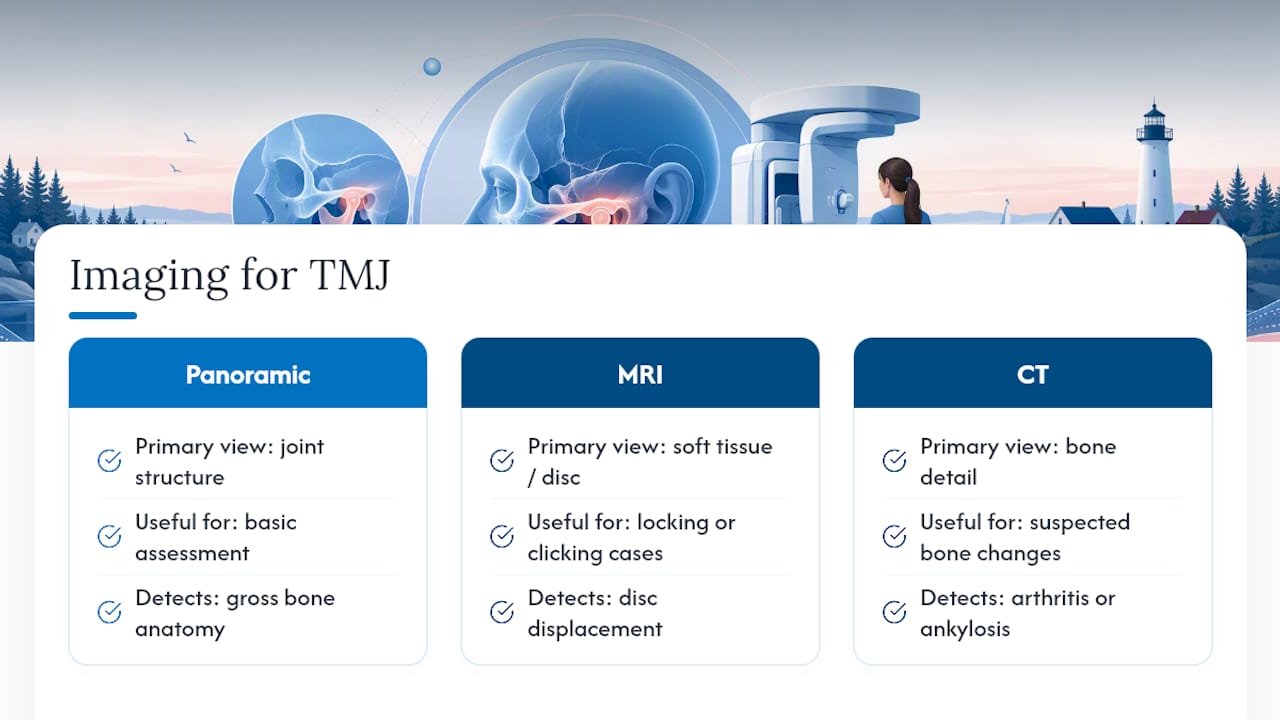
Imaging comes in when the clinical picture is unclear or symptoms are severe. Panoramic X-rays give a basic view of the joint structure, while an MRI shows the soft tissue, including the disc that cushions the joint, useful when locking or clicking suggests disc displacement. A CT scan is reserved for cases where bone changes, like arthritis or ankylosis, are suspected.
Dentists also rule out look-alike problems. Tooth pain, sinus infections, ear infections, and even certain headache disorders can mimic TMJ symptoms closely enough to send patients down the wrong treatment path. That's part of why a hands-on exam by someone trained in orofacial pain matters more than jumping straight to imaging.
Bite assessment rounds out the picture. Misaligned teeth, an uneven bite, or missing teeth can all shift load onto the jaw joint over time, so a thorough evaluation looks at your whole mouth, not just the joint itself.
Causes and Risk Factors Behind TMJ Disorders
TMJ disorders rarely trace back to one single cause. NIDCR-funded research describes TMD as multifactorial, which is exactly why a personalized, multimodal plan tends to outperform any single fix.
Clenching and grinding, often tied to stress or sleep disorders, place repetitive strain on the jaw joint and surrounding muscles. Injury, including whiplash or a direct blow to the jaw, can damage the joint structure directly. Arthritis, whether osteoarthritis or rheumatoid, affects the TMJ the same way it affects other joints in the body.
Genetics play a role too. Some people are simply born with joint or connective tissue characteristics that make them more prone to TMJ problems. Hormonal factors matter as well. TMJ disorders are diagnosed in women considerably more often than men, and researchers have looked at estrogen's role in joint tissue sensitivity as a possible explanation.
Posture and daily habits round out the risk list. Forward head posture from constant phone or laptop use pulls on jaw and neck muscles in ways that add up over months. Chewing gum constantly, nail biting, and resting your chin on your hand are smaller habits that compound the same strain.
Lifestyle and Ergonomic Changes That Prevent TMJ Strain
Prevention often comes down to posture and habit, not medical intervention. Where your head sits relative to your spine changes how much load your jaw muscles carry all day.
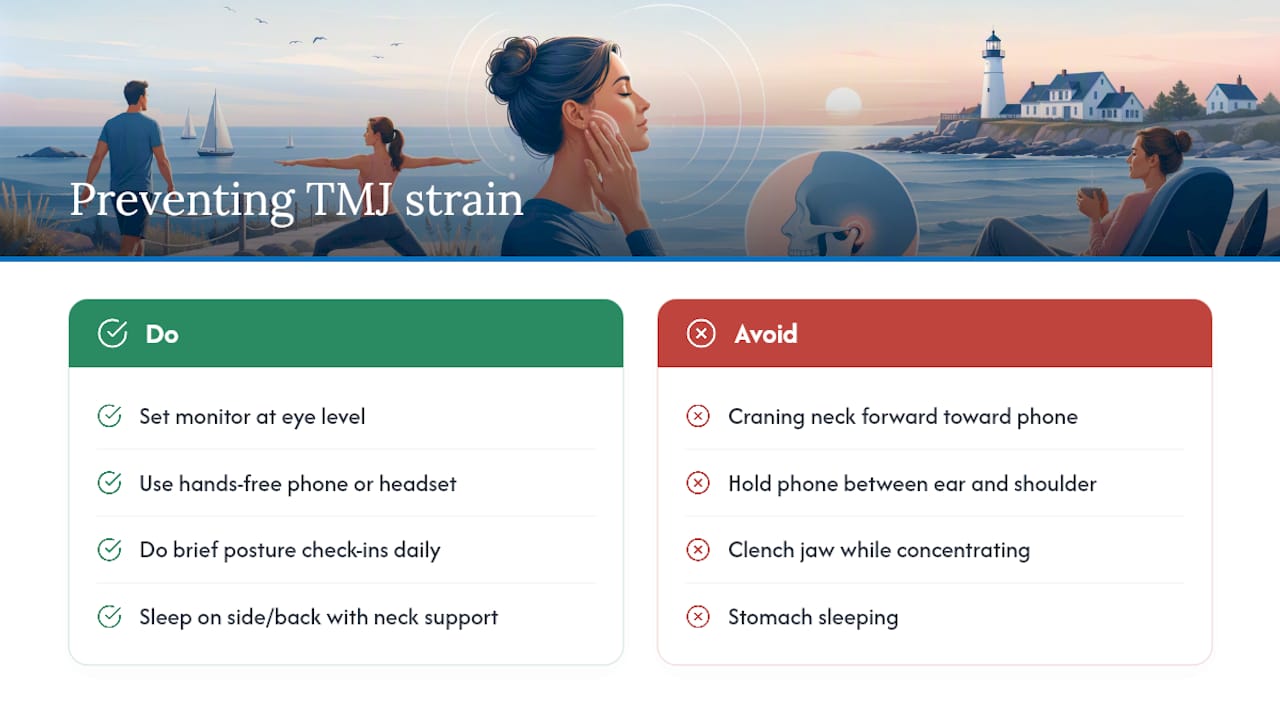
Set up your workstation so your monitor sits at eye level and your phone doesn't require craning your neck forward. That single fix reduces the forward head posture that drags on jaw and neck muscles for hours at a time.
Watch your daytime habits. Clenching your jaw while concentrating, resting your chin on your hand, or holding a phone between your ear and shoulder all add strain you don't notice until it becomes pain. Building brief posture check-ins into your day, even a sticky note reminder, breaks the pattern.
Sleep position matters too. Stomach sleeping twists the neck and can aggravate jaw tension; side or back sleeping with proper neck support tends to be gentler on the joint.
Stress management deserves a real place on this list, not just a mention. Since clenching and grinding often ramp up with stress, some people find relief through acupuncture or structured relaxation techniques alongside their dental care. These complementary therapies aren't a replacement for clinical treatment, but they can reduce the muscle tension that keeps symptoms simmering.
Finally, treat food and posture as connected. Chewing gum for hours, biting nails, or eating hard candy regularly all put low-grade, repetitive stress on a joint that's already working overtime just from talking and eating three meals a day.
Long-Term Outlook for TMJ Disorders
Most TMJ disorders improve substantially with conservative care and don't require surgery or permanent intervention. The prognosis for muscle-driven TMD, the most common type, tends to be good when patients stick with a combination of self-care, physical therapy, and habit changes.
That said, TMJ pain can be cyclical. Stress spikes, seasonal allergies affecting sinus pressure, or a stretch of poor sleep can bring symptoms back even after months of feeling fine. This is where a maintenance mindset beats a "cure" mindset. Keeping up gentle jaw stretches, wearing a night guard as directed, and catching flare-ups early usually prevents them from becoming chronic again.
A smaller subset of patients, particularly those with joint degeneration from arthritis or structural damage, deal with a more chronic course that needs ongoing management rather than a single fix. For these patients, periodic reevaluation matters, since joint changes can progress slowly over years.
The strongest predictor of a good long-term outcome isn't which treatment you choose first. It's how quickly you get an accurate diagnosis and start matching treatment intensity to what your symptoms actually need, rather than over-treating mild cases or under-treating ones that need more structured care.
An Editorial Take on TMJ Care
The biggest mistake I see in how people approach jaw pain is treating it like a dental problem when it's really a musculoskeletal one that happens to live in the mouth. Conservative, multimodal care isn't the slow option. It's usually the fastest path to lasting relief. If jaw pain is changing how you eat, sleep, or talk, that's your cue to get evaluated rather than wait it out.
— Alex
Get Your Jaw Pain Evaluated at Starboard Dental
Guesswork about whether your jaw pain is muscle strain, joint damage, or something else entirely wastes the weeks you could spend actually fixing it. Starboard Dental's TMD care in Kennebunk pairs a hands-on clinical exam with digital scanning technology, so you get a specific diagnosis instead of a generic night guard prescription.

Same-day appointments mean you're not stuck waiting weeks while your symptoms get worse. Whether you need a custom night guard to interrupt nighttime clenching, a full diagnostic workup, or ongoing TMD care for a more complex case, the evaluation starts with understanding what's actually happening in your joint. Check the conditions treated at Starboard Dental and book an appointment to get a real answer instead of another round of self-care that might not fit your specific case.
Sources
- Management strategies for temporomandibular disorders (PMC10381711)
- TMD | National Institute of Dental and Craniofacial Research (NIDCR)
- Temporomandibular disorders — Merck Manual
This article is general information, not a substitute for advice from a qualified doctor. Consult a qualified healthcare professional about your own circumstances before acting on anything here.
FAQ
What Is the Most Successful Treatment for TMJ?
There's no single most successful treatment because TMJ disorders have different causes in different people. For most cases driven by muscle tension, conservative multimodal care, including physical therapy, behavioral approaches, and short-term appliance use, produces the best outcomes according to current clinical practice guidelines.
What Is the Three-Finger Test for TMJ?
The three-finger test checks how wide you can open your mouth by seeing if you can fit three stacked fingers vertically between your upper and lower front teeth. A normal opening fits three fingers comfortably; a noticeably smaller gap can indicate joint restriction worth mentioning to a dentist during evaluation.
How Do You Live With Chronic TMJ Pain?
Living with chronic TMJ pain usually means combining daily habit management, like a soft diet during flares and posture correction, with ongoing professional care such as physical therapy or a night guard. Consistency matters more than any single fix, since flare-ups tend to respond best to the same conservative steps used early on. A TMJ specialist near you can help build a maintenance plan suited to your specific pattern of symptoms.
Can High Cortisol Levels Cause TMJ Disorders?
Elevated stress hormones like cortisol don't directly damage the jaw joint, but chronic stress strongly correlates with the clenching and grinding behaviors that strain it over time. Managing stress through relaxation techniques or behavioral therapy often reduces the muscle tension behind TMJ flare-ups, even without addressing cortisol directly.
Are Night Guards a Permanent Fix for TMJ?
No, night guards reduce the impact of nighttime clenching but don't correct the underlying cause of TMJ disorders. The Merck Manual notes that unsupervised long-term wear can even shift your bite, so periodic dental monitoring matters even after symptoms improve.