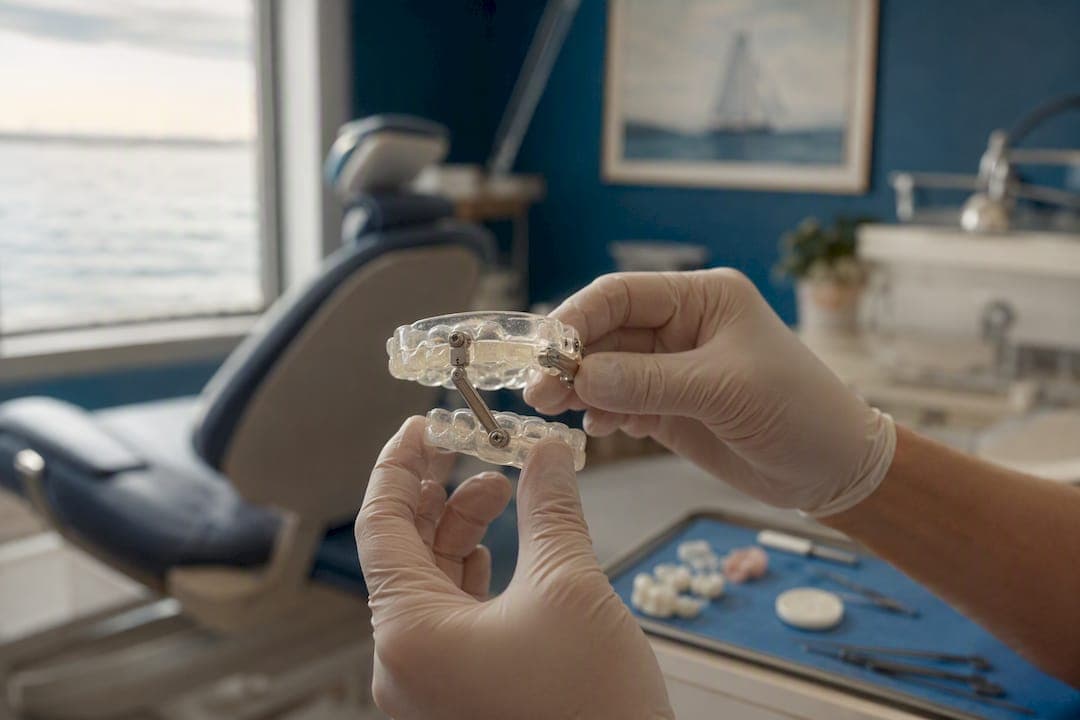
A mandibular advancement device holds your lower jaw slightly forward while you sleep, opening the airway and cutting down on snoring and mild-to-moderate obstructive sleep apnea (OSA). The American Academy of Sleep Medicine and NCBI clinical guidance support MADs for primary snoring, mild-to-moderate OSA, and as a fallback for people who cannot tolerate CPAP.
You're likely a good candidate if you:
- Snore regularly but haven't been diagnosed with moderate or severe OSA
- Have mild-to-moderate OSA confirmed by a sleep study
- Can't stick with CPAP long-term despite trying
Quick fact: Custom, dentist-fitted MADs are titratable in increments as small as 1 millimeter, which is what separates them clinically from store-bought mouth guards.
Key Takeaways
Custom, titratable mandibular advancement devices work by holding the jaw forward to open the airway, and they succeed clinically when fitting, titration, and follow-up are handled by a trained dentist.
| Point | Details |
|---|---|
| Best-suited patients | Primary snorers, mild-to-moderate OSA, and CPAP-intolerant patients respond best to MAD therapy. |
| Adherence beats raw efficacy | MADs often match CPAP on quality-of-life outcomes because people wear them more consistently. |
| Titration is the key variable | Incremental jaw adjustments of about 1 millimeter balance symptom control against jaw discomfort. |
| Watch for dental side effects | Bite changes and tooth migration can develop over time and need dentist monitoring. |
| Starboarddental's role | Offers digital scanning, custom MAD fabrication, and scheduled titration visits for eligible patients. |
Table of Contents
- How a Mandibular Advancement Splint Opens Your Airway
- Who Should Actually Try a Mandibular Advancement Device
- Does a Sleep Apnea Mouthpiece Actually Work?
- Custom, Semi-Custom, or Boil-and-Bite: Which Device Type Matters
- What Happens During Fitting and Titration
- Side Effects and When to Call Your Dentist
- Getting a Mandibular Advancement Device: Cost, Timeline, and Insurance
- Oral Appliance vs. CPAP: Making the Actual Choice
- What to Expect at a Dental Sleep Medicine Visit
- Ready for a Sleep Apnea Evaluation? Here's Where to Start
- Frequently Asked Questions
- Sources
How a Mandibular Advancement Splint Opens Your Airway
The mechanism is mechanical, not magical. Pushing the lower jaw forward tensions the muscles and soft tissue connected to the tongue and throat, which drags the tongue base forward and widens the oropharyngeal airway. Less tissue sagging into that space at night means less vibration (snoring) and fewer collapses (apneas). This is the physiological basis clinical guidelines rely on when they recommend MADs for primary snoring and mild-to-moderate OSA.
Picture the device as two connected trays, one over the upper teeth and one over the lower, joined by hinges or connector rods that hold the lower tray forward relative to the upper.
A well-built device typically includes:
- Two-piece "bibloc" construction so the jaws can still separate slightly and you can talk or sip water
- Adjustment screws or hinges that let a dentist advance the jaw gradually
- Biocompatible acrylic or thermoplastic material molded to your actual teeth
Who Should Actually Try a Mandibular Advancement Device
MADs work best for people with primary snoring, mild-to-moderate OSA, or severe OSA patients who've genuinely tried and failed CPAP. Clinical factors that predict a better response include positional apnea (worse on your back), a smaller neck circumference, a retrognathic (set-back) lower jaw, and younger age.
Not everyone qualifies. Dentists typically rule out:
- Patients with no teeth (edentulous) or severe periodontal disease, since the device needs healthy teeth for retention
- Severe TMJ disease or a jaw too stiff to advance safely
- Central sleep apnea, which isn't an airway obstruction problem at all and won't respond to jaw repositioning
Pro Tip: Bring your sleep study results to your dental consult. A dentist experienced in dental sleep medicine can't judge candidacy on snoring complaints alone; they need the AHI (apnea-hypopnea index) numbers.
Does a Sleep Apnea Mouthpiece Actually Work?
Yes, for the right patient. A PMC systematic review found that while CPAP lowers AHI more reliably on paper, MADs often close the gap on real-world outcomes because people actually wear them. That adherence advantage is the whole story with oral appliance therapy: a device that stays in your mouth every night beats a theoretically superior one gathering dust on the nightstand, according to research on mandibular advancement splint therapy.
The clinical logic is simple: treatment only works while it's being used, and MADs get used far more consistently than CPAP machines do in everyday life.
Some pooled analyses, including a 2024 meta-analysis, have reported dramatic AHI reductions with MAD use, though figures like this vary widely by study population and device type and should be read as directional rather than a guarantee for any individual.
What the evidence supports plainly:
- MADs reduce snoring loudness and frequency in most users
- AHI improvement is real but less predictable than with CPAP
- No reliable tool yet exists to predict, before treatment, exactly who will respond best
Custom, Semi-Custom, or Boil-and-Bite: Which Device Type Matters
Three tiers exist, and they are not interchangeable. Fully custom devices are made from a dental impression or digital scan, fabricated in a lab, and adjusted incrementally by your dentist. Semi-custom or mail-order kits use a "boil-and-bite" fit and offer limited adjustability. One-piece monobloc OTC devices, sold without any dental oversight, fix the jaw in one position with no titration at all.
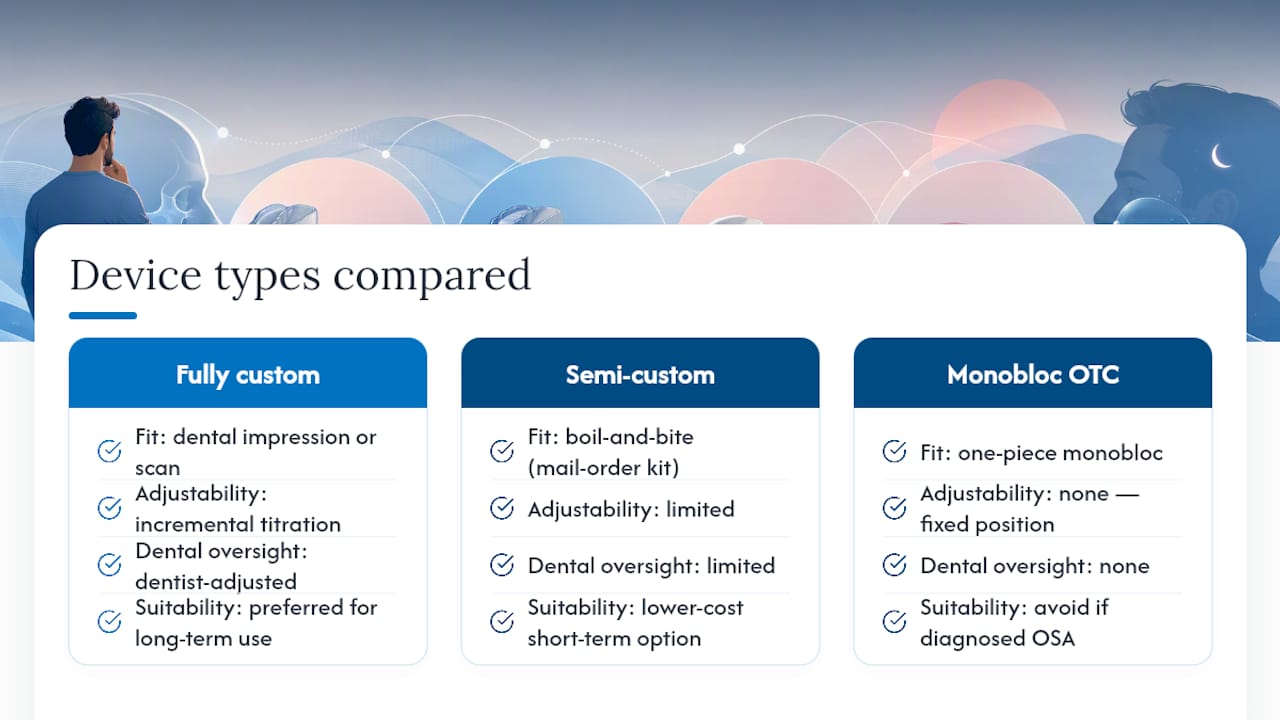
The RACGP's clinical guidance notes semi-tailored devices can work as a short-term, lower-cost option, but fully tailored devices are preferred whenever durability or precise titration matters.
Pro Tip: Adjustability isn't a luxury feature. A device you can advance in sub-millimeter steps lets your dentist find the sweet spot between symptom control and jaw discomfort, which is exactly what AASM's guidance on device technology points to as the standard of care.
Skip unregulated OTC options if you have diagnosed OSA. They aren't titratable and offer no dental supervision if problems develop.
What Happens During Fitting and Titration
Getting an oral appliance for sleep apnea follows a fairly predictable sequence:
- Diagnosis first. A sleep study confirms OSA severity and rules out central sleep apnea.
- Dental referral. A dentist trained in dental sleep medicine takes impressions or a digital scan of your teeth.
- Delivery visit. You get the device and instructions on insertion, cleaning, and morning exercises.
- Acclimatization. Expect a week or two of mild jaw soreness or excess saliva as your mouth adjusts.
- Titration. The dentist advances the jaw position in small increments, often 1 millimeter at a time, over several visits to balance symptom relief against discomfort.
- Efficacy testing. A follow-up sleep study or home test confirms the final position is actually working.
The VA/DoD clinical protocol recommends a check-in within 24 to 48 hours, an in-person visit within 30 days, then follow-ups at six months and annually after that.
Pro Tip: Ask your dentist about a morning occlusal repositioning guide, a small device you bite into for a few minutes after removing your MAD. It helps your bite settle back and lowers the odds of permanent tooth movement.
Side Effects and When to Call Your Dentist
Short-term side effects are common and usually mild: jaw soreness, excess salivation, dry mouth, and tooth sensitivity in the first few weeks. Long-term use carries a different set of risks worth tracking.

Over months or years, documented adverse effects can include gradual bite changes, minor tooth migration, and occasional TMJ symptom shifts, some of which persist after stopping. Dentists manage most of these by slowing the titration pace, adjusting the device, or scheduling a reline or repair.
Watch for these red flags:
- Jaw pain that worsens instead of settling after two to three weeks
- A bite that feels noticeably different when you're not wearing the device
- Numbness, tingling, or other new neurologic symptoms
Any of those warrant an urgent call to your dentist or sleep physician rather than waiting for your next scheduled visit.
Getting a Mandibular Advancement Device: Cost, Timeline, and Insurance
Start with a diagnosis, not a device. Here's the realistic path:
- See your primary care doctor or a sleep physician to confirm OSA severity through a sleep study.
- Get referred to a dentist trained in dental sleep medicine, who will evaluate your teeth, gums, and jaw joint before recommending a MAD.
- Complete impressions or a digital scan, then wait roughly two to four weeks for lab fabrication.
- Attend the delivery and titration visits, usually spaced two to four weeks apart until the optimal position is reached.
Costs vary by device tier. Fully custom, lab-made MADs run considerably more than semi-custom kits, while OTC boil-and-bite options are the cheapest but least appropriate for diagnosed OSA. Many dental and medical insurance plans cover custom oral appliances when a sleep study documents OSA and, in some cases, documented CPAP intolerance. Before your appointment, gather your sleep study report, any notes on CPAP trials, and your dental insurance information; insurers commonly ask for all three.
Oral Appliance vs. CPAP: Making the Actual Choice
CPAP still wins on raw AHI reduction for most patients with moderate-to-severe OSA. But the comparison isn't just about numbers on a report.
- Effectiveness: CPAP lowers AHI more consistently across severity levels
- Adherence: MADs are worn more consistently night after night, which narrows the real-world gap
- Portability: A MAD fits in a shirt pocket; CPAP needs power and a machine
- Comfort: No mask, no hose, no machine noise with a MAD
Ask your sleep physician and dentist together about severity, dental health, travel habits, and how well you've tolerated CPAP so far. Some patients do best combining both: CPAP at home, a MAD for travel or as backup on nights the mask feels intolerable. That kind of shared decision, made with both providers, usually beats picking one therapy and sticking with it out of habit alone.
What to Expect at a Dental Sleep Medicine Visit
A sleep-focused dental visit isn't the same as a routine cleaning appointment. At Starboarddental, evaluation for a sleep apnea and snoring device starts with a review of your sleep study, followed by a digital scan instead of the old-style putty impressions, which is faster and more precise for lab fabrication.
Expect:
- A consultation reviewing your sleep study and dental history
- Digital scanning for a custom device fit
- A delivery visit with instructions on wear and care
- Scheduled titration visits to fine-tune jaw position
Pro Tip: Bring a list of questions: ask for a written titration plan and the expected replacement timeline for your device, typically every few years depending on wear.
A dentist's take on choosing a custom, titratable MAD
Given the choice, I'd steer most eligible adults toward a custom, adjustable device over a boil-and-bite kit every time. The ability to fine-tune jaw position in small steps is what actually determines whether you get relief without wrecking your bite. That said, this only works within a team: your dentist and sleep physician need to be talking to each other, not treating your airway and your teeth as separate problems. And if your OSA is moderate to severe and CPAP is working, don't switch just because a mouthpiece sounds easier.
Ready for a Sleep Apnea Evaluation? Here's Where to Start
Starboarddental treats snoring and sleep apnea as a dental problem with a dental solution, not just a side conversation during a checkup. Our digital scanners replace the old goopy impression trays, so getting fitted for a custom oral appliance takes less time and fewer return trips than the traditional process.

If you've already had a sleep study, bring the results. If you haven't, we can point you toward the right referral before we ever touch a scanner. Either way, the first visit covers your dental and airway history together, since conditions like sleep apnea often overlap with teeth grinding or TMJ symptoms that affect device fit. For readers weighing OTC options first, a partner resource on oral appliance basics is worth a read before you buy anything online.
Request a consultation through our new patient page to get your snoring or OSA evaluation on the calendar.
Frequently Asked Questions
Is a mandibular advancement device the same as a mouth guard? No. A night guard protects teeth from grinding, while a MAD repositions the jaw to keep the airway open. Some patients need both for different reasons, which your dentist can assess through a teeth grinding evaluation.
Can I use a mandibular advancement device for severe sleep apnea? It's possible if you've genuinely tried and can't tolerate CPAP, but severe OSA generally responds better to CPAP first. Discuss this directly with your sleep physician before switching.
How long does a custom MAD last? Most custom devices last several years with proper care, though heavy grinding or normal wear can shorten that. Regular dental checkups catch problems before they affect fit or effectiveness.
Will insurance cover a mandibular advancement device? Many plans cover custom oral appliances when a sleep study documents OSA, and some require proof of CPAP intolerance first. Check your specific policy and bring your sleep study documentation to your dental consult.
This article is general information, not a substitute for advice from a qualified doctor. Consult a qualified healthcare professional about your own circumstances before acting on anything here.
Sources
- Mandibular advancement device (NCBI Bookshelf)
- Mandibular advancement device for obstructive sleep apnea (PMC review)
- VA/DoD guidance on mandibular advancement device for OSA (VA healthquality)
- Mandibular Advancement Splint Therapy (PubMed)