
Yes, TMJ disorders are a common and plausible explanation if you're dealing with jaw pain, especially if it comes with clicking, stiffness, or discomfort near your ears. TMD affects a wide range of adults, and many cases respond well to conservative care rather than surgery.
Watch for these typical signs:
- Jaw pain or tenderness, especially when chewing
- Clicking, popping, or grinding sounds when you open your mouth
- Limited opening or a jaw that catches or locks
- A bite that suddenly feels different, like your teeth don't meet the way they used to
Some symptoms need attention now, not next week. If you suddenly can't open or close your mouth, if pain is constant and severe, or if you're struggling to eat or swallow, call a dental or medical provider today rather than waiting it out.
Key Takeaways
TMJ symptoms are usually driven by muscle overuse or joint strain, and most cases improve with conservative, non-surgical care rather than irreversible procedures.
| Point | Details |
|---|---|
| Core symptom cluster | Jaw pain, clicking, limited opening, and morning stiffness together point strongly toward TMD. |
| Sounds aren't always trouble | Clicking or popping without pain is common and usually doesn't need treatment on its own. |
| Red flags need prompt care | Sudden jaw locking, constant severe pain, or trouble eating means don't wait for a routine appointment. |
| Rule out look-alikes first | Sinus issues, ear disease, dental pain, and migraine can all mimic TMJ and need different care. |
| Starboard Dental's approach | Offers conservative-first TMJ evaluation, night guards, and same-day appointments in Kennebunk. |
Table of Contents
- What TMJ and TMD Symptoms Actually Point To
- The Full TMJ Symptoms Checklist
- What Causes TMJ Pain and Jaw Dysfunction
- TMJ vs. Sinus, Ear, and Other Look-Alike Conditions
- How Dentists Diagnose TMD and When to Get Checked
- Conservative Treatment Options That Actually Work
- What Happens During a TMJ Evaluation
- Getting Your Jaw Symptoms Properly Evaluated
- Where to Learn More About TMJ and TMD
- Sources
What TMJ and TMD Symptoms Actually Point To
The TMJ, or temporomandibular joint, is actually a pair of joints, one on each side of your face, connecting your jawbone to your skull just in front of your ears. TMD (temporomandibular disorder) refers to problems affecting those joints and the muscles that move your jaw. It's a broad category, covering more than 30 distinct conditions, not a single diagnosis.
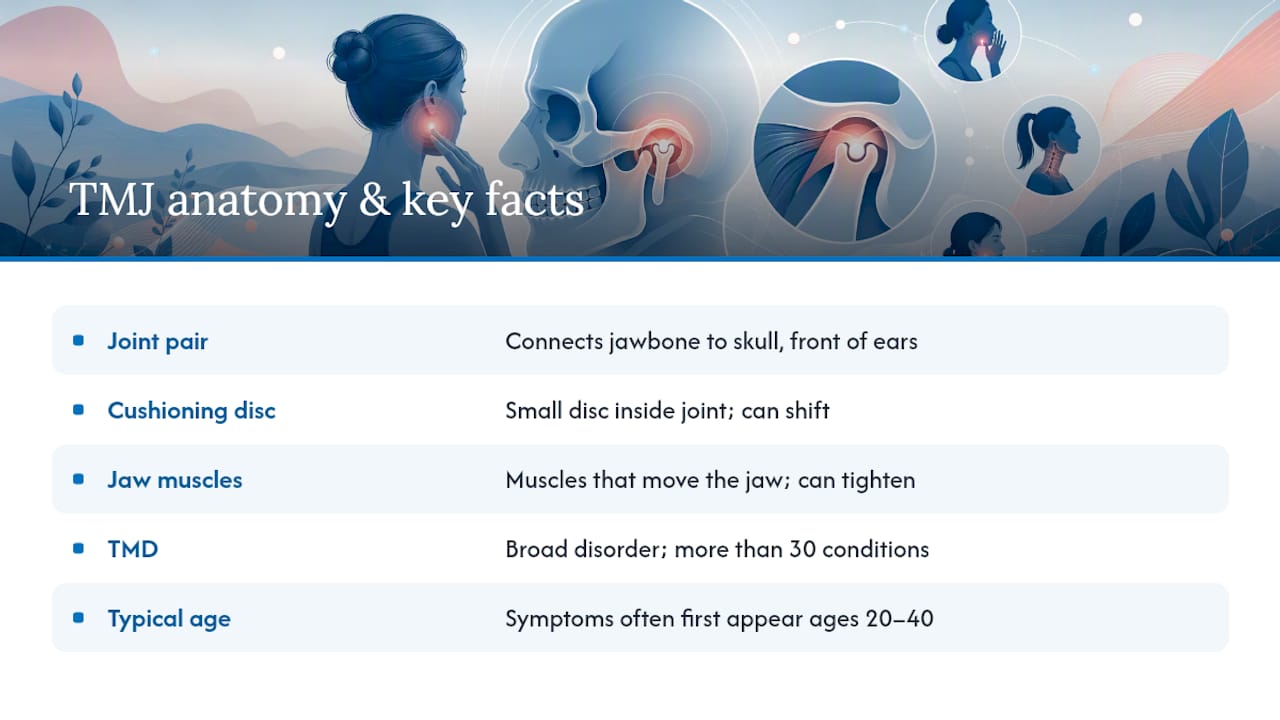
Symptoms often show up first in adults between 20 and 40 years old, a detail worth knowing because it means TMD isn't primarily an "older adult" problem the way arthritis in other joints might be. Picture the joint like a hinge with a small cushioning disc inside it. When that disc shifts, or the muscles around it tighten up, that's when symptoms start.
The Full TMJ Symptoms Checklist
Jaw pain doesn't always look the same from person to person, which is part of why TMD gets misdiagnosed so often. Here's how to break down what you're feeling.
Primary symptoms are the ones clinicians look for first:
- Pain or tenderness in the jaw, particularly around the joint itself
- Aching in the muscles used for chewing, sometimes radiating toward the temple
- Limited mouth opening, or a jaw that locks in an open or closed position
- General stiffness, especially noticeable first thing in the morning
Mechanical signs are sounds and movements, not necessarily pain:
- Clicking or popping when you open or close your mouth
- Grinding or grating sensations (clinically called crepitus) during jaw movement
Here's something that surprises a lot of people: jaw noises without pain are usually not a problem requiring treatment. A clicking jaw that doesn't hurt and doesn't restrict movement is common and often just reflects normal joint mechanics. That said, a small number of people with clicking do go on to develop locking, which is one reason tracking changes over time matters more than reacting to a single noisy day.
Associated symptoms are the ones that send people to the wrong specialist first:
- Headaches, sometimes daily, concentrated around the temples
- Earache, ringing in the ears (tinnitus), or a sensation of fullness
- Dizziness
- Neck or shoulder pain
- A dull, toothache-like ache that isn't coming from an actual tooth
- A bite that suddenly feels off, like your teeth are meeting unevenly
Timing patterns tell you a lot. Pain that worsens specifically with chewing or wide yawning points toward the joint or muscles doing the work. Morning soreness that eases over the day often traces back to nighttime clenching or grinding, since your jaw muscles work overtime while you sleep and no one's there to tell them to stop. Symptoms that fluctuate with stress, or flare after a stretch of gum chewing or a long dental appointment, usually point toward muscle overuse rather than joint damage.
Pro Tip: Keep a one-week symptom diary before your appointment. Each day, jot down pain level (1 to 10), what triggered it (chewing, waking up, stress), any clicking or locking, and what helped. A week of real data gives your dentist far more to work with than "it hurts sometimes."
What Causes TMJ Pain and Jaw Dysfunction
Most TMD traces back to a combination of habits and mechanics rather than one single cause. Behavioral triggers top the list: bruxism (clenching or grinding your teeth), chronic gum chewing, nail biting, and habitually chewing tough foods on one side.

Biologically, things like disc displacement inside the joint, early arthritis, general joint wear, muscle overuse, or a direct injury to the jaw can all set off symptoms. Trauma doesn't have to be dramatic. A hard fall, a sports collision, or even a difficult dental extraction can trigger months of joint irritation.
Then there are the situational contributors that make everything worse:
- Chronic stress, which shows up physically as jaw clenching, often without you noticing
- Sleep-disordered breathing, including sleep apnea, which is linked to nighttime grinding
- Recent dental work, especially procedures that keep your mouth open wide for a long stretch
The 20-to-40 age window lines up with peak years for stress, orthodontic history, and the accumulation of small jaw injuries. It's not that older adults are immune. It's that a lot of TMD cases are essentially years of low-grade strain finally catching up.
TMJ vs. Sinus, Ear, and Other Look-Alike Conditions
TMJ symptoms overlap heavily with sinus infections, ear disease, dental pain, migraine, and even neck problems, which is exactly why misdiagnosis happens so often. Getting this distinction right matters clinically, since chasing the wrong cause means wasted appointments and unnecessary tests.
A few contrasts help sort it out:
- TMJ vs. sinus: TMJ pain tends to shift with jaw movement and chewing. Sinus pain usually comes with nasal congestion and often worsens when you bend forward.
- TMJ vs. ear disease: True ear infections often bring hearing changes or drainage; TMJ related ear symptoms (fullness, ringing) usually shift when you move your jaw.
- TMJ vs. dental pain: A cavity or cracked tooth usually reacts sharply to hot, cold, or biting on that exact tooth. TMJ discomfort is more diffuse.
- TMJ vs. migraine: Migraines bring light sensitivity, nausea, or visual changes that jaw disorders typically don't.
Ask yourself: does the pain change when you chew or open wide? Does leaning forward make it worse? If chewing is the trigger, TMJ is more likely. If congestion or posture is the trigger, an ENT evaluation makes more sense. Persistent facial pain with no clear jaw connection may also warrant a look at your cervical spine or a neurologic workup.
How Dentists Diagnose TMD and When to Get Checked
A TMD diagnosis usually starts with a conversation, not a scan. Clinicians typically work through:
- A history covering pain patterns, prior injuries, stress levels, and sleep habits
- Movement tests, checking how wide you can open and whether your jaw deviates
- Palpation of the jaw muscles and joint to locate tender spots
- Listening for clicking, popping, or grinding during movement
Imaging like X-ray, CBCT, or MRI isn't the first step for most people. It gets ordered when the exam suggests structural joint damage, when symptoms aren't improving with conservative care, or when something atypical shows up, since Mayo Clinic notes many cases resolve without ever needing a scan.
Some symptoms shouldn't wait for a routine appointment. Seek prompt care if you experience a sudden inability to open or close your mouth, constant severe pain, or any difficulty swallowing or breathing. As a general rule, give conservative self-care about two to four weeks before expecting real improvement. If nothing's changed by then, or if things are getting worse, that's your cue to get evaluated rather than push through it.
Conservative Treatment Options That Actually Work
Most TMD improves without surgery, and the NIDCR specifically recommends starting conservative before considering anything invasive. That's the framework worth understanding before you agree to any treatment plan.
Self-care comes first, and it's more effective than people expect:
- Sticking to a soft diet for a stretch (soup, eggs, yogurt, pasta) to give the joint a break
- Alternating heat and ice on the jaw muscles
- Deliberately resting your jaw, meaning less gum, less nail biting, smaller bites
- Better sleep habits, since poor sleep and nighttime clenching often feed each other
- Stress reduction techniques, because clenching frequently tracks stress levels almost exactly
Clinician-delivered options step in when self-care isn't enough. Guided physical therapy for the jaw muscles, custom-fitted night guards to reduce grinding damage, trigger-point injections for stubborn muscle knots, and short-term medications like anti-inflammatories or muscle relaxants all fall into this category. In select cases, Botox is used to calm overactive jaw muscles when other conservative measures haven't fully resolved symptoms.
Here's where caution matters most: avoid irreversible procedures, meaning anything that permanently reshapes your teeth, bite, or jaw joint, until conservative options have had a real chance. The FDA maintains oversight on TMJ implant devices precisely because these interventions carry real risk and aren't first-line care. Surgery gets reserved for a small subset of refractory cases that don't respond to anything else.
Pro Tip: Track your symptom diary alongside whatever treatment you start. If pain hasn't dropped at all after three to four weeks of consistent self-care, that's useful information for your next appointment, not a sign to give up on conservative treatment entirely.
Most people see noticeable improvement within a few weeks of starting conservative care, with follow-up typically scheduled at the two-to-four-week mark to check progress and adjust the plan.
What Happens During a TMJ Evaluation
A TMJ evaluation is more thorough than a quick look in your mouth. It usually runs through several structured steps:
- An intake conversation covering your symptom history, any past jaw trauma, and your sleep and stress patterns
- A functional exam measuring how wide you can open and whether your jaw shifts to one side
- Palpation of the jaw and surrounding muscles to pinpoint exactly where it hurts
- A bite assessment to check whether your teeth are meeting evenly
- Imaging orders only if the exam findings point toward something structural
Your dentist will also ask about tooth wear patterns (a strong clue for nighttime grinding), whether you've noticed clicking, and how your range of motion compares side to side. Most evaluations run a standard appointment length and often include immediate next steps, patient education, a few jaw stretches to try at home, or a temporary appliance while a custom night guard gets made.
A note on conservative care and what actually helps patients
Most jaw pain we see responds to conservative measures long before anyone needs to consider anything invasive. What makes the biggest difference isn't a single treatment. It's catching patterns early, whether that's grinding, stress, or a bite that's shifted, and building a plan around the specific patient. At Starboard Dental, that means combining a thorough diagnostic exam with same-day scheduling, so patients aren't stuck waiting weeks while pain gets worse.
Getting Your Jaw Symptoms Properly Evaluated
If you've been living with jaw clicking, morning stiffness, or that dull ache near your ear, the next move is a real evaluation, not more guessing. Starboard Dental offers TMJ assessments built around a conservative-first approach: a full diagnostic exam, imaging only when it's actually needed, and a treatment plan that starts with the least invasive option that fits your situation.

Depending on what your exam shows, that might mean a custom night guard for grinding, a referral for guided physical therapy, or Botox for TMD in cases where muscle overactivity is the main driver. Same-day appointments mean you're not stuck waiting weeks while symptoms progress, and the clinic's TMJ evaluation and treatment services are built specifically around ruling out other causes before recommending anything irreversible. If jaw pain, clicking, or morning stiffness has been part of your routine for more than a few weeks, book a general dentistry appointment and get a clear answer instead of another month of wondering.
Where to Learn More About TMJ and TMD
For deeper clinical detail beyond this overview, these sources cover the condition from different angles:
- Cleveland Clinic — general overview, prevalence, and typical age of onset
- NIDCR — research-backed guidance on symptoms and conservative treatment
- Merck Manuals — associated symptoms and bruxism connections
- Mayo Clinic — symptom red flags and when to see a provider
- MedlinePlus — condition classification and symptom summary
Talk with a dentist or physician for advice specific to your own symptoms and history.
This article is general information, not a substitute for advice from a qualified doctor. Consult a qualified healthcare professional about your own circumstances before acting on anything here.
Sources
- Temporomandibular disorders (TMDs) — Cleveland Clinic
- TMD — National Institute of Dental and Craniofacial Research (NIDCR)
- Temporomandibular disorders (TMDs) — Merck Manuals
- TMJ: Symptoms and causes — Mayo Clinic
- Temporomandibular disorders — MedlinePlus