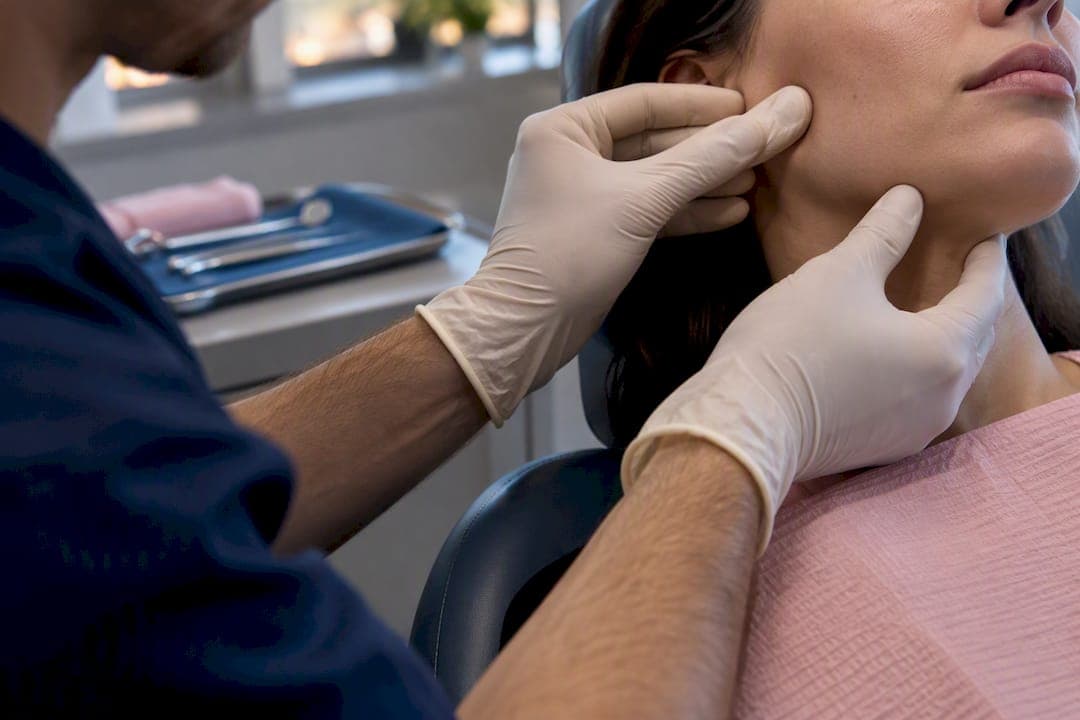
Botox can meaningfully reduce muscle-related TMJ pain for some patients, but it's an off-label, adjunctive treatment, not a fix for the joint itself. Clinical trials show pain reduction versus placebo lasting three to four months per round, with results varying widely between studies. Most clinicians reserve it for patients who've already tried splints, physical therapy, and behavioral changes without enough relief.
TL;DR:
- Botox for TMJ pain typically lasts three to four months, with most studies reporting about a 59% pain reduction at one month and 70% at six months.
- Effectiveness varies widely depending on whether the underlying problem is muscular overactivity or structural joint issues, with better results seen in muscular TMD cases.
- The best candidates are patients with persistent muscle-driven TMJ pain who have already tried conservative treatments like splints and physical therapy without full relief.
- Proper injection technique requires mapping the masseter, temporalis, and sometimes the lateral pterygoid muscles, and skilled providers with TMJ-specific experience are essential.
- Long-term risks include muscle atrophy, reduced bite force, and possible jawbone changes, especially with repeated high-dose treatments over time.
Table of Contents
- How Botox Reduces Jaw-Muscle Overactivity
- Does Botox Actually Work for TMJ Pain?
- Who Should Consider Botox for TMJ Pain?
- What Happens During and After a Botox Treatment for TMJ
- What Are the Risks and Side Effects of TMJ Botox?
- Where Botox Fits Into a Full TMJ Treatment Plan
- How to Choose a Safe, Experienced TMJ Botox Provider
- Starboard Dental's Approach to TMJ Evaluation
- Get a TMJ Evaluation at Starboard Dental
- The Gap Between Botox's Reputation and Its Actual Track Record
- Sources
- FAQ
How Botox Reduces Jaw-Muscle Overactivity
Botox works by blocking the release of acetylcholine, the chemical messenger that tells muscle fibers to contract. Injected into an overactive jaw muscle, it prevents the nerve signal from reaching the muscle fully, so the muscle relaxes instead of clenching. The effect isn't instant. It builds over several days as the toxin binds to nerve endings, and it fades gradually as those nerve connections regenerate, which is why results wear off rather than stop abruptly.
For TMJ-related pain, injections typically target the muscles doing the overworking. The clinical literature on botulinum toxin for myofascial jaw pain identifies three main sites:
- Masseter — the primary chewing muscle along the jawline, and usually the biggest contributor to clenching-related pain.
- Temporalis — the fan-shaped muscle at the temple that assists in closing the jaw and often tightens during stress-related grinding.
- Lateral pterygoid — a deeper muscle involved in jaw movement, injected less often because it sits closer to nerves and blood vessels and requires more precise technique.
Here's the distinction that trips people up: Botox treats the symptom, not the cause. It relaxes muscles that are gripping too hard, but it does nothing to repair a displaced disc, worn cartilage, or a misaligned bite. Patients who notice a benefit typically report less morning jaw tightness, reduced clicking-adjacent muscle soreness, and an easier time opening their mouth within one to two weeks of treatment. If the underlying issue is mostly structural rather than muscular, Botox tends to disappoint.
Does Botox Actually Work for TMJ Pain?
The most recent systematic review and meta-analysis found that botulinum toxin type A was significantly more effective than placebo for reducing pain intensity in muscular TMD, with benefits measurable at both one month and six months out.
By the numbers: Some trial cohorts in that review reported roughly 59% pain reduction at one month and around 70% at six months, with several studies using an 80-unit dose split across the masseter and temporalis muscles. These figures come from specific trial populations and aren't a guarantee for every patient.
That's the encouraging half of the picture. The harder half comes from an umbrella review synthesizing 18 systematic reviews, which concluded that while BoNT-A beats placebo in many individual studies, it doesn't consistently outperform standard conservative therapies like splints or physical therapy. In other words, Botox works better than doing nothing, but it hasn't proven itself clearly superior to the treatments most dentists try first.
Dosing across the research isn't standardized. Trials commonly report bilateral totals generally within a moderate unit range, split between the masseter and temporalis. Some protocols test a typical moderate flat dose with reported benefit at both short and longer follow-up points.
- Wide variation in injection mapping, meaning two studies using similar total doses might place them very differently across the muscle.
Why the inconsistency? Study designs differ in how they measure pain, how long they follow patients, and which muscles they inject. Sample sizes in TMD-specific BoNT-A trials also tend to be smaller than in migraine or cosmetic research, so reviewers stay cautious about overstating certainty. The honest summary: promising evidence, real effect size in many trials, but not a slam-dunk verdict.
Who Should Consider Botox for TMJ Pain?
Botox for TMJ tends to work best for a fairly specific patient profile, and clinicians weigh several factors before recommending it.
The typical good candidate has persistent muscular TMD (as opposed to primarily joint-based TMD), has already tried conservative measures like a night guard or physical therapy without full relief, and shows visibly strong or hypertrophic jaw muscles from chronic clenching or bruxism. If your pain flares mainly during stress, worsens with gum chewing, or comes with a "tired jaw" feeling by evening, you likely fit this group better than someone whose pain stems from disc displacement alone.
Certain conditions rule Botox out or require extra caution:
- Pregnancy or breastfeeding, since safety data in these groups is limited.
- Neuromuscular disorders like myasthenia gravis, which can amplify Botox's muscle-weakening effect dangerously.
- Active infection at the planned injection site.
- Use of medications that interact with neuromuscular blockade, including certain antibiotics.
Pro Tip: Keep a two-week symptom log before your consultation, tracking when your jaw hurts most and what triggers it. Clinicians use that pattern, not just an exam, to decide whether your pain is muscle-driven enough for Botox to help.
Some clinicians will consider Botox earlier if bruxism is severe enough to threaten tooth structure, while others avoid it entirely for patients whose imaging shows the pain is coming primarily from joint degeneration rather than muscle strain.
What Happens During and After a Botox Treatment for TMJ
A Botox visit for TMJ pain follows a fairly consistent sequence, though details vary by provider.
- Diagnostic confirmation. Your provider reviews your history, examines your bite, and rules out other causes before confirming that muscle overactivity is driving your symptoms.
- Muscle mapping. The clinician palpates the masseter and temporalis (and occasionally the lateral pterygoid) to identify the exact spots carrying the most tension.
- Injection. Using a fine needle, the provider delivers small amounts of Botox across several points per muscle. Literature examples often describe splitting a 60 to 100 unit total dose across multiple sites rather than one large injection.
- Onset window. Most patients notice softening of muscle tension within three to seven days, though full effect can take up to two weeks.
- Peak effect and duration. Peak relief usually falls around the four to six week mark, and the effect duration typically runs three to four months before wearing off.
- Re-treatment planning. Because the effect fades, most patients on a maintenance plan return every three to four months, though some stretch that interval as muscle patterns change.
After treatment, mild soreness or bruising at injection sites is common for a day or two. Contact your provider if you notice difficulty swallowing, drooping in the face, or weakness spreading beyond the jaw. These are rare but warrant a same-day call.
What Are the Risks and Side Effects of TMJ Botox?
Short-term side effects are usually mild. Patients commonly report temporary soreness at the injection site, minor bruising, and a few days of slightly weaker chewing strength, especially with tougher foods like steak or raw vegetables.
Documented safety signal: Reviews examining repeated or higher-dose treatment cite reduced bite force, visible muscle atrophy, and in some cases measurable changes in mandibular bone volume over time. These findings come from a mix of clinical and imaging studies and aren't universal, but they're consistent enough across the literature to take seriously.
The longer-term concerns are worth understanding before committing to repeat cycles:
- Muscle atrophy. Chronic paralysis of the masseter can shrink the muscle over months to years of repeated dosing, which sometimes changes jaw contour.
- Reduced bite force. Some patients notice they can't chew as forcefully as before, which is usually reversible but can persist with sustained high-dose use.
- Bony changes. A smaller body of evidence links long-term masseter Botox to reduced mandibular bone density, likely because chewing muscles stimulate jawbone maintenance.
- Injection-site issues. Rare, but includes infection or, if the needle strays, temporary drooping from affecting a nearby facial muscle.
Risk generally scales with dose, frequency, and injector skill. A provider who understands facial anatomy and titrates dose to your specific muscle bulk, rather than using a one-size dose for everyone, reduces these risks considerably. If you notice a lopsided smile, trouble chewing that doesn't improve, or visible muscle wasting, contact your provider rather than waiting for the next scheduled visit.
Where Botox Fits Into a Full TMJ Treatment Plan
Botox is rarely, if ever, a standalone treatment. Most treatment pathways start with less invasive options and add Botox only when those aren't enough.
Common first-line approaches include:
- Custom night guards or oral splints to reduce nighttime clenching.
- Jaw physical therapy and targeted stretching exercises.
- Behavioral changes, like reducing gum chewing or catching daytime clenching before it becomes habitual.
- Short courses of muscle relaxants or anti-inflammatory medication during flare-ups.
When these help partially but not completely, Botox often gets added on top, not instead of. A typical combined plan might keep the night guard for sleep, continue jaw stretches, and use Botox every few months to manage the muscle tension that the guard alone can't fully resolve. Mayo Clinic's guidance on TMJ care reflects this pattern, listing injections as a later-stage option used after conservative therapies have been given a real chance. If you start Botox, don't expect to drop your other tools. Most patients who do best keep the noninvasive habits running alongside it.
How to Choose a Safe, Experienced TMJ Botox Provider
Not every provider offering Botox has real experience with jaw muscles, and the anatomy here carries more risk than the forehead or crow's feet.
Look for a provider with a background suited to facial musculoskeletal work, specifically orofacial pain dentists, oral and maxillofacial surgeons, or ENT specialists with documented TMJ experience. General cosmetic injectors may have excellent technique for wrinkles but limited training in jaw-specific muscle mapping.
Before booking, ask these questions:
- How many TMJ-specific Botox cases have you treated, as opposed to cosmetic injections?
- What dose range do you typically use, and how do you decide it for my case?
- How do you handle and report adverse events if they occur?
- What does your follow-up schedule look like after the first injection?
Precision matters because the masseter sits close to the parotid gland and facial nerve branches, and the lateral pterygoid lies near major vessels. An experienced injector maps these danger zones before ever picking up the needle.
Pro Tip: Be wary of any provider who skips a real bite and muscle exam, pushes Botox as a purely cosmetic jaw-slimming add-on without discussing your pain history, or offers injections at a group event with no follow-up plan. TMJ treatment should feel like a medical consultation, not a party favor.
Starboard Dental's Approach to TMJ Evaluation
At Starboard Dental, TMJ evaluation starts with a full bite and muscle exam, often supported by digital scanning for a precise picture of how your jaw actually functions day to day. Patients walk through their symptom history, past treatments, and daily habits like clenching or grinding before any injection decision gets made.
The clinic offers scheduling options and provides comfort touches to help ease anxiety that often comes with jaw exams. Whether Botox becomes part of your plan depends on that first conversation, not a one-size answer.
Get a TMJ Evaluation at Starboard Dental
Chronic jaw pain doesn't have to mean guessing between a night guard you bought online and a treatment you're not sure fits your case. Starboard Dental evaluates TMJ symptoms directly, checking whether your pain is muscular, structural, or both, before recommending anything, including Botox as part of TMD care.

A consultation typically starts with a review of your symptom history and a hands-on bite exam, so bring notes on when your jaw hurts most and what makes it worse. From there, the team maps out whether conservative options like a night guard make sense first, or whether Botox fits your situation now. Appointments are available for patients seeking evaluation for jaw pain. If you're ready to stop guessing about what's causing your jaw pain, book a TMJ evaluation with Starboard Dental and get a plan built around your actual exam findings, not a generic template.
The Gap Between Botox's Reputation and Its Actual Track Record
Botox for TMJ gets talked about online like it's either a miracle cure or a scam, and both extremes miss what the research actually shows. The real story is more useful than either headline: a treatment with a genuine, measurable effect on muscle-driven pain that still hasn't earned FDA approval for this specific use, and one that works better for some patients than others depending on whether their pain is coming from muscle or joint.
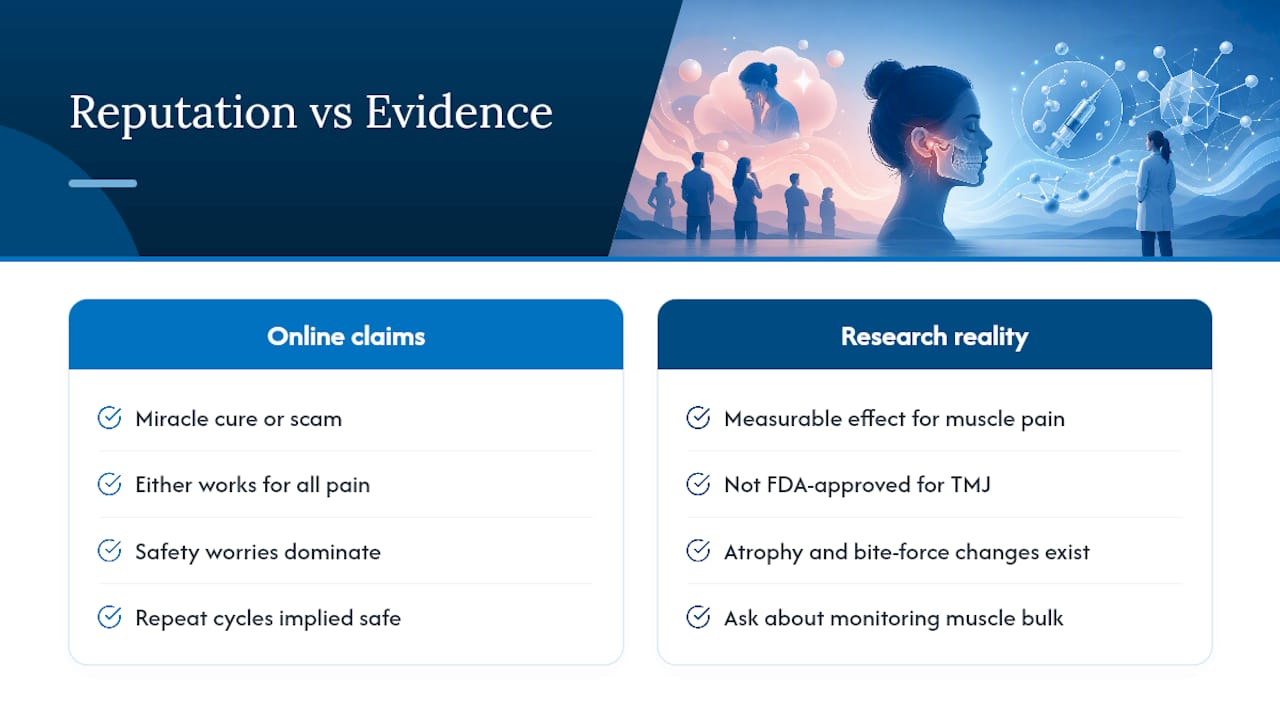
What gets underweighted in most patient conversations is the atrophy and bite-force data. It's not scary enough to justify avoiding treatment, but it's real enough that anyone considering repeat cycles for years should ask their provider how they're monitoring muscle bulk over time, not just tracking pain scores. A provider who only asks "does it still hurt less?" at each visit is missing half the picture.
The other underrated point: Botox's biggest value might be as a bridge, not a destination. It buys relief while a night guard, physical therapy, or a behavioral habit change has time to actually take hold. Patients who treat it as the whole plan tend to be disappointed when the effect wears off on schedule. Patients who treat it as one tool alongside others tend to report the steadier, longer-term improvement.
— Alex
This article is general information, not a substitute for advice from a qualified doctor. Consult a qualified healthcare professional about your own circumstances before acting on anything here.
Sources
- PubMed entry: systematic review / meta-analysis 2024
- Temporomandibular myofacial pain treated with botulinum toxin injection (PMC)
- Botulinum Toxin‑A for the Treatment of Myogenous TMDs: An Umbrella Review (Springer Nature)
- TMJ disorders - Diagnosis and treatment - Mayo Clinic
- Botox for TMJ pain: What to expect - Cleveland Clinic
FAQ
Does Botox for TMJ Really Work?
Botox reduces muscle-related TMJ pain for many patients, with trial data showing significant pain reduction versus placebo at both one and six months. It works better for muscle-driven jaw pain than for pain caused primarily by joint or disc problems, and results typically last three to four months per treatment.
Will Insurance Cover Botox for Jaw Clenching?
Coverage varies widely because Botox is FDA-approved for other conditions but used off-label for TMJ, which many insurers treat as a gray area. Some plans cover it when a dentist documents medically necessary muscular TMD after conservative treatments failed, while others deny it outright, so checking with your specific insurer before treatment is worth the phone call.
Why Isn't Botox Approved for TMJ?
The FDA has not granted Botox an approved indication for TMJ, meaning its use for jaw pain remains off-label even though it's legal and commonly practiced. Off-label doesn't mean unsafe. It means the specific TMD indication hasn't gone through the formal approval trials that cosmetic and migraine uses have.
Where Is the Danger Zone for TMJ Botox Injections?
The main risk areas sit near the parotid gland and facial nerve branches around the masseter, and near major blood vessels close to the lateral pterygoid muscle. This is why providers with real anatomical training and TMJ-specific experience matter more here than with typical cosmetic Botox sites like the forehead.
How Does Botox Compare to Other TMJ Treatments?
Reviews show Botox reduces pain compared to placebo but doesn't consistently outperform standard conservative therapies like night guards or physical therapy. Most treatment plans use Botox alongside these approaches rather than as a replacement for them.