
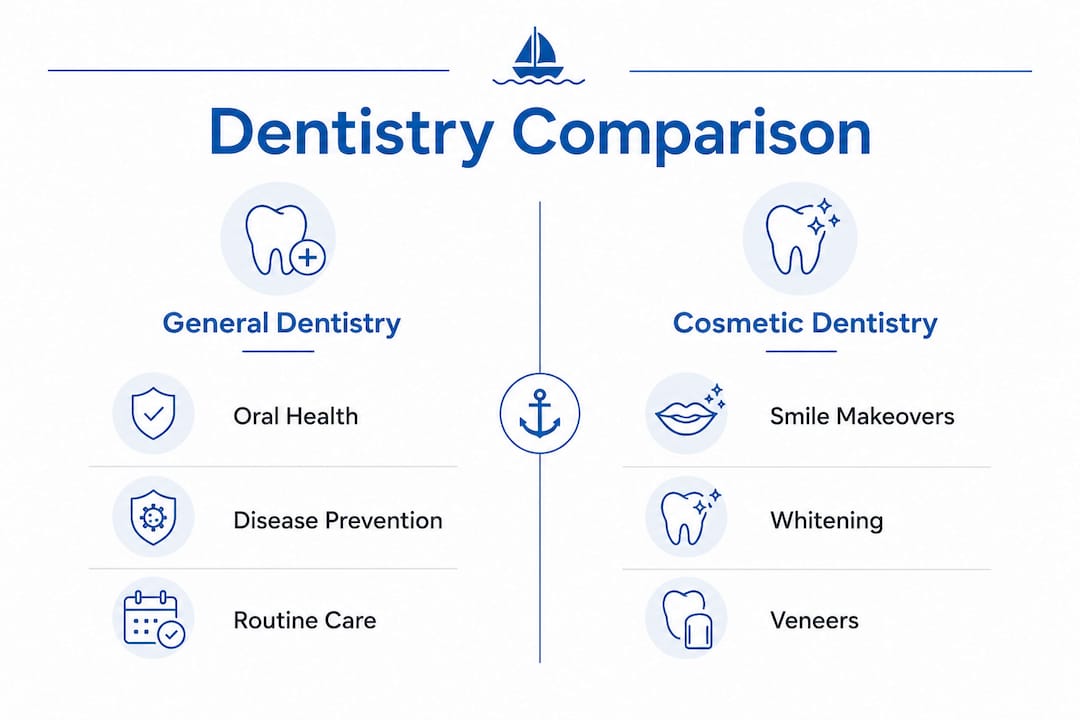
The difference between a cosmetic and a general dentist is this: general dentists focus on oral health, disease prevention, and treating dental conditions, while cosmetic dentists specialize in improving the appearance of your smile. Both work on teeth, but their primary goals, training paths, and the procedures they prioritize are distinct. Understanding which type of care you need saves you time, money, and frustration. The overlap between the two fields is real, but so are the differences in cost, insurance coverage, and long-term outcomes.
What is the difference between cosmetic vs general dentist services?
General dentistry is the foundation of oral health. A general dentist handles routine exams and cleanings, cavity fillings, gum disease treatment, root canals, extractions, and preventive fluoride treatments. These services keep your teeth and gums healthy and functioning correctly.
The core distinction in general vs cosmetic dentist differences comes down to medical necessity. General dentistry procedures treat conditions that affect your health. Cosmetic dentistry procedures improve how your smile looks. A cavity filling is a health issue. Porcelain veneers are an aesthetic choice.
Cosmetic dentistry, as a field, focuses on smile makeovers, teeth whitening, veneers, dental bonding, and tooth contouring. A cosmetic dentist designs smiles with attention to symmetry, color, and proportion. The goal is a result that looks natural and lasts.
One critical fact: cosmetic dentistry is not an ADA-recognized specialty. Any licensed general dentist can legally call themselves a cosmetic dentist. True expertise in cosmetic work requires post-graduate fellowship training, such as programs offered through the Las Vegas Institute (LVI). That distinction matters enormously when you are choosing a provider for complex aesthetic work.
What services does a general dentist provide?
General dentist services cover the full range of preventive and restorative care. These are the procedures that keep dental disease from taking hold and that repair damage when it does.
- Routine exams and X-rays: Detect decay, bone loss, and early signs of gum disease before they become serious problems.
- Professional cleanings: Remove tartar buildup that brushing and flossing cannot reach, reducing your risk of gum disease.
- Cavity fillings: Restore tooth structure lost to decay using composite resin or amalgam materials.
- Gum disease treatment: Scaling and root planing remove bacteria below the gumline to stop periodontal disease from progressing.
- Root canals and extractions: Address infections and teeth that cannot be saved.
- Preventive fluoride treatments: Strengthen enamel and reduce cavity risk, especially for children and high-risk adults.
Medical experts recommend seeing a general dentist first if you have tooth pain, sensitivity, or gum issues. Active oral health problems must be resolved before any cosmetic work begins.
Pro Tip: Schedule a general dentistry exam before booking any cosmetic consultation. A dentist who skips this step is cutting corners that will cost you later.
What does a cosmetic dentist do, and what training sets them apart?
A cosmetic dentist focuses on the visual result of dental treatment. The procedures they perform include:
- Porcelain veneers: Thin shells bonded to the front of teeth to correct color, shape, and minor misalignment.
- Teeth whitening: Professional-grade bleaching that delivers results far beyond over-the-counter products.
- Dental bonding: Tooth-colored resin applied to repair chips, gaps, or discoloration.
- Tooth contouring: Reshaping enamel to improve symmetry and proportion.
- Smile makeovers: Comprehensive treatment plans combining multiple procedures for a complete aesthetic transformation.
The training gap between a general dentist offering cosmetic services and a true cosmetic specialist is significant. Cosmetic work by specialist-trained providers routinely lasts 15–20 years. Work done by general dentists without advanced cosmetic training often begins failing within about 5 years. That gap reflects differences in case planning, material selection, and technical execution.
Advanced cosmetic dentists use principles like the Golden Proportion to design smiles that look mathematically balanced. They also work with master ceramists who craft restorations that mimic natural enamel translucency and texture. This level of collaboration produces results that standard dental labs cannot match.
Pro Tip: When evaluating a cosmetic dentist, ask specifically about post-graduate training credentials and whether they work with a dedicated ceramist. These two factors predict outcome quality better than any before-and-after photo.
High-end cosmetic dentistry also involves bite engineering. This means designing how teeth meet, accounting for jaw mechanics and facial anatomy. Bite engineering and facial harmony determine whether a cosmetic result holds up over decades or breaks down within a few years. A beautiful smile that creates a bad bite will fail.
How do insurance coverage and costs differ?
The financial gap between general and cosmetic dentistry is one of the sharpest differences patients encounter. General dentistry procedures are typically 50–100% covered by dental insurance because they are medically necessary. Cosmetic treatments are 97% paid out-of-pocket by patients.
That 97% figure reflects how insurers classify elective procedures. Teeth whitening, veneers, and cosmetic bonding are not considered medically necessary, so most plans deny coverage entirely.
87% of dental plans cover preventive general dentistry at 100%. Routine cleanings and exams cost you nothing out-of-pocket under most plans. The same plan that fully covers your cleaning will not pay a dollar toward porcelain veneers.
The nuance worth knowing: some cosmetic procedures like bonding may receive partial insurance coverage when they serve a restorative purpose. If a tooth is chipped due to trauma, bonding to restore its function may qualify for coverage. The same bonding done purely for aesthetics will not. A dental treatment plan that documents medical necessity can make a real difference in what your insurance covers.
HSA and FSA accounts add another layer. Medically necessary dental work qualifies for HSA and FSA spending. Purely cosmetic procedures generally do not. However, procedures that serve both a functional and aesthetic purpose may qualify, so it is worth confirming with your plan administrator before treatment.
When should you choose a general dentist vs a cosmetic dentist?
The decision comes down to your current oral health status and your goals.
- See a general dentist first if you have any active health issues. Tooth pain, bleeding gums, sensitivity to hot or cold, and visible decay all require general dentistry before anything else. Cosmetic procedures on unhealthy teeth or gums fail quickly. Veneers placed over decayed teeth will not last.
- Establish a healthy baseline before pursuing cosmetic work. This means no active cavities, stable gum health, and a bite that functions correctly. Think of it as building on a solid foundation.
- Seek a cosmetic dentist when your oral health is stable and your goal is aesthetic improvement. If your teeth are healthy but you want to change their color, shape, or alignment, a cosmetic specialist delivers better long-term results than a general dentist offering the same services.
- Verify cosmetic dentist credentials before committing. Ask about post-graduate training, the institutions attended, and how many cases similar to yours they have completed. LVI fellowship training is one recognized benchmark for cosmetic expertise.
- Consider an integrated practice that offers both. Practices that provide general, restorative, and cosmetic care under one roof simplify your care. You get continuity, and the dentist treating your health issues understands your aesthetic goals from the start.
Pro Tip: Do not let marketing language drive your decision. "Cosmetic dentist" is not a protected title. Ask for credentials, not just a portfolio.
How do cosmetic and general dentistry overlap?
The biggest misconception about general vs cosmetic dentistry is that they are entirely separate fields. They are not. Most dentists perform some cosmetic procedures regardless of their primary focus. The line between the two blurs constantly in clinical practice.
- Most general dentists offer teeth whitening and basic bonding as part of their standard services.
- Restorative work like crowns and bridges affects both function and appearance simultaneously.
- Cosmetic dentistry can improve bite alignment and function when done correctly, not just aesthetics.
- Gum health directly affects cosmetic outcomes. Inflamed or receding gums undermine even the best veneer work.
- Aesthetic dental work must balance gum line, lip line, and facial harmony. Without that coordination, results look unnatural even when technically successful.
The best cosmetic outcomes depend entirely on a solid general oral health foundation. A cosmetic dentist who does not assess your bite, gum health, and bone structure before designing your smile is working without the full picture. The two fields are complementary, not competing.
Key Takeaways
Choosing between a general and cosmetic dentist requires understanding their distinct goals, training levels, and financial implications before you book an appointment.
| Point | Details |
|---|---|
| Primary focus differs | General dentistry treats oral health; cosmetic dentistry improves smile appearance. |
| Training gap is real | Specialist-trained cosmetic dentists produce results lasting 15–20 years vs. about 5 years from generalists. |
| Insurance covers general care | 87% of plans cover preventive care at 100%; 97% of cosmetic work is paid out-of-pocket. |
| Health comes first | Active cavities or gum disease must be resolved before any cosmetic procedure begins. |
| Credentials matter | Cosmetic dentistry is not an ADA specialty; always verify post-graduate training before choosing a provider. |
Why I think most patients ask the wrong question
Most patients walk into a dental consultation asking "cosmetic or general?" when the real question is "what does my mouth actually need right now?" I have seen patients spend thousands on veneers placed over unresolved gum disease, only to watch the work fail within two years. The sequence matters more than the label.
The other thing I have learned: the "cosmetic dentist" title is almost meaningless without credentials behind it. Any dentist can print it on a business card. What separates a provider who produces a smile that looks natural for 20 years from one whose work looks artificial after 5 is post-graduate training, a relationship with a skilled ceramist, and a genuine understanding of bite mechanics. Those are not marketing claims. They are verifiable facts you can ask about directly.
My honest advice: prioritize your oral health foundation first, then choose a cosmetic provider based on training credentials and case experience, not before-and-after photos alone. Integrated practices that handle both general and cosmetic care in one place tend to produce the best outcomes because the same team understands your full dental history. That continuity is worth more than any single procedure.
— Alex
General and cosmetic dental care at Starboarddental
Starboarddental in Kennebunk offers both general dentistry services and cosmetic dentistry treatments under one roof, so your care stays coordinated from your first cleaning through any smile work you choose later.

The practice uses digital scanners for precision, same-day appointments for convenience, and a patient-centered approach that addresses dental anxiety directly. Whether you need a routine exam, gum disease treatment, teeth whitening, or a full smile makeover, Starboarddental builds your treatment around your actual health status and aesthetic goals. Contact the Kennebunk office to schedule a consultation and find out exactly which type of care fits where you are right now.
FAQ
What is the main difference between a cosmetic and general dentist?
A general dentist focuses on oral health, disease prevention, and treating dental conditions. A cosmetic dentist focuses on improving the appearance of your smile through procedures like veneers, whitening, and bonding.
Does insurance cover cosmetic dentistry?
Cosmetic procedures are 97% paid out-of-pocket because insurers classify them as elective. General dentistry, including preventive cleanings, is covered at 50–100% by most dental plans.
Can a general dentist do cosmetic work?
Yes, most general dentists offer basic cosmetic services like whitening and bonding. However, complex cosmetic work produces better and longer-lasting results when performed by a dentist with dedicated post-graduate cosmetic training.
When should I see a cosmetic dentist?
See a cosmetic dentist after your oral health is stable, meaning no active cavities, gum disease, or bite problems. Cosmetic procedures placed on unhealthy teeth fail quickly.
Is cosmetic dentistry an official dental specialty?
No. The American Dental Association does not recognize cosmetic dentistry as an official specialty. Any licensed dentist can use the title, so verifying post-graduate training credentials is the only reliable way to assess a provider's expertise.