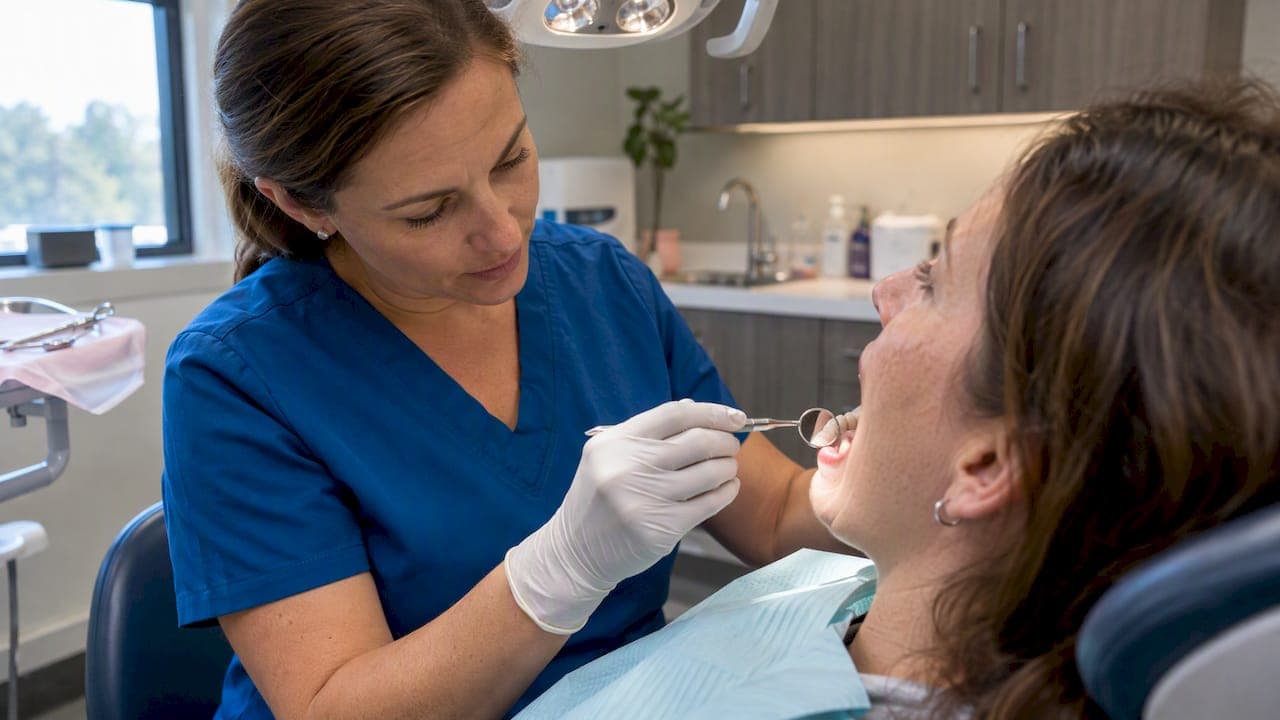
Crowded lower teeth happen when there is not enough space along the lower jaw for every tooth to sit flat and straight, so teeth twist, overlap, or tuck behind each other. Mild to moderate cases are typically corrected with fixed braces, clear aligners, interproximal reduction, or in select cases extraction or limited distalization. The right option depends on measured crowding, tooth-size ratios, and bite factors, and every plan ends with a retainer to hold the result.
TL;DR:
- Crowding often results from a hereditary mismatch between tooth size and jaw capacity, which worsens as the arch perimeter shrinks with age.
- Accurate diagnosis involves digital scans, space analysis, and imaging like X-rays, which guide whether to use braces, aligners, or extractions.
- Mild to moderate crowding can typically be corrected within several months to two years using braces or aligners, followed by long-term retainer use.
- Treatment decisions should weigh measured crowding, bite relationships, personal priorities, and compliance, with set-up models helping clarify options.
- Retainers are essential after treatment, as teeth tend to shift over time, especially if not properly retained, necessitating extended or lifelong wear.
Table of Contents
- What causes crowded lower teeth
- How crowding affects your mouth and daily life
- How dentists measure crowding and plan treatment
- Treatment options explained: what each one actually does
- How to choose the right treatment and what to ask
- What to expect during treatment and afterward
- How modern clinics evaluate and present your options
- A clinician's perspective on treating crowded lower teeth
- Sources
- FAQ
What causes crowded lower teeth
Lower crowding usually comes down to a mismatch between tooth size and jaw size, and that mismatch is often inherited. A person can get larger teeth from one parent and a smaller jaw from the other, leaving no room for a straight row.
Age plays a role too. Arch perimeter, the usable space along the jaw, tends to shrink over the years, which is one reason crowding that was mild in your twenties can look worse by your forties, according to a scoping review on mandibular crowding. The same review describes the lower jaw as a "guide arch" with limited capacity to expand, unlike the upper arch, which has more room to work with.
Other contributors include:
- Genetics that pass down a tooth-to-jaw size imbalance.
- Pressure from the tongue, lips, or cheeks that nudges teeth out of position.
- Early loss of baby teeth, which lets neighboring teeth drift into open space.
- Mandibular third molars (wisdom teeth), though their role is debated.
A systematic review with meta-analyses found a statistical association between wisdom teeth and late lower crowding in pooled data, but called the link inconclusive. Removing wisdom teeth purely to prevent crowding is not routinely recommended on that evidence alone.
How crowding affects your mouth and daily life
Overlapping lower teeth create tight spots that floss and a toothbrush can not fully reach, which lets plaque build up and raises the risk of cavities and gum disease. Over months and years, that buildup can progress to more serious periodontal problems if it goes unaddressed.
Crowding also changes how teeth meet. Edges that should align instead rub unevenly, leading to:
- Abnormal enamel wear on overlapping edges.
- Extra stress on certain teeth during chewing or biting.
- Jaw soreness, clicking, or headaches tied to an uneven bite.
- Speech changes when the tongue has to work around displaced teeth.
If you notice new overlapping, difficulty cleaning between teeth, or jaw discomfort that was not there before, it is worth getting an evaluation rather than waiting for symptoms to worsen.
How dentists measure crowding and plan treatment
Assessing lower crowding starts with a clinical exam, followed by a digital scan or traditional impressions to create accurate study models. From there, a provider runs a space analysis, often using Little's Index, to quantify exactly how many millimeters of crowding exist and where.
The full workup typically includes:
- A panoramic X-ray to check root positions and the presence of unerupted teeth, including third molars.
- A cephalometric X-ray to evaluate jaw relationships and profile when orthodontic treatment is being planned.
- CBCT imaging in more complex cases, when a clearer 3D view of bone and root position is needed.
- A Bolton analysis comparing upper and lower tooth widths, since a discrepancy there can limit how well the bite will fit together after treatment.
- A review of overjet, overbite, and gum health, since periodontal status can rule out certain tooth movements.
These findings together determine whether a conservative approach is realistic or whether more space needs to be created.
Treatment options explained: what each one actually does
Fixed braces and clear aligners both move teeth into better alignment, but they do it differently. Braces give a clinician more direct control over rotations and root positioning, which matters in more severe lower crowding. Aligners work well for milder to moderate cases and offer a removable, less visible option, though success depends on consistent wear.

Interproximal reduction (IPR), a small amount of enamel removed between teeth, is a conservative way to create space without pulling a tooth. A systematic review comparing IPR and incisor extraction found both approaches effective for selected Class I crowding cases, though the evidence base is still limited and case selection drives the outcome. Guidance from that research generally caps safe reduction at around 0.5 millimeters per contact point and avoids removing more than about half the enamel thickness.
Other paths include:
- Incisor or premolar extraction, reserved for more severe crowding, which can shift overjet and overbite and needs careful planning around facial profile.
- Limited distalization or arch-form appliances like lip bumpers or Schwarz-type devices, which produce modest space gains but carry a real risk of relapse.
- Surgical or skeletal approaches, rarely used for the lower jaw alone and considered only in unusual skeletal discrepancies.
Pro Tip: Ask your provider to show you a set-up model comparing IPR versus extraction before committing. Seeing the predicted result on a physical or digital model makes the trade-offs concrete.
How to choose the right treatment and what to ask
Matching a treatment to your case comes down to a few measurable factors, then layering in personal priorities.
- Start with the numbers: measured crowding in millimeters, Bolton ratio, overjet and overbite, and periodontal clearance for any tooth movement.
- Weigh your own priorities: how long you are willing to be in treatment, how much the result matters cosmetically, and how your insurance or budget handles the chosen option.
- Be honest about compliance: aligners only work if they are worn as directed, so consider whether braces suit your routine better.
- Bring questions to the consultation: how many millimeters of space the plan expects to gain, what the alternative looks like if you decline extraction, and what the retention plan will be once treatment ends.
A provider who walks you through set-up models or digital previews before anything irreversible happens is giving you the clearest basis for a decision.
What to expect during treatment and afterward
Mild crowding often resolves in several months with limited aligner or brace use, while moderate to severe cases can take one to two years or more depending on how much movement and space creation is required; minor reshaping or bonding after alignment are among the conservative cosmetic diastema closure options patients may consider to refine their smile. Aligner patients typically check in every six to eight weeks, while braces usually mean monthly adjustments plus occasional IPR or other adjunctive steps along the way.
Once active treatment ends, retention takes over:
- Fixed retainers, a thin wire bonded behind the lower front teeth, worn continuously.
- Removable retainers, worn nightly or as directed, often long-term.
- Retention commonly needs to continue well beyond the first year, since teeth keep shifting throughout life.
The American Association of Orthodontists notes that retainers are necessary after treatment because teeth continue to move with age, and many patients end up on an extended or lifelong retention schedule.
How modern clinics evaluate and present your options
At Starboard Dental, digital scanners replace messy impressions and let our team build set-up models that show predicted outcomes for IPR versus extraction before any decision is final, a workflow detailed in our overview of digital dentistry. Same-day scheduling and a comfortable, low-anxiety setting make it easier to get that first scan done. Bring any prior X-rays, photos of your smile over time, and a written list of questions so your first visit covers everything that matters to you.
A clinician's perspective on treating crowded lower teeth
Every case of lower crowding is its own puzzle: the same millimeter of crowding can call for completely different treatment in two different mouths, depending on tooth size, bite, and gum health. What gets underestimated is retention. Even mild crowding tends to creep back without a retainer, so treat that phase as part of the plan, not an afterthought. If your bottom teeth have shifted or started crowding more than they used to, get an exam rather than waiting to see if it settles on its own.
— Alex
This article is general information, not a substitute for advice from a qualified doctor. Consult a qualified healthcare professional about your own circumstances before acting on anything here.
Sources
- Mandibular Crowding: Diagnosis and Management—A Scoping Review
- Are retainers necessary after orthodontic treatment? | American Association of Orthodontists
FAQ
What happens if crowding is left untreated?
Untreated crowding makes brushing and flossing harder, which raises the risk of cavities and gum disease over time. It can also lead to uneven wear on tooth edges and added stress on the jaw joint, sometimes contributing to discomfort or headaches.
How do you fix overcrowded teeth?
Common fixes include fixed braces, clear aligners, interproximal reduction to create small amounts of space, or extraction in more severe cases. The right choice depends on measured crowding, tooth-size ratios, and bite factors determined during a clinical workup.
Does teeth crowding get worse as you age?
Yes, lower crowding often worsens over time because the usable space along the jaw, known as arch perimeter, tends to decrease with age according to a scoping review on mandibular crowding. This is part of why even mild crowding in early adulthood can become more noticeable later.
What are the causes of lower incisor crowding?
The leading cause is a mismatch between tooth size and jaw size, often inherited. Age-related loss of arch space, pressure from the tongue or lips, early loss of baby teeth, and a debated link to mandibular third molars can all contribute.
Is Starboard Dental able to treat crowded lower teeth?
Starboard Dental offers clear aligners and general dental evaluations that can determine whether aligners, referral for braces, or a conservative approach like enamel reshaping fits your case. A consultation, including a digital scan, is the starting point for a personalized plan.