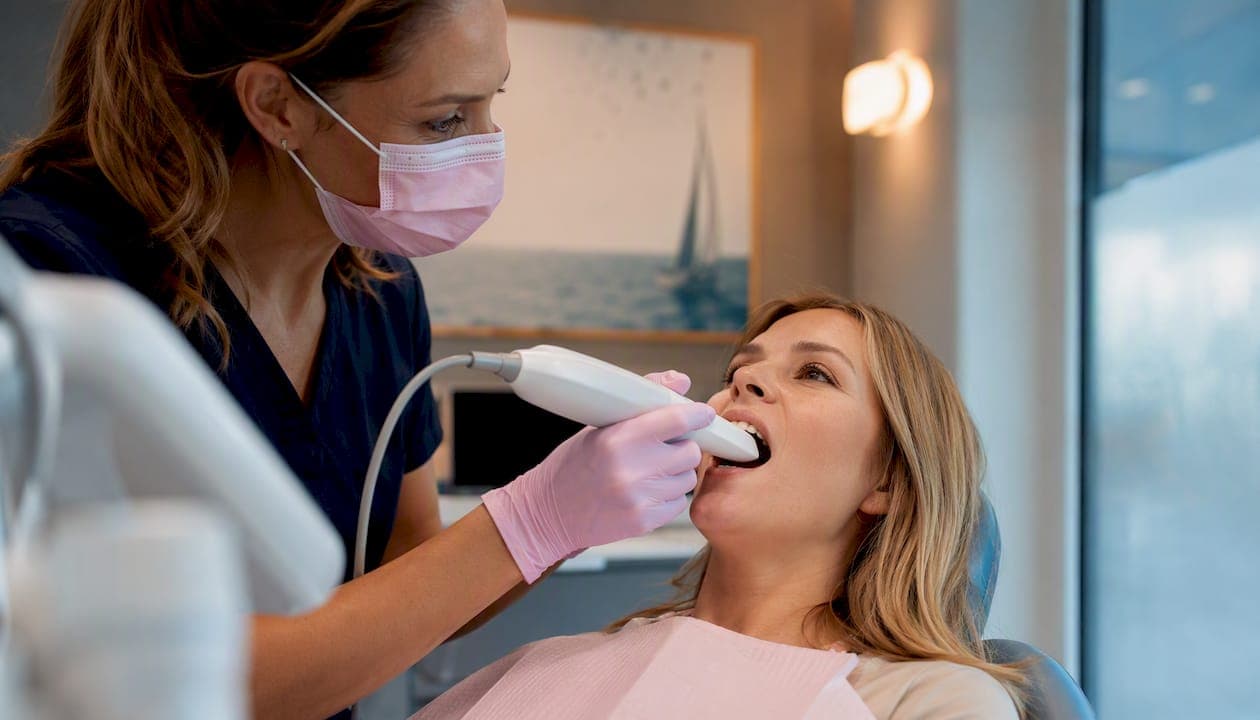
A digital dental impression is a 3D scan of your teeth and gums captured with a small handheld wand, and for most patients, it is the more comfortable and faster option compared to traditional putty-based molds. One clinical trial recorded total working time of just 12 minutes for digital impressions versus 75.5 minutes for conventional ones, and patients in the same study rated digital impressions as more comfortable than traditional methods. For single crowns, short-span bridges, and orthodontic models, the clinical evidence is solid. For full-arch cases and complex implant work, the picture is more nuanced.
Your immediate next step: call your dentist and ask two questions. Do they use an intraoral scanner? And is your specific treatment a good fit for a digital workflow? If they use a system like the 3Shape TRIOS, iTero Element, Medit i500, or Carestream CS series, you are likely in good hands for most common restorations.
- Digital scans are clinically comparable to traditional impressions for single crowns and short-span restorations.
- They are faster, more comfortable, and eliminate the gag reflex triggered by impression trays.
- Full-arch and complex implant cases require more scrutiny before assuming digital is the right call.
- Not every dental practice owns an intraoral scanner, so it is worth asking before you book.
Table of Contents
- How digital impressions are captured
- What does the research say about accuracy?
- When digital impressions are not the right choice
- Which treatments benefit most from digital scanning?
- How much do digital impressions cost?
- Do all dentists offer digital impressions?
- Digital vs. traditional impressions: a side-by-side comparison
- How Starboarddental uses digital impressions
- Key Takeaways
- Why the comfort argument undersells digital impressions
- Ready for a comfortable digital scan at Starboarddental?
- Useful sources and further reading
How digital impressions are captured
The actual scanning process is straightforward, but understanding each step helps you know what to expect and why the dentist pauses at certain moments.
Before the scan:
- The dentist or assistant dries the area being scanned. Moisture and saliva can interfere with the scanner's optics, so you may feel a brief burst of air.
- Some scanners require a thin layer of scanning spray on reflective surfaces like gold restorations or very shiny enamel, though many newer systems work without it.
- The scanner tip is warmed up to prevent fogging from the temperature difference between the device and your mouth.
During the scan: 4. The wand moves in a specific path, usually starting on the biting surfaces, then sweeping to the outer (cheek-side) surfaces, then the inner (tongue-side) surfaces. 5. A live 3D model builds on the monitor in real time. You can watch your teeth appear as the scan progresses. 6. A bite registration scan captures how your upper and lower teeth fit together, which the lab needs to fabricate a restoration that meets correctly.
After the scan: 7. The dentist reviews the completed model on screen immediately. Any gap or blurry patch can be rescanned in seconds without starting over. This real-time quality check is one of the biggest practical advantages over traditional impressions, where a flaw is not discovered until the lab calls. 8. The file is exported and sent electronically to the lab or loaded into the in-office milling system.
The 3Shape overview of digital impression workflows describes how the scanner builds polygonal 3D models from overlapping image captures, the same geometry used in animation and engineering software. The dentist is essentially creating a precise digital replica of your mouth that can be manipulated, measured, and shared without any physical material degrading over time.
Pro Tip: Ask to watch the monitor during your scan. Seeing your teeth appear in 3D in real time is genuinely interesting, and for patients who feel anxious, having something to focus on makes the appointment go faster.
What does the research say about accuracy?
The short answer: digital impressions are clinically reliable for single crowns and short-span fixed restorations. For full-arch scans and complex implant cases, the evidence is more mixed, and the choice of scanner and operator experience matters more than most patients realize.
An umbrella review covering 23 systematic reviews found that time savings and patient preference consistently favor digital methods, but accuracy findings across full-arch cases remain conflicting. A 2026 Frontiers systematic review reached a similar conclusion: intraoral scanners are faster and better tolerated by patients, but study heterogeneity across devices and scanning protocols limits sweeping claims about universal superiority.
For partial edentulous patients with maxillary defects, a Scientific Reports study found that intraoral scanning produced acceptable accuracy for the remaining dentition but showed deviations greater than 2 mm concentrated in the defect areas. In those cases, a functional conventional impression may still be the clinically appropriate choice.
What "trueness" and "precision" actually mean for you:
- Trueness is how close the scan is to the actual shape of your tooth. A high-trueness scan means the crown your lab fabricates will fit well.
- Precision is how consistently the scanner produces the same result if you scan the same tooth twice. High precision means the system is repeatable.
Both matter, and research shows that scanner model, scanning path, operator experience, and the software algorithm used to stitch images together all affect both measures. A well-trained clinician with a mid-range scanner often outperforms a novice using a premium device.
| Metric | Digital impressions | Traditional impressions |
|---|---|---|
| Chairside time (full-arch) | ~12 minutes | ~75.5 minutes |
| Patient comfort | high | lower |
| Accuracy for single crowns | Comparable to conventional | Reference standard |
| Accuracy for full-arch | Mixed evidence; may decline with span | Generally reliable |
| Accuracy in defect areas | Greater deviations reported | More established |
Sources: MDPI clinical trial; Scientific Reports; ScienceDirect comparative review.
When digital impressions are not the right choice
Digital scanning is not universally superior, and a good clinician will tell you when a conventional impression is the better call.
Technical limitations to know:
- Full-arch accuracy. Accuracy tends to decline as the scan area grows. For a full arch of 28 teeth, small errors in each quadrant can compound, and comparative research confirms that conventional impressions remain more reliable for large-span cases in some clinical scenarios.
- Subgingival finish lines. When a crown margin sits below the gumline, the scanner cannot always capture it clearly. Bleeding or excess tissue in that area blocks the optics.
- Moisture and reflective surfaces. Active bleeding, heavy saliva, or highly polished metal restorations can cause scan artifacts. The dentist may need to control the field carefully or switch methods.
- Highly mobile soft tissue. In edentulous (toothless) arches, the scanner struggles with soft tissue that shifts during scanning. Functional impressions that record tissue under load are often more appropriate.
Operational realities:
- Intraoral scanners represent a significant equipment investment for a practice, which is part of why not every office has one.
- There is a learning curve. A dentist who has used a scanner for two years will generally produce better results than one who installed it last month.
- Occasional rescans of small areas are normal and expected; a full rescan is rare but possible.
Patient-specific situations where traditional may be preferred:
- Severe trismus (limited mouth opening) that prevents comfortable wand placement
- Complex maxillary defects where deviations in defect areas exceed clinical tolerance
- Full-arch implant prostheses where passive fit requirements are extremely tight
Pro Tip: If you are having a full-arch implant case or a complex denture, ask your dentist specifically whether they use a digital or conventional workflow for that procedure, and why. The answer tells you a lot about their experience level and clinical reasoning.
Which treatments benefit most from digital scanning?
Single crowns and short-span bridges are where digital impressions shine most clearly. The scan is fast, the accuracy is well-supported by clinical evidence, and the file can go straight to a lab or an in-office milling machine. Same-day crowns, where the dentist mills a ceramic restoration while you wait, depend entirely on a digital scan.
Treatments with strong digital workflow evidence:
- Single crowns and onlays/inlays
- Short-span fixed bridges (up to three or four units)
- Orthodontic study models for clear aligners like Invisalign (the iTero Element is the native scanner for Align Technology's workflow)
- Surgical guides for implant placement, which require precise 3D data
- Partial denture frameworks where the remaining teeth provide stable reference points
Treatments where evidence is mixed or conventional methods remain common:
- Full-arch implant prostheses, where passive fit is critical and scan accumulation errors can be clinically significant
- Complete dentures for fully edentulous patients, where soft tissue recording under functional load is part of the impression
- Cases with significant maxillary defects or surgical anatomy
For common dental procedures like crowns and bridges, the digital path typically means faster lab turnaround because the file arrives electronically the same day rather than waiting for a physical model to be poured and shipped. For patients considering full-arch implant options, the impression choice is one of several technical decisions worth discussing in detail with your provider.
How much do digital impressions cost?
Pricing for digital impressions in the U.S. varies, and the way practices bill for them is not always transparent. Most offices bundle the scan cost into the overall procedure fee rather than listing it as a separate line item. A crown appointment, for example, might be quoted as a single fee that includes preparation, scanning, and the restoration itself.
What drives the cost:
- The scanner itself is a significant capital investment for a practice, and that cost is reflected in procedure fees over time.
- Some practices charge a separate digital impression fee, typically in the range of $50–$200, though this varies widely by region and practice type.
- Treatment complexity matters: a single-tooth scan costs less to perform than a full-arch scan that takes more chair time and processing.
Insurance considerations:
Most dental insurance plans reimburse based on the procedure code for the restoration (crown, bridge, denture) rather than the impression method used. The scan is generally not billed as a standalone covered benefit. That means your out-of-pocket cost for a crown should be similar whether your dentist uses a digital scan or a traditional impression, assuming the same procedure code is submitted.
- Ask the front desk for a written fee estimate before your appointment.
- Ask specifically whether the scan is included in the quoted procedure fee or billed separately.
- If you have a dental savings plan or are uninsured, ask whether the practice offers a fee schedule or payment plan.
- Verify your plan's coverage for the specific procedure code (e.g., D2740 for a porcelain crown) rather than asking about "digital impressions" as a category, since that is not how insurers categorize it.
Do all dentists offer digital impressions?
No. Intraoral scanner adoption in the U.S. has grown steadily, but a meaningful share of general dental practices still rely on conventional impression materials, particularly smaller solo practices and offices that have not yet made the capital investment. Specialty practices, particularly orthodontists and prosthodontists, tend to have higher adoption rates.
How to find a practice that uses digital scanning:
- Check the practice's website. Most offices that have invested in a scanner mention it under technology or services.
- Call and ask directly: "Do you use an intraoral scanner for impressions, and which system do you use?"
- Search for "digital impressions" or "intraoral scanning" in Google Maps reviews or provider profiles.
- Ask your current dentist whether they offer it, and if not, whether they can refer you to a colleague who does.
Questions worth asking when you book:
- Which scanner do you use, and how long have you been using it?
- Do you handle full-arch or implant cases digitally, or do you use conventional impressions for those?
- Is the scan fee included in the procedure quote, or is it billed separately?
- Do you send files to an outside lab, or do you mill restorations in-office?
Prioritize operator experience over scanner brand. A dentist who has performed hundreds of digital scans on a mid-range system will generally deliver better results than one who recently purchased a premium scanner and is still on the learning curve. For patients in the Kennebunk, ME area, Starboarddental uses digital scanning as part of its restorative and cosmetic workflows. More on that below.
Digital vs. traditional impressions: a side-by-side comparison
| Dimension | Digital impressions | Traditional impressions |
|---|---|---|
| Accuracy (single crowns/short-span) | Clinically comparable | Reference standard |
| Accuracy (full-arch) | Mixed evidence; may decline with span | Generally more reliable |
| Chairside time | ~12 min (full-arch trial) | ~75.5 min (full-arch trial) |
| Patient comfort (VAS) | 9.03 (digital) | 6.66 (conventional) |
| Gag reflex risk | Low (no tray or putty) | Higher (tray fills mouth) |
| Typical patient cost | Bundled in procedure fee; scan add-on $50–$200 | Bundled in procedure fee |
| Operator learning curve | Moderate; technique-dependent | Well-established |
| Lab turnaround | Faster (electronic file same day) | Slower (physical model shipped) |
| Best indications | Single crowns, short bridges, ortho models, surgical guides | Full-arch implants, edentulous arches, defect cases |
The main takeaway is that digital impressions win on comfort and speed for the majority of common restorations, and the accuracy evidence supports their use for single-tooth and short-span work. Traditional impressions remain the more reliable choice for full-arch implant prostheses, complete dentures, and cases with complex anatomy. The right method depends on your specific treatment, your dentist's experience, and the clinical scenario, not on which technology sounds more advanced.
How Starboarddental uses digital impressions
Starboarddental in Kennebunk, ME integrates digital scanning into its restorative and cosmetic dentistry workflows as a standard part of patient care. The scanner replaces traditional putty impressions for crowns, bridges, veneers, and clear aligner treatment, which means patients spend less time in the chair and leave with a verified digital record of their teeth rather than waiting for a physical model to be processed.
The clinic's approach to patient comfort extends beyond the scan itself. Ceiling-mounted TVs give patients something to watch during procedures, personalized comfort items are available on request, and same-day appointments are offered for patients who need prompt care. For patients who have avoided dental work because of anxiety around impressions specifically, the digital workflow removes one of the most commonly cited barriers.
What patients can expect at Starboarddental:
- A brief explanation of the scanning process before it begins, so nothing is a surprise
- The option to watch the 3D model build on screen during the scan
- A quality check before you leave, so you know the scan is complete and accurate
- Electronic file submission to the lab the same day, which typically shortens the time between your prep appointment and your final restoration
- Insurance and billing handled at the front desk, with written estimates available before treatment
The peer-reviewed evidence cited throughout this article, including the MDPI clinical trial and the Frontiers systematic review, supports the clinical choices Starboarddental makes in recommending digital scanning for appropriate cases. For treatments where conventional impressions remain the stronger clinical choice, the team will say so and explain why.
New patients can learn more about what to expect at their first visit on the new patients page.
Key Takeaways
Digital dental impressions are clinically reliable for single crowns and short-span restorations, significantly faster and more comfortable than traditional methods, and the right choice for most patients when performed by an experienced operator.
| Point | Details |
|---|---|
| Comfort advantage is real | Patients rated digital impressions as more comfortable than traditional methods in a clinical trial (mean VAS 9.03 vs. 6.66). |
| Speed difference is significant | Digital full-arch scanning took ~12 minutes, vs. ~75.5 minutes for conventional in the same trial. |
| Accuracy has limits | Digital scans are comparable for single crowns but show mixed evidence for full-arch and defect cases. |
| Ask the right questions | Before booking, ask which scanner your dentist uses and how long they have been using it. |
| Starboarddental offers digital scanning | Starboarddental in Kennebunk, ME uses intraoral scanning for restorative and cosmetic workflows with same-day appointments available. |
Why the comfort argument undersells digital impressions
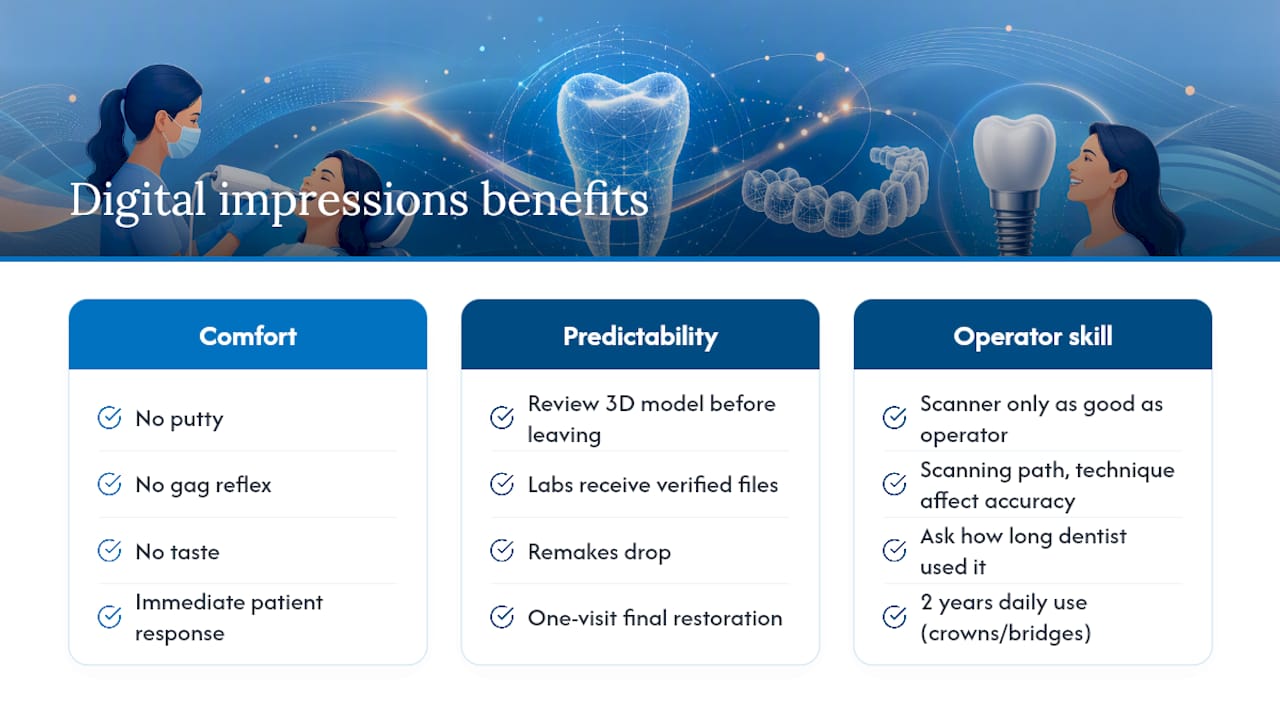
The conversation around digital impressions tends to lead with comfort, and that is fair. No putty, no gag reflex, no taste. Patients respond to that immediately. But focusing on comfort alone undersells what actually changes when a practice adopts a well-run digital workflow.
The more consequential shift is what happens after the scan. When a dentist can review a complete 3D model before you leave the chair, the entire downstream process becomes more predictable. Labs receive verified files. Remakes drop. Patients come back for their final restoration, not for a second impression because the first one had a bubble in it. That is a different category of benefit than "more comfortable," and it is the reason experienced clinicians tend to prefer digital workflows for appropriate cases even when patient comfort is not the primary concern.
The caveat that rarely gets enough attention: the scanner is only as good as the operator using it. A PubMed study on IOS accuracy factors makes clear that scanning path, technique, and experience level materially affect trueness and precision. Patients who ask only "do you have a scanner?" are asking the wrong question. The better question is how long the dentist has been using it and for which procedures. A practice that adopted digital scanning two years ago and uses it daily for crowns and bridges is in a meaningfully different position than one that bought a scanner six months ago and uses it occasionally.
The patient-centered care approach that Starboarddental emphasizes is not just about comfort features. It is about giving patients the information they need to make a real decision, including when a conventional impression is the right call. That kind of transparency is what separates a practice that has a scanner from one that actually knows how to use it.
Ready for a comfortable digital scan at Starboarddental?
Starboarddental in Kennebunk, ME offers digital scanning as part of its restorative and cosmetic care, and the difference patients notice most is not just the absence of putty. It is the shorter appointment, the on-screen model they can see before they leave, and the faster turnaround on their final restoration.

If you are considering a crown, bridge, veneer, or clear aligner treatment, a digital scan is likely part of that workflow at Starboarddental. New patients are welcome, same-day appointments are available, and the team handles insurance verification and written estimates upfront so there are no billing surprises. Most major dental plans are accepted, and the front desk can confirm your specific coverage before your visit.
To schedule your appointment or ask whether your treatment is a good fit for a digital workflow, visit the new patients page or call the Kennebunk office directly.
Useful sources and further reading
The clinical evidence in this article draws from peer-reviewed studies and systematic reviews. Patients who want to read the primary literature or explore related topics can start here:
- Evaluation of Intraoral Full-Arch Scan versus Conventional Preliminary Impression
- Conventional versus Digital Dental Impression Techniques: What Is the Future? An Umbrella Review
- Evaluation of the patient's perception, reliability and reproducibility, and chairside time with intraoral scanners in adult population—a systematic review
- Accuracy of intraoral scanning versus conventional impressions for partial edentulous patients with maxillary defects
- Dental Impressions: Purpose & Procedure
- What are digital impressions and how do they work?
- Comparative research on digital intraoral scanners and conventional impression techniques (2022 research summary)
- Digital impression making in dentistry: A review - PMC - NIH
- PubMed indexed study on factors affecting IOS accuracy
This article provides general patient education and is not a substitute for professional dental advice. Consult your dentist to determine which impression method is appropriate for your specific treatment.