
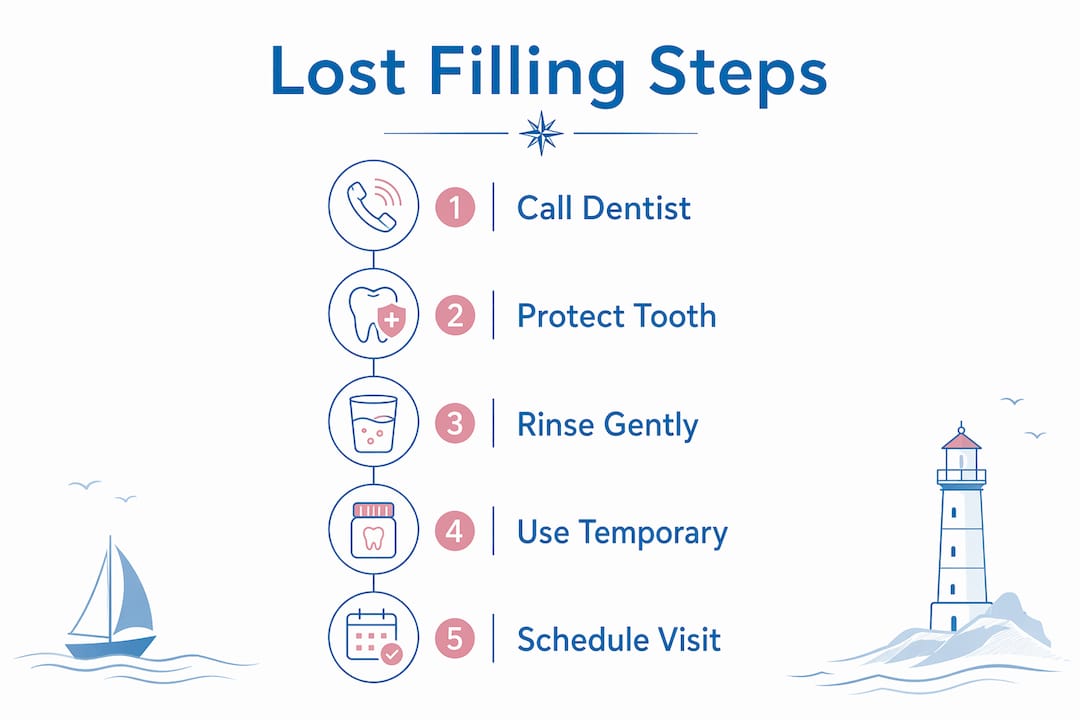
If your filling just fell out, do two things immediately: call your dentist to get on the schedule, and protect the exposed tooth until you're seen. That's the whole game. Everything else is detail.
For patients in Kennebunk and the surrounding area, Starboard Dental keeps urgent slots available and can often see you same-day. Call the office, describe your symptoms, and they'll triage from there.
While you wait, rinse gently with warm salt water, avoid chewing on that side, and if you find the filling piece, drop it in a small clean container and bring it along. Over-the-counter temporary cements like Dentemp or Cavit can cover the exposed tooth for a short window, but they're a bridge to your appointment, not a fix.

Table of Contents
- What should you do in the first hours after a filling falls out?
- How to use temporary filling kits safely (Dentemp, Cavit, and pharmacy options)
- When is a lost filling a dental emergency?
- What will the dentist actually do when you come in?
- What happens if you wait too long to replace a lost filling?
- How can you prevent fillings from failing in the future?
- How Starboard Dental evaluates and treats a lost filling
- Key Takeaways
- A lost filling is fixable — here's the honest perspective
- Starboard Dental is ready to help you today
- Useful sources and where to learn more
What should you do in the first hours after a filling falls out?
The first few hours matter more than most people realize. An exposed tooth picks up bacteria fast, and sensitivity can go from mild to sharp quickly depending on how deep the cavity was.
Work through these steps in order:
- Inspect carefully, don't probe. Use good lighting and a mirror to look at the tooth. Don't poke the area with your finger or a toothpick — you can push debris into the cavity or irritate the nerve.
- Rinse with warm salt water. Mix 1/2 teaspoon of salt in 8 ounces of warm water and swish gently. This clears debris and reduces bacterial load without irritating the exposed dentin. Skip alcohol-based mouthwash entirely — it stings exposed dentin and can worsen sensitivity.
- Collect the filling piece. If you find it, put it in a small container and bring it to your appointment. The dentist can examine it for clues about why it failed — decay underneath, material fatigue, or a crack. Re-cementing the original piece is rarely the long-term solution, but the information it carries is useful.
- Eat soft foods only. Yogurt, mashed potatoes, scrambled eggs. Avoid anything hot, cold, sticky, or hard. Chew exclusively on the opposite side.
- Manage pain with OTC medications. Ibuprofen or acetaminophen at standard doses handles most mild-to-moderate discomfort. A cold compress held against the cheek for 10–15 minutes can reduce swelling and numb the area. Topical numbing gels (benzocaine-based products like Orajel) can take the edge off briefly, but they wear off fast.
- Dental wax as a stopgap. If the tooth has a sharp edge that's cutting your tongue or cheek, dental wax from any drugstore can cover it. Sugar-free gum works in a genuine pinch, but only until you get proper materials.
Pro Tip: Never use household glue, super glue, or any non-dental adhesive inside your mouth. These products can cause chemical burns to soft tissue and interfere with the bonding agents your dentist needs to place a proper restoration.
How to use temporary filling kits safely (Dentemp, Cavit, and pharmacy options)
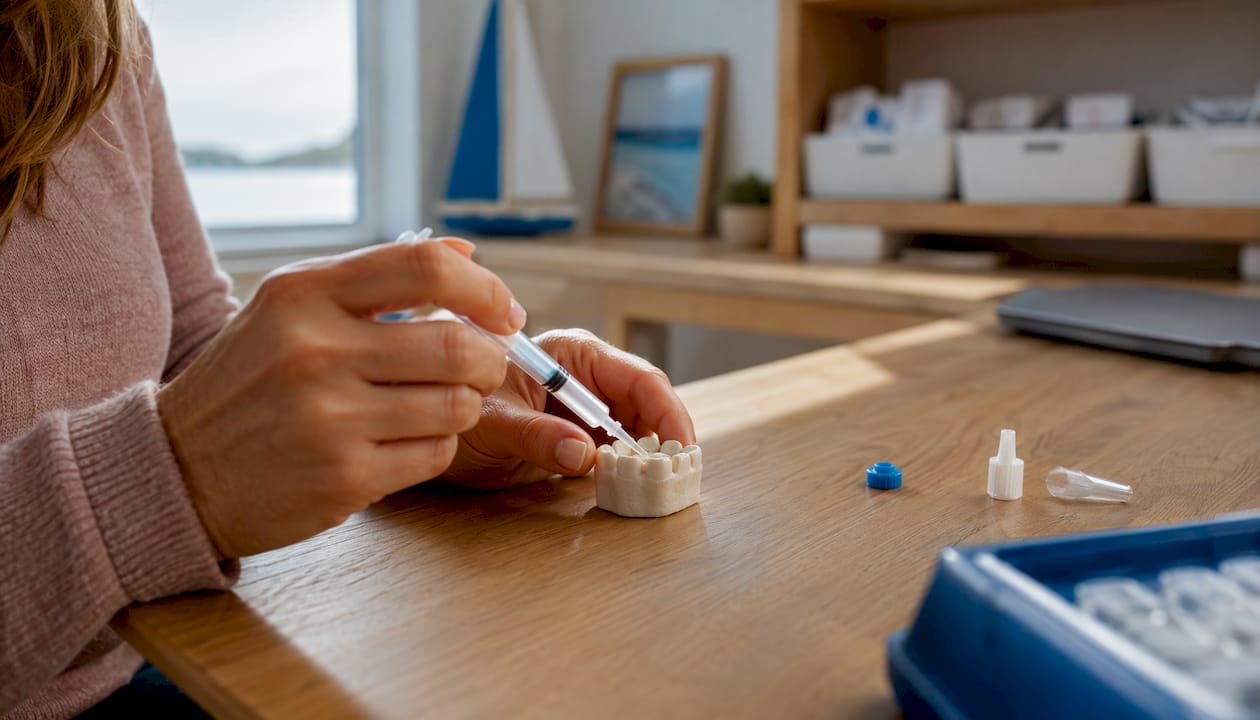
Temporary dental cements exist for exactly this situation. They're not a permanent fix, but they protect the tooth from bacteria, temperature, and pressure while you wait for your appointment.
When to use them (and when not to):
Temporary filling material makes sense when you can't get to a dentist within a few hours and the tooth is sensitive or exposed. Skip them if you have severe pain, visible swelling, or any of the red flags listed in the next section — those symptoms need a phone call, not a pharmacy run.
Step-by-step application:
- Rinse your mouth with warm salt water and pat the area dry with a clean piece of gauze or tissue.
- Read the product instructions fully before opening the kit. Dentemp and Cavit each have slightly different consistencies.
- Take a small amount of the putty or paste and roll it into a soft ball.
- Press it gently into the cavity opening. Don't pack it hard — you want it to sit flush with the surrounding tooth surface, not mound above it.
- Bite down gently to shape it to your bite. Remove any excess that squeezes out.
- Avoid eating or drinking for at least 30–60 minutes to let the material set.
What to expect from each product:
- Dentemp is widely available at pharmacies and drugstores. It comes as a paste that firms up after placement. It's easy to apply and works well for molars and premolars.
- Cavit is a pre-mixed temporary filling material used in dental offices and available OTC. It's slightly softer and self-sealing, which makes it forgiving for first-time users.
Both are short-term protection only. OTC temporary materials can fail during a single meal. Treat them as a 24-hour measure, not a multi-day solution.
What to avoid:
- Household glues or adhesives of any kind
- Alcohol-based mouthwash after placement
- Pressing the original filling back into the tooth yourself
- Assuming the material is still in place if you feel sensitivity return — it may have washed out
When is a lost filling a dental emergency?
Most lost fillings are urgent but not life-threatening. A few situations, though, require same-day care or a trip to an emergency department.
Call your dentist immediately or go to urgent care if you have:
- Severe pain that doesn't respond to ibuprofen or acetaminophen
- Facial swelling, especially if it's spreading toward the jaw, neck, or eye
- Fever above 101°F alongside tooth pain
- Pus or drainage near the tooth or gum
- Difficulty breathing or swallowing
- Uncontrolled bleeding from the area
Swelling combined with fever is a red flag for a dental abscess, which can escalate quickly. If you notice signs of abscess-related swelling, don't wait for a morning appointment — get evaluated the same day.
If you have only mild sensitivity and no swelling or fever, you're not in an acute emergency, but you still need to be seen within 24–48 hours. Mild symptoms can progress faster than expected once the tooth is exposed.
For a fuller breakdown of what qualifies as a dental emergency, the emergency dental care guide covers triage in detail.
What will the dentist actually do when you come in?
Knowing what to expect at the appointment takes most of the anxiety out of it. The visit has two parts: diagnosis and treatment.
The exam:
- Visual inspection of the tooth and surrounding tissue
- Probing to check for soft spots, new decay, or cracks
- Bite check to assess how forces distribute across the tooth
- Digital X-rays or intraoral scan to see what's happening below the gumline and evaluate remaining tooth structure
Treatment options, from simplest to most complex:
- New filling: If the tooth structure is intact and there's no significant new decay, the dentist places a composite or amalgam filling. Front teeth typically get tooth-colored composite; back molars may use amalgam for durability.
- Crown: If the tooth has lost significant structure or has a crack, a crown protects what's left. This usually takes two visits — a temporary crown first, then a permanent one once the lab fabricates it.
- Root canal: If decay has reached the pulp or the nerve is infected, root canal therapy clears the infection before the tooth is restored. This is more involved but saves the tooth.
- Extraction: Rare, and only when the tooth can't be saved. If it comes to that, options like a bridge or implant can replace it.
The treatment options for common dental procedures are worth reviewing before your visit if you want more context on what each involves.
A good dentist doesn't just replace the missing material. The appointment is a diagnostic opportunity to find out why the filling failed in the first place — decay underneath, a crack, or bite forces from grinding — so the replacement actually lasts.
What happens if you wait too long to replace a lost filling?
Waiting feels low-stakes when there's no pain. It usually isn't.
- Exposed dentin allows bacteria to enter and cause decay that progresses silently. A painless exposed tooth can still develop rapid decay and require a much larger restoration.
- A small cavity under the old filling grows quickly without a protective seal.
- The tooth can crack or fracture under normal chewing forces once the structural support is gone.
- Bacteria reaching the pulp causes infection, which typically means root canal therapy.
- In the worst case, the tooth can't be saved and requires extraction.
Early intervention almost always preserves more natural tooth and costs less. That's not a scare tactic — it's just the biology of how decay works once the barrier is gone.
How can you prevent fillings from failing in the future?
No filling lasts forever, but the gap between a five-year filling and a fifteen-year one usually comes down to daily habits and a few specific choices.
- Brush twice daily with fluoride toothpaste and floss every day. Plaque buildup at the margins of a filling is the most common cause of recurrent decay.
- Avoid chewing ice, hard candy, and sticky foods. These put disproportionate stress on restorations and are among the most common mechanical causes of filling failure.
- Wear a night guard if you grind your teeth. Bruxism generates far more force than normal chewing and wears down fillings faster than almost anything else. A custom night guard from your dentist fits better and lasts longer than an over-the-counter option.
- Keep your regular checkup schedule. Dentists can spot open margins, micro-cracks, and early secondary decay before they cause a filling to fail. Catching these early means a simple repair instead of a full replacement.
- Address older, large fillings proactively. If a filling is large and showing signs of wear or recurrent decay at the edges, replacing it before it fails is almost always the simpler and less expensive path.
Pro Tip: If you've had multiple fillings fail in a short period, ask your dentist about your bite pattern and whether bruxism might be contributing. A night guard and a bite adjustment can change the trajectory significantly.
For a deeper look at daily habits that protect restorations, preventing cavities between checkups covers the specifics.
How Starboard Dental evaluates and treats a lost filling
When a patient comes in with a filling that's fallen out, the first question isn't "what material do we use?" It's "why did this happen?"
Common causes seen in clinic:
- New decay forming under or around the old filling
- A crack in the tooth that compromised the seal
- Wear from bruxism or heavy bite forces
- Material fatigue in older, large restorations
Diagnostic tools used at Starboard Dental:
- Clinical exam with probing and bite assessment
- Digital X-rays to evaluate decay depth and bone level
- Intraoral scanning for precise assessment of remaining tooth structure
The practice prioritizes tooth-sparing restorations whenever possible. Same-day temporaries are available for patients who need immediate protection, with definitive restorations scheduled once the full picture is clear. The goal is always to treat the underlying cause, not just fill the hole.
Practical logistics: When you call, mention that you've lost a filling and describe your symptoms. Bring your insurance information, the lost filling piece if you have it, and any photos you took of the tooth. Starboard Dental serves patients in Kennebunk, York, and Saco, ME.
Key Takeaways
A lost filling needs a dentist's attention within 24–48 hours at most; temporary OTC materials protect the tooth briefly but never replace professional care.
| Point | Details |
|---|---|
| Call your dentist first | Book same-day or urgent care; describe symptoms so the office can triage correctly. |
| Protect the exposed tooth | Rinse with warm salt water, avoid chewing on that side, and use Dentemp or Cavit only as a short-term bridge. |
| Watch for red flags | Swelling, fever, pus, or severe pain that won't respond to OTC pain relievers means same-day emergency care. |
| Delaying has real costs | A painless exposed tooth can develop silent decay fast, turning a simple filling into a crown or root canal. |
| Starboard Dental | Offers same-day urgent appointments, digital diagnostics, and tooth-sparing restorations for patients in Kennebunk, York, and Saco, ME. |
A lost filling is fixable — here's the honest perspective
Lost fillings are one of the most common calls a dental office gets, and they're almost always fixable. The anxiety people feel is understandable, but the situation is rarely as dire as it seems in the first moment.
What actually concerns me is the patients who wait. Not because they're being careless, but because the tooth doesn't hurt, so it doesn't feel urgent. That's the trap. Exposed dentin is a quiet problem. Bacteria don't announce themselves. By the time pain shows up, the decay has often already reached a depth that changes the treatment plan entirely.
The other thing worth saying: a lost filling is diagnostic information. If your filling came out, something caused it. Decay underneath, a crack you didn't know about, grinding forces you haven't addressed. A good appointment doesn't just replace the material — it figures out why the material failed. That's the difference between a restoration that lasts two years and one that lasts fifteen.
If you're anxious about the visit itself, that's worth mentioning when you call. Dental anxiety is common, and a practice that takes it seriously will adjust the pace and approach accordingly. You shouldn't have to white-knuckle your way through a filling replacement.
Starboard Dental is ready to help you today

When a filling falls out, the last thing you need is a long wait or a practice that can't fit you in. Starboard Dental's restorative team in Kennebunk handles lost fillings, broken teeth, and urgent dental needs with same-day availability and the diagnostic tools to get the full picture fast. Digital X-rays and intraoral scanning mean no guessing about what's happening under the surface.
The practice offers restorative dentistry services covering everything from a simple filling replacement to crowns and root canal coordination, serving patients across Kennebunk, York, and Saco, ME. Most major insurance plans are accepted, and the front desk can walk you through payment options when you call.
Call Starboard Dental today, describe your symptoms, and get on the schedule. Bring your insurance card, the lost filling if you have it, and any questions about what to expect. The sooner you're seen, the more options you have.
Useful sources and where to learn more
- Healthline: What to Do If Your Filling Falls Out — A clear, clinician-reviewed overview of immediate steps and when to seek urgent care. Good starting point for general guidance.
- BCBS FEP Dental: If a Filling Falls Out — Insurance-perspective guidance on treatment escalation from fillings to crowns and root canals; useful for understanding cost and coverage implications.
- Dental Group: What to Do If You Lose a Dental Filling — Practical home-care steps including the salt-water rinse formula and mouthwash cautions.
- Dental Specialty Center: Tooth Filling Fell Out? Quick Fixes — Detailed guidance on OTC temporary materials (Dentemp, Cavit) and the safety warnings around household adhesives.
- Gorgeous Smiles Dental: What to Do If My Tooth Filling Fell Out — Covers silent decay risk and the value of bringing the lost filling to your appointment.
- Towne Dental: Emergency Dental Services — Practical overview of emergency dentistry logistics and what to expect when you need urgent care.
- Starboard Dental: Dental Fillings Kennebunk ME — Service page covering filling types, materials, and when each is appropriate for your tooth.