
Aligners actively move teeth into a new position. Retainers hold teeth in place after that movement is done. If your teeth are still crooked or you have a bite issue, you need aligners or braces. If you've finished active treatment, you need a retainer, and according to the American Association of Orthodontists, that retention phase often lasts a lifetime.
Quick decision checklist:
- Teeth are crooked, gapped, or crowded → you need active aligner treatment
- You just finished braces or aligners → you need a retainer, starting immediately
- Your retainer broke or you lost it → contact your provider today, not next week
- You grind your teeth → ask about a hybrid retainer or night guard option
- You're unsure whether your teeth have shifted → book a clinical evaluation
Starboarddental in Kennebunk offers both clear aligner treatment and retainer fabrication, so wherever you are in the process, there's a clear next step.
Table of Contents
- How retainers vs aligners actually differ
- Why they look so similar and how to tell them apart
- What types of retainers are available to you
- How clear aligner systems work
- When retainers enter the picture: the treatment timeline
- How long you wear each device
- Can you use your last aligner as a retainer?
- Cleaning and maintaining your appliance
- What aligners and retainers typically cost in the U.S.
- Who actually needs aligners vs who just needs a retainer
- How Starboarddental approaches aligner treatment and retention
- Key Takeaways
- The habit gap is where most retention fails
- Starboarddental makes the next step straightforward
How retainers vs aligners actually differ
The core distinction is mechanical. Aligners apply a controlled, sequential force to shift teeth through a series of custom trays, each one slightly different from the last. Retainers apply no meaningful force. Their job is purely stabilizing: holding the bone and periodontal ligaments in place while they consolidate around the new tooth positions.
That difference in purpose drives every other difference between the two devices.
- Purpose: Aligners correct tooth position; retainers prevent relapse after correction
- Mechanism: Aligners use staged tray sequences to apply progressive force; retainers provide passive resistance to natural drift
- Material and thickness: Clear retainers have a standard thickness designed for durability; aligner plastic is thinner and more pliable by design, engineered to flex slightly as teeth move into each new position
- Durability: Retainer-grade plastic is built for long-term wear; aligner trays are disposable, replaced every one to two weeks
- Timing: Aligners come first; retainers follow the moment active treatment ends
What you feel in your mouth tells you which one you're wearing. A new aligner tray creates noticeable pressure and sometimes mild soreness for the first day or two. A well-fitting retainer should feel snug but neutral. If your retainer feels tight, that's a signal your teeth have already shifted, not a normal sensation to push through.
Pro Tip: If a retainer feels tight after a break from wearing it, don't force it. Contact your provider. Forcing a tight retainer can damage both the appliance and your teeth, and tightness usually means you need a clinical assessment to decide whether to re-fit or restart active treatment.
Why they look so similar and how to tell them apart
Both devices are clear, removable trays that fit snugly over your teeth. On a bathroom counter, they're nearly impossible to tell apart without knowing what to look for. That visual similarity causes real problems: patients accidentally swap trays, use worn-out aligners as makeshift retainers, or follow the wrong wear schedule because they assumed the devices were interchangeable.
They are not.
- Thickness: A retainer feels slightly stiffer and more rigid; an aligner tray has a subtle flex when you press it
- Labeling: Most aligner trays are numbered or marked with upper/lower and a sequence number; retainers typically aren't numbered
- Instructions: Your clinician's written instructions are the most reliable guide. Keep them
- Source: If you're still in active treatment, the tray in your case is an aligner. If your provider handed it to you on the day your braces or aligners came off, it's a retainer
The practical takeaway: never guess. If you're not sure which device you're holding or whether it still fits correctly, call your dental office before wearing it.
What types of retainers are available to you
Retainers come in three main forms, and the right one depends on your bite, your lifestyle, and whether you have habits like grinding.
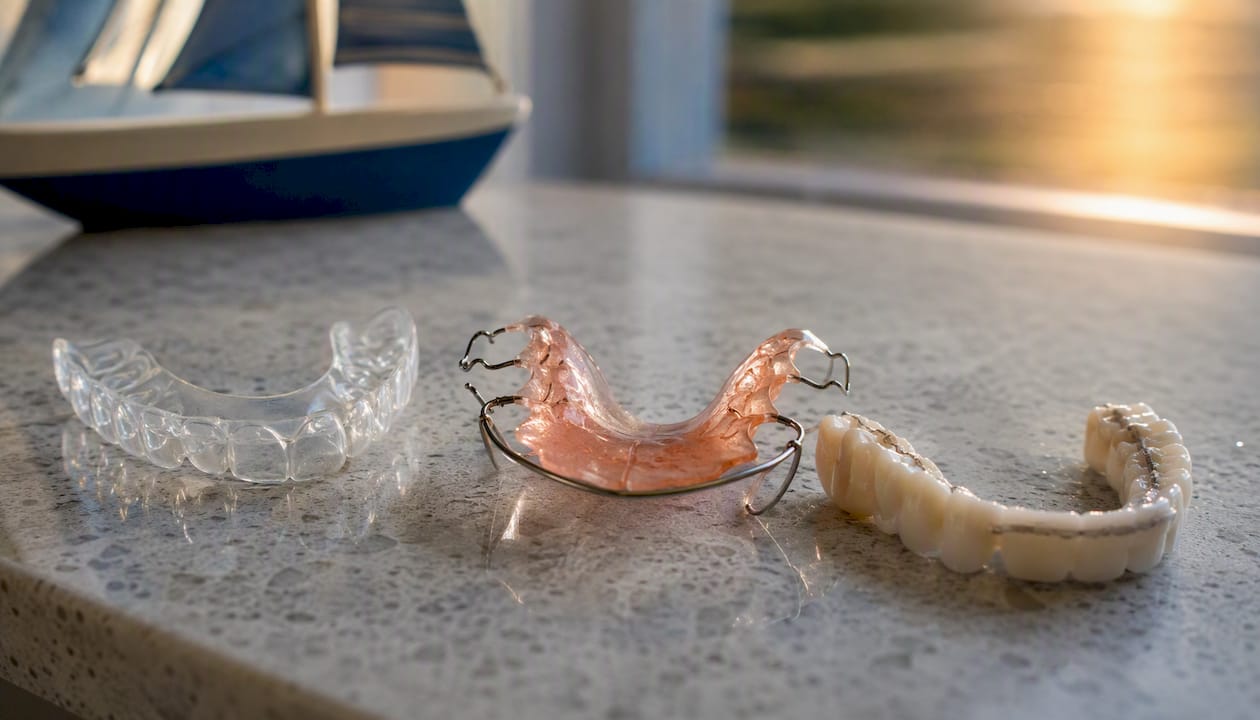
Removable clear retainers (Essix-style) These are the most common type given after clear aligner treatment. They're made from clear thermoplastic, fit over all the teeth, and are nearly invisible when worn. The downside is durability: they can crack, warp from hot water, or wear thin over time, especially for patients who clench. Standard clear retainers have a thickness designed for durability.
Hawley retainers An acrylic base with a metal wire that runs across the front teeth. Less discreet than clear retainers, but significantly more durable and adjustable. If minor settling is still expected after treatment, a Hawley can be tweaked without fabricating a new appliance. They're also easier to clean and tend to last longer with proper care.
Fixed (bonded) retainers A thin wire bonded to the back surfaces of the front teeth, usually the lower anteriors. You can't remove it, which means compliance isn't a factor. That's the main advantage. The trade-off is hygiene: the wire creates areas where plaque accumulates, and flossing requires a threader or specialized floss. Bonded retainers are often recommended when a provider has concerns about patient compliance or when lower front teeth have a strong tendency to crowd.
Hybrid retainers for bruxism Patients who grind their teeth need more than a standard clear retainer. Standard clear retainers may not be sufficiently durable for patients who grind their teeth; hybrid appliances provide enhanced retention strength and durability. If you grind, ask specifically about this option.
Pro Tip: If you've been told you grind your teeth or you wake up with jaw soreness, mention it before your retainer is fabricated. A standard clear retainer may not survive six months of bruxism. A hybrid appliance protects both your alignment and your enamel.
How clear aligner systems work
Clear aligners are a series of custom-made trays, each one engineered to move specific teeth by a fraction of a millimeter. The sequence is planned digitally before treatment begins, using 3D scans of your current bite. Each tray is worn for one to two weeks, then swapped for the next in the series. Invisalign is the most widely recognized system and uses this staged-movement model with digital treatment planning.
Key points about the aligner treatment experience:
- Daily wear: 20–22 hours per day is the standard requirement. Dropping below that consistently delays treatment and can compromise outcomes
- Tray changes: Every one to two weeks, depending on your provider's protocol and your rate of tooth movement
- Treatment length: Mild cases can resolve in a few months; moderate-to-complex cases often take one to two years or longer
- Compliance dependency: Unlike braces, aligners only work when they're in your mouth. Patient discipline is a real clinical variable
- Limitations: Severe rotations, significant vertical bite corrections, and complex skeletal discrepancies may still require traditional braces or auxiliary appliances alongside aligners
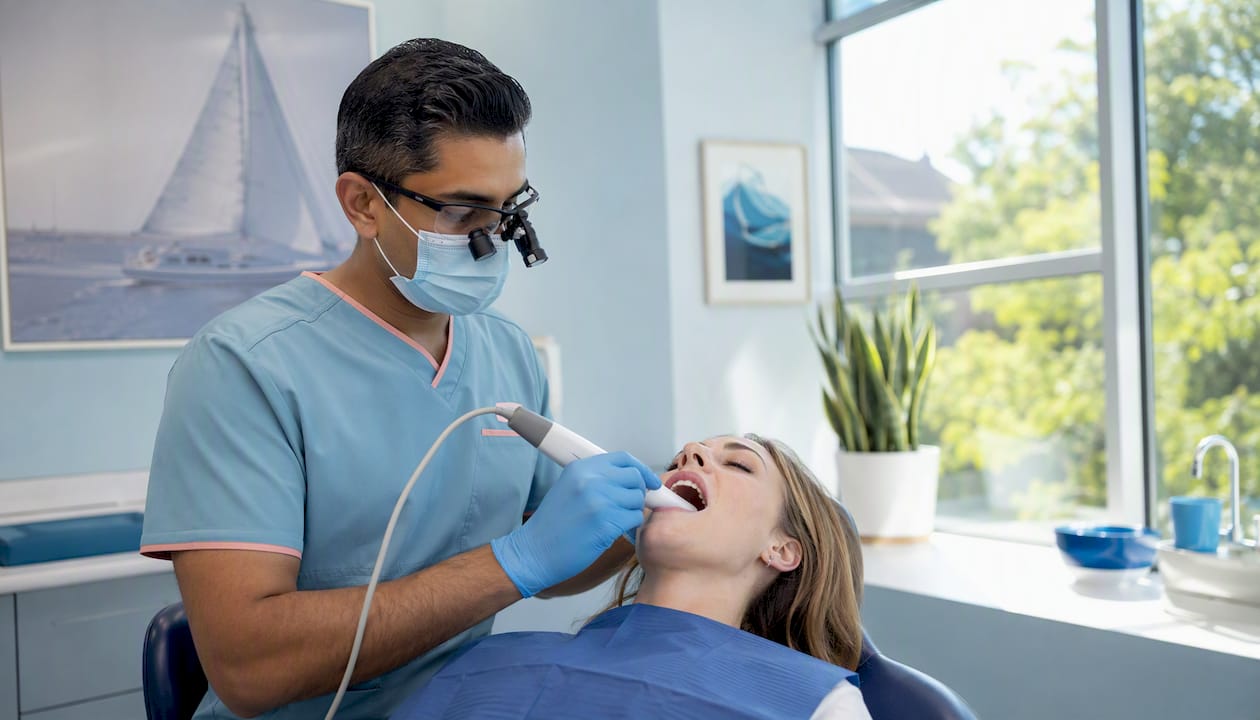
Invisalign and similar systems use digital scanning rather than physical impressions, which improves fit accuracy and makes the process more comfortable. At Starboarddental, digital scanning is part of the standard workflow for aligner patients.
When retainers enter the picture: the treatment timeline
Retainers are issued the day active treatment ends, or within a short window while a custom appliance is fabricated from final scans. That timing is not arbitrary. When teeth finish moving, the bone and periodontal ligaments surrounding them are still in a plastic, unstable state. Retention is the phase where those structures consolidate around the new positions. Skip it, and teeth drift.
Here's what the transition typically looks like:
- Final appointment: Active aligner or braces treatment ends; final digital scans or impressions are taken
- Retainer delivery: Custom retainer is fitted, often the same day or within one to two weeks
- Instructions: Your provider gives you a wear schedule, cleaning protocol, and a follow-up appointment date
- Immediate phase: Full-time wear (20–22 hours/day) for the first several months while bone consolidates
- Taper phase: Gradual shift to nighttime-only wear, typically after the first several months, based on your provider's assessment
- Long-term: Nightly wear indefinitely for most patients, with annual or biannual check-ins
Orthodontists treat the end of active treatment as the beginning of a long-term retention plan, not the finish line. Patients who understand that framing tend to stay compliant longer.
How long you wear each device
The commitment levels are very different, and it's worth knowing that before you start.
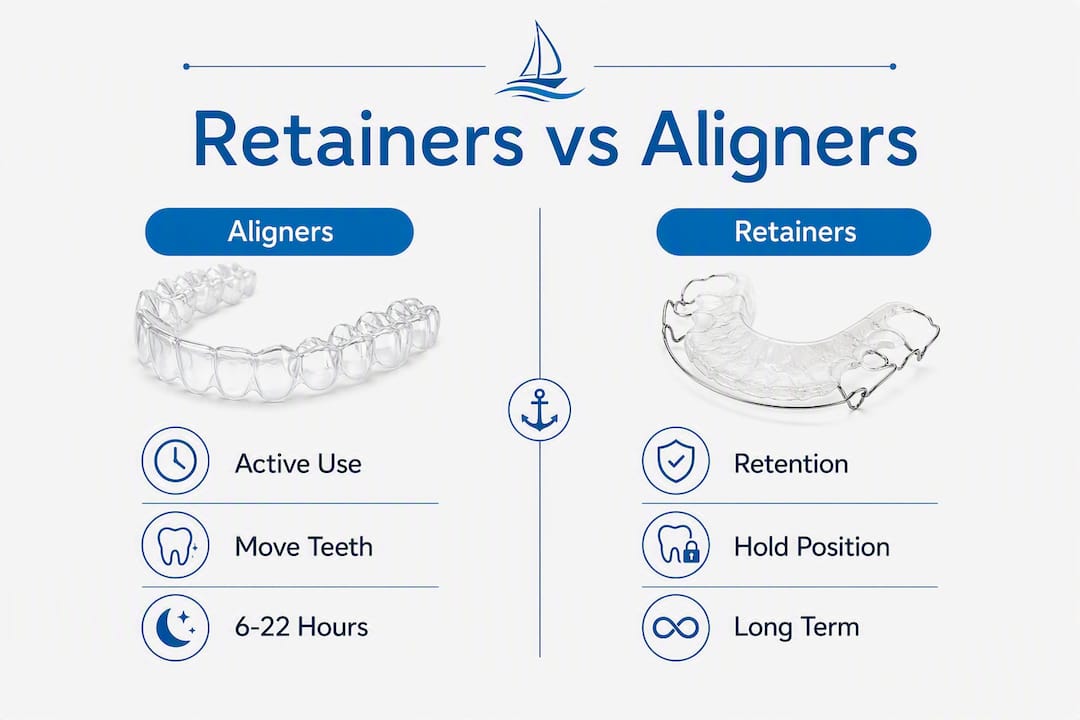
| Phase | Device | Daily Wear | Duration |
|---|---|---|---|
| Active treatment with clear aligners involves wearing the appliance most of the day for a period determined by clinical needs. | |||
| Early retention generally requires near full-time retainer wear during the initial months after treatment. | |||
| Ongoing retention commonly involves nightly wear of a retainer indefinitely to maintain tooth position. |
Teeth have a natural tendency to drift back toward their original positions after orthodontic movement. That tendency doesn't disappear after a year of wearing a retainer. It's a biological reality driven by the memory of the periodontal ligaments. The AAO's guidance reflects this: long-term, often lifetime nightly wear is the standard recommendation for most patients.
What non-compliance looks like in practice: skipping retainer wear for a few weeks after treatment usually produces noticeable tightness when you try to put it back in. A few months of skipping can mean teeth have shifted enough that the retainer no longer fits. At that point, you're looking at either a new retainer or restarting active treatment.
Can you use your last aligner as a retainer?
Short answer: temporarily, and only with your provider's approval. Not as a permanent solution.
Final aligner trays are not designed for long-term retention. They're made from thinner, more pliable plastic engineered for tooth movement, not stabilization. Over weeks of continuous wear, they distort, lose their fit, and can apply unintended forces to teeth rather than holding them steady. There's also a fit issue: the final tray in a series is designed for the tooth position at a specific treatment stage, which may not perfectly match the final corrected bite.
- Acceptable short-term use: Bridging a gap of a few days while a proper retainer is being fabricated, with your clinician's explicit sign-off
- Not acceptable: Using the last tray as your permanent retainer because it's convenient or because you lost your retainer
- Risk of long-term use: Distortion of the plastic, inadequate retention, and the possibility of minor unintended tooth movement
- If your retainer is lost or broken: Contact your provider immediately. Most offices can fabricate a replacement from your existing digital scans relatively quickly
A retainer is fabricated from final scans specifically to match your corrected bite. The last aligner tray was not made for that purpose. Those are different devices, even if they look the same in a case.
Cleaning and maintaining your appliance
Hygiene habits for aligners and retainers are similar but not identical, and the stakes are real: a dirty appliance sitting against your teeth for 20 hours a day accelerates decay and gum problems.
For removable clear aligners and clear retainers:
- Rinse the tray with cool water every time you remove it
- Brush gently with a soft-bristled toothbrush and a small amount of clear, unscented soap (not toothpaste, which is abrasive enough to scratch the plastic)
- Never use hot water; it warps the tray
- Soak periodically in a retainer-cleaning solution or diluted white vinegar to control odor and bacteria
- Store in a ventilated case when not in your mouth; never wrap in a napkin (that's how retainers get thrown away)
For Hawley retainers:
- Brush the acrylic and wire with a soft brush and mild soap
- Avoid soaking in mouthwash containing alcohol, which can degrade the acrylic over time
- Bring it to every dental checkup for professional inspection
For fixed (bonded) retainers:
- Floss daily using a floss threader or orthodontic floss to clean under the wire
- Use a water flosser as a supplement, not a replacement for threading floss
- Bonded retainers increase plaque and tartar accumulation around the wire and adjacent tooth surfaces; routine professional cleanings are not optional
Troubleshooting:
- Tightness: Teeth have shifted; see your provider before wearing it again
- Cracking or warping: Replace immediately; a damaged retainer doesn't retain
- Persistent odor despite cleaning: Soak more frequently; if it persists, the appliance may need replacement
- Discoloration: Usually from coffee, tea, or colored foods; a cleaning soak helps, but some staining is permanent
Pro Tip: For patients with bonded retainers, consistent dental visits are the single most effective way to prevent tartar buildup under the wire. Professional scaling reaches areas a toothbrush and floss can't.
What aligners and retainers typically cost in the U.S.
Cost is one of the sharpest differences between the two devices.
| Device | Typical U.S. Cost Range | Notes |
|---|---|---|
| Full clear aligner treatment | — | Varies by case complexity, number of trays, and provider type |
| Removable clear retainer (per arch) | — | Single set; replacement sets are additional |
| Hawley retainer (per arch) | — | More durable; may last longer before replacement |
| Fixed/bonded retainer (per arch) | — | Includes placement; removal or repair billed separately |
Retainers cost far less than full aligner treatment because they're simpler to fabricate: a single custom tray or wire made from one set of scans, with no multi-tray sequencing or digital treatment planning involved.
On the insurance side: many dental plans include an orthodontic benefit that covers a portion of aligner treatment, typically with a lifetime maximum (commonly $1,000–$2,000). Retainers after active treatment are sometimes covered as part of that orthodontic benefit, but replacement retainers are frequently out-of-pocket. Check your specific plan before assuming coverage. FSA and HSA funds can generally be used for both aligners and retainers.
Who actually needs aligners vs who just needs a retainer
You're likely a candidate for aligner treatment if:
- Your teeth are visibly crowded, gapped, or rotated
- You have a mild-to-moderate overbite, underbite, or crossbite
- You've never had orthodontic treatment, or you had it years ago and significant relapse has occurred
- You're motivated to wear a removable device 20–22 hours a day consistently
- Aesthetics during treatment matter to you (clear aligners are far less visible than metal braces)
A retainer alone is appropriate if:
- You've just completed active aligner or braces treatment
- You have very minor settling after growth completion and your provider confirms no active movement is needed
- You're managing minor relapse caught early, and your provider determines a new retainer (rather than re-treatment) is sufficient
When to see a dentist or orthodontist for an evaluation:
- Your teeth look noticeably different from how they looked after treatment ended
- A retainer that used to fit now feels tight or won't seat fully
- You have jaw pain, clicking, or TMJ symptoms alongside bite changes
- You're considering aligners for the first time and want to know if you're a candidate
- You grind your teeth and aren't sure whether your current appliance is protecting your alignment
Complex malocclusions, significant skeletal discrepancies, and rapid relapse all require in-person clinical assessment. An online photo or a self-diagnosis based on how your teeth feel is not a substitute.
How Starboarddental approaches aligner treatment and retention
At Starboarddental in Kennebunk, the treatment path for aligner patients follows a structured sequence designed to produce stable, long-term results rather than just straight teeth at the end of active treatment.
The process typically includes:
- Initial consultation: Clinical exam, review of your dental and medical history, and a conversation about your goals and timeline
- Digital scanning: Intraoral digital scans replace traditional impressions, producing a precise 3D model of your current bite with no mess and no gagging
- Treatment planning: A staged movement plan is built from the scans; you see the projected outcome before treatment begins
- Active aligner phase: Sequential trays with scheduled check-ins to monitor progress and make any mid-course adjustments
- Retainer fabrication: At the end of active treatment, new scans are taken and a custom retainer is fabricated to match your final corrected bite
- Follow-up: Wear schedule instructions, a cleaning protocol, and scheduled follow-up appointments to monitor retention
The practice offers clear aligner treatment including Invisalign, retainer fabrication, bonded retainers, and night guards for patients who grind. Ceiling-mounted TVs, personalized comfort options, and same-day appointment availability make the experience easier for patients who have put off treatment because of anxiety or scheduling constraints.
Key Takeaways
Aligners move teeth; retainers keep them there, and skipping the retention phase is the most common reason patients end up back in active treatment.
| Point | Details |
|---|---|
| Aligners vs retainers: core role | Aligners apply force to move teeth; retainers passively hold the final position after treatment ends. |
| Retention is often lifelong | Many patients reduce to nightly retainer wear after an initial full-time phase, with use often continuing long-term. |
| Last aligner ≠ permanent retainer | Final aligner trays are thinner and not designed for stabilization; use one only as a short-term bridge with clinician approval. |
| Bruxism changes the equation | Standard clear retainers (0.75–1.0 mm) may fail early for grinders; ask about hybrid appliances at 1.5–2.0 mm. |
| Starboarddental next step | Starboarddental offers digital-scan-based aligner treatment, retainer fabrication, and night guards in Kennebunk, ME. |
The habit gap is where most retention fails
Most patients who relapse after orthodontic treatment didn't fail because their biology was unusual. They failed because they stopped wearing their retainer regularly, and by the time they noticed the shift, the retainer no longer fit.
The common mistakes follow a predictable pattern: skipping retainer wear for a few nights, then a few weeks, then losing the appliance and not replacing it promptly because the teeth still look fine. They don't look fine for long. Teeth move faster than most people expect once the retainer is gone, and the lower front teeth, which have the strongest tendency to crowd, are usually the first to shift.
Using the last aligner tray as a permanent retainer is the other frequent error. It feels logical: the tray fits, it's clear, it looks identical to a retainer. But aligner plastic is not built for long-term stabilization, and a distorted tray that no longer fits precisely can apply unintended pressure rather than preventing movement.
The behavioral fix is simple, even if the discipline isn't: keep your retainer case on your nightstand, not in a drawer. Set a phone reminder for the first week until the habit is automatic. Keep a spare retainer if your provider offers that option. Schedule an annual check-in even when everything feels fine, because early detection of minor shifting is far cheaper than re-treatment.
Retention is not the boring part of orthodontic care. It's the part that determines whether the investment you made in active treatment actually holds.
Starboarddental makes the next step straightforward
Whether you're starting aligner treatment for the first time or you've finished active treatment and need a retainer fabricated, Starboarddental in Kennebunk handles both with the same digital-first approach. No physical impressions, no guesswork on fit. Digital scans produce a precise model of your current bite, and treatment or retention planning follows from there.

The practice offers Invisalign, clear aligner treatment, custom retainer fabrication, bonded retainers, and night guards for patients who grind. Same-day appointments are available for patients who need to be seen quickly, whether that's a broken retainer, a tight fit that needs evaluation, or a first consultation to find out whether aligners are right for you.
If you're in the Kennebunk, York, or Saco area and ready to find out where you stand, book a consultation at Starboarddental. Bring any existing appliances to the appointment so your provider can assess fit and condition alongside your current bite.
Useful sources
- PMC: Long-term effects and hygiene considerations with fixed retainers — Peer-reviewed evidence on plaque accumulation risks with bonded retainers and the importance of professional monitoring.
- Cleveland Clinic: What Is a Teeth Retainer? — Patient-facing overview of retainer types, purpose, and care.
- Nationwide Children's Hospital: Wearing a Retainer — Practical guide to Essix and Hawley retainers, especially useful for teen patients and parents.
- Starboarddental: Clear Aligners in Kennebunk, York, Saco ME — Local treatment details, Invisalign offerings, and how to schedule an aligner consultation at Starboarddental.