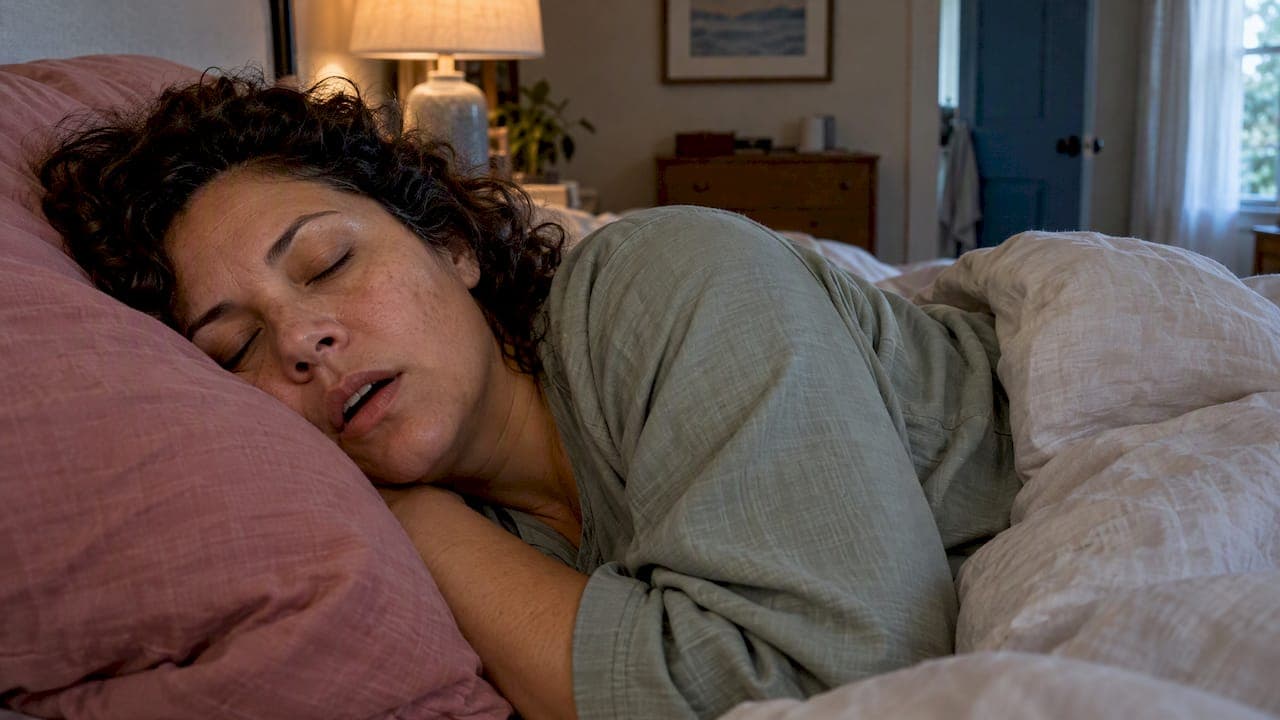
Snoring without sleep apnea is called primary snoring. The tissues at the back of your throat vibrate as you breathe, but your airway does not repeatedly close, so oxygen and sleep quality are not being disrupted the way they are in apnea. It is common, it is often treatable, and for many people the first real step is simple: confirm it is only snoring, then choose a fix that fits your anatomy and habits.
The catch is the word "confirm." Snoring is also the most familiar symptom of obstructive sleep apnea, so the order matters. This guide explains what causes simple snoring, which signs point to a sleep test, what you can change tonight, and where a dentist fits in.
TL;DR
- Primary snoring means noisy breathing during sleep without the repeated airway blockages of sleep apnea. About 150 million US adults snore without apnea.
- Only a sleep physician should rule out apnea. Gasping, witnessed pauses in breathing and heavy daytime sleepiness are reasons to ask for a sleep study first.
- Side sleeping, limiting alcohol near bedtime, weight loss when it applies and treating nasal congestion help many people.
- If those are not enough, a custom oral appliance fitted by a dentist is a well-supported option, and it needs ongoing dental follow-up.
Table of Contents
- What primary snoring actually is
- Why you can snore without having apnea
- When snoring is not "just snoring"
- What you can change at home first
- Where a dentist fits in: oral appliances
- Jaw, grinding and snoring often travel together
- How to decide: a short checklist
- Our perspective at Starboard Dental
- Snoring care at our Kennebunk practice
- FAQ
- Sources
What primary snoring actually is
Snoring is the sound of tissue at the top of the airway striking together and vibrating as air moves past. MedlinePlus describes it as breathing that is partly blocked during sleep. In sleep apnea the airway narrows or closes completely, breathing pauses, and the brain briefly wakes the body to restart it. In primary snoring there is vibration and noise, but no repeated pauses and no steady drop in oxygen.
That does not make it harmless to your life. Loud, frequent snoring can keep you and your bed partner from getting enough sleep, and the same MedlinePlus patient instructions note that it can sometimes be a sign of a more serious breathing problem. A 2024 randomized clinical trial was designed in part because so few studies have looked at how snoring affects sleepiness and quality of life in people who do not have apnea.
Why you can snore without having apnea
Snoring comes down to anything that narrows the space air has to move through, or relaxes the tissue around it. Common contributors include:
- Nasal blockage. Allergies, a cold, chronic congestion or a deviated septum force you to breathe harder and can make the throat tissues flutter.
- Sleeping on your back. Gravity pulls the tongue and soft palate toward the back of the throat.
- Alcohol and sedatives. They relax throat muscles more than usual, so snoring often gets worse on nights you drink in the evening.
- Extra weight. Tissue around the neck and throat can narrow the airway.
- Anatomy. A long soft palate, large tonsils, a large tongue or a recessed lower jaw all reduce airway space.
- Sleep loss. Being overtired can deepen sleep and relax the airway further.
- Age and hormones. Muscle tone changes with age. A 2024 systematic review reports that snoring becomes more common in women after menopause, and that how well a treatment works depends heavily on anatomy, age and other health conditions.
Because the causes overlap, one-size-fits-all advice rarely works. A person who snores only when congested needs something different from a person who snores every night on their back with a small lower jaw.
When snoring is not "just snoring"
This is the part most pages skip past. Researchers who reviewed the evidence on treating primary snoring stress that the diagnosis belongs with a sleep physician. The Australasian Sleep Association position statement is clear that primary snoring should be established by a physician, because treating the noise without checking the cause can hide a serious condition. A dentist can notice the signs, but a dentist should not be the one to declare you apnea-free.
Talk to your primary care doctor and ask about a sleep evaluation if you notice any of these:
- Your partner has seen you stop breathing, choke or gasp during sleep.
- You wake with a dry mouth, a headache or a sense of not having rested, even after a full night.
- You fall asleep during quiet activities in the day, or feel drowsy while driving.
- You have high blood pressure or significant weight gain along with loud nightly snoring.
- You snore loudly every night and it has recently gotten much worse.
If you have already had a sleep study that came back negative for apnea, you are in the group this article is for. If you have never been tested and have several of the signs above, start there.
A note for Maine drivers
Snoring on its own is not what drivers are asked to report. Obstructive sleep apnea with daytime impairment is a different matter, and the Maine Bureau of Motor Vehicles medical rules cover medical conditions that can affect licensing. If you are drowsy behind the wheel, that is a safety issue to raise with your doctor promptly, not something to wait on.
What you can change at home first
Conservative steps are the standard starting point, and several cost nothing. The MedlinePlus guidance on adult snoring lists the main ones.

Change your sleeping position. If you snore mostly on your back, side sleeping can make a real difference. The same source notes that positional therapy suits people who snore mainly when lying face up, though sticking with older mechanical devices over the long term is often poor. A body pillow behind your back is a low-effort first test.
Watch alcohol and sedatives. Avoid them in the hours before bed. If you want to test whether alcohol is a factor, keep a simple note for two weeks: what you drank, when, and how your partner rated the night.
Lose weight if it applies. For people who are overweight, even modest weight loss can reduce tissue crowding around the airway.
Open your nose. If congestion is the issue, internal or external nasal dilators may help. Persistent blockage, especially on one side, is worth an exam by your doctor or an ear, nose and throat specialist, because a deviated septum is a structural problem a strip will not fix.
Protect your sleep. Regular hours and enough hours keep your throat muscles from sagging into deeper, noisier sleep.
Give these a fair trial of a few weeks. If your partner still reports loud snoring, it is reasonable to look at options that act on the jaw and tongue.
Where a dentist fits in: oral appliances
When simple measures fall short, the best-studied dental option is a mandibular advancement device, often called a MAD. It looks like a slim sports mouthguard, but it is custom made from impressions or scans of your teeth. It holds the lower jaw slightly forward during sleep, which opens the space behind the tongue and tightens the tissues that vibrate.
The evidence is encouraging:
- The 2015 joint guideline from the American Academy of Sleep Medicine and the American Academy of Dental Sleep Medicine recommends that sleep physicians prescribe oral appliances rather than no therapy for adults who request treatment for primary snoring. It is a standard-strength recommendation.
- In a 2024 randomized trial of 50 couples, 21 of 23 snorers using a mandibular advancement device (91%) were rated as responders by their bed partners after four weeks. In the group using combined airway and positional therapy, 11 of 19 (58%) were rated responders.
That is a small trial, and results vary person to person. But it explains why this option comes up so often when side sleeping and nasal care are not enough. Our own explainer on the mandibular advancement device walks through what the appliance is and what adults should expect.
What a MAD can and cannot do
| Question | Honest answer |
|---|---|
| Does it quiet snoring? | Often, according to trial and guideline evidence. Not for everyone. |
| Does it diagnose apnea? | No. That takes a sleep physician and a sleep test. |
| Is it removable? | Yes. You wear it at night. |
| Does it need follow-up? | Yes. Fit, comfort and bite changes should be checked over time. |
| Who may not be a good candidate? | People with significant gum disease, loose teeth, or jaw joint problems usually need those addressed first. |
Side effects worth knowing before you start
The trial authors note that a good treatment decision weighs convenience, side effects such as temporary jaw pain or tooth movement, and cost. Over the long term the dental changes can add up. In a study that followed 77 patients for an average of 11 years of mandibular splint therapy, researchers measured progressive changes in the bite, including reductions in overbite and overjet. The changes did not simply level off.
None of that means the appliance is a bad idea. It means it should be monitored by a dentist who looks at your bite regularly and adjusts or stops the device if your teeth are shifting in a way you do not want. Earlier research on dental side effects of an oral device found the same pattern: most people tolerate it, and some notice bite or comfort changes that follow-up visits can catch.
Jaw, grinding and snoring often travel together
People who snore are often also clenching or grinding at night, or waking with a sore jaw. These are separate problems with overlapping causes, and a good exam looks at them together. If you wake with a tight jaw, our pages on teeth grinding and the common causes of bruxism explain what dentists check before suggesting a night guard. If clicking is the main complaint, see our article on jaw clicking without pain, and for ongoing soreness our guide to TMJ pain treatment that starts with self care. This matters because an appliance that moves your jaw forward has to be planned around the health of the jaw joint, not just the noise.
How to decide: a short checklist
Use this before you book anything.
- Rule out apnea. If you have warning signs or have never been evaluated, see your doctor about a sleep study first.
- Try the basics for a few weeks. Side sleeping, less evening alcohol, nasal care.
- Have your partner rate the result. The trial above used bed partners' ratings because snorers rarely hear themselves accurately.
- Get a dental exam. Healthy gums, stable teeth and a comfortable jaw joint make an appliance far more likely to work.
- Plan the follow-up. Ask how often your bite will be rechecked and what happens if your teeth shift.
- Discuss cost and coverage. Ask your dental or medical insurer what it covers and what documentation it needs.
Our perspective at Starboard Dental
We see snoring from the dental chair, and the most important thing we can say is where our job stops. We do not diagnose sleep apnea. If something in your history or your partner's description suggests it, we will point you toward your physician and a sleep evaluation before we talk about a device. That order protects you.

Once apnea has been ruled out, we think snoring deserves more attention than it gets. Many patients treat it as a joke or a nuisance, and yet it can cost both partners sleep. Looking at your airway, your bite, your jaw joints and any grinding together is where a general dental practice adds real value, because we already examine all of them at checkups.
We also believe a device should never be a set-and-forget purchase. Oral appliances move teeth a little, and the long-term research bears that out. So we build follow-up into the plan and treat comfort as part of the treatment. Many of our patients arrive anxious about dentistry, and we would rather have you tell us honestly that something feels off than quietly stop wearing it. If a fix is not working, we would rather adjust it or send you back to your physician than keep a device in your mouth that is not helping.
— Alex
Snoring care at our Kennebunk practice
Starboard Dental offers sleep apnea and snoring care for patients in Kennebunk and the surrounding area, including York and Saco. We look at your bite, gums, teeth and jaw joints, use digital scanning for precise impressions, and talk through whether an oral appliance makes sense for you. If your history suggests you need a medical sleep evaluation first, we will say so. You can start with a general dentistry exam, and we offer same-day appointments when your schedule needs it. We also provide night guards for grinding.
FAQ
How do you stop snoring if you don't have sleep apnea?
Start with side sleeping, avoiding alcohol and sedatives before bed, treating nasal congestion and losing weight if it applies. If snoring continues, a custom oral appliance is the best-studied dental option, and guidelines support it for primary snoring. Check with your doctor first to confirm it really is primary snoring.
Why is my snoring so loud but I don't have sleep apnea?
Loudness depends on how narrow the airway is and how much tissue vibrates, not on whether you have apnea. Congestion, back sleeping, alcohol, anatomy and age can all make snoring louder. If you have never had a sleep study, loud snoring alone is a good reason to ask for one.
Can snoring without apnea still be harmful?
It may not cause the oxygen drops of apnea, but it can break up your sleep and your partner's. Research also treats its effect on daytime sleepiness and quality of life as an open question worth studying. New or worsening snoring, gasping or heavy daytime sleepiness should be checked by a physician.
Can a dentist treat snoring?
Yes, once a physician has ruled out sleep apnea or has recommended an oral appliance. A dentist can fit a custom mandibular advancement device, check your bite and jaw joints, and monitor tooth movement over time. A dentist should not make the sleep apnea diagnosis.
Is snoring more common after menopause?
A 2024 systematic review reports that snoring prevalence rises in women after menopause, likely due to hormonal changes. Because causes and responses vary, it is worth getting an individual assessment rather than relying on generic remedies.
Sources
- Mandibular Advancement vs Combined Airway and Positional Therapy for Snoring: A Randomized Clinical Trial
- Clinical Practice Guideline for the Treatment of Obstructive Sleep Apnea and Snoring with Oral Appliance Therapy: An Update for 2015
- Australasian Sleep Association position statement on treatment for primary snoring
- Snoring in adults: MedlinePlus patient instructions
- Snoring: MedlinePlus
- Systematic review on snoring in women, 2024
- Obstructive sleep apnea and mandibular advancement splints: occlusal effects over a decade of treatment
- Dental side effects of an oral device to treat snoring and obstructive sleep apnea