
Most people with TMJ pain should start with conservative self-care and targeted jaw exercises, which ease symptoms for the majority of patients within weeks to months. That means a soft diet, heat or ice, stress reduction, and simple stretches before anything involving needles, drugs, or surgery. See a dentist or doctor sooner if you can't open your mouth, the pain is getting worse fast, or you notice swelling, fever, or a sudden change in how your teeth fit together.
TL;DR:
- Most TMJ pain can be eased through a soft diet, heat or ice application, and habit changes like avoiding gum or resting the jaw, with many experiencing improvement within weeks.
- In cases of severe symptoms such as inability to open the mouth or worsening pain, prompt evaluation by a dentist or doctor is necessary, especially if signs of infection or structural changes appear.
- Proper use of self-care exercises, including jaw stretches and posture training, is crucial and may take around two weeks of consistent effort to assess effectiveness.
- Injections, medications, or appliances like night guards should be considered only after conservative methods have been tried, and they work best as part of a comprehensive treatment plan.
- Long-term relief depends on addressing triggers like stress and habits, with most cases showing significant improvement with non-invasive, sustained self-care and physical therapy.
Table of Contents
- What Is TMJ Pain and What Causes It?
- Self-Care and Home Remedies for TMJ Pain
- Exercises and Physical Therapy for TMJ Pain
- Medications and Clinician-Delivered Injections
- Oral Appliances and Night Guards: What They Can and Cannot Do
- Nonpharmacological Therapies: Acupuncture, Laser, and Massage
- When to See a Clinician and Who to Consult
- What to Expect: Timeline and Prognosis for Conservative Care
- How to Decide What to Try Next
- How Starboard Dental Approaches TMJ Evaluation and Care
- The Real Gap in Most TMJ Advice
- Ready to Get Your Jaw Pain Evaluated?
- Sources
- FAQ
What Is TMJ Pain and What Causes It?
TMJ pain refers to discomfort in the temporomandibular joint, the hinge connecting your jawbone to your skull just in front of each ear. Clinicians usually call the broader condition temporomandibular disorder, or TMD, since the pain often involves the surrounding chewing muscles as much as the joint itself. You'll see both terms used interchangeably online, but TMD is the standard clinical name you'll hear from a dentist or specialist.
The causes are rarely singular. Clenching or grinding your teeth (bruxism), a bad bite, arthritis in the joint, a direct injury to the jaw, or simply chronic stress can all set it off. Stress deserves more attention than it usually gets: people under psychological strain clench their jaw muscles without noticing, and that sustained tension is a major driver of flare-ups. Symptoms typically include a dull ache near the ear, clicking or popping when you open your mouth, headaches, and in some cases a jaw that locks or catches.
TMJ pain also overlaps with other orofacial pain conditions, which is why self-diagnosis can go wrong. Trigeminal neuralgia, sinus infections, ear infections, and even dental abscesses can mimic jaw pain closely enough to fool you. If your pain is sharp, electric, or one-sided with no clicking and no jaw movement trigger, that's a signal it might not be TMJ at all, and a dentist or physician needs to rule out those other causes before you spend weeks on jaw exercises for the wrong problem.
The encouraging part: most signs and symptoms improve over time with a conservative, multimodal approach, and more invasive procedures only get considered after that approach has genuinely failed. That's the framework this entire article follows.
Self-Care and Home Remedies for TMJ Pain
Home care isn't a stopgap while you wait for a real treatment. It's the actual first-line treatment, and it works for the majority of people who stick with it.
Change what and how you chew. Switch to a soft diet for a week or two: eggs, yogurt, soup, mashed potatoes, fish, cooked vegetables. Skip anything that demands wide jaw opening or heavy grinding, like bagels, raw carrots, tough steak, or whole apples. Cut food into smaller pieces so you never have to stretch your jaw wide to take a bite.

Break the habits that overload the joint. Chewing gum is one of the worst offenders because it keeps the jaw muscles working for hours at a time with no rest. Nail-biting, pen-chewing, and resting your chin on your hand all add unnecessary strain. Try to keep your teeth slightly apart during the day, tongue resting gently on the roof of your mouth, which relaxes the jaw muscles instead of letting them idle in a clenched position.
Use temperature therapy correctly. Applying moist heat or a cold pack for 15 to 20 minutes, several times a day, is a core piece of TMJ home management. Ice works best in the first 24 to 48 hours after a flare, when swelling and acute pain dominate. Once the sharp edge fades, switch to moist heat, which relaxes tight muscles and improves blood flow to the joint. A washcloth run under hot water and wrapped in a thin towel works as well as anything you'd buy.
Take basic anti-inflammatories short term. Over-the-counter NSAIDs like ibuprofen, or acetaminophen if NSAIDs aren't an option for you, can knock down pain and inflammation enough to let the other self-care steps do their job. Stick to the labeled dosing and don't run NSAIDs for more than about a week or two without checking with a clinician, since long-term use carries stomach and kidney risks.
Here's a quick reference for the habit changes that matter most:
- Eliminate gum chewing entirely during a flare, not just "less often."
- Keep a soft-food rotation ready so you're not tempted by crunchy snacks.
- Practice the "teeth apart, tongue up" resting position throughout the day.
- Avoid resting your jaw on your hand or holding a phone between shoulder and ear.
- Apply ice in the first two days of a flare, then switch to moist heat.
Pro Tip: Set a phone reminder every two hours for the first few days of a flare. Most people don't realize how often they're clenching until they're forced to check in with their jaw on a schedule.
Exercises and Physical Therapy for TMJ Pain
Jaw exercises retrain the muscles around the joint the same way physical therapy retrains a bad knee. Physical therapy modalities, including stretching and posture training, can improve range of motion, though how much they reduce pain varies by person and by technique.
Here's how to do the exercises that tend to matter most:
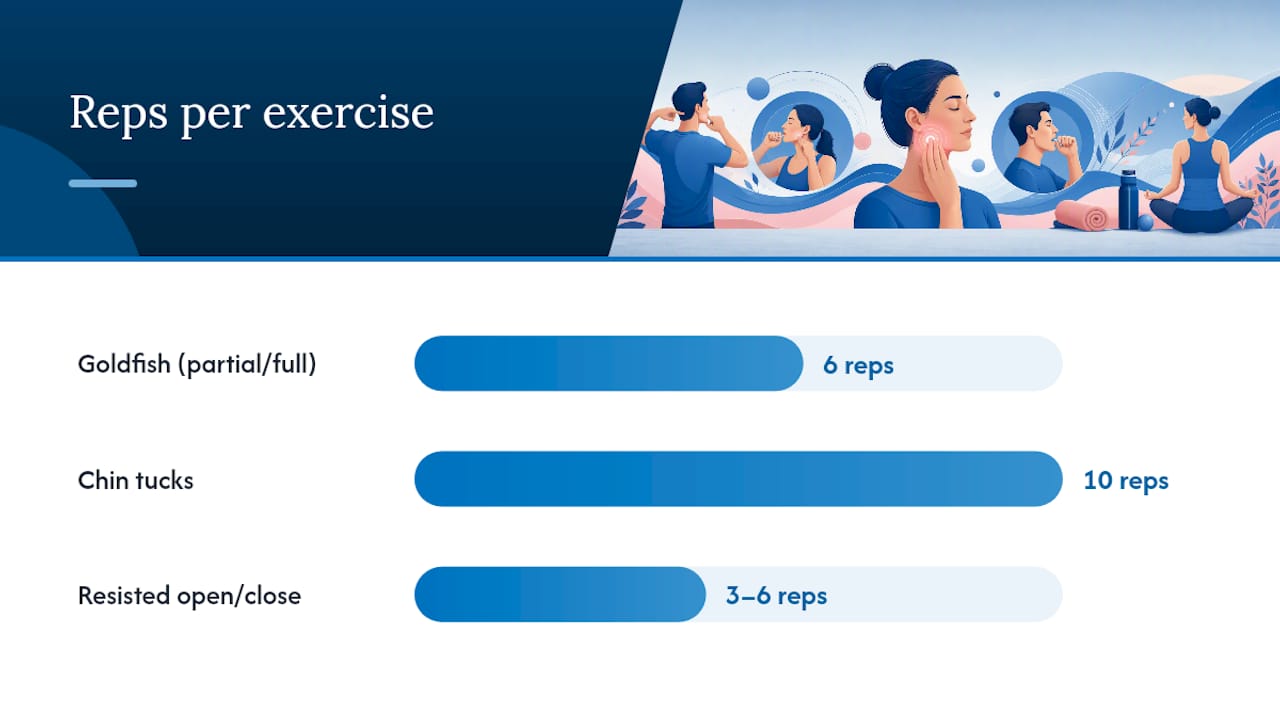
- Goldfish exercise (partial opening). Place your tongue on the roof of your mouth, one finger on the joint in front of your ear, one finger on your chin. Drop your lower jaw halfway and close. Do six reps, six times a day.
- Goldfish exercise (full opening). Same finger placement, but this time open your mouth all the way, hold for a second, then close slowly. Six reps, six times a day, paired with the partial version.
- Chin tucks. Pull your chin straight back, creating a double chin, and hold for three seconds. This resets jaw and neck posture, which are more connected than most people expect. Ten reps, several times daily.
- Resisted opening and closing. Put your thumb under your chin and gently push upward as you try to open your mouth against that resistance. Then press two fingers against your chin and try to close against resistance. Three to six reps each direction.
- Side-to-side and forward jaw glides. Place a tongue depressor or your finger between your front teeth for reference, then slide your lower jaw left, right, and slightly forward, holding each position for a few seconds.
Do the full set once or twice daily, and never push into sharp pain. Mild stretching discomfort is expected; a jaw that locks up harder afterward is your cue to back off. Give any single exercise about two weeks before deciding whether it's helping, since jaw muscles retrain slowly.
Pro Tip: Do the goldfish exercises in front of a mirror for the first week. Most people move their jaw slightly sideways without realizing it, which trains the muscles unevenly and can make clicking worse instead of better.
If pain persists past two to three weeks of consistent exercise, or your range of motion isn't improving, ask your dentist for a referral to a physical therapist who specializes in orofacial conditions, or to an orofacial myofunctional therapist. These specialists can spot compensation patterns (like using your neck muscles to open your mouth) that you'd never catch on your own, and they can build a program around your specific joint mechanics rather than a generic exercise sheet.
Medications and Clinician-Delivered Injections
Acetaminophen and NSAIDs remain the first-line pharmacologic options for TMJ-related pain, and for most flare-ups, that's as far as medication needs to go. Ibuprofen or naproxen at standard over-the-counter doses, taken with food to protect your stomach, covers both the pain and the inflammation driving it.
When self-care and OTC options aren't enough, a clinician has a few more tools available:
- Short-term muscle relaxants for cases where muscle spasm, not joint inflammation, is the main driver. These are typically prescribed for a limited window, not ongoing use, because of sedation and dependency concerns.
- Intra-articular steroid injections, delivered directly into the joint space, which can reduce inflammation in more stubborn cases but come with limits on how often they can be safely repeated.
- Hyaluronic acid injections, sometimes used to improve joint lubrication, though the evidence supporting long-term benefit is mixed.
- Botulinum toxin injections for myofascial jaw pain, aimed at relaxing overactive chewing muscles.
That last one deserves a caveat. Botulinum toxin gets a lot of attention online as a TMJ fix, and it can help some patients with muscle-driven clenching pain, but clinical evidence for it and other nonpharmacological options tends to show short-term relief more often than a durable cure. It's not a first choice, and it's typically reserved for people who haven't responded to the more conservative steps above.
Any of these clinician-delivered options should be a later step, not a starting point. Reserving injections and surgical options for selected cases, after conservative measures have had a fair trial, keeps you from taking on procedural risk you may not need.
Stress and anxiety are worth naming directly here, because they're often the reason medication alone doesn't fully resolve symptoms. Muscle-relaxant prescriptions treat the clenching, but they don't treat the reason you're clenching. If stress is a clear trigger for your flares, addressing it, through counseling, cognitive behavioral techniques, or even basic sleep and workload changes, often does more for long-term control than another prescription would.
Oral Appliances and Night Guards: What They Can and Cannot Do
A custom night guard reduces the muscle strain from nighttime clenching and grinding, which for many people is the single biggest driver of morning jaw soreness. It works by keeping your teeth from grinding directly against each other and by changing how the jaw muscles engage during sleep.
What it does not do is guarantee pain relief. Splints may help some patients, but results are variable, and a guard that fits poorly or gets worn for years without follow-up can actually shift your bite over time. That's a real risk, not a theoretical one: long-term, improperly managed appliance use is a recognized cause of unintended bite changes.
Here's what a responsible trial of a night guard should look like:
- Get it custom-fitted by a dentist rather than buying a boil-and-bite version from a drugstore, since a poor fit can make clenching worse instead of better.
- Start with a defined trial period, typically a few weeks to a couple of months, rather than open-ended nightly use with no check-in.
- Schedule a follow-up visit so your dentist can check for shifts in your bite or joint symptoms before you commit to long-term wear.
- Pair the guard with the self-care and exercise steps above rather than treating it as a standalone fix.
- Ask your dentist to rule out other bruxism triggers, like sleep apnea, before assuming a guard alone will solve the problem.
If you've been told you grind your teeth but no one has asked about your sleep quality, that's worth raising. Bruxism often has an underlying cause that a guard alone won't address, including sleep-disordered breathing, which is common enough that dentists increasingly screen for it before fitting an appliance. A night guard fitted through general or restorative dental care works best as one piece of a broader plan, not the entire plan.
Nonpharmacological Therapies: Acupuncture, Laser, and Massage
Acupuncture, low-level laser therapy, physiotherapy, and massage all show up regularly in TMJ treatment discussions, and the honest answer is that the evidence for them is real but limited. Systematic reviews find moderate short-term benefits for these approaches, but the overall quality of the underlying studies is low, and long-term effects are inconsistent.
That doesn't mean skip them. It means set your expectations correctly: these are adjuncts that can take the edge off pain and muscle tension, not standalone cures.
- Acupuncture typically runs in a course of six to twelve sessions, once or twice weekly, targeting points around the jaw and neck. Some patients report noticeable relief within the first few sessions.
- Low-level laser therapy is usually delivered in short in-office sessions, often two to three times a week for several weeks, aimed at reducing localized inflammation.
- Massage and manual therapy can be done by a trained therapist or, to a lesser degree, self-administered on the masseter and temple muscles daily.
- TENS (transcutaneous electrical nerve stimulation) uses low-level electrical current to interrupt pain signals and is sometimes used alongside physical therapy sessions.
Cost and access vary widely by provider and region, and insurance coverage for these therapies is inconsistent, so ask upfront what a course will run before committing to a multi-week plan. Look for a provider with specific training in orofacial or TMJ-related treatment rather than a general practice, since technique matters more here than in most massage or acupuncture applications.
When to See a Clinician and Who to Consult
Certain symptoms mean you shouldn't wait out a few weeks of home care before getting evaluated.
- Inability to open your mouth normally, or a jaw that locks open or closed, needs same-week evaluation.
- Rapidly worsening pain that isn't responding at all to rest, ice, or OTC medication over several days.
- Signs of infection, including fever, swelling, or redness near the jaw, which need urgent attention rather than a wait-and-see approach.
- A sudden change in how your teeth fit together when you bite down, which can signal a structural problem beyond simple muscle strain.
For anything short of those red flags, your dentist or primary care provider is the right first call. A dentist can examine your bite, check for joint sounds, palpate the chewing muscles, and rule out dental causes like an abscessed tooth masquerading as jaw pain. If symptoms persist past several weeks of conservative care, ask for a referral to an orofacial pain specialist, an oral and maxillofacial surgeon (OMFS), an ENT if ear symptoms are prominent, or a physical therapist for a more structured PT protocol.
Imaging isn't the first step for most people. A clinician will usually start with history and a hands-on exam; MRI or CT scans get ordered when there's suspicion of structural joint damage, a suspected fracture, or when conservative treatment has failed and a clinician needs a clearer picture before considering injections or surgery. If your dentist recommends imaging, it's a sign they're being thorough, not a sign your case is unusually severe.
What to Expect: Timeline and Prognosis for Conservative Care
The numbers here are genuinely encouraging. Conservative, non-invasive treatment reduces symptoms in 50% to 90% of patients, with many people experiencing significant relief within about three months. That's a wide range because TMJ presentations vary enormously, from a mild ache after a stressful week to years of chronic muscle tension, but it tells you the odds favor improvement if you actually do the work of self-care and exercises consistently.
There's a meaningful difference between an acute flare and chronic TMD, and it changes what you should expect:
- Acute flares, often triggered by a stressful period, an injury, or a stretch of heavy clenching, tend to respond fastest to self-care and usually settle within days to a few weeks.
- Chronic TMD, present for months or years, responds more slowly and often needs the fuller stepwise approach: exercises, PT, possibly a night guard, and ongoing habit management rather than a single fix.
- Recurrence is common even after improvement, particularly when stress returns or old habits like gum chewing creep back in.
If you're three months into consistent conservative care with no meaningful change, that's the point to reassess rather than keep repeating the same routine. Realistically, the goal for most people isn't a permanent, guaranteed cure. Many cases are self-limiting, and the honest target is symptom control and functional improvement, not eliminating every trace of joint noise or occasional tightness for good.
How to Decide What to Try Next
Treatment for TMJ pain follows a logical order, and skipping steps rarely pays off. Here's the pathway most evidence-based approaches follow, and how to know when it's time to move to the next stage.
- Start with self-care for two to four weeks. Soft diet, heat or ice, habit changes, and gentle jaw rest. If pain is trending down even slightly, keep going.
- Add structured exercises if self-care alone plateaus. Give the goldfish, chin tuck, and resistance exercises a consistent two-week trial before judging whether they're helping.
- Bring in short-term medication or a night guard if pain or nighttime clenching persists. This is the point to loop in your dentist for a proper evaluation rather than continuing to self-manage blind.
- Consider adjunct therapies (acupuncture, laser, massage) if muscle tension is the dominant issue and the steps above haven't fully resolved it.
- Discuss injections or, in rare refractory cases, surgery only after conservative options have had a genuine, sustained trial. Irreversible procedures should be reserved for cases that don't respond to reversible care, not offered as a shortcut.
Time and function are your two decision markers at every step: if a stage isn't improving your pain or your jaw's range of motion after a reasonable trial (generally two to six weeks depending on the intervention), that's your signal to advance, not to keep waiting.
Pro Tip: Before agreeing to any irreversible procedure, ask your clinician three questions: What conservative options haven't we tried yet? What's the expected success rate for my specific case? And what happens if this procedure doesn't work? A clinician confident in the recommendation will have straightforward answers to all three.
How Starboard Dental Approaches TMJ Evaluation and Care
At Starboard Dental in Kennebunk, a TMJ evaluation starts the way it should: a detailed history of your symptoms, a hands-on exam of the jaw joint and chewing muscles, and imaging only when the exam suggests it's actually needed. That order matters, because jumping straight to scans without a proper clinical exam misses the muscle tension and habit patterns that cause most cases in the first place.
From there, care tends to start conservative. That can mean a custom-fitted night guard, guided instruction on the jaw exercises covered above, or a referral out if symptoms point toward a specialist. Evaluations are available for patients dealing with an active flare who don't want to wait weeks for a first look.
Because dental anxiety is common with any jaw-related complaint, comfort touches and a warm and low-pressure atmosphere aim to make a TMD evaluation feel less clinical and more manageable, especially for patients who've been putting off getting checked out.
The Real Gap in Most TMJ Advice
Most TMJ content online oversells certainty in both directions. Either it promises a permanent fix that doesn't match how self-limiting many cases actually are, or it jumps straight to injections and surgery as though conservative care is a formality to get through quickly. Neither serves the reader.
What the evidence actually supports is less exciting but more useful: consistent, boring self-care and exercise, done for weeks rather than days, resolves or meaningfully improves the condition for most people. The conventional advice fails by underselling how much stress and habit patterns drive flare-ups, treating TMJ as a purely mechanical joint problem when it's often a muscle and behavior problem wearing a joint problem's symptoms.
If you take one thing from this, prioritize the unglamorous stuff first: soft diet, heat, the goldfish exercise, and an honest look at whether stress is behind your clenching. Save the appliances and injections for when that groundwork has genuinely been given a fair trial, not skipped because it felt too slow.
— Alex
Ready to Get Your Jaw Pain Evaluated?
If home care and exercises haven't settled things after a few weeks, or you're not sure whether what you're feeling is even TMJ, getting a proper evaluation beats guessing. Patients seeking a practical next step for diagnosis can find options with evaluations available to avoid waiting weeks while a flare-up goes unassessed.

A visit typically starts with a conversation about your symptoms, a hands-on jaw exam, and a look at your bite and joint sounds, followed by a plan that starts conservative: exercise coaching, a custom night guard if nighttime clenching is driving your pain, or a referral if something more specialized is warranted. Bring notes on when your pain flares, what makes it better or worse, and whether you've noticed clenching or grinding, since that history speeds up an accurate diagnosis. Explore TMD care options or the full general dentistry offering, and book an evaluation to get a clear answer instead of another few weeks of uncertainty.
Sources
- Temporomandibular Syndrome — NCBI Bookshelf
- Nonpharmacological Interventions for Pain in Patients with Temporomandibular Joint Disorders: A Systematic Review — PMC
- Temporomandibular Joint (TMJ) Syndrome Treatment & Management — Medscape
- Temporomandibular Syndrome — MedlinePlus Medical Encyclopedia
This article is general information, not a substitute for advice from a qualified doctor. Consult a qualified healthcare professional about your own circumstances before acting on anything here.
FAQ
How Can I Relieve TMJ Pain at Home?
Start with a soft diet, apply moist heat or ice for 15 to 20 minutes several times a day, and cut out gum chewing and other habits that overwork the jaw. Conservative home care resolves or significantly improves symptoms for most patients, especially when paired with gentle jaw exercises like the goldfish stretch.
What Triggers a TMJ Flare-Up?
Stress-driven clenching or grinding is the most common trigger, often worsened by gum chewing, nail-biting, poor posture, or eating tough, chewy foods. Cold weather, a recent dental procedure, or a stretch of poor sleep can also set off a flare in people already prone to jaw tension.
What Doctor Should I See for Jaw Pain?
Start with your dentist, since they can examine your bite, joint, and chewing muscles and rule out dental causes in the same visit. If symptoms persist, ask for a referral to an orofacial pain specialist, an oral and maxillofacial surgeon, or a physical therapist trained in jaw disorders.
Is TMJ a Chronic Illness?
TMJ disorder can be either short-lived or chronic, depending on the cause and how it's managed. Many cases are self-limiting and improve substantially with conservative care, though some people experience recurring flares tied to stress or ongoing clenching habits that need long-term management rather than a one-time fix.