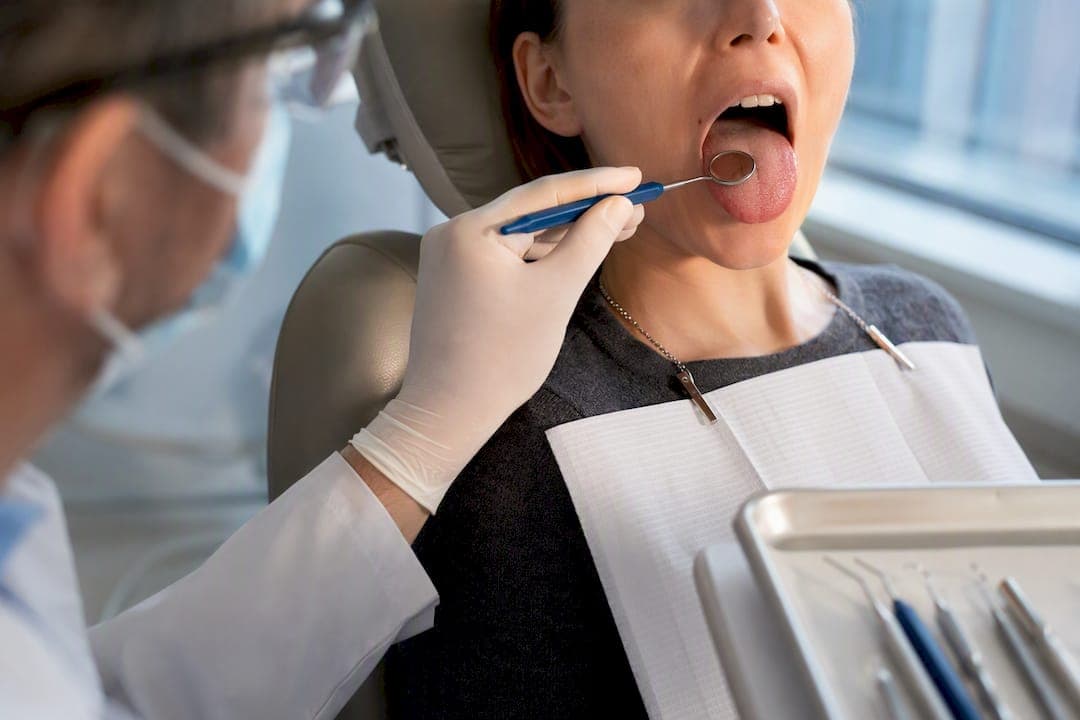
Most bad breath starts in the mouth, not the stomach or the lungs. Bacteria coating your tongue and hiding in gum pockets produce sulfur compounds that create the odor, and for about 80 to 85% of cases, that's the whole story. The immediate fix is better mechanical cleaning, brushing, flossing, and scraping your tongue, and if the smell doesn't clear up after one to two weeks of doing that consistently, book a dental exam.
TL;DR:
- Most bad breath originates from bacteria on the tongue and gum pockets, with the back third of the tongue being the most common reservoir.
- Poor oral hygiene, dry mouth, and dental appliances significantly contribute to bacterial buildup and odor, which standard brushing often misses.
- Systemic illnesses like diabetes, kidney, or liver issues produce distinctive odors, but they are much less common and usually accompanied by other symptoms.
- A professional diagnosis involves breath smell analysis, tongue scraping, and dental examination to identify the oral cause before considering medical testing.
- Consistent daily routines, including brushing, flossing, tongue cleaning, and cleaning dental devices, typically eliminate most oral bad breath within one to two weeks.
Table of Contents
- What Are the Main Bad Breath Causes Inside Your Mouth?
- When Is Bad Breath a Sign of Something Beyond Your Mouth?
- How Do Dentists Figure Out What's Causing Bad Breath?
- What Home Care and Professional Treatments Actually Work?
- A Dentist's-Eye View: What We Check First
- Can Diet or Fasting Cause Bad Breath Even Without "Smelly" Foods?
- How Bad Breath Affects Confidence and Relationships
- What Are the Biggest Myths About Bad Breath?
- What Foods, Habits, and Medications Cause Bad Breath?
- When Should You Get Medical Testing for Bad Breath?
- What Role Do Oral Bacteria Play in Causing Bad Breath?
- Practical Reassurance From a Clinical Standpoint
- How Starboard Dental Can Help You Get to the Bottom of It
- Sources
- FAQ
What Are the Main Bad Breath Causes Inside Your Mouth?
Bad breath happens when anaerobic bacteria break down proteins from food debris, dead cells, and saliva. That process releases volatile sulfur compounds, mainly hydrogen sulfide and methyl mercaptan, the same family of compounds responsible for the smell of rotten eggs. These bacteria thrive in low-oxygen environments, which is exactly what your tongue's surface and the space under your gumline provide.
The back third of your tongue is the biggest offender. Its rough, papillated surface traps food particles, mucus, and dead cells, creating a biofilm that's hard to disturb with a toothbrush alone. Tonsil stones, small calcified clusters that form in the tonsil crypts, add to this reservoir and sometimes fall out on their own, releasing a noticeable smell when they do.
Gum disease is the other major driver. Periodontal pockets, the gaps that form between teeth and gums as disease progresses, give anaerobic bacteria a sheltered place to multiply undisturbed by brushing. Untreated cavities and old, cracked, or poorly sealed fillings work the same way: they trap food and bacteria in spots your toothbrush can't reach.
Common intraoral sources include:
- Posterior tongue coating (the single most overlooked cause in people with otherwise decent hygiene)
- Periodontal disease and deep gum pockets
- Untreated cavities or defective restorations
- Tonsil stones
- Dentures, retainers, or aligners that aren't cleaned daily or that fit poorly
Dental appliances deserve their own mention. Dentures that sit in a cup overnight without proper cleaning accumulate the same bacterial biofilm as natural teeth, and an ill fitting denture creates friction sores that add their own odor. Braces and clear aligner trays trap plaque against enamel in spots a regular toothbrush skips, which is why orthodontic patients often notice breath changes within the first few weeks of treatment.
When Is Bad Breath a Sign of Something Beyond Your Mouth?
Sometimes the odor's source sits outside the oral cavity entirely, and the breath signature usually gives it away. Sinusitis and chronic postnasal drip produce a smell that's often stronger through the nose than the mouth, paired with congestion, facial pressure, or thick mucus draining down the throat. Tonsillitis creates a more localized odor, frequently with visible white patches or swelling on the tonsils themselves.
Metabolic and systemic conditions cause distinctive, almost unmistakable odors. Uncontrolled diabetes in ketoacidosis produces a fruity or acetone-like smell. Kidney failure can leave breath smelling like ammonia or urine, and liver failure sometimes produces a musty, slightly sweet odor clinicians call fetor hepaticus. These systemic causes are real but far less common than oral ones, and they rarely show up without other symptoms like fatigue, excessive thirst, swelling, or confusion.
Gastrointestinal causes get blamed constantly, but true GI sources of chronic bad breath are uncommon. Conditions like GERD or an esophageal diverticulum (a small pouch where food can get trapped) can contribute, and they typically come with regurgitation, chronic coughing, or a sour taste, not just isolated odor. If you don't have those accompanying symptoms, the stomach probably isn't your problem.
How Do Dentists Figure Out What's Causing Bad Breath?
Diagnosing halitosis follows a fairly standard sequence, and it starts with something surprisingly low tech.
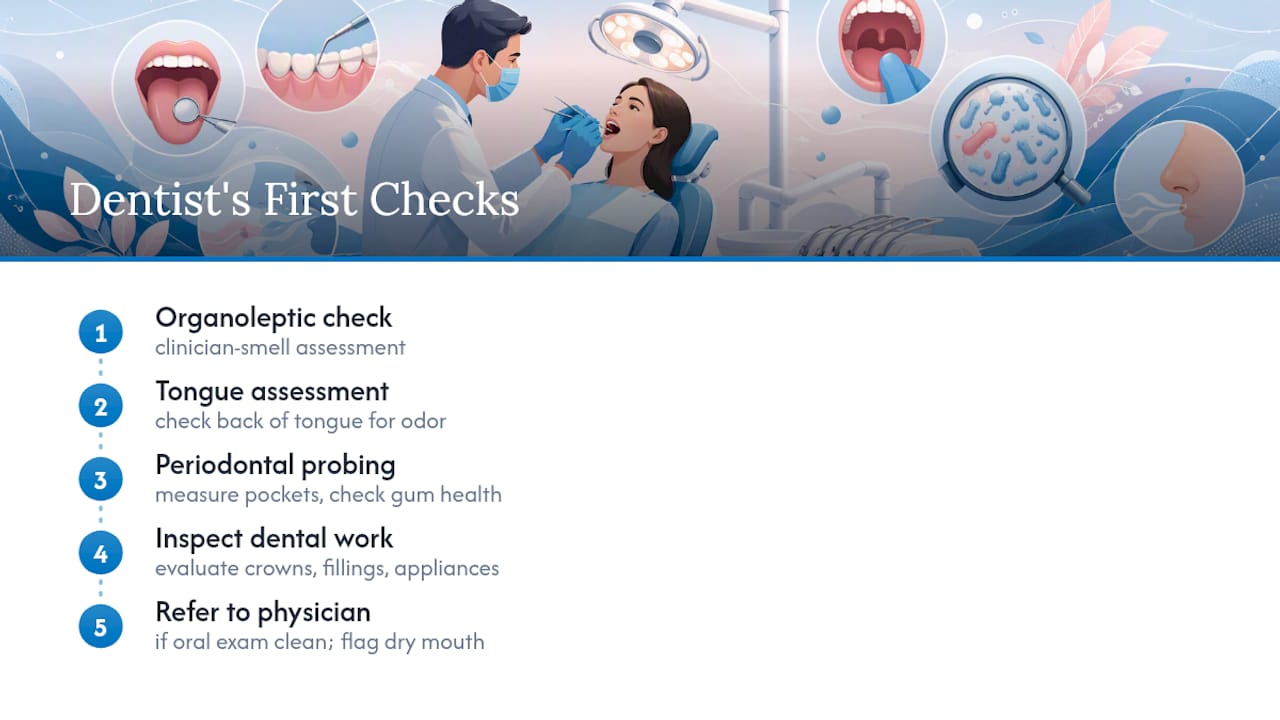
- Organoleptic evaluation. The clinician smells your breath from both your mouth and your nose separately, a method that sounds informal but remains the clinical gold standard for localizing odor source. A smell that's stronger from the mouth points to an oral cause; stronger from the nose points toward sinus or nasal involvement.
- Posterior tongue scraping and sniff test. Scraping the back of the tongue and smelling the residue helps confirm whether the tongue itself is the reservoir, which it often is even in patients who brush and floss diligently.
- Full dental exam. This covers periodontal probing for pocket depth, checking for cavities and failing restorations, and assessing denture or appliance fit. A professional cleaning at this visit often serves as both diagnosis and treatment.
- Medical referral when indicated. If the exam rules out oral causes, or if symptoms point toward sinus disease, a metabolic condition, or a lung or GI issue, the dentist refers out to the appropriate physician.
That structured process is why persistent bad breath deserves an actual visit, not another round of guessing with mouthwash.
What Home Care and Professional Treatments Actually Work?
Fixing bad breath comes down to a short list of habits that outperform almost everything else on the market, plus knowing when a home routine isn't enough.
Your daily routine should include:
- Brushing twice a day with fluoride toothpaste, at least two minutes each time
- Flossing once daily to disrupt plaque between teeth, where a brush can't reach
- Scraping or brushing your tongue, focusing on the back third, not just the tip
- Cleaning dentures, retainers, or aligners every day with the appropriate solution, not just rinsing them
Pro Tip: Angle your tongue scraper as far back as you can comfortably reach without triggering a gag reflex, then work forward in one smooth motion. Most people stop halfway and miss the exact spot where odor-causing bacteria concentrate most heavily.
When home care isn't enough, professional treatment closes the gap. Scaling and root planing removes the hardened plaque and bacteria that hide below the gumline in periodontitis. Fillings and crown replacements eliminate the traps created by decay or failing restorations. Denture adjustments fix the friction points and gaps where bacteria collect.
Dry mouth deserves its own strategy. Saliva rinses bacteria and food debris away naturally, so when saliva flow drops, whether from medication side effects, mouth breathing, or an underlying condition, odor tends to follow. Staying hydrated, using saliva substitutes, chewing sugar free gum, and reviewing your medication list with your prescriber can all help. For more persistent cases, our guide to dry mouth treatment options walks through when over-the-counter measures stop being enough.
As for mouthwash: it's not useless, but it's not a fix either. Rinses mask odor temporarily, and antimicrobial formulas like chlorhexidine can reduce bacterial counts, but they work best as an add-on to brushing and flossing, not a replacement for them.
A Dentist's-Eye View: What We Check First
In practice, the tongue gets checked before almost anything else. Patients who floss religiously but skip tongue cleaning are some of the most common cases we see for persistent odor, because the back of the tongue is easy to ignore and hard to reach.
On a same-day visit for bad breath, the routine is simple: organoleptic check, tongue assessment, periodontal probing, and a look at any existing dental work or appliances. If everything oral checks out clean and the smell persists, that's the signal to loop in a physician rather than keep experimenting with rinses at home. Dry mouth from medication is flagged early, since it's often the quiet variable behind cases that otherwise look mysterious.
Can Diet or Fasting Cause Bad Breath Even Without "Smelly" Foods?
Yes, and this trips people up because they assume odor only comes from garlic or onions. Any extended gap without eating changes your breath chemistry. Low-carb and ketogenic diets push your body into ketosis, where it burns fat for fuel and produces ketones, including acetone, as a byproduct. Some of that acetone gets released through your breath, giving it a distinct, slightly sweet or nail-polish-remover smell that has nothing to do with oral bacteria.
Fasting works the same way. Skip meals for long enough and saliva production drops along with the natural chewing and swallowing action that normally clears bacteria and food debris. Less saliva means less rinsing, which means more concentrated bacterial activity and stronger odor, independent of anything you ate.
Dehydration compounds both effects. A dry mouth from low fluid intake reduces the same protective saliva flow, so odor tends to spike during hot weather, illness, or simply forgetting to drink enough water during a busy day.
The fix here isn't complicated: drink water consistently through the day, don't go long stretches without eating if you're prone to this, and if you're deliberately doing a low-carb diet, treat tongue cleaning and hydration as non-negotiable parts of your routine rather than an afterthought. This kind of bad breath usually resolves within a day or two of returning to normal eating patterns, which is a useful clue that it's diet-driven rather than a sign of gum disease or something more serious.
How Bad Breath Affects Confidence and Relationships
Chronic bad breath carries a social weight that's easy to underestimate until you've lived with it. People with persistent halitosis often report pulling back from close conversations, avoiding situations that involve standing near others, or constantly monitoring their own breath in a way that becomes exhausting. It's a specific kind of self-consciousness that doesn't show up in most conversations about oral health but shapes daily behavior in a real way.
There's also a strange social dynamic worth naming directly: close friends and family members are often the last people to say anything. Most people find it awkward to tell someone their breath smells, so the person dealing with it can go months or years without honest feedback, which only deepens the anxiety once they do find out or start suspecting it themselves.
The most effective way out of that cycle isn't avoidance or over-reliance on mints, it's getting an actual diagnosis. Once you know whether the source is your tongue, your gums, dry mouth, or something else, you can treat the actual cause instead of masking a symptom you're not even sure is real. A lot of the psychological burden of bad breath comes from uncertainty: not knowing if it's noticeable, not knowing if it's fixable, not knowing who to ask. A dental exam replaces that uncertainty with a plan, and for most people, that plan works within a matter of weeks.
What Are the Biggest Myths About Bad Breath?
A few persistent myths keep people from actually fixing the problem.
Myth: Mouthwash cures bad breath. It masks it for an hour or two. Without mechanical cleaning behind it, the underlying bacterial buildup keeps producing odor once the mint flavor fades.
Myth: Bad breath always means poor hygiene. Plenty of people with excellent brushing habits still have chronic halitosis because they skip tongue cleaning, have dry mouth from medication, or have periodontal pockets that a toothbrush physically can't reach.
Myth: It's almost always your stomach. This is one of the most common misconceptions, and it's largely backwards. Oral sources account for the overwhelming majority of cases; true gastrointestinal causes are uncommon and usually come with other digestive symptoms, not isolated odor.
Myth: You can smell your own breath accurately. Most people can't judge their own breath reliably because of how quickly the nose adapts to a constant smell. That's part of why the professional sniff test exists, and why a trusted friend's honest opinion is often more useful than your own assessment.
Myth: Chewing gum is a real fix. Sugar-free gum stimulates saliva, which genuinely helps with dry-mouth-related odor temporarily. But it doesn't address plaque, tongue coating, or gum disease, so treating it as a long-term solution just delays an actual diagnosis.
What Foods, Habits, and Medications Cause Bad Breath?
Certain foods create odor through a mechanism separate from bacteria entirely. Garlic and onions contain sulfur compounds that get absorbed into your bloodstream and released through your lungs as you breathe, which is why brushing doesn't immediately fix it, the odor is coming from inside your body, not just leftover residue in your mouth. Coffee dries out the mouth and leaves acidic residue, which feeds bacteria.
Tobacco use, smoked or smokeless, coats the mouth and throat with chemicals that create their own persistent odor and also dries out oral tissue, reducing the saliva flow that would otherwise help clear bacteria. Smoking additionally increases the risk of gum disease, compounding the problem with a second cause layered on top of the first.
Medications are an underrated factor. A long list of common prescriptions, antihistamines, blood pressure medications, antidepressants, and diuretics among them, list dry mouth as a side effect. Since saliva is your mouth's natural cleaning system, anything that reduces its flow tends to increase odor over time, sometimes gradually enough that patients don't connect the two.
If you've started a new medication and noticed a change in your breath around the same time, that's worth mentioning at your next dental visit rather than assuming it's unrelated. Reviewing your medication list with your prescriber sometimes reveals an alternative with less drying effect, and even when it doesn't, simply knowing the cause changes how you manage it: more water, sugar-free lozenges, and closer attention to tongue and gum cleaning.
When Should You Get Medical Testing for Bad Breath?
Medical testing becomes worth considering only after a dental exam has ruled out the oral causes that account for the vast majority of cases. If your dentist finds healthy gums, no decay, a clean tongue, and well-fitting appliances, and the odor still persists, that's the point to loop in a physician rather than keep cycling through mouthwashes and mints.
Specific warning signs point toward a systemic workup. A persistent fruity or acetone smell alongside excessive thirst, frequent urination, or unexplained fatigue warrants checking blood sugar, since it can signal diabetic ketoacidosis. An ammonia-like or urine-like odor paired with swelling, reduced urination, or fatigue points toward kidney function tests. A musty, sweetish smell combined with jaundice, abdominal swelling, or confusion suggests liver involvement.
Chronic nasal congestion, thick postnasal drainage, or facial pain alongside the odor points toward a sinus workup rather than a strictly oral one, even though a dentist can often flag this possibility during your exam. And if regurgitation, chronic cough, or a persistent sour taste accompany the breath odor, that combination is worth raising with a physician for a possible GERD evaluation.
The sequence matters here: dental first, medical second. Skipping straight to expensive systemic testing before ruling out the mouth wastes time and money on the wrong problem in the large majority of cases.
What Role Do Oral Bacteria Play in Causing Bad Breath?
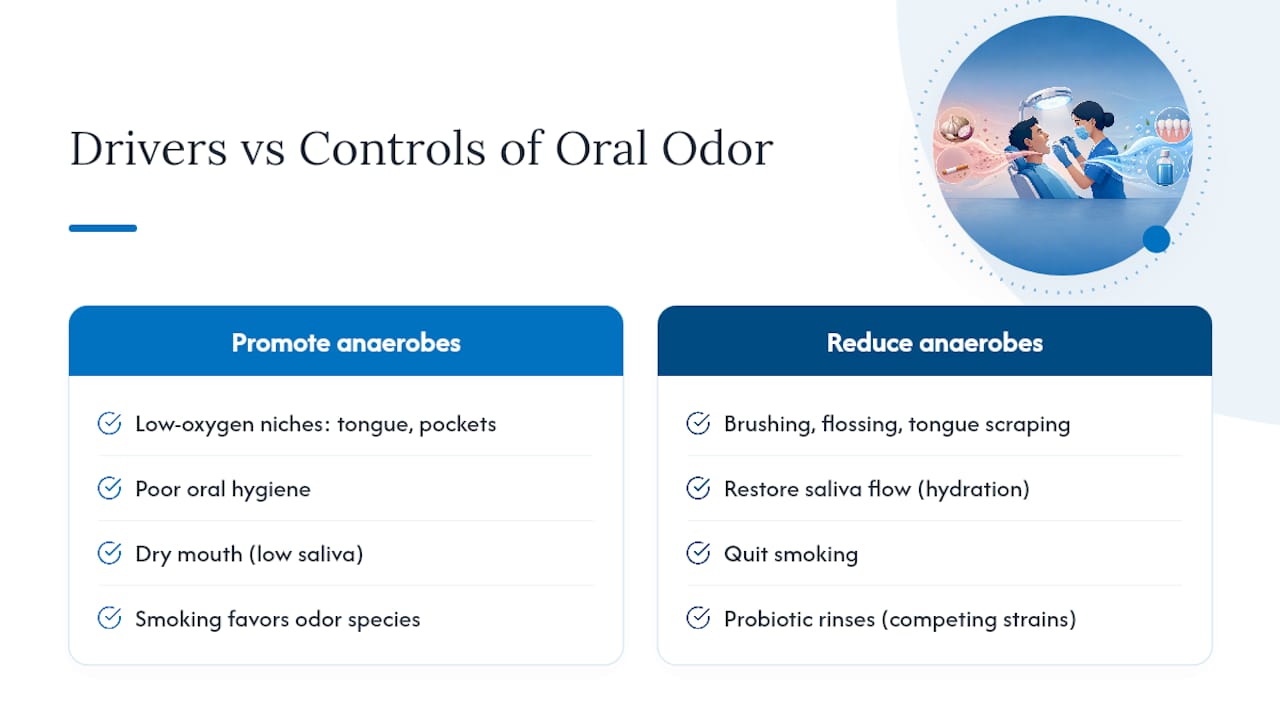
Your mouth hosts hundreds of bacterial species, and most of them are harmless or even beneficial. The trouble comes from a specific subset: anaerobic, gram-negative bacteria that thrive in low-oxygen pockets like the back of the tongue, periodontal pockets, and the spaces between teeth.
Species like Porphyromonas gingivalis, Fusobacterium nucleatum, and Tannerella forsythia are frequently implicated in both gum disease and halitosis, since they specialize in breaking down proteins, an activity that directly produces volatile sulfur compounds as a byproduct. This is why bad breath and gum disease often show up together: the bacteria driving one are frequently the same ones driving the other.
The balance of your oral microbiome shifts based on factors you can influence. Poor hygiene lets these anaerobic species multiply unchecked. Dry mouth removes the oxygen-rich, antibacterial effect of a steady saliva flow, letting anaerobic bacteria gain ground. Smoking alters the oral environment in ways that favor odor-producing species over more benign ones.
This is also why probiotic mouth rinses and "good bacteria" products have generated interest. The idea is straightforward: introduce competing bacterial strains to crowd out the anaerobic species responsible for odor. The evidence for that approach is still developing, and it doesn't replace the fundamentals. Mechanical removal, brushing, flossing, and tongue scraping physically reduces the bacterial load in a way no rinse fully replicates. Think of your oral microbiome less as something to sterilize and more as something to keep in balance, tipping the numbers back toward benign species through consistent cleaning rather than trying to eliminate bacteria altogether.
Practical Reassurance From a Clinical Standpoint
Here's the reassuring part: most bad breath is oral, treatable, and responds quickly to routine care. Give improved hygiene one to two weeks; if the odor persists, get a dental exam rather than guessing further. Bring your medication list and a rough timeline of when the smell started. That detail alone often points straight to the cause.
— Alex
How Starboard Dental Can Help You Get to the Bottom of It
If you've tightened up your brushing, flossing, and tongue cleaning and the odor still won't quit, that's exactly the situation a dental exam is built for. Dental practices that offer same-day appointments for concerns like this can help patients avoid waiting for weeks in uncertainty. A halitosis-focused visit typically includes a breath and tongue assessment, a periodontal check, and a review of any dental work or appliances that might be trapping bacteria.

We treat the full range of causes covered here, from routine checkups and cleanings that catch early gum disease before it becomes a bigger issue, to restorative work for decay or failing fillings, to practical dry-mouth guidance for patients on medications that reduce saliva flow. If dentures or an oral appliance are part of the picture, we can also check fit and walk through a cleaning routine that actually keeps bacteria from building up.
Bring a list of your current medications and a note on when you first noticed the smell. That small bit of prep helps us narrow things down fast. Ready to get an answer instead of another guess? Schedule a checkup with Starboard Dental and get a straight diagnosis instead of another bottle of mouthwash.
This article is general information, not a substitute for advice from a qualified doctor. Consult a qualified healthcare professional about your own circumstances before acting on anything here.
Sources
- Halitosis — StatPearls (2023)
- Bad breath — Diagnosis and treatment (Mayo Clinic)
- Extraoral causes of halitosis (PMC article)
- Halitosis — MSD Manual
FAQ
How can I get rid of bad breath?
Brush twice daily, floss once a day, and scrape the back of your tongue, since that's where most odor-causing bacteria collect. If the smell persists after one to two weeks of consistent care, see a dentist for an exam.
What breath smells indicate an underlying illness?
A fruity or acetone-like smell can signal uncontrolled diabetes, an ammonia-like odor may point to kidney problems, and a musty, sweetish smell can indicate liver issues. These systemic causes are far less common than oral ones and usually come with other symptoms like fatigue or excessive thirst.
How do I get rid of bad breath if it's coming from my gut?
True gastrointestinal causes of chronic bad breath are uncommon; most odor blamed on the stomach actually originates in the mouth. If you have regurgitation, chronic cough, or a sour taste alongside the odor, a GERD evaluation with a physician is reasonable after a dental exam rules out oral causes.
Why does my friend's breath smell so bad even though they seem to brush their teeth?
Regular brushing without tongue cleaning misses the biggest bacterial reservoir in the mouth, the back of the tongue. Gum disease, dry mouth from medication, or an ill-fitting dental appliance can also cause persistent odor despite otherwise decent brushing habits.
Can dry mouth alone cause bad breath?
Yes. Saliva naturally clears bacteria and food debris, so reduced saliva flow from medication, mouth breathing, or a medical condition lets odor-causing bacteria build up faster. Staying hydrated and reviewing medications with a prescriber often improves it.