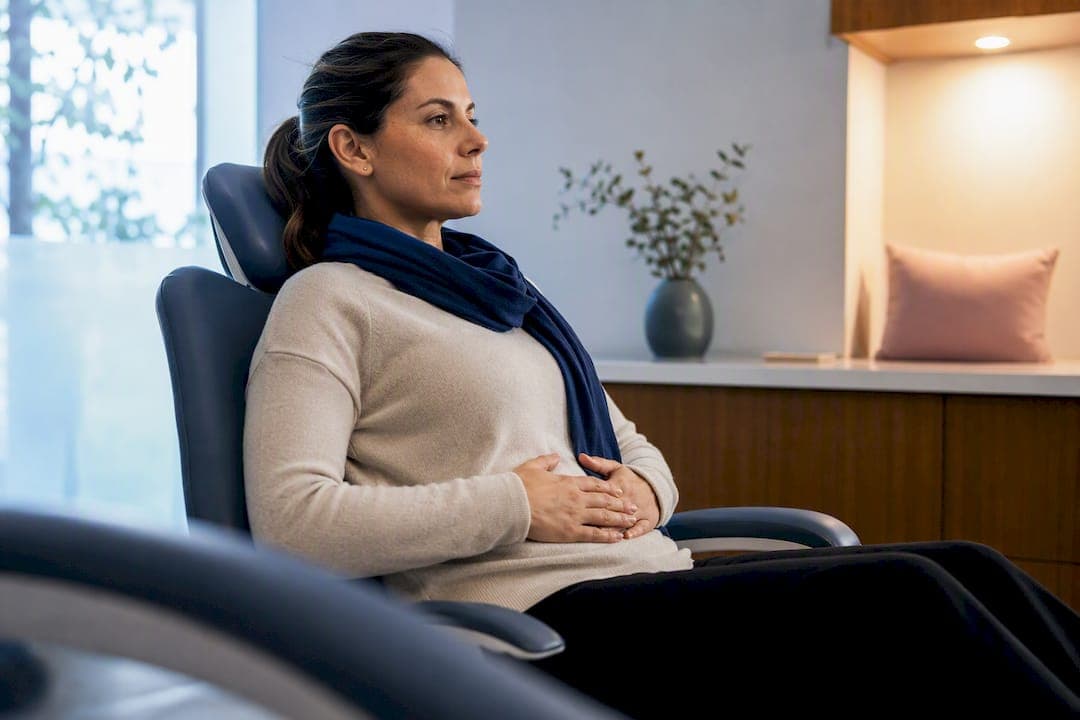
Tell your dentist you're anxious, agree on a stop signal before treatment starts, and practice slow breathing while you're still in the waiting room. Bring headphones for distraction, and ask about nitrous oxide if you want mild sedation. These steps handle mild-to-moderate anxiety well; if you're avoiding appointments entirely or panicking at the thought of a cleaning, that's a sign to talk to a therapist alongside your dentist.
TL;DR:
- Breathing exercises like box breathing or the 3-4-5 method should be practiced at home to become automatic before dental visits and effectively reduce anxiety.
- Using headphones with familiar content, aromatherapy, or weighted items can help distract and calm patients during treatment, with moderate evidence supporting their benefit.
- Saying early and specific concerns to the dentist, such as requesting a stop signal, improves trust and allows adjustments tailored to your anxiety level.
- Scheduling morning appointments, opting for digital tools, and requesting shorter, digital-dentistry procedures can lower stress and reduce chair time.
- For severe anxiety or phobia, cognitive behavioral therapy and exposure therapy are recommended, with sedation options ranging from nitrous oxide to general anesthesia depending on the level of fear.
Table of Contents
- Practical Dental Anxiety Tips You Can Use Before and During Your Visit
- How Do You Talk to Your Dentist About Anxiety?
- What Office Features Actually Reduce Dental Anxiety?
- Sedation Options: Which One Fits Your Level of Anxiety?
- When Does Dental Anxiety Become a Phobia That Needs Therapy?
- Can Apps Help With Dental Anxiety Between Visits?
- Should You Bring Someone With You to a Dental Appointment?
- How Do You Build Long-Term Tolerance to Dental Visits?
- How Starboard Dental Puts These Ideas Into Practice
- Sources
- FAQ
Practical Dental Anxiety Tips You Can Use Before and During Your Visit
Most dental anxiety tips fail because they're vague. "Just relax" isn't a technique. What actually works is specific, physical, and rehearsed before you're sitting in the chair with your heart already pounding.
Start with breathing. Box breathing works well: inhale for four counts, hold for four, exhale for four, hold for four, repeat. The 3-4-5 method is a simpler variation for people who find counting distracting: breathe in for three seconds, hold for four, and exhale slowly for five. Either one slows your heart rate within a couple of minutes, and both work better if you practice them at home first rather than trying to learn them for the first time in the waiting room.
Progressive muscle relaxation (PMR) is the other core skill worth learning. You tense a muscle group, hold it for five seconds, then release and notice the difference. Work from your feet up to your jaw, or just focus on your hands and shoulders if you're short on time. Rehearsing PMR and breathing drills during calm moments, not just before appointments, builds a kind of muscle memory that makes them more reliable under stress.
Distraction matters more than most people give it credit for. A systematic review found moderate-certainty evidence that audiovisual distraction and breathing exercises both reduce anxiety and how much pain a patient reports during treatment. Bring headphones and a playlist or podcast you already know well. Familiar audio works better than something new, because your brain doesn't have to process unfamiliar content on top of managing anxiety.
A few sensory supports have moderate evidence behind them too: aromatherapy and weighted lap items show up in research on non-pharmacological strategies as helpful, though the effect size is modest. They're worth trying, especially paired with breathing work.
Here's a simple sequence to follow:
- Book a consultation-only visit first if your anxiety is high, so you can meet the team without any treatment happening.
- Arrive 10 to 15 minutes early to avoid rushing and to let your nervous system settle in the waiting room.
- Do five rounds of box breathing before you're called back.
- Bring headphones loaded with familiar content.
- Use PMR on your shoulders and jaw once you're seated, before the exam starts.
Pro Tip: Practice your breathing technique for two minutes every night for a week before a big appointment. The goal isn't to master it, it's to make it automatic, so it still works when your adrenaline spikes.
How Do You Talk to Your Dentist About Anxiety?
Say it out loud, early, and specifically. Vague comments like "I hate the dentist" don't give the team much to work with. Calling ahead or mentioning it the moment you check in gives staff time to adjust pacing, explanations, and even scheduling.
A few scripts and requests worth using:
- When booking: "I have dental anxiety. Can I schedule a consultation-only visit before any treatment?"
- At check-in: "Please note in my chart that I get anxious. I'd like the dentist to explain each step before doing it."
- Before treatment starts: "I want to agree on a stop signal. If I raise my left hand, please pause immediately."
- Mid-procedure: "Can we take a short break every few minutes if I need one?"
That stop signal isn't a formality. Cleveland Clinic notes that teams need to be trained to respond to it right away, because a signal that gets ignored once destroys the trust it was built to create. Charting your anxiety ahead of time also functions as real clinical information: it changes how the team plans your visit before you even sit down. If you want to know exactly what to expect step by step, reviewing a typical checkup walkthrough ahead of time removes a lot of the guesswork that fuels anxiety in the first place.
What Office Features Actually Reduce Dental Anxiety?
Not every clinic looks the same, and the differences matter more than people expect. Sensory-adapted environments, calmer lighting, quieter equipment, tailored sensory input, along with computer-controlled anesthetic delivery, are backed by research showing they reduce stress and improve cooperation during procedures.
When you call to book, ask about these:
- Morning appointment slots, when waiting rooms are quieter and you're not stewing over it all day.
- Digital scanners instead of old-style impression trays, which cut down on gagging and shorten appointment time.
- Computer-controlled anesthetic delivery, which the strongest evidence in the 2026 systematic review links to reduced injection discomfort.
- Same-day consultation availability, so you're not waiting weeks while dread builds.
Faster, more precise visits aren't just a convenience. Shorter chair time with digital dentistry tools means less time for anxiety to build mid-procedure.
Sedation Options: Which One Fits Your Level of Anxiety?
Sedation isn't one thing, it's a range, and matching the right level to your anxiety matters. Nitrous oxide (laughing gas) treats mild anxiety, wears off within minutes, and lets you drive yourself home. Oral sedation, usually a pill taken before your appointment, handles moderate anxiety but requires someone to drive you. IV sedation goes deeper for patients with more severe anxiety or longer procedures, and general anesthesia is reserved for the most extreme phobia cases or complex surgery, both requiring a companion and full recovery time.
Dental anxiety is common enough that about 1 in 3 people experience it at some point, so asking about sedation isn't an overreaction, it's a normal question. Many patients with mild-to-moderate anxiety are managed well in general practice using communication and nitrous oxide alone, without ever needing IV sedation.
Before your appointment, ask your dentist:
- Which sedation level fits my specific anxiety and procedure?
- Will I need someone to drive me home afterward?
- What does recovery look like, and how long before I feel normal again?
For a deeper breakdown of each option, this guide to sedation types covers what each level involves in more detail.
When Does Dental Anxiety Become a Phobia That Needs Therapy?
There's a real line between "I don't love the dentist" and dentophobia, a clinical phobia that needs more than breathing exercises. Watch for these signs:
- You've canceled or skipped appointments for years because the thought is unbearable.
- You experience panic attacks, sweating, or severe nausea just thinking about a visit.
- You avoid dental care even when you're in pain.
When anxiety reaches that level, cognitive behavioral therapy and exposure therapy are recognized treatment pathways. CBT helps you identify and challenge the specific thoughts driving the fear ("this will hurt uncontrollably," for example), while exposure therapy gradually rebuilds tolerance through small, manageable steps. Ask your primary care doctor or dentist for a referral to a therapist who has experience with phobias, and expect a few months of gradual work rather than an overnight fix. Many patients combine therapy with a supportive dental office, using the strategies above once the underlying phobia has been addressed.
Can Apps Help With Dental Anxiety Between Visits?
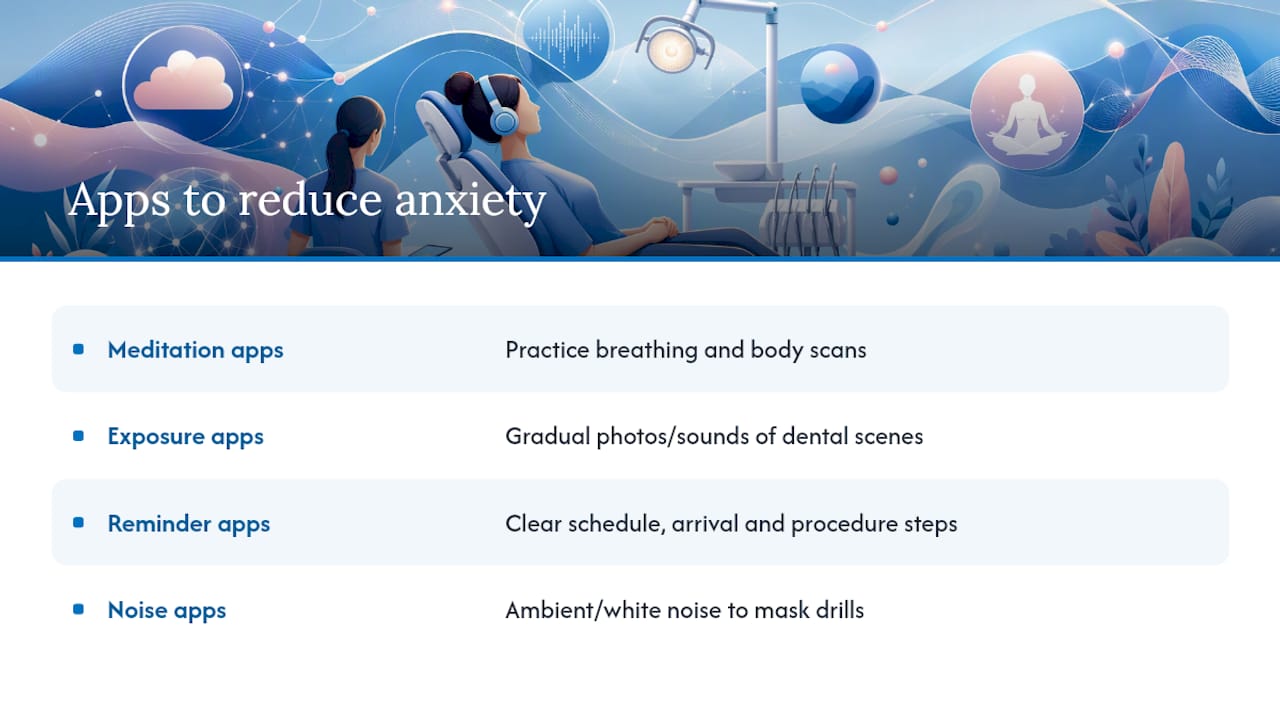
Apps won't replace a stop signal or a good conversation with your hygienist, but they fill a real gap: the anxiety that builds in the days before an appointment, when you're not in a clinic at all. Guided meditation apps built around breathing and body scans give you a structured way to practice the same techniques you'll use in the chair, which matters because rehearsal outside the appointment is what makes the technique actually work under stress.
Some apps use graduated exposure specifically for medical and dental fear, walking you through photos, sounds, and videos of dental settings in small steps before you ever book an appointment. That mirrors the same logic behind exposure therapy, just self-directed and lower stakes.
Reminder and scheduling apps help too, in a less obvious way. A big chunk of dental anxiety comes from anticipation and uncertainty, so an app that sends you a clear breakdown of what to expect, arrival time, what happens first, how long it takes, removes some of the unknown that anxiety feeds on. Noise-canceling headphone apps with ambient sound or white noise are worth pairing with your own playlist if you're sensitive to the sound of dental equipment specifically.
None of this replaces talking to your dental team. But using an app for a week or two before a stressful appointment gives you daily practice instead of a single rushed attempt in the waiting room.
Should You Bring Someone With You to a Dental Appointment?
Bringing a support person changes the emotional weight of a visit more than most people expect. A trusted friend or family member in the waiting room, or in the treatment room if your dentist allows it, gives you someone to talk to right before and right after the procedure, which shortens the window where anxiety has nothing to do but build.

The value isn't just emotional. A companion can help you remember questions to ask, confirm post-procedure instructions you might be too rattled to absorb, and drive you home if you've had sedation. For oral or IV sedation specifically, a companion isn't optional, most offices require one before they'll proceed.
If you're bringing someone for emotional support rather than logistics, tell the front desk when you book so they can confirm whether that person can stay in the room during treatment. Some procedures allow it, others don't for space or sterility reasons. Either way, having someone in the building, not just on standby at home, makes a measurable difference for a lot of anxious patients.
If you don't have someone available, say so. Staff can adjust pacing and check-ins to compensate for not having that extra support in the room.
How Do You Build Long-Term Tolerance to Dental Visits?
The techniques above manage anxiety in the moment. Building real tolerance over time takes a different approach: gradual exposure, spaced out over months, not one white-knuckle visit followed by another two-year gap.
Start small. If you've avoided the dentist for years, the first visit shouldn't be a filling, it should be a consultation with no treatment at all. Just sit in the chair, meet the dentist, and leave. The second visit might be a simple cleaning. Each low-stakes visit rewires the association between "dental office" and "danger" a little more, which is the same principle behind exposure therapy, just applied preventively rather than as treatment for a diagnosed phobia.
Consistency matters more than intensity. Six-month checkups, kept on schedule even when you don't feel anxious in the moment, prevent the anxiety from resetting to zero between visits. Skipping a cycle because you're feeling fine is often what lets the fear creep back in.
Track your own progress, loosely. Notice if your heart rate during breathing exercises is lower at your third visit than your first, or if you no longer need PMR before you're called back. Small, self-reported wins like that build confidence that compounds over years, which is really the only cure for the long version of this problem.
How Starboard Dental Puts These Ideas Into Practice
Comfort items, ceiling-mounted TVs, and digital scanners aren't gimmicks, they're direct answers to the anxiety triggers described above: unfamiliar sounds, long unpredictable procedures, and nothing to focus on but the drill. Charting a patient's anxiety before they arrive, agreeing on a stop signal, and offering same-day consultations are routine tools we use, not exceptions we make for a handful of nervous patients. Most people benefit from small, practical accommodations. If dental visits have been a source of dread, request a consultation and tell us what you need before you sit down.
— Alex
This article is general information, not a substitute for advice from a qualified doctor. Consult a qualified healthcare professional about your own circumstances before acting on anything here.
Sources
- Dental Anxiety: 4 Ways To Deal — Cleveland Clinic
- Systematic review: non-pharmacological tools for dental anxiety (PMC)
- Dentophobia (Fear of Dentists) — Cleveland Clinic
FAQ
How Do I Stop Being Anxious at the Dentist?
Tell the front desk about your anxiety when you book, agree on a stop signal with your dentist, and practice slow breathing like box breathing before and during your visit. Bringing headphones for distraction and asking about a consultation-only first visit also helps significantly.
Which Is Better for Dental Anxiety: Sedation or Relaxation Techniques?
Neither is universally better, they solve different problems. Breathing, distraction, and communication with your dental team work well for mild-to-moderate anxiety, while sedation options like nitrous oxide or oral sedation help when anxiety is strong enough that relaxation techniques alone aren't enough to get through treatment.
What Drug Is Used for Dental Anxiety?
Nitrous oxide (laughing gas) is the mildest sedation option and wears off within minutes, letting you drive yourself home afterward. Oral sedatives, typically a pill taken before the appointment, handle moderate anxiety but require someone to drive you, and stronger IV sedation is reserved for more severe cases.
Is Dental Anxiety the Same as Dental Phobia?
No. Dental anxiety is common, roughly 1 in 3 people experience it, and usually responds to office-level techniques like breathing and communication. Dentophobia is a clinical phobia marked by avoidance and panic, and it typically requires psychotherapy such as CBT alongside dental care.