Porcelain veneers typically run in a range starting near $925 up to about $2,500 per tooth in the U.S., according to current pricing data. Most patients treat several front teeth, so full-set totals vary accordingly, with typical sets costing several thousand dollars. That's a wide range, and where your case falls depends on factors you can actually control or at least anticipate.
Quick price snapshot:
- Per tooth (low): $925
- Per tooth (typical): $1,200–$1,800
- Per tooth (high): $2,500
- Social six (6 teeth): $5,550–$15,000
- Eight-tooth smile line: $7,400–$20,000
- Full arch (10–14 teeth): $9,000–$35,000+
National average: Most U.S. patients pay roughly $1,500 per tooth for a quality porcelain veneer, placing a common eight-tooth case near $12,000 before any adjustments for location or complexity.
Key Takeaways
Porcelain veneers cost $925 to $2,500 per tooth in the U.S., with most eight-tooth cases landing between $7,400 and $20,000 depending on material, lab quality, dentist experience, and location.
| Point | Details |
|---|---|
| Per-tooth price range | Porcelain veneers run $925–$2,500 per tooth nationally, with a typical mid-range near $1,500. |
| Full-set totals | An eight-tooth case typically costs $7,400–$20,000; a ten-tooth case can reach $25,000. |
| Biggest cost drivers | Lab quality, dentist experience, geographic market, and case complexity move price the most. |
| Insurance and financing | Veneers are usually not covered by dental insurance; CareCredit, FSA/HSA, and in-office plans are common payment routes. |
| Starboarddental next step | Book a consultation at Starboard Dental in Kennebunk for a digital scan, written treatment plan, and itemized quote. |
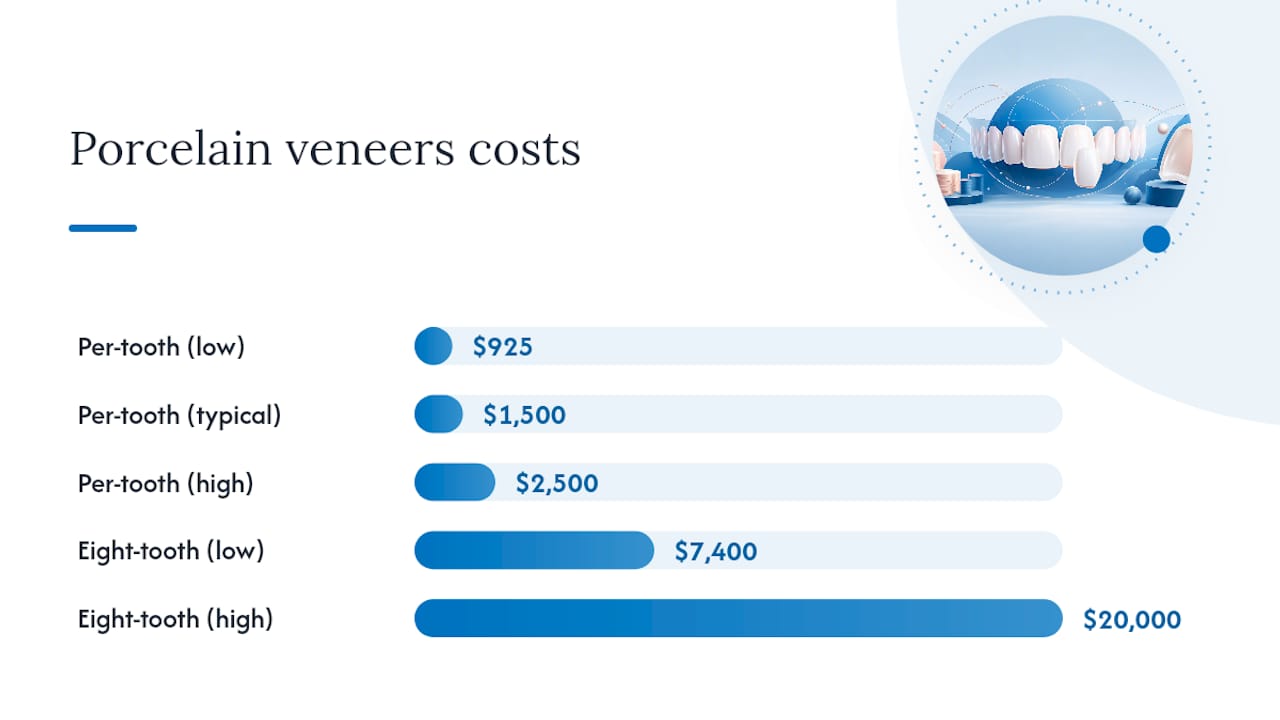
Table of Contents
- What does the porcelain veneers cost actually include?
- What factors change your veneer price the most?
- Will insurance cover veneers, and what are your payment options?
- What does the veneer process look like, and how long does it take?
- Lower-cost alternatives: how do they compare on price and longevity?
- How to get an accurate, itemized veneer estimate
- What patients at Starboard Dental usually need to know before choosing veneers
- Porcelain veneers at Starboard Dental: schedule your consult
- Sources
What does the porcelain veneers cost actually include?
The sticker price on a veneer covers more than a thin ceramic shell. Lab fabrication and dentist time are the two principal cost components, and each breaks down further into line items most patients never see itemized.
Common cost components:
- Dentist prep fee: Enamel reduction, shade matching, and bonding appointment
- Lab fee: The porcelain shell itself, fabricated by an outside dental lab
- Temporary veneers: Worn while the lab builds your permanent set (one to three weeks)
- Diagnostics: Digital scans, X-rays, and photographs taken at the consultation
- Anesthesia: Local anesthetic used during prep (usually included, sometimes billed separately)
- Follow-up adjustments: Minor bite corrections after bonding
A boutique lab producing hand-layered feldspathic porcelain charges significantly more than a high-volume lab turning out pressed lithium disilicate, and that difference shows up directly in your bill.
Sample case totals:
| Small cases (2-4 teeth) | Cost varies by case complexity and provider. | Medium cases (6 teeth) | Prices typically reflect a moderate investment for smile enhancement. | Larger cases (10 or more teeth) | Costs increase significantly with the number of teeth treated.
Per-tooth pricing from national cost guides places full smile makeovers of six to ten veneers commonly between $9,000 and $25,000, which aligns with the typical column above.
What factors change your veneer price the most?
Material and lab quality
Not all porcelain is the same. Feldspathic porcelain, layered by hand, produces the most natural translucency but is more fragile and more expensive to fabricate. Pressed lithium disilicate (brands like e.max) offers excellent durability and a slightly lower lab cost. Higher-priced cosmetic dentists often use boutique labs and advanced materials that raise upfront fees but tend to improve longevity and esthetics. The lab choice is something you can ask about directly.
Number of teeth
Veneers are billed per tooth, so the count drives the total more than any other single variable. A single chipped lateral incisor costs a fraction of a full eight-tooth smile line. That said, some practices offer per-arch or package pricing for multi-tooth cases, which can reduce the effective per-tooth rate.
Dentist experience and credentials
A cosmetic-focused dentist who completes advanced training in esthetic dentistry typically charges more per tooth than a general dentist offering veneers as one of many services. The premium reflects case selection skill, shade-matching precision, and the ability to handle complications. For a procedure that will be on your face for a decade or more, that gap in experience matters.
Geographic location
Metro markets consistently produce higher prices than rural or suburban practices, driven by higher overhead, lab costs, and local competition for cosmetic patients. A veneer that costs $1,200 in a mid-sized New England town might run $2,000 or more at a Manhattan cosmetic practice.
Case complexity and preparatory work
Some cases require work before a single veneer goes in. Orthodontic treatment to align teeth, gum contouring to even the gumline, or a root canal on a compromised tooth all add cost and time. These aren't optional extras; they're clinical prerequisites for a result that lasts.
Pro Tip: Ask your dentist specifically whether the quoted price includes temporaries, digital scans, and follow-up adjustments, or whether those are billed separately. Also ask whether the practice offers bundled pricing for cases of six or more teeth — many do, and it's rarely advertised.
Will insurance cover veneers, and what are your payment options?
Dental insurance generally treats veneers as elective cosmetic procedures, so standard plans usually won't cover them. The exception is a narrow one: if a veneer is the clinically appropriate treatment for a fractured or structurally compromised tooth, some plans will apply partial coverage. That determination depends on your plan's language and your dentist's documentation. Check your dental insurance coverage details before assuming either way.
For the majority of patients paying out of pocket, practical options include:
- FSA/HSA funds: Flexible spending accounts and health savings accounts can cover dental procedures, including veneers, if your plan administrator allows it. Confirm eligibility before your appointment.
- CareCredit: A widely accepted third-party medical credit card that many patients use to manage the upfront cost of elective cosmetic dentistry. Promotional periods with deferred interest are common.
- In-office payment plans: Some practices offer their own installment arrangements, often interest-free for shorter terms.
- Medical credit cards: Similar to CareCredit, products like Alphaeon Credit or Proceed Finance are accepted at select dental offices.
- Savings strategies: Scheduling treatment in two phases (upper arch one year, lower the next) lets you spread cost across FSA plan years.
Pro Tip: If you're combining CareCredit with FSA funds, confirm with the practice which payment method to apply first. Some offices require full payment upfront and reimburse; others will split the charge. Also ask about prepayment penalties and whether early payoff of an in-office plan changes the interest terms. Local readers can find clinic-specific guidance at Starboarddental's dental financing guide for Kennebunk patients.
What does the veneer process look like, and how long does it take?
Most porcelain veneer cases run two to four visits over two to six weeks. The exact timeline depends on lab turnaround and whether any preparatory work is needed.
Typical visit breakdown:
- Visit 1 — Consultation: Dental exam, X-rays or digital scans, shade discussion, and treatment planning. No prep work yet. Duration: 45–90 minutes.
- Visit 2 — Preparation: Enamel reduction (usually 0.3–0.5 mm), impressions or digital scan sent to the lab, and placement of temporary veneers. Duration: 1.5–2.5 hours.
- Visit 3 — Try-in and bonding: Lab-fabricated veneers are checked for fit, color, and bite before permanent bonding. Duration: 1.5–2 hours.
- Visit 4 — Follow-up (if needed): Minor bite adjustments or polishing. Duration: 30–45 minutes.
Where delays happen: Lab remakes (color or fit corrections) add one to three weeks. Unexpected decay found during prep can require a filling or crown before veneers proceed. Gum contouring, if needed, typically requires a healing period of two to four weeks before prep begins.
The lab fabrication window, usually one to three weeks, is the longest single gap in the process. During that time, temporary veneers protect the prepped teeth and give you a preview of the final shape.
Lower-cost alternatives: how do they compare on price and longevity?
Porcelain isn't the only path to a better smile. The right alternative depends on what you're correcting and how long you need the result to last.
- Composite veneers: Applied directly to the tooth in one visit, costing roughly $400–$1,500 per tooth. Composite options generally last five to seven years versus ten to twenty for porcelain, making them a reasonable choice for younger patients or minor corrections. They stain more readily and can't match the translucency of porcelain.
- Dental bonding: Essentially the same composite material applied to repair chips, gaps, or discoloration. Cost per tooth is similar to composite veneers, often on the lower end. Single-visit, reversible, and well-suited to small defects. Not a substitute for a full cosmetic transformation.
- Dental crowns: Cover the entire tooth rather than just the front surface. Appropriate when a tooth is structurally compromised, not just cosmetically imperfect. Cost per tooth runs $1,000–$2,000 or more, and the procedure is more invasive. Restorative options like crowns serve a different clinical purpose than veneers.
- Dental contouring: Reshaping enamel to correct minor irregularities. No lab, no temporaries, often completed in one visit for a few hundred dollars per tooth. Works only when the issue is shape, not color or size.
Pro Tip: To compare options on long-term value, divide total cost by expected lifespan. A $1,200 composite veneer lasting six years costs $200 per year. A $1,800 porcelain veneer lasting fifteen years costs $120 per year. The porcelain option is cheaper over time despite the higher upfront price.
How to get an accurate, itemized veneer estimate
A verbal ballpark from a dentist is not a quote. Here's what to bring and what to ask to get a number you can actually plan around.
Bring to your consultation:
- Current dental X-rays (if taken within the past year)
- Photos of your smile from multiple angles
- Your dental insurance card and plan summary
- A written budget range you're comfortable sharing
- A list of any medications or conditions that affect healing
Questions to ask for an itemized estimate:
- What is the per-tooth lab fee, and which lab do you use?
- Is the dentist prep fee billed separately from the lab fee?
- Are temporary veneers included, or billed as an add-on?
- What does the quote include for diagnostics (scans, X-rays, photos)?
- Is anesthesia included?
- What is your warranty or guarantee policy if a veneer chips or debonds?
- What is the expected lifespan for the material you're recommending?
- What is your retreatment policy after the warranty period?
When comparing two quotes, confirm they cover the same number of teeth, the same porcelain type, and the same lab tier. A $1,000 per-tooth quote using a high-volume offshore lab and a $1,800 quote using a domestic boutique lab are not the same product. Ask for a written, itemized treatment plan before signing anything. Practices that resist providing one in writing are worth approaching with caution. You can also review new patient logistics at Starboarddental to understand what to bring to a first appointment.
What patients at Starboard Dental usually need to know before choosing veneers
Most patients who ask about veneers come in with one of two goals: fixing a specific tooth that's been bothering them for years, or redesigning their smile more broadly. Both are valid, but they lead to very different treatment plans and very different price points.
At Starboard Dental, the consultation starts with digital scans rather than traditional impressions, which gives a more precise picture of tooth structure and lets us preview the final result before any enamel is touched. That step alone tends to change the conversation, because patients can see what's actually possible rather than working from a verbal description. Ceiling-mounted TVs and same-day scheduling help with the anxiety side of things, but the technology is what drives the clinical outcome.
Veneers are the right call when the concern is primarily cosmetic and the underlying teeth are structurally sound. When there's decay, significant bite issues, or a tooth that needs structural support, a crown or restorative approach through Starboarddental's restorative services is often the more appropriate starting point. Getting that distinction right at the consultation stage saves patients from investing in veneers that won't last.
Porcelain veneers at Starboard Dental: schedule your consult
Starboard Dental's cosmetic dentistry services in Kennebunk include porcelain veneers with digital scanning for precision fit and shade matching. The clinic serves patients across Kennebunk, York, and Saco, ME, with same-day appointments available for consultations. Every veneer case starts with a full exam and a written treatment plan so you know exactly what you're paying for before prep begins. Financing options, including CareCredit and in-office payment arrangements, are available at the practice. To book a consultation or ask about current veneer pricing, visit the new patient page or call the clinic directly.
Sources
- Dental Veneer Cost Per Tooth (2026)
- Veneer Cost Guide 2026 | Veneers Authority
- Are Veneers Expensive? What Drives the Cost
- How dental veneers cost and financing options | CareCredit
- Dental veneers cost and insurance coverage | Delta Dental