
Dental insurance is a contract between you and an insurer where the insurer agrees to share the cost of your dental care after you meet a deductible. You pay a monthly premium to keep the coverage active, and when you receive care, the insurer covers a set percentage while you pay the rest through copays or coinsurance. Most plans follow a 100/80/50 coverage structure: 100% for preventive care, 80% for basic procedures like fillings, and 50% for major work like crowns. The American Dental Association is clear that dental coverage is designed to help manage routine and predictable dental costs, not to cover every possible procedure without limit.
Here is a quick overview of the core components:
- Premium: Your monthly payment to maintain coverage
- Deductible: The amount you pay out of pocket before insurance kicks in
- Copay: A flat fee you pay per visit or procedure
- Coinsurance: The percentage you owe after the deductible is met
- Annual maximum: The most your insurer will pay in a single plan year
- Waiting period: A delay before certain coverage begins, often 6–12 months for restorative work
What types of dental insurance plans are available?
Understanding dental insurance starts with knowing which plan structure you are buying into, because the type of plan shapes everything from which dentists you can see to how much you pay per visit.
PPO (Preferred Provider Organization)
PPO plans are the most common type in the U.S. market. They pair traditional indemnity insurance with a network of dentists who have agreed to charge set fees. You can see an out-of-network dentist, but your costs will be higher. According to the American Dental Association, contracted dentists must accept the plan's maximum allowable fee, while non-contracted dentists may charge more than the plan allows.
DHMO (Dental Health Maintenance Organization)
Under a DHMO, you are assigned a primary care dentist and must receive treatment at a contracted office to get any benefit. The plan pre-pays contracted dentists a fixed monthly amount per enrolled patient, and those dentists then provide certain services at no cost or reduced cost. There are no claims to file, but your choice of provider is limited.
Indemnity (traditional) plans
Indemnity plans let you visit any dentist you choose. The insurer pays a percentage of the charges, usually based on "usual, customary, and reasonable" (UCR) fees for your area. If your dentist charges more than the UCR rate, you cover the difference.
Discount dental plans
Discount plans are not insurance at all. They charge a membership fee and give you access to a network of dentists who have agreed to charge reduced rates. You pay the dentist directly at the discounted rate, and no claims are filed. There are no deductibles, no annual maximums, and no waiting periods.
Quick comparison:
- PPO: Flexible network, moderate premiums, most widely accepted
- DHMO: Low cost, restricted to network dentists, no claims process
- Indemnity: Full provider choice, higher premiums, UCR fee limits apply
- Discount plan: Not insurance, membership fee only, direct payment at reduced rates
What does dental insurance typically cover, and what does it exclude?
Most dental plans organize coverage into three tiers, each with a different reimbursement rate.
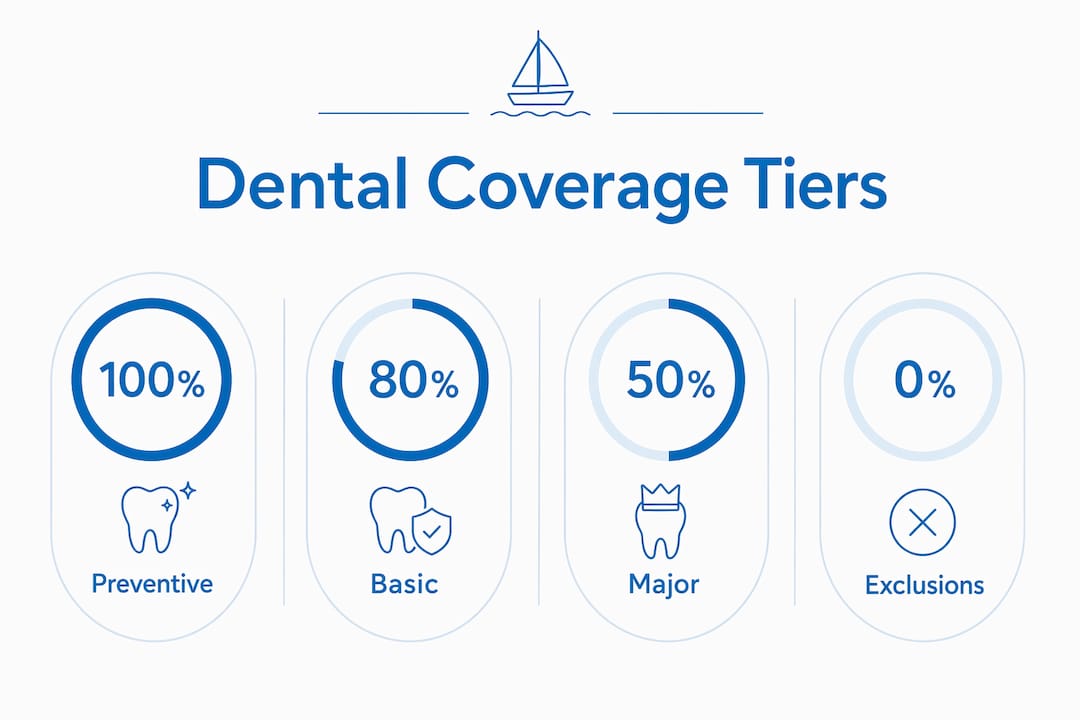
| Service category | Typical coverage | Examples |
|---|---|---|
| Preventive | 100% | Cleanings, routine X-rays, oral exams |
| Basic | 80% | Fillings, tooth extractions, root canals |
| Major | 50% | Crowns, bridges, dentures, oral surgery |
Preventive care is almost always covered in full, which is by design. Catching problems early costs far less than treating them later. A routine dental checkup typically includes the cleaning and X-rays that fall squarely in the preventive tier.
Frequency limitations
Plans do not let you claim preventive services without limit. Frequency caps typically restrict coverage to two cleanings per year and one set of bitewing X-rays every 12 months, regardless of how much annual maximum benefit you have left. Exceeding those limits means paying out of pocket even if your annual maximum is untouched.
Waiting periods
Many dental plans impose waiting periods of 6–12 months before covering restorative work like fillings or crowns. Buying a plan the week before you need a crown will not get that crown covered. Preventive care is usually available from day one.
Common exclusions
- Cosmetic procedures: teeth whitening, veneers, and cosmetic contouring are almost universally excluded
- Dental implants: some plans cover them partially; many exclude them entirely
- Orthodontics: braces and aligners require a separate orthodontic benefit rider, and lifetime maximums apply
- Pre-existing conditions: some plans exclude dental conditions you had before enrollment
- Experimental procedures: no standard plan covers treatments not yet recognized as clinically established
How much does dental insurance actually cost?
The core cost components of any dental policy are premiums, deductibles, coinsurance, and the annual maximum. Each one affects what you actually spend in a given year.

Premium: This is the fixed monthly amount you pay to keep coverage active. Employer-sponsored plans often split the premium between you and your employer. Individual plans purchased directly from an insurer cost more because you bear the full premium yourself.
Deductible: You pay all dental costs out of pocket until you hit this threshold, at which point the insurer starts sharing costs. Deductibles typically reset every 12 months. Preventive services are often exempt from the deductible entirely.
Coinsurance: Once your deductible is met, coinsurance determines your share of each bill. A filling that costs $100 under a plan with 80% basic coverage leaves you with a $20 coinsurance payment. As the Cleveland Clinic explains, coinsurance helps keep premiums lower by spreading costs between you and the insurer.
Annual maximum: This is the ceiling on what your insurer will pay in a plan year. Once you hit it, every additional dollar of dental care comes out of your pocket until the plan renews.
Practical tips for estimating your yearly costs:
- Add your annual premium to your deductible to find your baseline cost before insurance pays anything
- Factor in your coinsurance percentage for any procedures you anticipate
- Check whether your expected treatments fall within the annual maximum
- Ask whether your plan has a separate lifetime maximum for orthodontics
- Confirm whether your dentist is in-network before scheduling major work
Why having dental insurance benefits you
Dental coverage pays its clearest dividend on preventive care. Cleanings, exams, and X-rays are covered at 100% under most plans, so you can stay on top of your oral health without worrying about the bill. Catching a cavity early and treating it as a filling is far cheaper than letting it progress to a root canal or crown, both for you and your insurer.
Beyond prevention, insurance makes budgeting more predictable. You know your monthly premium, you know your deductible, and you have a reasonable estimate of your coinsurance exposure for common procedures. That predictability matters especially for families with children, where dental needs are frequent and sometimes unpredictable.
For restorative work, the cost reduction is real. A crown that costs $1,200 at 50% coverage leaves you paying $600 rather than the full amount, assuming you have remaining annual maximum. Procedures like dental fillings at 80% coverage represent meaningful savings over the course of a year.
Practical advantages at a glance:
- Preventive care at little or no direct cost
- Predictable monthly premiums for easier budgeting
- Reduced out-of-pocket costs for fillings, extractions, and root canals
- Family plans that cover children's dental needs under one policy
- Early detection of problems before they become expensive
Common misconceptions about dental insurance
A lot of confusion around dental coverage comes from misunderstanding who controls what. Your dentist does not set your benefits. Dental insurance is a contract between you and your insurer, and your dentist is simply the service provider who treats you under the terms of that contract. If your plan denies a claim or limits coverage for a procedure, that decision comes from the insurer, not your dentist.
Dental insurance vs. discount plans
These two products are frequently confused, but they work very differently. A dental discount plan is a membership program, not insurance. You pay a fee, get access to a network of dentists who charge reduced rates, and pay the dentist directly at that reduced rate. No claims, no deductibles, no annual maximums. Insurance, by contrast, involves the insurer actually paying a portion of your bill after you meet your deductible.
Insurance is not always cheaper than paying out of pocket
For people who only need two cleanings a year and have no history of major dental work, paying out of pocket can cost less than the combined total of premiums and deductibles. The math only favors insurance when your expected dental costs exceed what you would pay in premiums and cost-sharing over the year.
Expert insights worth knowing:
- Waiting periods mean you cannot buy insurance right before a costly procedure and expect it to be covered
- Your annual maximum can be exhausted by a single crown and a couple of fillings
- Frequency limits apply even when you have annual maximum dollars remaining
- Pre-existing condition clauses can leave you paying full price for work you needed before enrollment
Pro Tip: Before enrolling in any plan, add up your last 12 months of dental spending, including what you paid and what insurance covered. Then compare that total to the plan's annual premium plus your likely deductible and coinsurance. That calculation tells you whether the plan actually saves you money.
How to choose the right dental insurance plan for your needs
Start with your dentist. If you have a provider you trust, check whether they are in-network for the plans you are considering. Switching to an out-of-network dentist or paying out-of-network rates can easily erase any premium savings.

Next, think honestly about your dental history. If you have had multiple fillings, crowns, or periodontal treatment, a plan with a higher premium and a higher annual maximum will likely pay off. If your teeth are healthy and your needs are minimal, a lower-premium preventive plan may be enough.
For families, look at whether the plan covers orthodontics and what the lifetime orthodontic maximum is. Children's dental needs change quickly, and a plan that covers pediatric dental care well is worth a higher premium. Also check whether the plan has a family deductible cap, which stops the family from paying more than a set deductible total even when multiple members need care.
Questions to ask before you enroll:
- Is my current dentist in-network?
- What is the annual maximum, and is it realistic for my expected needs?
- Does the plan have waiting periods for basic or major services?
- Are orthodontic services covered, and what is the lifetime limit?
- What procedures are excluded entirely?
How to read and understand a dental insurance policy
The summary of benefits is the most useful document your insurer provides. It lists covered services, the percentage the plan pays for each category, your deductible, your annual maximum, and any exclusions. Read it before you need care, not after.
Pay close attention to the "exclusions and limitations" section. This is where you will find frequency limits, waiting periods, and any services the plan does not cover. The "least expensive alternative treatment" (LEAT) clause is one that catches many patients off guard: if there are two ways to treat a problem, the plan will only pay for the cheaper option, and you cover the difference if you choose the more expensive one.
When you receive an Explanation of Benefits (EOB) after a visit, compare it line by line against your bill. The EOB shows what the insurer paid, what was adjusted off under the contracted rate, and what you owe. Discrepancies between your EOB and your dentist's bill are worth questioning directly with the billing office.
How to file a dental insurance claim
In most cases, your dentist's office files the claim for you. You provide your insurance card at check-in, the office submits the claim electronically after your visit, and the insurer sends payment directly to the dentist. You receive an EOB in the mail or online showing how the claim was processed.
If you see an out-of-network dentist or a provider who does not file on your behalf, you will need to file the claim yourself. Get an itemized receipt from the dentist that includes procedure codes (CDT codes), the date of service, and the provider's tax ID number. Submit that receipt to your insurer along with a completed claim form, which you can usually download from the insurer's website.
Keep copies of everything. If a claim is denied, you have the right to appeal. The denial letter will explain the reason, and your insurer must provide a process for challenging that decision. Common grounds for appeal include claims denied due to missing documentation or a procedure coded incorrectly by the dental office.
Key dental insurance terms you need to know
| Term | What it means |
|---|---|
| Annual maximum | The most your insurer pays in a plan year; you cover costs above this amount |
| Deductible | What you pay out of pocket before the insurer begins sharing costs |
| Coinsurance | Your percentage share of a covered procedure after the deductible |
| Copay | A flat dollar amount you pay per visit, regardless of the total bill |
| Waiting period | A delay of 6–12 months before coverage begins for certain procedures |
| Frequency limitation | A cap on how often a covered service can be claimed per year |
| UCR fee | "Usual, customary, and reasonable" fee; the benchmark insurers use to set reimbursement |
| LEAT clause | Insurer pays only for the least expensive treatment option available |
| EOB | Explanation of Benefits; the insurer's statement of how a claim was processed |
| Lifetime maximum | A total cap on benefits for specific services like orthodontics over your enrollment lifetime |
| Pre-existing condition | A dental condition present before enrollment that some plans exclude from coverage |
A dental treatment plan from your dentist will typically reference many of these terms when outlining recommended procedures and estimated costs. Understanding them before that conversation puts you in a much stronger position to ask the right questions and avoid billing surprises.
Key Takeaways
Dental insurance shares the cost of your care through a structured system of premiums, deductibles, and coinsurance, but it is designed for routine and restorative needs, not unlimited coverage.
| Point | Details |
|---|---|
| 100/80/50 coverage structure | Plans typically cover 100% preventive, 80% basic, and 50% major procedures. |
| Waiting periods apply | Most plans delay coverage for restorative work by 6–12 months after enrollment. |
| Annual maximums cap benefits | Once your insurer hits its annual limit, all remaining costs fall to you. |
| Discount plans are not insurance | Discount plans offer reduced rates with no claims, deductibles, or insurer payments. |
| Out-of-pocket can cost less | For patients with minimal dental needs, premiums plus cost-sharing may exceed direct payment. |
Ready to use your dental coverage at Starboarddental?

Knowing how your plan works is only half the equation. The other half is finding a practice that works with your coverage and actually makes dental care worth showing up for. At Starboarddental in Kennebunk, the team handles general dentistry services ranging from preventive cleanings to restorative procedures, all within a practice built around patient comfort. Same-day appointments, ceiling-mounted TVs, and a genuinely welcoming atmosphere make it easier to stay consistent with the preventive care your insurance already covers at 100%. If you have questions about what your plan covers or want to confirm in-network status before booking, the Starboarddental team is ready to help.