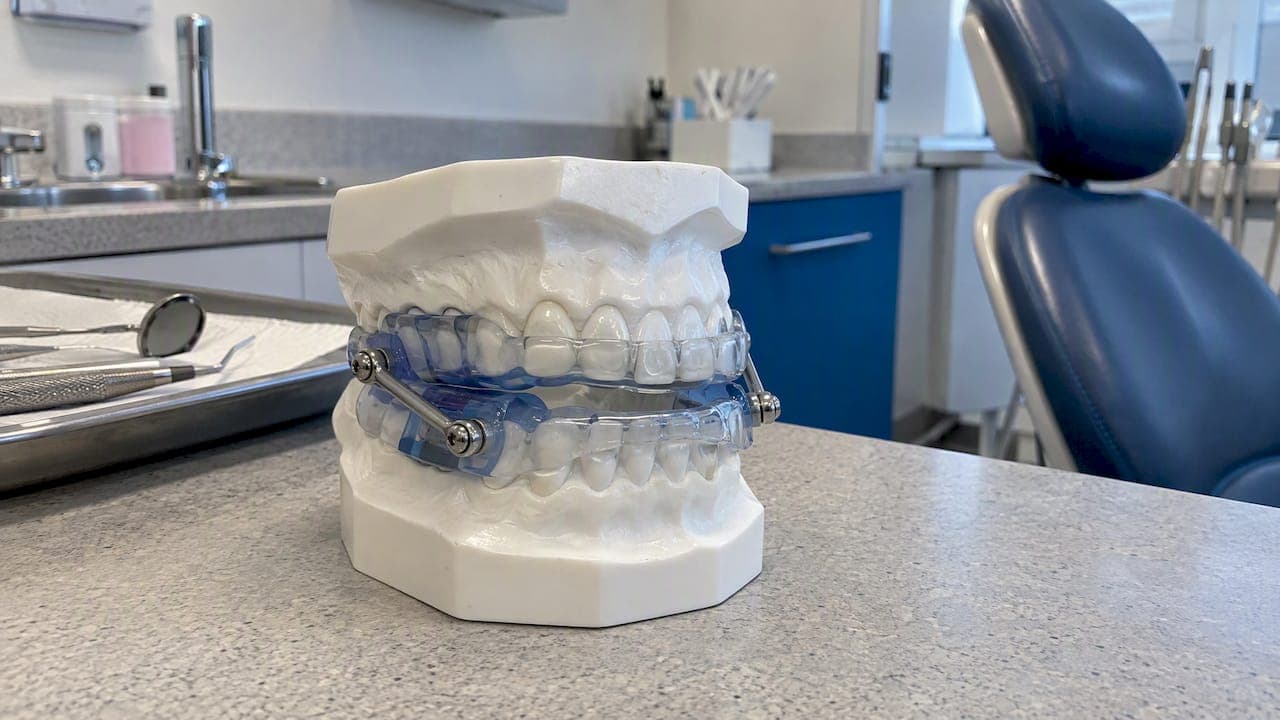
Yes, a dentist can treat snoring, and the main tool is a custom-made oral appliance worn in your mouth at night. It holds your lower jaw or tongue slightly forward so the airway behind it stays open. There is one rule that comes before any mouthpiece: snoring can be a sign of obstructive sleep apnea, so the cause needs to be sorted out by a physician first. Below, we explain how the process works, who is a good candidate, what the fitting involves and what to ask before you start.
TL;DR
- Dentists treat snoring mainly with custom oral appliances that reposition the jaw or tongue to keep the airway open during sleep.
- Snoring is often a symptom of sleep apnea. A physician makes that diagnosis, not the dentist, so a sleep evaluation comes first.
- Oral appliances are a recommended option for primary snoring, and for sleep apnea patients who cannot tolerate CPAP or prefer an alternative.
- Treatment is not finished at the fitting. Expect adjustments, follow-up visits and, for sleep apnea, repeat sleep testing.
- If you live near Kennebunk, Maine, our team offers sleep apnea and snoring care for adults.
Table of Contents
- Why a dentist is involved in snoring at all
- Snoring or sleep apnea: why the order matters
- How oral appliance therapy works
- What the evidence says
- Is an oral appliance right for you?
- What to expect at the dentist
- Side effects and honest trade-offs
- Insurance and cost: what to ask first
- Our perspective
- Seeing us in Kennebunk
- Questions people ask
- Sources
Why a dentist is involved in snoring at all
Snoring happens when tissue in the back of the throat vibrates as you breathe in sleep. The tongue, the soft palate and the position of the lower jaw all affect how much room air has to pass. Dentists spend their days looking at exactly those structures: the bite, the jaw, the tongue, the teeth that anchor a device. That is why dentistry developed the mouthpiece approach.
There is also a practical reason. According to the American Academy of Dental Sleep Medicine, most people see a dentist about twice a year, which makes a routine checkup a natural place to notice warning signs such as worn teeth, a scalloped tongue, a small airway or a partner's complaint about loud nights, and to suggest a sleep assessment.
Snoring or sleep apnea: why the order matters
This is the part many articles skip, and it is the most important one.
Loud snoring can be harmless. It can also be the main symptom of obstructive sleep apnea (OSA), a condition in which breathing repeatedly pauses during sleep. The two look similar from the outside. The difference is found with testing.
The American Academy of Dental Sleep Medicine advises that a snorer tell their doctor about the snoring and related issues, and notes that a sleep study or a physician visit is how snoring is evaluated. Treating the noise alone while OSA goes unrecognized can delay care for a condition linked to cardiovascular, metabolic and cognitive problems. A practical clinical guide in the Australian Dental Journal describes OSA in just those terms.
Here is how the sequence typically works:
- You notice the problem. A partner hears the snoring, or you wake with a dry mouth, headaches or daytime sleepiness.
- You see a physician. Your primary care provider or a sleep specialist decides whether you need a sleep test. Tests include in-lab polysomnography or an FDA-cleared home sleep test.
- You get a result. OSA is graded by breathing interruptions per hour: mild is 5 to 15, moderate 15 to 30, severe over 30. No pauses at all, with loud snoring, points to primary snoring.
- You and your care team choose a therapy. CPAP, an oral appliance, or something else.
- A dentist fits and follows the appliance. That is where we come in.
If you have never had a sleep evaluation, start at step 2. If you already have results, bring them to your appointment.
How oral appliance therapy works
An oral appliance looks a little like a sports mouthguard or a clear retainer, but it is built for a different job. The National Heart, Lung, and Blood Institute describes two main types:
- Mandibular repositioning devices hold the lower jaw forward.
- Tongue-retaining devices hold the tongue forward.
Both aim to keep the upper airway from narrowing or collapsing while you sleep. The mandibular type is by far the more familiar of the two, and it is what most people picture when they search for an anti-snoring mouthpiece. If you want a deeper look at how that design works, we wrote a separate guide to the mandibular advancement device.
Custom versus store-bought
Drugstore boil-and-bite mouthpieces are sold for snoring, and they are a different thing from a dentist-made appliance. A custom device is made from precise records of your teeth and bite, so it fits your mouth, can be adjusted in small steps, and is checked by someone who watches for side effects. A generic one has none of that oversight. If you have not been evaluated, a generic device can also mask a sleep apnea problem that needs real treatment.
What the evidence says
The central reference is the 2015 joint clinical practice guideline from the American Academy of Sleep Medicine and the American Academy of Dental Sleep Medicine. Its key points for readers:
- For adults who request treatment of primary snoring, without sleep apnea, the guideline recommends that sleep physicians prescribe an oral appliance rather than no therapy.
- For adults with OSA who cannot tolerate CPAP or prefer another option, oral appliances are recommended instead of no treatment.
- CPAP remains the most effective therapy for OSA in general. Oral appliances can still improve daytime sleepiness and quality-of-life measures, and the guideline discusses results comparable to CPAP on several of those measures.
That last point matters to people who have given up on a CPAP machine. A therapy you wear every night beats a better one that sits in a closet. The guideline also stresses that a custom, adjustable device from a qualified dentist is preferred over a non-custom one.
The guideline is from 2015, and it is still the document most clinicians cite. Ask your physician whether newer guidance affects your case.
Is an oral appliance right for you?
There is no single answer, and the decision belongs to you, your physician and your dentist together. These are the factors that usually decide it.
| Factor | Why it matters |
|---|---|
| Diagnosis | Primary snoring and mild to moderate OSA are the usual cases. Severe OSA generally starts with CPAP, and your physician decides. |
| CPAP experience | If you cannot tolerate CPAP or prefer an alternative, an appliance becomes a leading option. |
| Teeth and gums | Appliances rely on teeth for anchoring. Untreated decay, loose teeth or active gum disease should be handled first. |
| Jaw joints | If you have jaw pain or clicking, we need to evaluate your joints before moving the jaw forward each night. |
| Preference | Many people simply want something quiet, portable and without a hose. |
Notice how much of that table is dental. A good fit starts with a healthy mouth. That is one reason a general exam, X-rays and a gum check are part of the process, and why you may need a filling, a crown or periodontal care before an appliance is made. You can read more about our general dentistry and periodontal therapy if either applies.
What to expect at the dentist
Every practice sets its own schedule, so treat this as the typical shape of care rather than a promise of exact visits.
1. The evaluation
We review your medical history, your sleep evaluation or test results if you have them, and your health in general. We examine your teeth, gums, bite, jaw joints and airway. We ask about nighttime grinding, dry mouth, morning headaches and anything else that bears on the choice of device.
2. Impressions or digital scans
The appliance is built from a precise model of your teeth. We use digital scanners for precision, which many patients find far more comfortable than traditional trays of impression material.
3. The fitting
When the appliance returns from the lab, we check how it seats, how it feels and how well you can open and close. You learn how to put it in, remove it and clean it.
4. Titration, which means gradual adjustment
Most mandibular devices advance the jaw in small increments. We start conservatively and adjust over time, balancing relief of snoring against comfort. The guidelines describe this as a core task of the dentist: titrating the device to maximize comfort and adherence.

5. Follow-up
This stage is not optional. The same guideline describes dentists monitoring for side effects such as excess salivation, dry mouth and jaw discomfort. If you have OSA, your physician repeats sleep testing to confirm the appliance is working. Experts treat success as more than quieter nights: regular use (at least four hours a night), better daytime function and measurable improvement in test results.
Side effects and honest trade-offs
Oral appliances are well tolerated by many people, but they are not free of downsides. Expect some of these, especially in the first weeks:
- Extra saliva or a dry mouth
- Sore teeth or jaw muscles in the morning
- A bite that feels slightly different when you take the device out
- The need to be disciplined: it only works when it is in your mouth
Most mild effects ease with adjustment. Call us if you have persistent jaw pain, clicking that is new or tooth movement you can feel. The Australian Dental Journal guide emphasizes that long-term oversight by both a qualified dentist and a sleep physician helps catch problems early and keeps the therapy effective.
If you also clench or grind, mention it. A snoring appliance and a night guard do different jobs, and grinding can wear down either one. Our guides on bruxism causes and night guard cleaning cover the basics, and if your jaw is sore in the morning, our page on teeth grinding is a good place to start.
Insurance and cost: what to ask first
We do not publish a price for this treatment, and what you pay depends on your diagnosis and your plan. Coverage is the question that surprises people. Because sleep apnea is a medical condition, an appliance for it is usually billed differently from routine dental work, and your medical plan, not your dental plan, may be the one to ask about. Before you begin, ask:
- Does my medical plan cover an oral appliance for sleep apnea, and what diagnosis documentation does it require?
- Is prior authorization needed?
- Does primary snoring without OSA count as covered?
- What are my deductible and coinsurance?
Our front desk can walk through these questions with you. A written treatment plan also helps you see each step and its cost. Our guide to what a dental treatment plan is explains how to read one.
Our perspective
We see snoring as a health question first and a comfort question second. Plenty of people come to a dentist wanting the noise to stop, and that is a fair reason to ask for help. Our job is to make sure the noise is not hiding something larger.

So we ask early whether you have had a sleep evaluation, and we are plain about the fact that diagnosing sleep apnea is a physician's role. What we bring is the dental side: a careful look at your teeth, gums, jaw joints and bite, precise digital scans, and a fit that you can live with night after night. Anxiety about dental visits is common, so we have built the office around comfort, including ceiling-mounted TVs and personalized comfort items, so that fittings and follow-ups are easy to keep.
The best appliance in the world fails if it stays on the nightstand. We would rather spend an extra visit adjusting a device until you forget you are wearing it than hand you something and say goodbye. We see you as a patient for the long run, not a one-time fitting.
— Alex
Seeing us in Kennebunk
Starboard Dental is a general, restorative and cosmetic practice in Kennebunk, Maine, serving patients of all ages, and sleep apnea and snoring care is one of our specialty services. If snoring is disrupting your nights or your partner's, start with our sleep apnea and snoring page to see how we approach it, or contact us through our main site to book a visit. If you need other dental work first, such as an exam, a crown or a bridge, we can plan the order of care in one place.
Questions people ask
How do dentists fix snoring?
Most often with a custom oral appliance that moves the lower jaw or holds the tongue forward, which keeps the airway more open during sleep. The dentist also checks your teeth and jaw joints, adjusts the device over several visits and watches for side effects. If a physician has diagnosed sleep apnea, they coordinate with that physician.
Can my dentist diagnose sleep apnea?
No. A physician must make the diagnosis, usually based on a sleep study. Your dentist can notice warning signs, suggest you get tested and then build and manage an appliance once you have a diagnosis.
Is an oral appliance as good as CPAP?
For obstructive sleep apnea, CPAP is still considered the most effective therapy. Oral appliances are recommended for people with primary snoring and for people with OSA who cannot tolerate CPAP or prefer another option. The joint guideline reports comparable gains in sleepiness and quality of life.
Will a store-bought mouthpiece do the same thing?
Not reliably. A custom device is made to your bite, adjusted in small steps and monitored by a dentist. A generic mouthpiece lacks that fit and oversight, and using one without a sleep evaluation could leave sleep apnea untreated.
Sources
- Sleep Apnea: Treatment, NHLBI
- Snoring and Snore-Reducing Devices, AADSM
- For Patients, AADSM
- AASM and AADSM joint clinical practice guideline announcement
- Clinical Practice Guideline for Oral Appliance Therapy, Journal of Clinical Sleep Medicine (PDF)
- 2015 Guideline update, PMC
- Oral appliance therapy for snoring and obstructive sleep apnoea: a Practical Guide, Australian Dental Journal