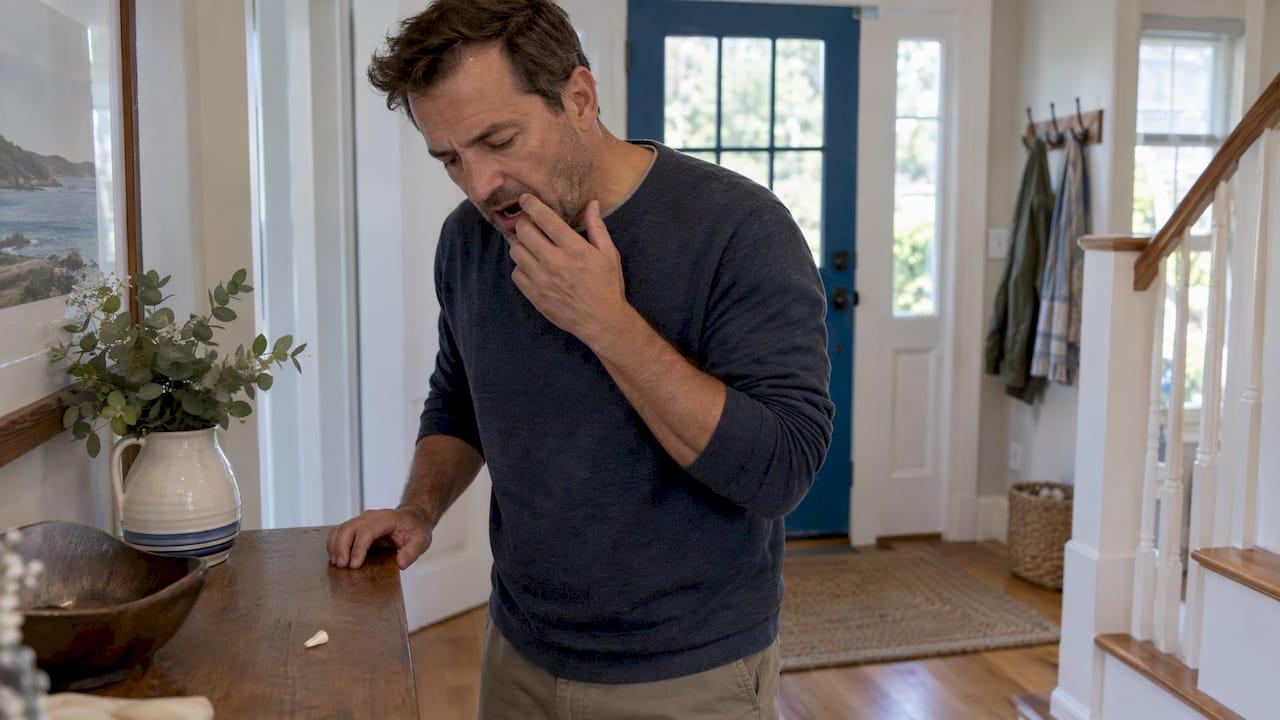
If an adult tooth has been knocked out, pick it up by the crown (the white chewing part), gently rinse it only if it is dirty, push it back into the socket if you can, and get to a dentist within 30 minutes. If you can't put it back, keep it moist in milk or inside your cheek. A knocked-out adult tooth can often be saved when you act fast, and our team in Kennebunk keeps same-day and walk-in appointments for exactly this kind of urgent visit.
TL;DR
- Hold the tooth by the crown only. Never touch or scrub the root.
- Try to replant it in the socket right away, then bite gently on clean gauze or a damp cloth to hold it.
- If it won't go back in, keep it moist in cow's milk, in your own saliva, or in an ADA-approved preservation product. Never let it dry out.
- Get to a dentist within 30 minutes if you can. If the office is closed, go to a hospital emergency department.
- Even after an hour or more, a tooth may still be saved, so go anyway.
Table of Contents
- The first five minutes: what to do right now
- If you can't put the tooth back in
- How fast do you really need to move?
- What if the dentist's office is closed?
- What happens at the dentist
- What if the tooth can't be saved?
- When the tooth isn't out, only loose or broken
- Mistakes that cost people their tooth
- Perspective
- Getting seen in Kennebunk
- After the emergency: protecting your smile
- A simple emergency kit for your home or car
- FAQ
- Sources
The first five minutes: what to do right now
This is the part that decides the outcome. Work through it in order.
- Find the tooth and pick it up by the crown. The root is covered in delicate cells that help the tooth reattach. Mayo Clinic says to handle the tooth by the crown only, not the roots.
- Rinse it only if it is dirty, and keep it brief. The American Association of Endodontists (AAE), the body for root and nerve specialists, says to use water only, with no soap or chemicals, and no scrubbing or drying. Mayo Clinic suggests a brief rinse with cow's milk or saliva instead of tap water.
- Put it back in the socket if you can. Push it in gently, facing the right way. Don't force it. MedlinePlus, from the U.S. National Library of Medicine, notes that a knocked-out permanent tooth can sometimes be put back in place.
- Hold it there. If it won't go all the way in, bite gently on gauze, a napkin or a damp paper towel to keep it in position. Be careful not to swallow it.
- Call and go. Phone the dentist on your way. Say "knocked-out adult tooth" so the team can clear time for you.
If you are bleeding, press gauze against the area. A cold compress on the outside of your mouth eases pain, according to MedlinePlus.
If you can't put the tooth back in
Sometimes the socket is bleeding too much, you feel faint, or the tooth is damaged and replanting isn't realistic. Then the goal is simple: keep the root surface wet until a dentist can take over.
The options, from the sources above:
| Storage option | How to do it | Notes |
|---|---|---|
| Cow's milk | Place the tooth in a small container with just enough milk to cover it | Recommended by Mayo Clinic and MedlinePlus |
| Your own saliva | Hold the tooth between your cheek and gum, or under your tongue | Only if you are alert and won't swallow it; the ADA's MouthHealthy page lists the cheek-and-gum option |
| Tooth-preservation product | Use a kit with the ADA Seal of Acceptance, such as Save-A-Tooth | Sold without a prescription, and some dental offices have them |
Two things to avoid. First, don't wrap the tooth in tissue or cloth. Mayo Clinic explains that this can damage the root surface and make survival less likely. Second, don't leave it in tap water for long. Too much tap water can kill the cells on the root that help the tooth reattach. MedlinePlus also warns against scraping or wiping the root, cleaning the tooth with alcohol or peroxide, and letting it dry out.
If you are carrying a young child's tooth, that is a different situation: baby teeth are not replanted. This article is for adult (permanent) teeth.
How fast do you really need to move?
The AAE advises seeing a dentist or endodontist within 30 minutes. That is the target, not a cliff edge. The AAE also says a tooth may still be saved even if it has been outside the mouth for an hour or more.
Here is what the evidence says about timing:
- The ADA's page on Save-A-Tooth states that the solution is effective up to 24 hours, but survival is highest when a dentist replants the tooth within one hour.
- A 2023 case report in PMC describes success rates for reimplantation ranging widely, from 4% to 50%, depending on how long the tooth was out and how it was stored. It also notes that replanting within 5 to 20 minutes of dry time is widely accepted as the best emergency treatment.
- The same report says that even in delayed cases, replanting is still recommended because of the value of keeping a natural tooth, though a long time outside the socket raises the risk of complications such as root resorption (the body slowly dissolving the root).
The practical message: every minute counts, and a late arrival is still worth the trip. Don't decide the tooth is lost and leave it at home.
What if the dentist's office is closed?
The ADA's MouthHealthy page says that most dentists reserve time in their schedules for emergency patients, and that if the accident happens when the office is closed, you should visit your local emergency room. MedlinePlus agrees: if you can't reach your dentist, go to a hospital emergency department and bring the tooth.
Go to the emergency room right away, not a dental office, in these situations:
- You can't close your upper and lower teeth together. MedlinePlus says this may mean a broken jaw, which needs medical help immediately.
- You lost consciousness, or you hit your head.
- Bleeding won't stop with direct pressure.
In those cases, take the tooth with you, kept moist, and tell the staff you need a dentist to see it too.
What happens at the dentist
Knowing what comes next takes some of the panic out of the moment.
Exam and X-rays. The dentist checks the tooth, the socket, the neighboring teeth and the bone for fractures. Dental X-rays show whether the socket or jaw was damaged, and whether any piece of root stayed behind. Mayo Clinic notes that if you can see a sharp or shiny surface where the tooth was, part of the root may still be in the socket. The tooth can still go back in, but replanting is less likely to succeed.

Replanting and stabilizing. If you didn't manage to put the tooth back, the dentist can do it. The tooth is typically held steady while the tissue around it heals. Your dentist will give you the exact plan for how long and how to eat in the meantime.
Nerve treatment. MedlinePlus says that after replantation you will most likely need a root canal, because the nerve inside the tooth was cut when it came out. Your dentist will tell you when that step is needed.
Follow-up. A replanted tooth needs monitoring. Expect return visits so the dentist can check that the root is healing and not resorbing.
What if the tooth can't be saved?
Some teeth are cracked at the root, were out too long, or sit in a socket too damaged to hold them. That is not the end of the story. A missing front tooth can be replaced in a way that looks and works like the original.
The main options are:
- A dental implant: a titanium post placed in the jawbone, topped with a crown. See our page on dental implants in Kennebunk.
- A dental bridge: a replacement tooth anchored to the teeth on each side. Our page on dental bridges explains how it works.
- Crowns and cosmetic repair for neighboring teeth that were chipped in the same accident. Our restorative dentistry and cosmetic dentistry pages cover these.
Which one fits depends on the bone, the gums, the neighboring teeth and your goals. An exam is the only way to know.
When the tooth isn't out, only loose or broken
Not every injury is a full knockout. A tooth pushed out of position, a loose tooth or a break each call for a dentist the same day, and some are closer to the scenarios we've covered on our blog. If your tooth is only wobbly, read what a loose adult tooth means. If a piece snapped off, our guide to a broken tooth emergency explains when to get care. For a smaller chip, see chipped tooth repair. And for a broader overview of what counts as urgent, there's our emergency dental care guide.
Mistakes that cost people their tooth
Most failed rescues come from a handful of understandable errors:
- Holding the tooth by the root. It feels natural to grab the pointed end. Resist.
- Scrubbing it clean. Blood and dirt are less harmful than removing the root cells. Rinse briefly, nothing more.
- Wrapping it in a tissue or leaving it on a counter. Drying is the enemy. MedlinePlus lists letting the tooth dry out as something to avoid.
- Storing it in plain water for a long time. Use milk, saliva or a preservation kit.
- Waiting until morning. Even if the pain is manageable, the clock is running on the root cells.
- Using alcohol or peroxide. MedlinePlus warns against both.
Perspective
We know a knocked-out tooth is frightening, and the first call is the hardest. Our job is to make that moment less stressful. We offer same-day and walk-in appointments, so you aren't left waiting for a slot while the clock runs on your tooth.
Our Kennebunk office is built around comfort for patients of every age, including people who dread the dentist. If you arrive shaken after an accident, you will meet a calm, welcoming team, and we have comfort items and ceiling-mounted TVs to help you settle during treatment.
We also use digital scanners for precision. That matters after trauma, when we need an accurate picture of the tooth and its neighbors to plan repair or replacement. Because we handle general, restorative and cosmetic dentistry under one roof, the same office that sees you first can follow through on crowns, bridges and implants if the tooth can't be kept.
Our advice: do the first-aid steps above, call us on the way, and come in. Don't spend the first hour wondering whether it is worth it.
Alex
Getting seen in Kennebunk
If you are in or near Kennebunk and have a tooth that was knocked out, Starboard Dental offers same-day and walk-in appointments. Our general dentistry team handles exams and X-rays, and our restorative and cosmetic teams can rebuild or replace a tooth that can't be saved.

Start at our general dentistry page to see what we do, or visit starboarddental.com to contact us. If you are reading this after an injury, call us on the way to the office.
After the emergency: protecting your smile
Once the tooth is back in place or replaced, a few habits reduce the chance of a repeat:
- Wear a mouthguard for sports. Knocked-out teeth often come from impact. We provide night guards for grinding, and a protective guard is worth asking about at your checkup. See our services page.
- Don't bite hard objects like ice, pens or packaging with your front teeth.
- Keep up with checkups. A weak or decayed tooth is more likely to fail under impact, and regular exams catch problems early. Our exams, checkups and cleanings are the place to start.
- Report new symptoms. A replanted tooth that darkens, becomes tender or has a swollen gum nearby needs a look. Call the office that treated you.
If you grind your teeth or your jaw clicks and aches after the injury, we also treat TMD, which is jaw joint trouble, at our main site.
A simple emergency kit for your home or car
You can prepare in two minutes, and it pays off if someone in your family plays sports or has a long drive.
- A small container with a tight lid, so you can store a tooth in milk.
- A few squares of clean gauze, to control bleeding and hold a replanted tooth in place.
- A tooth-preservation product with the ADA Seal of Acceptance. The ADA's page on Save-A-Tooth says it increases the survival rate of a knocked-out tooth when used as directed.
- Our office number saved in your phone.
This doesn't replace a dentist. It just helps you do the first five minutes well.
FAQ
Can a knocked-out tooth be saved?
Often, yes. The AAE says a knocked-out tooth isn't necessarily lost for good, and proper emergency action can let it be replanted and last for years. Your odds are best if the tooth goes back in within minutes and you see a dentist within 30 minutes to an hour.
Can I put the tooth back in myself?
Yes, if you can do it gently. Hold it by the crown, rinse it briefly if dirty, and push it into the socket facing the right way. Then bite gently on gauze and head to the dentist. If it won't seat, keep it in milk or in your cheek instead of forcing it.
What should I do if my front tooth fell out?
The steps are the same as for any adult tooth. Keep it moist, replant it if you can without touching the root, and get to a dentist right away. The ADA's MouthHealthy page gives this same advice for any permanent tooth.
Will I need a root canal after a replanted tooth?
Most likely. MedlinePlus says that after replantation you will most likely need a root canal to remove the cut nerve inside the tooth. Your dentist will explain the timing at your follow-up visits.
What if it has been more than an hour?
Go anyway. The AAE says a tooth may still be saved after an hour or more outside the mouth, and a 2023 case report notes that replanting is still recommended in delayed cases because of the value of keeping a natural tooth. If it can't be saved, replacement options such as implants and bridges are available.
Sources
- Tooth loss: First aid, Mayo Clinic
- Broken or knocked out tooth, MedlinePlus
- Dental Emergency, MouthHealthy (American Dental Association)
- Knocked Out Teeth, American Association of Endodontists
- Save-A-Tooth, American Dental Association
- Successful outcome of permanent maxillary incisor replantation, PMC (2023)