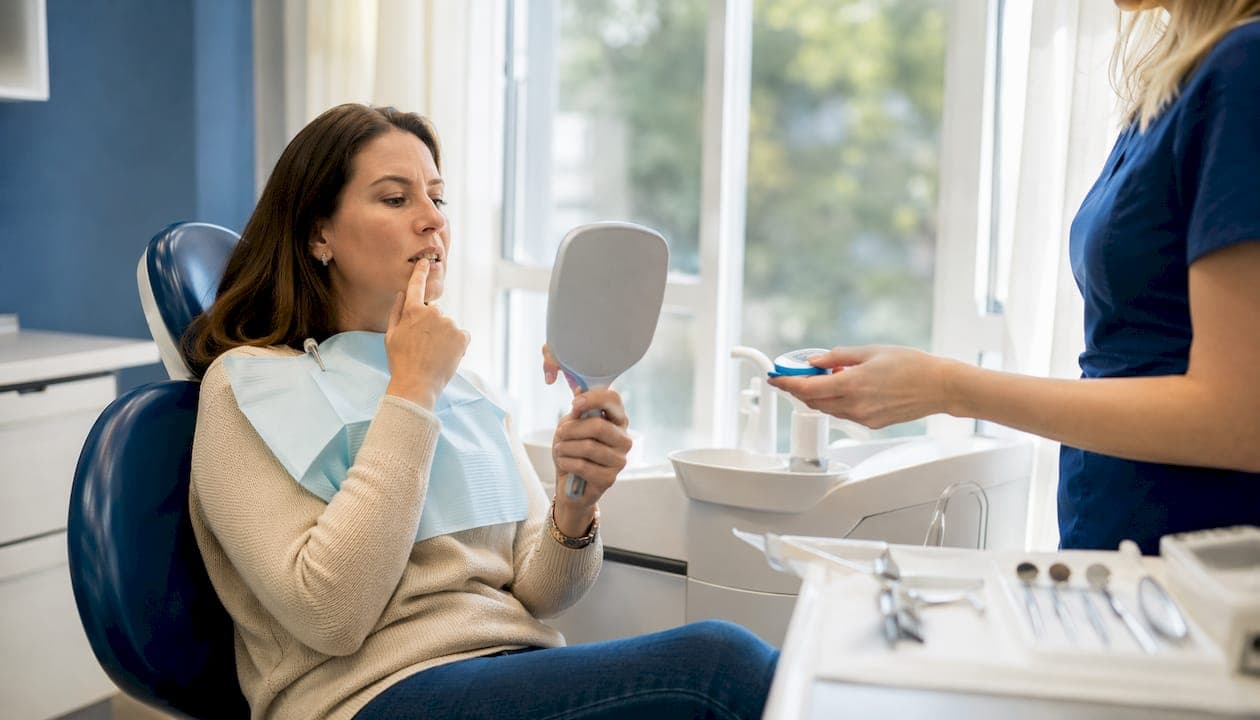
A chipped tooth needs a dental assessment as soon as possible. Most small chips are handled with dental contouring or composite bonding in a single visit. Larger breaks, especially those involving the inner dentin or the pulp, may require a crown, veneer, or root canal before a final restoration. The core repair options, ranked roughly from least to most invasive:
- Smoothing/contouring — for tiny enamel nicks with no sharp edges; no anesthesia, no material added
- Composite bonding — for small to moderate chips, especially on front teeth; completed chairside in one visit
- Dental filling — for posterior chips where strength matters more than aesthetics
- Porcelain veneer — for larger cosmetic chips on front teeth; requires two visits and lab work
- Crown — for significant structural breaks, especially on molars; full coverage, two visits typical
- Root canal + crown — when the pulp is exposed or infected; multiple visits, then a crown to protect the tooth
- Extraction + implant or bridge — only when the tooth cannot be saved
According to the Cleveland Clinic, repair choice depends entirely on damage severity, and the range of U.S. costs reflects that: treatment costs run roughly $100 to $6,000 depending on what the tooth needs. Starboarddental offers same-day appointments in Kennebunk for urgent assessments, so you do not have to wait days to find out where your chip falls on that spectrum.
Table of Contents
- What to do in the first minutes and hours after chipping a tooth
- What a chipped tooth actually is, and how it differs from a crack
- Common causes and the types of chips you might have
- How dentists evaluate a chipped tooth
- Professional repair options: what each one involves
- Realistic U.S. costs and how many visits each repair takes
- What to expect after repair, and how to prevent future chips
- How Starboarddental evaluates and treats chipped teeth
- Key Takeaways
- The part most guides skip
- Ready to get your tooth assessed at Starboarddental?
- Useful sources and further reading
What to do in the first minutes and hours after chipping a tooth
The first hour matters more than most people realize. Exposed dentin and pulp are vulnerable to bacteria almost immediately, and a jagged edge can cut your tongue or cheek with every swallow. Here is what to do before you reach the dentist.
Step 1: Rinse gently with warm water. This clears debris without irritating the exposed surface.
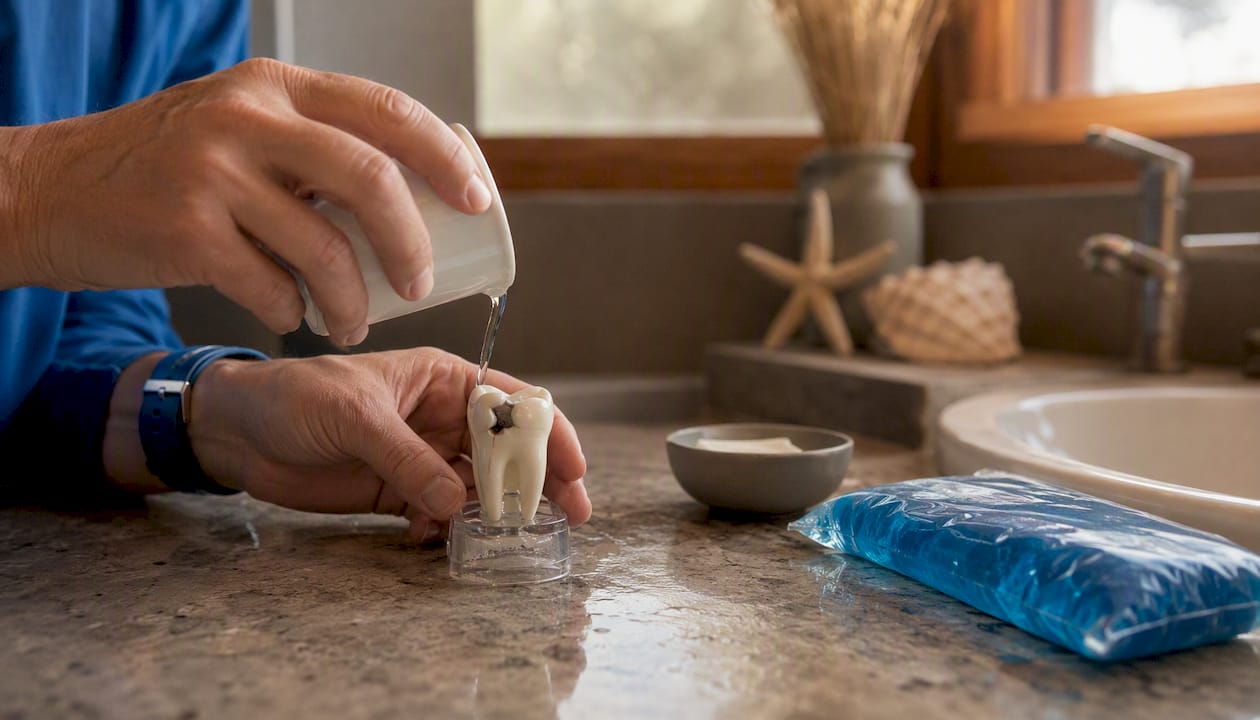
Step 2: Control any bleeding. Press clean gauze against the area for a few minutes. If bleeding does not slow, that is an emergency sign.
Step 3: Apply a cold compress. Hold it against your cheek for 10–15 minutes at a time to reduce swelling.
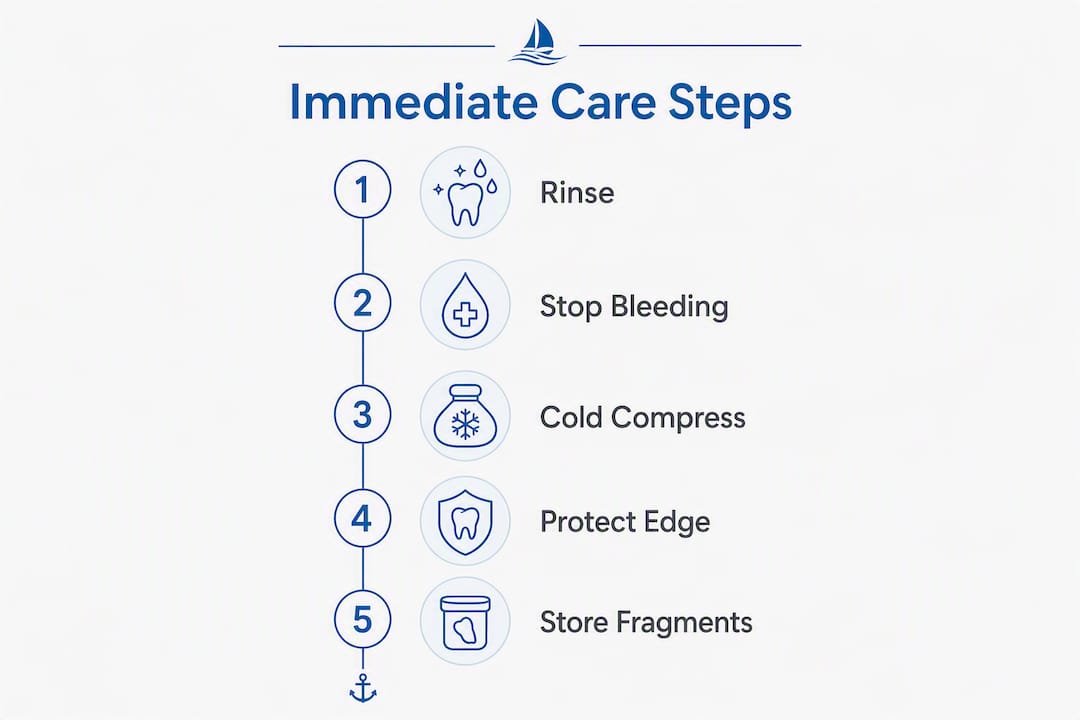
Step 4: Protect the sharp edge. Dental wax, available at most pharmacies, covers jagged enamel and prevents soft-tissue cuts until you get professional care. Sugar-free gum works in a pinch, though dental wax holds better.
Step 5: Recover and store any fragments. If you find the broken piece, keep it moist in milk or your own saliva. A dentist may be able to reattach the fragment for the most natural-looking result.
Step 6: Manage pain with OTC medication. Ibuprofen or acetaminophen at standard doses reduces both pain and inflammation. Avoid aspirin directly on the tooth or gum tissue.
Pro Tip: Never use household glue, nail adhesive, or at-home filing tools on a chipped tooth. These can permanently damage the enamel surface or introduce bacteria into an already vulnerable area.
Seek same-day emergency care if you experience any of these: severe or throbbing pain, uncontrolled bleeding, a visibly loose tooth, facial swelling, fever, or a chip that has clearly exposed the soft pink pulp inside the tooth. These signs suggest nerve involvement or infection risk that cannot wait 24–48 hours. For guidance on when a dental injury crosses into true emergency territory, see Starboarddental's emergency dental care guide.
For chips without those warning signs, contact a dentist within 24–48 hours. The tooth will not heal on its own, but the urgency level is lower.
What a chipped tooth actually is, and how it differs from a crack
Not every broken tooth is the same, and the distinction matters for treatment.
A chip is a loss of enamel or a small fragment of tooth structure from the outer surface. Enamel does not regenerate, so whatever is lost stays lost without a restorative material to replace it. A chip is typically visible and often has a sharp edge.
A crack is a split that runs into the tooth rather than breaking a piece off. Cracks can be superficial (craze lines in the enamel only) or deep enough to reach the dentin or pulp. The tricky part: a crack may not be visible to the naked eye at all.
A vertical root fracture or split tooth is more serious still. These extend from the root upward and often require extraction because the structural integrity of the tooth is compromised beyond repair.
| Type | What it involves | Typical severity | Requires X-ray to confirm? |
|---|---|---|---|
| Chip | Enamel or dentin fragment loss | Low to moderate | Sometimes |
| Crack (craze line) | Superficial enamel split | Low | Rarely |
| Deep crack | Extends into dentin or pulp | Moderate to high | Yes |
| Vertical root fracture | Root-level split | High | Yes |
| Split tooth | Complete separation of segments | Severe | Yes |
A tooth's outward appearance can understate internal damage. A chip that looks minor on the surface sometimes hides a crack that extends toward the root, which is exactly why X-rays and clinical testing are standard at any dental assessment for a broken tooth.
Common causes and the types of chips you might have
Chips happen in predictable ways. Trauma from a fall, collision, or sports impact is the most obvious cause. Biting down on something unexpectedly hard, like a popcorn kernel, an olive pit, or ice, accounts for a large share of non-traumatic chips. Teeth grinding (bruxism) wears enamel over time and makes teeth more susceptible to fracturing under normal bite forces. Existing large fillings can also weaken the surrounding tooth structure, making a cusp break more likely.
Where the chip occurs shapes what repair you will likely need:
- Tiny enamel nick (front or back): No dentin exposed; often handled with smoothing alone
- Moderate cosmetic chip (front tooth, dentin exposed): Sensitive to temperature; bonding or veneer is typical
- Large structural break (molar cusp loss): High bite forces make a crown the standard recommendation
- Chip exposing the pulp: Visible pink tissue or severe spontaneous pain; root canal therapy required before any final restoration
Front teeth repairs prioritize appearance. A bonded front tooth needs to match the shade and translucency of adjacent teeth, which is why composite selection and technique matter. Molars and premolars take the brunt of chewing forces, so the priority there is strength and full coverage rather than cosmetics.
How dentists evaluate a chipped tooth
Knowing what happens at the appointment removes a lot of anxiety. The assessment is usually straightforward, though it can take longer when the damage is ambiguous.
- Visual inspection: The dentist checks the chip's size, location, and whether dentin or pulp is visible.
- Palpation and probing: Feeling around the tooth and gum line for tenderness, mobility, or signs of a deeper fracture.
- Bite testing: Biting on a small stick or cotton roll can localize pain and help identify crack direction.
- Pulp vitality testing: If sensitivity or spontaneous pain suggests nerve involvement, a cold or electric stimulus test checks whether the pulp is still healthy.
- Dental X-rays: Standard for any chip beyond a minor enamel nick. X-rays reveal root damage, bone loss, and crack depth that clinical inspection alone cannot show. For guidance on what dentists look for in these images, Starboarddental's early decay detection guide explains the process well.
A minor chip check with no imaging takes a short appointment. A full assessment with X-rays and vitality testing typically takes longer depending on the case complexity. If the dentist suspects pulp involvement, they may refer to an endodontist before finalizing a treatment plan.
Professional repair options: what each one involves
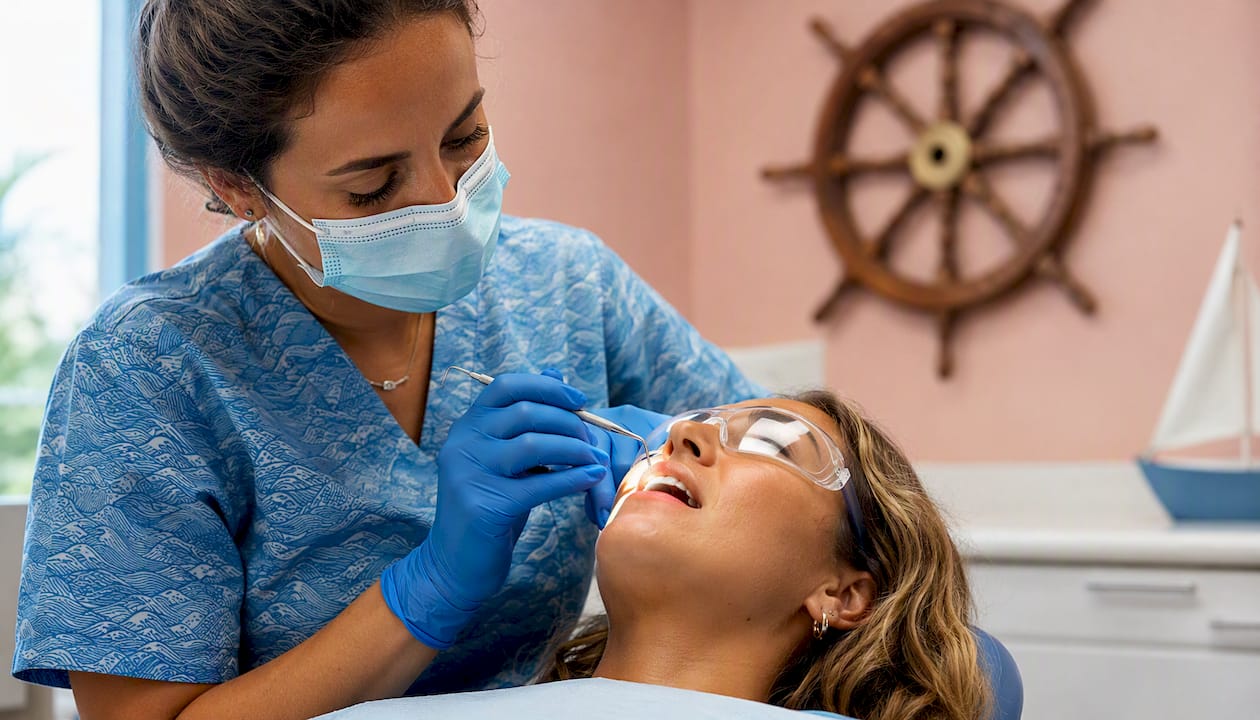
Repair options range from a five-minute polish to a multi-visit restorative sequence. The right choice depends on where the tooth is, how much structure is lost, and whether the nerve is involved.
| Treatment | Best for | Cosmetic or structural | Typical U.S. cost | Visits/timeline | Durability | Anesthesia/lab? |
|---|---|---|---|---|---|---|
| Contouring/smoothing | Tiny enamel nicks | Cosmetic | $50–$300 | 1 visit (5–10 min) | Permanent (no material to replace) | None |
| Composite bonding | Small–moderate front chips | Cosmetic/minor structural | $100–$600 per tooth | 1 visit (20–40 min) | 5–10 years with care | Local anesthesia sometimes; no lab |
| Dental filling | Posterior chips | Structural | $100–$500 | 1 visit | 5–15 years | Local anesthesia; no lab |
| Porcelain veneer | Larger front-tooth chips | Primarily cosmetic | $900–$2,500 per tooth | 2 visits (~2 weeks apart) | 10–20 years | Local anesthesia; lab required |
| Crown | Large breaks, molar cusp loss | Structural | $1,000–$3,500 | 2 visits (~2 weeks apart) | 10–30 years | Local anesthesia; lab required |
| Root canal + crown | Pulp exposure or infection | Structural | $1,500–$5,000+ | 2–4 visits | Long-term if maintained | Yes; lab required |
| Extraction + implant | Non-restorable tooth | Structural replacement | $3,000–$6,000+ | Multiple visits over months | Decades | Yes; surgical |
Composite bonding is the go-to for front-tooth chips. It is shaped directly on the tooth, cured with a light, and polished in one appointment. The trade-off: composite can stain over time and may need touch-ups every few years, especially in patients who drink coffee or tea regularly. It does not match the longevity of porcelain.
Veneers make sense when the chip is large enough that bonding would look bulky, or when the patient also wants to address shape and shade. Porcelain veneers are custom-made in a lab and bonded to the tooth surface, which means two visits spaced about two weeks apart. They last considerably longer than composite with proper care.
Crowns are the standard answer for a molar that has lost a significant cusp. The remaining tooth structure is often too weak to handle bite forces without full coverage. Crown therapy at Starboarddental uses digital scanning for precise fit, which reduces the adjustment time at the second visit.
Root canal therapy is not optional when the pulp is exposed or infected. Exposed dentin and pulp are vulnerable to rapid bacterial invasion, and delaying treatment increases the risk of abscess and bone loss. A crown almost always follows to protect the treated tooth.
Pro Tip: Ask your dentist whether a same-day CEREC crown is available. Digital milling technology allows some practices to fabricate and place a crown in a single appointment, eliminating the temporary crown phase and the second visit entirely.
Pros and cons of composite bonding:
- ✅ Single visit, no lab, lower cost
- ✅ Conservative — minimal tooth removal
- ✅ Easily repaired if chipped again
- ❌ Stains more readily than porcelain
- ❌ Shorter lifespan than veneers or crowns
- ❌ May not match adjacent teeth perfectly over time
Realistic U.S. costs and how many visits each repair takes
Cost is the first question most people have, and the honest answer is that it varies a lot. The main drivers: which tooth is involved, how much structure is missing, whether a root canal is needed, and whether the restoration requires lab work.
| Treatment | Typical U.S. cost range | Visits/timeline | Insurance coverage note |
|---|---|---|---|
| Contouring | $50–$300 | 1 visit | Often covered as preventive or minor restorative |
| Composite bonding | $100–$600/tooth | 1 visit | Partially covered for anterior teeth; cosmetic use may not be |
| Filling (posterior) | $100–$500 | 1 visit | Usually covered under basic restorative benefits |
| Porcelain veneer | $900–$2,500/tooth | 2 visits, ~2 weeks | Rarely covered; considered cosmetic by most plans |
| Crown | $1,000–$3,500 | 2 visits, ~2 weeks | Coverage varies after deductible |
| Root canal | $700–$1,500 (tooth only) | 1–3 visits | Usually covered at 50–80% |
| Implant (after extraction) | $3,000–$6,000+ | Multiple visits over months | Limited coverage; some plans exclude implants |
These U.S. cost ranges reflect out-of-pocket estimates without insurance. With a dental plan, traumatic injuries are often treated more favorably than elective cosmetic work.
- Call your insurer before the appointment to ask whether the chip qualifies as a traumatic injury, which typically triggers better coverage for exams, X-rays, fillings, and crowns.
- Ask the dental office for a pre-authorization if a crown or root canal is likely. This gives you a written estimate of what insurance will pay before treatment begins.
- Veneers are almost never covered by standard dental plans because they are classified as cosmetic, even when the underlying chip is structural.
A dental treatment plan from your dentist will sequence any multi-visit work and give you a clear financial picture before you commit.
What to expect after repair, and how to prevent future chips
Most repaired teeth function normally. The prognosis depends on the treatment: a contoured enamel nick is essentially permanent, while composite bonding typically needs a touch-up or replacement within 5–10 years. Porcelain veneers generally last 10–20 years with proper care. Crowns, when well-fitted and maintained, can last 10–30 years.
Warning signs that a repaired tooth needs re-evaluation:
- New sensitivity to cold or biting pressure
- Visible crack lines in bonding or veneer material
- The restoration feels high or shifted when you bite
- Pain that was not present right after treatment
Prevention is straightforward once you know the risk factors:
- Wear a custom mouthguard for any contact sport. Over-the-counter guards offer some protection, but a custom-fitted guard from your dentist absorbs impact more effectively.
- If you grind at night, a nightguard is one of the most cost-effective ways to protect both natural teeth and existing restorations.
- Avoid using your teeth as tools: opening packages, biting nails, or chewing ice all create stress concentrations that enamel was not designed to handle.
- Keep up with routine checkups. A dentist can spot wear patterns and early cracks before they become full chips.
For managing sensitivity after a repair, Starboarddental's guide on sensitive teeth covers practical strategies for the days following treatment.
How Starboarddental evaluates and treats chipped teeth
Starboarddental in Kennebunk is equipped to handle chipped teeth from the initial assessment through final restoration, with same-day appointments available for urgent cases.
What the clinic offers for chipped tooth cases:
- Same-day appointments for patients with pain, sharp edges, or visible damage
- Digital scanning for precise crown and veneer fabrication, reducing fit adjustments
- Full range of restorative and cosmetic options: contouring, composite bonding, fillings, veneers, and crowns
- Coordination with endodontic specialists when root canal therapy is needed before final restoration
- Sedation and local anesthesia options for patients with dental anxiety
- Insurance and financial discussion at the first visit, including pre-authorization support
What to expect at your first visit:
- A clinical exam and, when indicated, digital X-rays to assess crack depth and root involvement
- A clear explanation of which repair options apply to your specific chip, with cost estimates
- Same-day treatment for minor chips (contouring or bonding) when the diagnosis is straightforward
- A two-visit plan with a temporary restoration if a crown or veneer is needed
Starboarddental's conditions and treatments page gives a full overview of what the practice handles, and the new patient information page covers what to bring and what to expect at a first visit.
A note on children vs. adults: Primary (baby) teeth are treated more conservatively because they will eventually be replaced. A chipped baby tooth may only need smoothing unless the pulp is involved. Permanent teeth in children and adolescents are treated similarly to adults, though the dentist may choose materials with growth and long-term durability in mind.
Key Takeaways
Most chipped teeth are treatable in one or two visits, and the sooner you get a clinical assessment, the more repair options remain available.
| Point | Details |
|---|---|
| Act within 24–48 hours | Seek dental care promptly; same-day if you have severe pain, bleeding, or visible pulp. |
| Protect the tooth first | Use dental wax on sharp edges, store fragments in milk or saliva, and avoid chewing on the damaged side. |
| Repair type follows severity | Small chips often need only contouring or bonding; large breaks or pulp exposure require a crown or root canal. |
| U.S. costs range widely | Out-of-pocket costs run roughly $100–$6,000 depending on treatment; call your insurer about traumatic injury coverage. |
| Starboarddental offers same-day care | The Kennebunk clinic provides urgent assessments, digital scanning, and the full range of restorative and cosmetic repairs. |
The part most guides skip
Most chipped tooth articles spend their energy on the repair menu and the cost table. What they underplay is the window problem: the gap between when a chip happens and when most people actually call a dentist.
People wait. They wait because the pain is manageable, because they are busy, because they assume a small chip is just cosmetic. That delay is where the real cost accumulates. Exposed dentin is not just sensitive; it is an open invitation for bacteria. A chip that could have been fixed with bonding in one visit can become a root canal case in a matter of weeks if decay establishes itself in the exposed dentin. The repair cost does not just double; it can multiply several times over.
The other thing worth saying plainly: not every chip needs the most aggressive repair. There is a tendency in dental care to reach for the most durable option, and durability is genuinely important. But a composite bond on a front tooth is not a compromise. For the right chip, it is the correct treatment, and placing a veneer or crown on a tooth that only needed bonding removes healthy structure unnecessarily. The best dentists match the repair to the damage, not to the billing code.
If you are grinding your teeth at night and you have had more than one chip in the past few years, the chip is a symptom, not the problem. Treating the chip without addressing the bruxism is like patching a roof without fixing the leak. A nightguard is not glamorous, but it is the intervention that actually changes the trajectory.
Ready to get your tooth assessed at Starboarddental?
A chipped tooth that gets evaluated quickly is almost always easier and less expensive to treat. Starboarddental in Kennebunk offers same-day appointments for urgent dental concerns, so you do not have to spend days in discomfort waiting for an opening.

The clinic's restorative dentistry services cover everything from a quick bonding repair to full crown placement, with digital scanning for precise results. For cosmetic chips on front teeth, the cosmetic dentistry team handles bonding and veneers with shade-matching to blend seamlessly with your natural teeth. Bring your insurance card, any recovered tooth fragments, and a list of current medications. Call the Kennebunk office directly or book online through the new patients page to schedule your assessment today.
Useful sources and further reading
- Chipped Tooth: Causes, Symptoms & Repair — Cleveland Clinic: Clinical overview of chip types, immediate care steps, and repair options
- How Much Does It Cost to Fix a Chipped Tooth Without Insurance? — Aflac: U.S. consumer-facing cost ranges by treatment type
- Starboarddental Restorative Dentistry: Crowns, fillings, and structural repair options at the Kennebunk clinic
- Starboarddental Dental Bonding: Composite bonding service details and candidacy information
- Starboarddental Cosmetic Dentistry: Veneers and aesthetic repair options
- Emergency Dental Care Guide — Starboarddental: When a chip or break requires same-day emergency attention
This article is general health information, not professional dental advice. For a diagnosis and treatment recommendation specific to your situation, consult a licensed dentist (DDS or DMD) or contact Starboarddental directly.