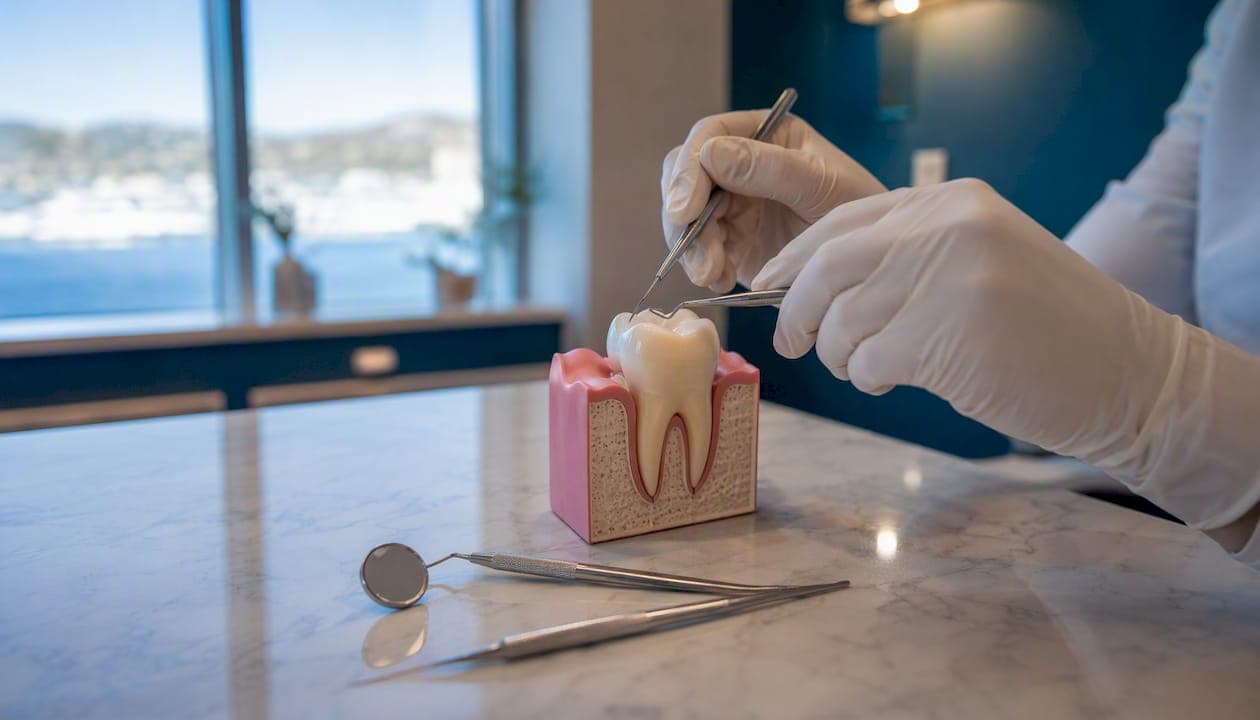
If a permanent tooth feels loose, stabilize it immediately, avoid chewing on it or wiggling it with your tongue, and contact your dentist the same day. A loose tooth adult diagnosis is never something to wait out, because the underlying cause, whether trauma or gum disease, tends to get worse without treatment, not better.
What you do in the next few minutes matters if the looseness followed an injury. What matters more if it developed slowly over weeks is getting a dentist to look at it before more bone support is lost.
Here's what to do right now:
- Stop touching or wiggling the tooth with your tongue, fingers, or during chewing.
- Switch to a soft diet immediately (yogurt, eggs, mashed foods) and chew on the opposite side.
- Rinse gently with warm salt water to reduce bacteria around the gum line.
- If there's bleeding, bite down gently on clean gauze for 10 to 15 minutes.
- If the tooth was knocked out entirely, keep it moist in milk or a saline solution and get to a dentist within the hour.
A tooth that's been avulsed, meaning it's been knocked completely out of the socket, has the best shot at successful reimplantation when it's handled by the crown (never the root), rinsed briefly if dirty, and either gently reinserted or stored in milk on the way to the dentist. Mayo Clinic's first-aid guidance treats this as a true race against time.
Treat it as an emergency if you're dealing with trauma, an avulsed tooth, bleeding that won't stop after 15 minutes of pressure, severe throbbing pain, or visible swelling and pus. Do not try to force the tooth back into place unless a dentist or an ER clinician instructs you to. And do not attempt to pull a loose permanent tooth yourself, even if it feels like it's barely hanging on. Removing it yourself can damage the socket and rule out reimplantation or grafting later.
Key Takeaways
Early evaluation is the single biggest factor in whether a loose adult tooth can be saved rather than lost.
| Point | Details |
|---|---|
| Act fast, don't force it | Stabilize the tooth, avoid wiggling or chewing on it, and never try to pull it yourself. |
| Trauma changes the protocol | A knocked-out tooth needs milk or saline storage and dental care within the hour for the best reimplantation odds. |
| Mobility grade drives prognosis | Grade 1 looseness with intact bone often responds to nonsurgical care; Grade 3 usually points toward extraction. |
| Watch for red-flag signs | Uncontrolled bleeding, spreading swelling, fever, or breathing trouble means ER, not a wait-and-see approach. |
| Starboard Dental offers same-day evaluation | The practice provides periodontal probing, x-rays, mobility grading, and same-day stabilization for loose teeth. |
Table of Contents
- Is a Loose Tooth Normal in Adults?
- Symptoms and Causes of a Loose Molar or Front Tooth
- How Dentists Diagnose and Grade a Loose Tooth
- Treatment Options: From Cleaning to Splinting to Extraction
- Safe Home Care While You Wait for Your Appointment
- When a Loose Tooth Becomes a Dental Emergency
- What's the Long-Term Outlook for a Loose Tooth?
- How Pregnancy, Osteoporosis, and Medications Change the Picture
- What Happens During Your Dental Visit for a Loose Tooth
- What I've Learned Watching Loose Teeth Get Saved (and Lost)
- Getting Your Loose Tooth Evaluated at Starboard Dental
- Frequently Asked Questions
- Sources
Is a Loose Tooth Normal in Adults?
No. Adult tooth mobility is never something to shrug off, though how alarmed you should be depends on the type of movement you're feeling.
Every tooth has a tiny amount of natural give. The periodontal ligament, the fibrous tissue anchoring your tooth root to the jawbone, acts like a shock absorber, letting teeth flex almost imperceptibly under the force of chewing. Dentists call this physiological micromobility, and it's normal and protective, not a warning sign.
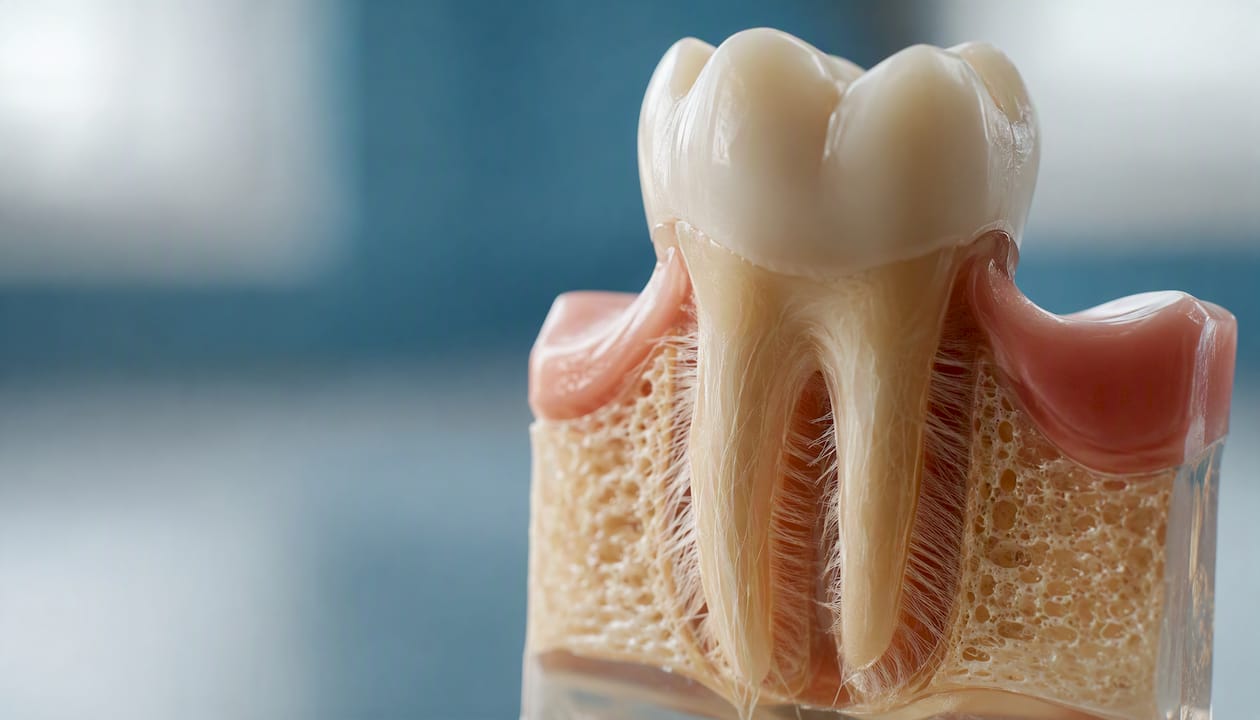
Pathological mobility is different. This is a tooth that visibly shifts when you press on it, feels like it's rotating in the socket, or has changed position enough to alter your bite. That kind of movement means something has compromised the tooth's support system: bone loss, ligament damage, or infection.
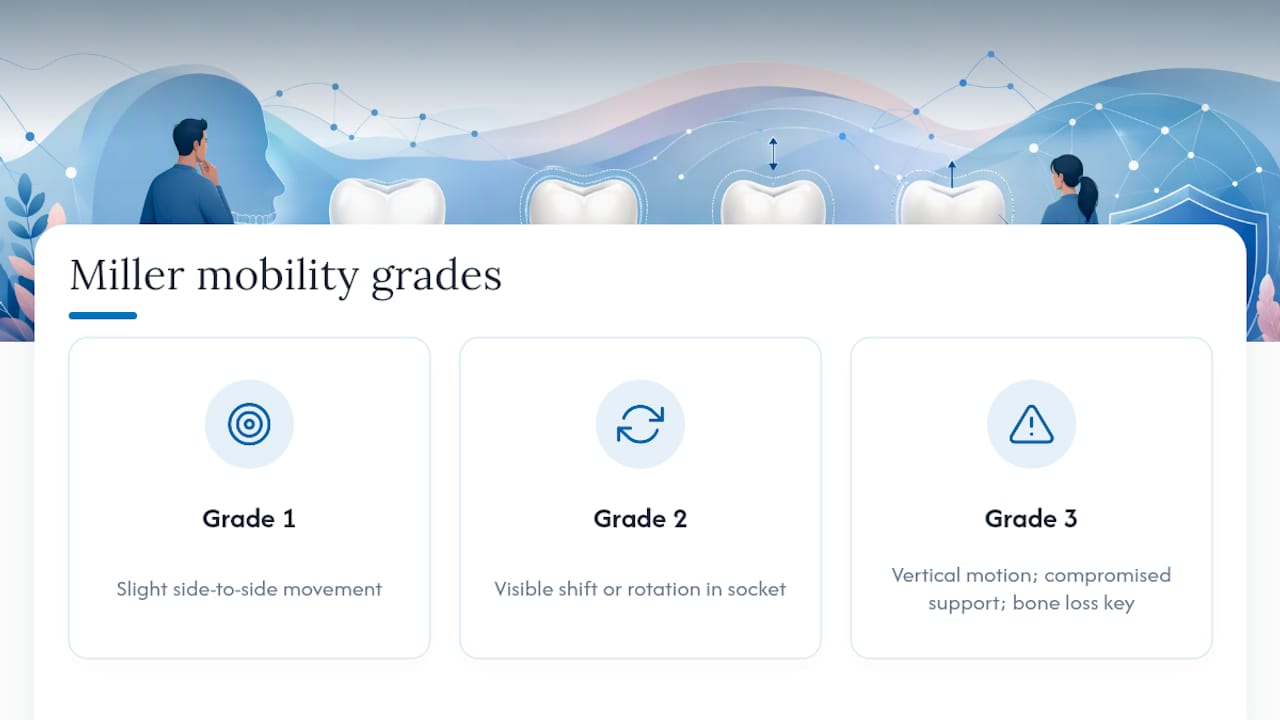
When you see a dentist about it, they'll likely describe what they find using a mobility grading system, sometimes called the Miller scale, running from Grade 1 (slight side-to-side movement) to Grade 3 (the tooth moves vertically in the socket, almost like it's being pushed down and popping back up). That grade, combined with how much bone has been lost around the root, largely determines whether the tooth can be saved.
Symptoms and Causes of a Loose Molar or Front Tooth
The main things to watch for are visible movement, a bite that feels "off," gum bleeding, swelling, pain, and persistent bad breath. Any combination of these is worth describing precisely when you call your dentist's office, because it helps them triage how urgently you need to be seen.
Several distinct problems can cause adult tooth mobility, and they don't all carry the same urgency:
- Periodontitis is the leading cause. Gum disease destroys the bone and connective tissue anchoring teeth, and it's often painless in its earlier stages, so mobility is sometimes the first symptom people notice.
- Dental trauma from a fall, sports injury, or car accident can loosen a tooth instantly, even without visible chips or breaks.
- Bruxism (chronic teeth grinding, often at night) puts repetitive stress on the ligament and bone that eventually shows up as looseness.
- Osteoporosis reduces bone density throughout the body, including the jaw, weakening the anchorage that holds teeth in place.
- Pregnancy triggers hormonal shifts that make gum tissue more prone to inflammation and bleeding, sometimes loosening teeth temporarily.
- Certain medications and systemic disease, including uncontrolled diabetes, interfere with healing and bone maintenance around teeth.
- Root fracture from an old injury or a failed root canal can destabilize a tooth that looks structurally fine from the outside.
- Failed restorations, such as a crown or filling that no longer seals properly, can let bacteria in and undermine the tooth from beneath.
Smoking, uncontrolled diabetes, poor oral hygiene, and age-related bone loss all raise your risk across the board. Research cited by the National Institutes of Health has associated osteoporosis in women with a higher rate of tooth mobility and eventual tooth loss, tied directly to reduced density in the alveolar bone that anchors teeth.
Before you call your dentist, run through this checklist mentally: Which tooth (or teeth)? Did it follow an injury, or come on gradually? Any bleeding, swelling, or pus? Does your bite feel different? Any pain, and does it radiate? Having clear answers helps the front desk get you into the right kind of appointment faster.
How Dentists Diagnose and Grade a Loose Tooth
Dentists determine both the cause and the severity of a loose tooth using clinical probing, mobility grading, a bite check, and dental x-rays, usually all in the same visit.
A typical exam for a mobile tooth runs through a fairly consistent sequence:
- Medical history review, including current medications, pregnancy status, and conditions like diabetes or osteoporosis.
- Periodontal probing, where the dentist or hygienist measures the depth of the gum pocket around the tooth with a small calibrated instrument. Deeper pockets generally mean more bone loss.
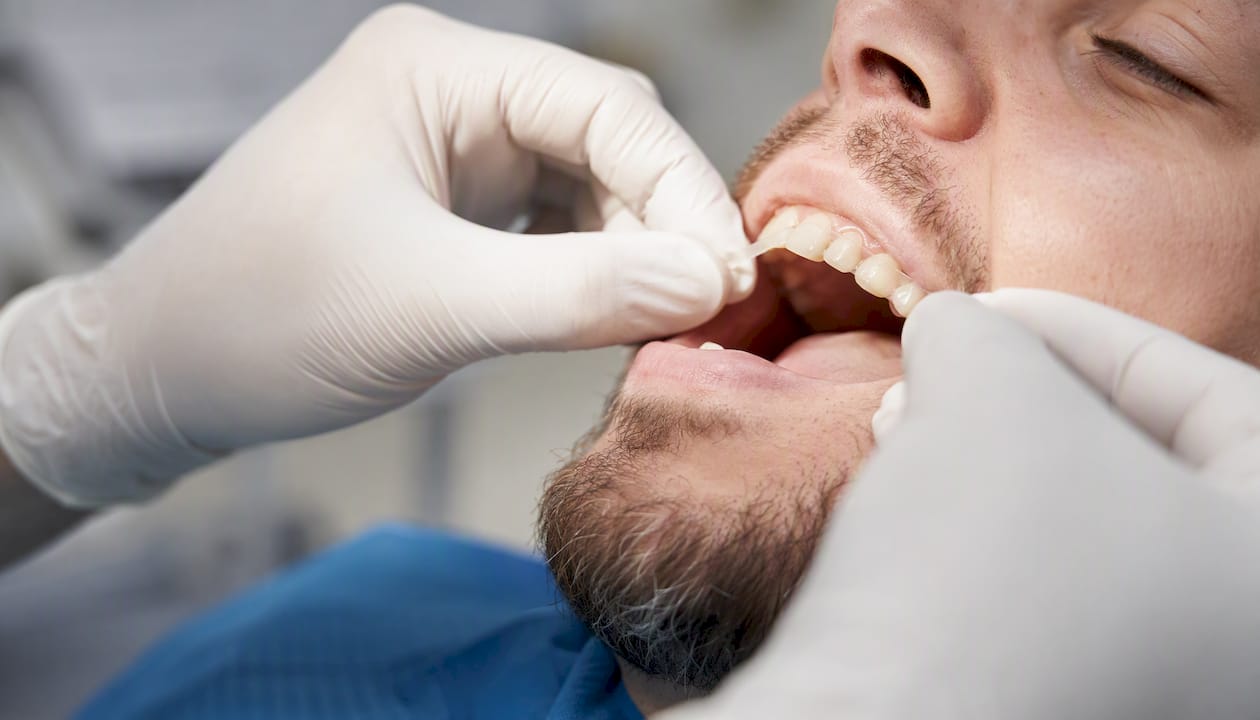
- Mobility grading, applying gentle pressure to classify the tooth's movement (Grade 1 through Grade 3).
- Bite analysis, checking whether the tooth is taking excessive force during chewing or clenching.
- Percussion and pulp testing, tapping the tooth and checking nerve response to rule out fracture or infection.
- Intraoral x-rays, periapical or bitewing images that reveal bone levels around the root.
- CBCT scanning, a 3D imaging option reserved for complex cases, such as suspected root fracture or planning for implant placement.
| Imaging Type | What It Shows | When It's Ordered |
|---|---|---|
| Periapical/bitewing x-ray | Bone levels around one or two teeth, root shape, decay | Routine mobility evaluation, first-line imaging |
| Panoramic x-ray | Full upper and lower jaw in one image | Broad screening, trauma assessment, wisdom teeth |
| CBCT (3D scan) | Detailed bone volume, root fractures, nerve position | Suspected fracture, implant planning, unclear standard x-ray |
Pro Tip: Mobility grade and pocket depth together are the strongest predictors of prognosis your dentist will use. A Grade 1 tooth with shallow pockets often responds well to nonsurgical care within weeks. A Grade 3 tooth, one that moves vertically in its socket, usually signals advanced bone loss and a much harder conversation about whether saving it is realistic.
Treatment Options: From Cleaning to Splinting to Extraction
Treatment for a loose tooth follows the cause: control the underlying risk factor first, then move into periodontal therapy, mechanical stabilization, and, if needed, surgery or replacement.
The path your dentist recommends depends heavily on what's driving the mobility:
- Improved oral hygiene and professional maintenance is the starting point for early gum disease, often enough on its own to reduce inflammation and slow further loss.
- Scaling and root planing, a deep cleaning below the gumline, removes plaque and tartar buildup that causes moderate periodontitis; most patients see measurable pocket-depth improvement within a few weeks.
- Antibiotics, when there's an active infection, are used alongside mechanical cleaning rather than as a standalone fix.
- Occlusal adjustment reshapes high spots on a tooth's biting surface to redistribute force evenly.
- Night guards protect teeth from the repetitive stress of bruxism, often preventing further loosening in patients who grind.
- Splinting, bonding a loose tooth to its neighbors for support, can stabilize a tooth that has adequate remaining bone but not enough on its own to withstand normal chewing.
- Periodontal flap surgery lets the dentist access and clean deep pockets and damaged bone that scaling alone can't reach.
- Bone grafting rebuilds lost bone volume around a tooth root, sometimes buying years of additional retention.
- Extraction and replacement, via a dental implant or bridge, becomes the recommended path when the tooth has lost too much support to reasonably expect long-term function.
Generally, a Grade 1 tooth caught early with intact bone support is salvageable through nonsurgical care alone. A tooth with deep pocketing, visible bone loss on x-ray, and Grade 3 mobility is far more likely headed toward extraction, no matter how aggressively it's treated.
Pro Tip: Splinting stabilizes a loose tooth mechanically, but it only works once the underlying cause, whether infection, inflammation, or excessive bite force, has been brought under control first. Splint too early and you risk masking ongoing bone destruction rather than stopping it, which is why dentists sequence treatment carefully rather than jumping straight to stabilization.
Safe Home Care While You Wait for Your Appointment
What you should do at home depends heavily on whether the looseness followed an injury or crept up gradually over weeks, so treat those two situations differently.
For slow-onset looseness, focus on protecting what stability remains: eat soft foods, avoid chewing directly on the affected tooth, rinse with warm salt water twice a day, and brush and floss gently rather than skipping hygiene out of fear of hurting it. Avoiding the area entirely often does more harm than good, since plaque buildup accelerates the very gum disease that likely caused the mobility in the first place.
For trauma-related looseness, especially a fully avulsed tooth, speed changes everything:
- Find the tooth and pick it up only by the crown (the white, visible part), never the root.
- If it's dirty, rinse it briefly under water, no scrubbing, no soap.
- If you're able to, gently reinsert it into the socket and hold it in place by biting on gauze.
- If reinsertion isn't possible, drop the tooth into a container of milk or a saline solution and get to a dentist immediately.
Reimplantation success for an avulsed permanent tooth drops sharply the longer the tooth sits dry outside the mouth. Milk preserves the delicate cells on the root surface far better than water or a dry tissue, which is part of why that specific detail shows up in nearly every emergency dental protocol.
For pain, acetaminophen or an NSAID like ibuprofen generally works fine as a short-term bridge to your appointment. Skip home remedies involving clove oil applied directly and undiluted, aggressive tooth-wiggling "to test it," or attempting to splint the tooth yourself with dental floss or wire. All of these tend to cause more harm than the delay of waiting for professional care.
When a Loose Tooth Becomes a Dental Emergency
Certain signs mean you need dental attention immediately, not "sometime this week." An avulsed tooth, uncontrolled bleeding, spreading facial swelling, or fever paired with dental pain all fall into that category.
Watch specifically for:
- A tooth completely knocked out of the socket (avulsion).
- Bleeding that hasn't slowed after 15 to 20 minutes of firm gauze pressure.
- Swelling that's visibly spreading across your face or into your neck.
- Fever accompanying tooth pain or gum swelling, a sign infection may be spreading.
- Pain that OTC medication doesn't touch at all.
- Difficulty breathing or swallowing, which can signal a serious spreading infection requiring emergency services, not a dental office visit.
Call your dentist's office first if it's reachable; most practices, including ones offering emergency dental care, keep same-day slots open for exactly this kind of situation. If your dentist is unreachable and you're seeing red-flag signs like breathing difficulty or facial swelling that's rapidly getting worse, go to the emergency room instead of waiting for a callback.
What's the Long-Term Outlook for a Loose Tooth?
Prognosis depends on the cause, how much bone support remains, the mobility grade, whether infection is present, and risk factors like smoking or unmanaged diabetes, not on any single one of those factors in isolation.
Dentists weigh several things together when predicting whether a tooth will hold:
- Pocket depth at the time of diagnosis, with shallower pockets generally meaning a better outlook.
- Bone loss visible on x-ray, since bone doesn't regenerate as readily as soft tissue.
- Mobility grade, with Grade 1 cases responding far better to treatment than Grade 3.
- Presence of pus or furcation involvement (bone loss reaching the point where a multi-rooted tooth's roots separate), both signs of more advanced disease.
- Systemic health, since uncontrolled diabetes and smoking both measurably slow healing after periodontal treatment.
Prevention overlaps heavily with general periodontal health: brush and floss daily, get professional cleanings on a regular schedule, quit smoking if you smoke, wear a night guard if you grind your teeth, use a mouthguard during contact sports, keep diabetes well controlled, and get enough calcium and vitamin D to support jawbone density.
Healing timelines vary by treatment. After scaling and root planing, most patients notice reduced bleeding and tighter gum tissue within two to four weeks, with a follow-up visit around six to eight weeks later to recheck pocket depths. Splinted teeth typically stay stabilized for several months while the underlying cause is treated, with the splint reassessed at each follow-up. Surgical grafting cases run longer, often three to six months before the graft has integrated enough to evaluate long-term success.
How Pregnancy, Osteoporosis, and Medications Change the Picture
Certain medical conditions and medications shift both your risk of a loose tooth and the treatment approach your dentist takes, so tell your dentist about all of them upfront.
A few situations that come up often enough to name specifically:
- Pregnancy gingivitis causes gum inflammation and sometimes mild tooth mobility due to hormonal shifts. It's typically reversible after delivery, though it still warrants a dentist's attention during pregnancy.
- Osteoporosis reduces bone density throughout the body, including the jaw, and has been linked to higher rates of tooth mobility and loss in women specifically, since alveolar bone loss weakens the anchorage teeth depend on.
- Antiresorptive medications, a class of drugs often prescribed for osteoporosis, carry a rare but serious risk of jaw osteonecrosis, meaning your dentist may need to adjust surgical timing or technique around these prescriptions.
- Diabetes, particularly when poorly controlled, impairs the body's ability to heal and fight infection, which slows recovery after periodontal treatment and raises the risk of complications.
- Immunosuppression, whether from medication or an underlying condition, similarly slows healing and can change how aggressively a dentist treats infection.
Always give your dentist a complete, current medication list, not just the ones you think are relevant. Clinicians sometimes adjust antibiotic coverage or delay elective surgical steps based on what you're taking, and finding that out mid-procedure is far worse than mentioning it at check-in.
What Happens During Your Dental Visit for a Loose Tooth
Clinics generally follow the same broad sequence: diagnose the cause first, then stabilize what needs immediate attention, then map out a short-term and long-term treatment plan.
A typical visit runs something like this:
- Triage, either over the phone or at check-in, to determine how urgent your case is.
- Exam and charting, including pocket depth measurements and a mobility grade for the affected tooth or teeth.
- X-rays to assess bone levels and rule out fracture.
- Urgent stabilization, if warranted, through splinting or a bite adjustment done that same day.
- Short-term prescriptions, such as antibiotics for active infection or something for pain management.
- Scheduling definitive care, whether that's a course of periodontal therapy, a root canal, or planning for extraction and replacement.
Most visits for this specific concern run 30 to 90 minutes, depending on whether x-rays and same-day stabilization are needed. Follow-up typically includes a periodontal maintenance cleaning within a few weeks, and a referral to a periodontist if the disease has progressed far enough to need surgical intervention.
A practice built for this kind of visit will generally offer general dentistry exams and cleanings, periodontal therapy for gum disease, restorative options like crowns and bridges, and same-day appointment availability for exactly the kind of situation described throughout this article.
What I've Learned Watching Loose Teeth Get Saved (and Lost)
The biggest misconception people carry into a dental visit is that a loose tooth is a death sentence for that tooth. It usually isn't, especially when it's caught at Grade 1 with intact bone underneath. What actually kills the chance of saving a tooth isn't the initial looseness; it's the delay. Every week someone waits to get evaluated is a week the underlying cause, whether that's bacteria eating away at bone or an untreated bite problem, keeps working against them.
The second thing people get wrong is assuming splinting is a fix rather than a support measure. A splint holds a tooth in place mechanically, but if the infection or inflammation underneath isn't addressed first, you've just built a stable-looking structure on top of an ongoing problem. That's why sequencing matters so much in how dentists approach treatment.
If you're reading this because you noticed a tooth move today, the honest advice is simple: don't wait to see if it gets better on its own, and don't assume it's automatically headed for extraction either. Call your dentist, describe exactly what you're feeling, and let a proper exam, with probing, imaging, and a mobility grade, tell you what's actually going on before you assume the worst.
Getting Your Loose Tooth Evaluated at Starboard Dental
Starboard Dental can evaluate and stabilize a loose tooth the same day it starts bothering you, without the multi-week wait some practices require for anything beyond a routine cleaning.

If you've noticed movement in a tooth, here's what we offer that's built for exactly this situation:
- General dentistry exams that include periodontal probing and mobility grading, not just a quick look.
- Periodontal therapy, including scaling and root planing, for gum disease that's causing the looseness.
- Splinting and bite adjustments to stabilize a tooth once the underlying cause is under control.
- Restorative dentistry, including crowns and bridges, for teeth that need reinforcement or replacement.
- Same-day scheduling for urgent concerns like a tooth that's suddenly loose or was knocked during an accident.
We work with most dental insurance plans, and our Kennebunk office is built around reducing the anxiety that keeps people from calling in the first place, ceiling-mounted TVs during procedures, digital scanners instead of messy impressions, and a team that explains what's happening at every step. If a tooth feels loose right now, don't sit on it. Visit our general dentistry page to see same-day appointment options and get it looked at before the situation gets harder to fix.
Frequently Asked Questions
Is it normal for an adult tooth to feel a little loose? A tiny amount of give is normal; that's the periodontal ligament doing its job. Visible movement, a shifting bite, or a tooth that rotates when pressed is not normal and needs evaluation.
Can a loose adult tooth tighten back up on its own? Sometimes, if the cause is mild and short-lived, like pregnancy gingivitis or a minor bite issue corrected early. Most cases caused by gum disease or bone loss won't improve without treatment and tend to worsen.
How long can I wait before seeing a dentist about a loose molar? Don't wait more than a day or two for slow-onset looseness, and don't wait at all for trauma-related looseness or an avulsed tooth. Bone loss and infection both progress the longer they go untreated.
Does a loose tooth always mean gum disease? No. Periodontitis is the leading cause, but trauma, grinding, osteoporosis, root fracture, and certain medications can all loosen a tooth without any gum disease present at all.
Will my loose tooth need to be extracted? Not necessarily. A tooth with a low mobility grade and reasonable bone support often responds well to cleaning, splinting, or periodontal therapy. Extraction becomes more likely with advanced bone loss and Grade 3 mobility.
This article is general information, not a substitute for advice from a qualified doctor. Consult a qualified healthcare professional about your own circumstances before acting on anything here.
Sources
The clinical claims throughout this article draw on established dental and medical references, worth reading directly if you want more depth on your specific situation.
- Loose Tooth: Causes & What To Do
- PMC article on tooth mobility
- Tooth loss: First aid - Mayo Clinic
- The Many Causes of Loose Teeth | Colgate
None of these sources replace an actual exam. If your tooth is loose right now, the most useful next step is still a phone call to a dentist who can put hands and imaging on the problem directly.