
Family dentistry is comprehensive oral care for patients of every age, from a baby's first tooth through a grandparent's annual cleaning, all delivered by one practice that knows your family's history. It covers preventive, restorative, and cosmetic treatments without requiring separate offices for children and adults. The result is a single dental home where records follow the patient across decades, not just appointments.
Key features of family dental care at a glance:
- Treats infants, children, teens, adults, and seniors under one roof
- Combines preventive, restorative, and cosmetic services
- Maintains unified dental records across all family members
- Coordinates specialist referrals when needed
- Builds long-term relationships that support personalized care
Who does family dentistry actually treat?
Family dentists treat patients across every life stage, from infants cutting their first teeth to seniors managing gum recession or tooth loss. That span is wider than most people expect. A single appointment day at a family practice might include a toddler's first exam, a teenager's cavity filling, and a parent's crown placement.
Patients served typically include:
- Infants and toddlers getting their first dental checkup, usually recommended within six months of the first tooth or by age one
- School-age children with developing permanent teeth and sealant needs
- Teens navigating orthodontic evaluations and wisdom tooth monitoring
- Adults maintaining long-term oral health and managing restorative work
- Seniors dealing with tooth loss, gum disease, or denture care
To treat children comfortably alongside adults, family practices invest in pediatric-sized dental chairs, smaller digital X-ray sensors, and child-friendly office environments. These adaptations let one team handle a five-year-old and a fifty-year-old on the same afternoon.
What services does family dentistry offer?
Family dental services span preventive, restorative, and cosmetic care, giving most households everything they need without leaving the practice. The specific menu varies by office, but the core categories are consistent.
| Service Category | Examples |
|---|---|
| Preventive | Cleanings, exams, fluoride treatments, sealants, digital X-rays |
| Restorative | Dental fillings, crowns, root canals, dental bridges |
| Cosmetic | Teeth whitening, Invisalign, dental bonding, contouring |
| Periodontal | Gum disease screening, scaling, maintenance |
| Specialty coordination | Orthodontic referrals, endodontic referrals |
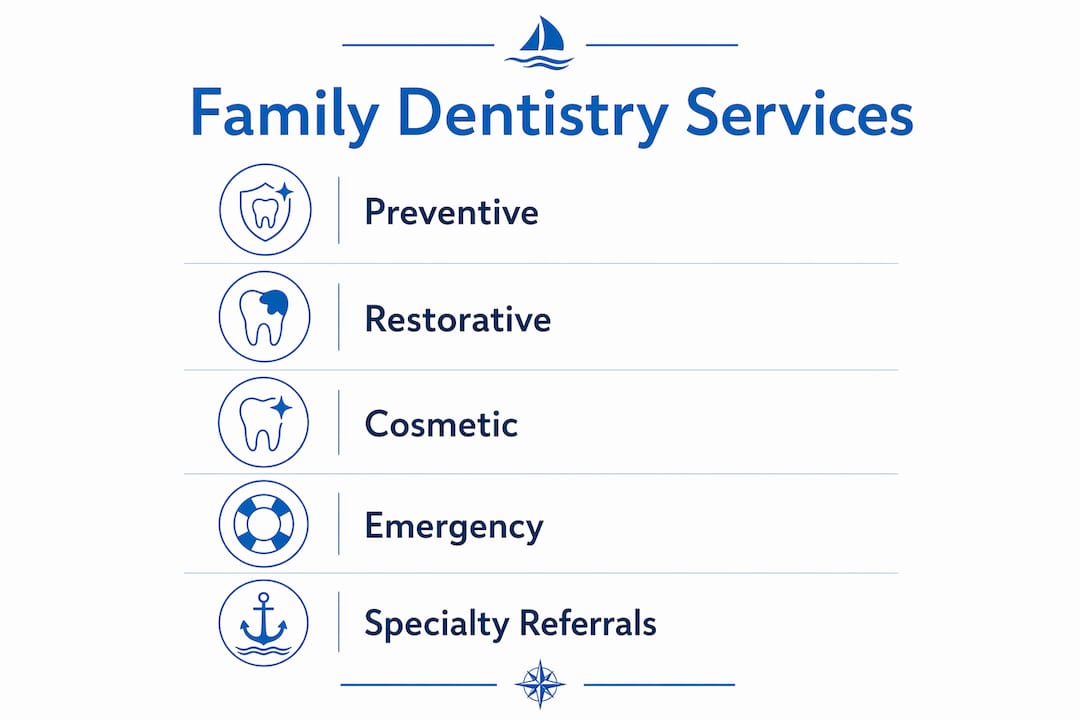
Preventive visits are the backbone of the model. Regular cleanings and exams catch small problems before they become expensive ones, and that early-detection advantage compounds over years of consistent care. When something falls outside the practice's scope, such as complex oral surgery, a family dentist coordinates the referral and keeps the records centralized.
How does family dentistry differ from general dentistry?
The difference is mostly about patient range and practice design, not clinical training. Family dentistry is a practice model, not a board-certified specialty. A family dentist holds the same general dentistry degree as any other dentist but deliberately structures the practice to serve all ages.

General dentistry, by contrast, often skews toward adult patients. Many general dentists set a minimum age of two or three years old, and some limit care to patients sixteen and older. Family dentistry removes that ceiling and floor entirely.
Key distinctions:
- Patient age scope: General dentists often focus on adults; family dentists treat everyone
- Practice design: Family offices invest in pediatric equipment and child-friendly environments
- Record continuity: Family practices track oral development from childhood through old age
- Relationship model: Long-term care across generations, not episodic adult treatment
The primary distinction comes down to who walks through the door. If a practice sees your toddler and your grandmother on the same day, it is functioning as a family dental practice.
Family dentistry vs. pediatric dentistry: what's the difference?
Family dentistry should not be confused with pediatric dentistry. Pediatric dentistry is a recognized specialty requiring two to three years of additional residency training beyond dental school, focused exclusively on children from infancy through adolescence. The American Academy of Pediatric Dentistry oversees those residency programs.
Family dentists are general dentists who treat all ages. They are not pediatric specialists, but they are fully qualified to care for children and do so routinely.
- Pediatric dentists: children only, specialty training, advanced behavior management techniques
- Family dentists: all ages, general training, equipped and experienced with children
- Overlap: both provide cleanings, exams, fluoride, and sealants for kids
- When to refer: complex developmental issues, severe dental anxiety in young children, or special needs cases may warrant a pediatric specialist
For most healthy children, a family dentist is entirely appropriate. The pediatric specialist becomes relevant when a child's needs go beyond routine care.
Why continuity of care makes family dentistry worth it
One team maintaining a family's dental history enables better tracking of hereditary patterns and growth milestones than any combination of separate providers can. A dentist who has seen a child since age two recognizes crowding patterns years before braces become necessary. That same dentist, seeing the parent, notices that gum disease runs in the family and adjusts the prevention plan accordingly.

Scheduling is the other practical advantage. Coordinated appointments for multiple family members at one location reduce the number of separate trips, which matters for working parents managing school schedules. Consistent hygiene appointments across all family members also improve long-term compliance, since the whole household reinforces the same habits.
Pro Tip: Ask your family dentist to note hereditary risk factors, such as thin enamel or gum disease history, in every family member's chart. That shared context shapes smarter prevention plans for each person.
How often should your family visit the dentist?
For most patients, regular visits cover the baseline: routine cleanings and exams. Children and adults with higher cavity risk, active gum disease, or orthodontic treatment may need three or four visits per year. Seniors with dry mouth or medication-related oral side effects often benefit from more frequent monitoring as well.
The regular dental visits are standard practice and supported by dental associations. Your family dentist adjusts that frequency based on each person's actual risk profile, not a one-size schedule.
When should you consider seeing a specialist instead?
A family dentist handles the vast majority of oral health needs, but some situations call for a specialist. Knowing when to make that call saves time and leads to better outcomes.
Consider a referral when:
- A child shows significant developmental delays in tooth eruption or jaw growth
- Severe dental anxiety in a young child requires sedation beyond what the practice offers
- Complex orthodontic cases need a dedicated orthodontist
- Gum disease has progressed to a stage requiring a periodontist
- Tooth loss or implant placement needs an oral surgeon or prosthodontist
A good family dentist does not resist these referrals. They initiate them and stay involved, keeping the specialist's findings in the central record so nothing falls through the gaps.
Insurance and payment options for family dental care
Most dental insurance plans cover family dentistry the same way they cover general dentistry, since family dentists hold general dentistry licenses. Preventive services like cleanings and exams are typically covered at 100% under most PPO plans. Restorative work such as fillings and crowns usually falls under a cost-sharing structure, and cosmetic procedures are rarely covered.
For families without insurance or with coverage gaps, many practices offer in-house membership plans, flexible payment schedules, or financing through third-party providers. Seeing one practice for the entire family can reduce administrative overhead and sometimes qualifies households for multi-patient discounts. Always confirm what your specific plan covers before scheduling, since benefits vary by employer and insurer.
Starboarddental in Kennebunk offers general dentistry services for patients of all ages, combining preventive, restorative, and cosmetic care in one welcoming practice. Same-day appointments, digital scanning technology, and a genuinely comfortable environment make it easier for the whole family to stay on track with their oral health.

Key Takeaways
Family dentistry provides comprehensive, age-inclusive oral care under one roof, making it the most practical dental model for households with members at different life stages.
| Point | Details |
|---|---|
| All-ages model | Family dentists treat patients from infancy through senior years with no age restrictions. |
| Service range | Preventive, restorative, and cosmetic care are all available within a single practice. |
| Not a specialty | Family dentistry is a practice model, not a board-certified specialty like pediatric dentistry. |
| Continuity advantage | Long-term records allow tracking of hereditary patterns and early detection across generations. |
| Insurance parity | Most dental insurance plans cover family dentistry the same as general dentistry. |