Most people searching for clear aligner cost want one number fast. Here it is: the national average runs about $5,108 without insurance, with a typical U.S. range of roughly $1,800–$8,100 depending on case complexity, provider type, and where you live. That spread is wide because a mild cosmetic case and a complex bite correction are genuinely different clinical undertakings. The single most useful thing you can do before comparing prices is request an itemized written estimate from at least two providers.
Table of Contents
- What does a clear aligner price usually include?
- What factors move your clear aligner quote up or down?
- How do U.S. state averages compare?
- How do insurance, HSA/FSA, and financing work for aligners?
- How do you get an accurate, comparable quote?
- How do clear aligners compare to braces and mail-order options?
- How these averages were calculated
- Key Takeaways
- What Starboard Dental recommends before you budget for aligners
- Clear aligners at Starboard Dental in Kennebunk, ME
- Useful sources and further reading
- A word on what the price conversation usually misses
What does a clear aligner price usually include?
Most quoted prices bundle several services together, which is why two quotes at different dollar amounts can still be comparing apples to oranges. A complete treatment estimate typically covers:
- Initial exam and consultation
- Diagnostic imaging and digital scans
- Treatment planning and case setup
- All aligner sets for the planned treatment
- Mid-treatment refinements (within the agreed scope)
- Retainers at the end of treatment
- Progress check visits
What often gets billed separately, or quietly omitted from the headline number:
- Attachments (small tooth-colored buttons that help aligners grip)
- Interproximal reduction (IPR), the minor enamel reshaping between teeth
- Additional refinement trays beyond the included rounds
- Replacement aligners for lost or damaged trays ($75–$300 each)
- Replacement retainers after treatment ($100–$900 per set)
- Sedation or specialty appliances for complex cases
Pro Tip: Ask every provider for a written, itemized estimate that shows exactly which line items are bundled and which are billed separately. A low headline number with vague language about "possible additional fees" often ends up costing more.
What factors move your clear aligner quote up or down?
Case complexity is the single biggest driver. Minor cosmetic spacing issues typically incur lower costs than more complex cases. Moderate cases involve mid-range prices, while complex bite corrections that require significant adjustments and refinements tend to be at the higher end of the cost spectrum.
Beyond clinical complexity, several other variables shift the number:
- Monitoring model: In-office supervision with regular visits costs more than remote-monitoring setups, but clinical oversight is built into that price.
Understanding how provider type affects your quote helps you interpret why two practices in the same town can quote very different numbers for what sounds like the same treatment.
How do U.S. state averages compare?
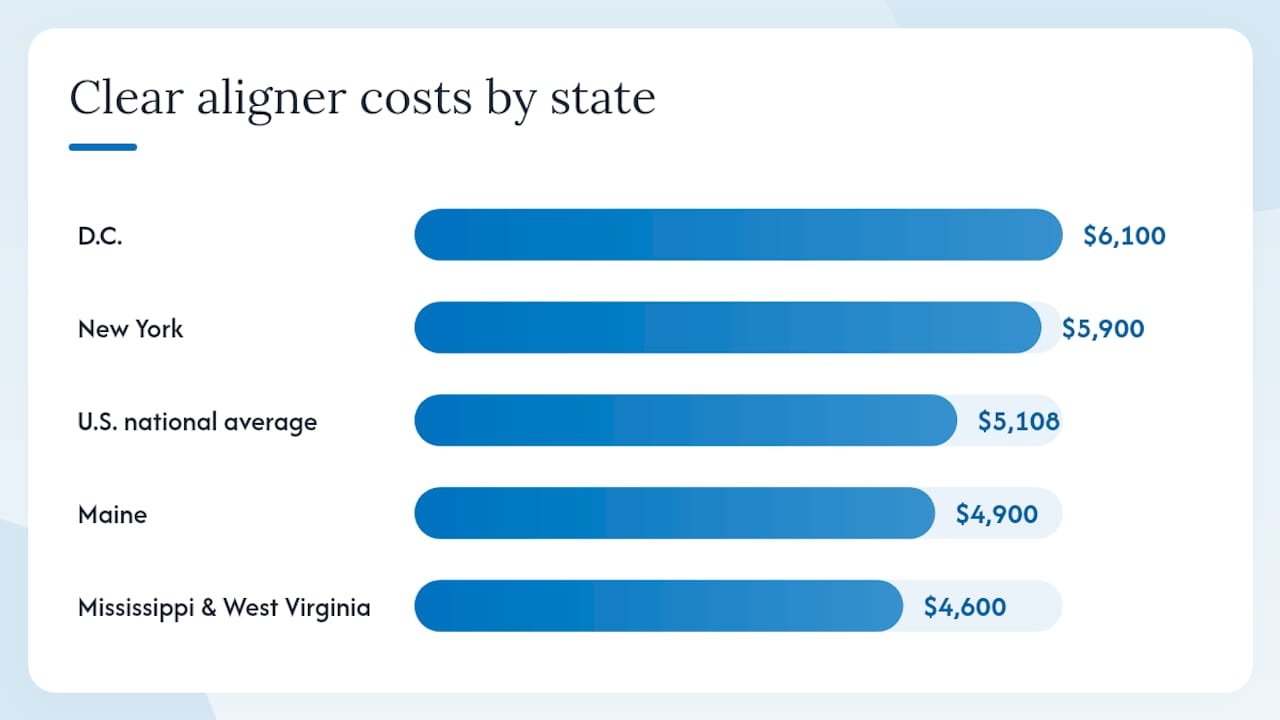
State-level averages give you a useful benchmark, though any individual quote can sit above or below the state figure depending on metro vs. rural location and practice overhead. The table below uses aggregated consumer and clinic data; treat these as directional guides, not guarantees.
State average costs for clear aligners vary across the U.S., generally clustering within a moderate range influenced by local market and economic factors. Prices tend to be higher in metropolitan areas and slightly lower in rural settings, with specific figures varying by state.
The national average of approximately $5,108 sits near the middle of most state figures. High-cost states like New York ($5,900) and D.C. ($6,100) reflect metro overhead; lower-cost states like Mississippi ($4,600) and West Virginia ($4,600) reflect smaller-market pricing. Maine's estimated average of $4,900 tracks modestly below the national figure.
How do insurance, HSA/FSA, and financing work for aligners?
Many dental insurance plans apply the same orthodontic benefit to clear aligners as to traditional braces, with a lifetime orthodontic maximum that commonly falls between $1,000 and $3,000. A few practical points:
- Confirm your plan's lifetime orthodontic maximum and whether you've used any of it previously.
- Check whether the plan language covers "removable appliances" — some older plans use wording that technically favors fixed appliances, which can create a coverage dispute.
- HSA and FSA funds are eligible for orthodontic treatment, giving you an immediate pre-tax discount equivalent to your marginal tax rate. Make sure the provider codes the billing correctly so the claim processes cleanly.
- For patients without coverage, options for dental care without insurance include in-house payment plans and third-party financing.
On financing: most offices offer in-house plans spanning 12–24 months, sometimes interest-free. A typical case cost can be spread over a period such as 18 months with monthly payments designed to be manageable for the patient. CareCredit is widely accepted and offers promotional periods that can reduce interest costs if the balance is paid within the promotional window. For a full walkthrough of dental financing payment plans in Kennebunk, Starboarddental publishes a local guide covering typical plan structures.
Pro Tip: Ask the office to run a benefits check before your consult and request a sample amortization schedule showing total repayment at different term lengths. That 30-minute step can save you hundreds.
How do you get an accurate, comparable quote?
Getting quotes you can actually compare takes a little structure. Follow these steps:
- Schedule a consultation that includes a digital scan, not just a visual exam.
- Request a written, itemized estimate listing every line item.
- Confirm in writing whether refinements and retainers are included.
- Ask the office to verify your insurance benefits and provide the result in writing.
- Repeat with at least one other provider before deciding.
Questions worth asking directly:
- What happens if I need more refinements than planned — is there a cap or an extra charge?
- What is your replacement policy for lost or damaged aligners?
- How long is the expected treatment, and what's the typical range for a case like mine?
- Who supervises my care between visits, and how often will I be seen?
Red flags to watch for: a flat-fee quote with no mention of an exam or scans, vague language about "possible" additional fees, and no clear answer about who monitors your progress. A dental treatment plan should spell out every phase before you sign anything.
How do clear aligners compare to braces and mail-order options?

For equivalent clinical complexity, clear aligners and traditional braces often land in a similar price range, both commonly falling between $3,000 and $8,000. The gap between them has narrowed considerably. The right choice depends on your bite, tooth movement needs, and lifestyle, not on which one costs $200 less.
Mail-order aligner systems advertise lower sticker prices, often in the $1,500–$2,800 range, because they eliminate chairtime and reduce clinical supervision. The trade-off is real: without in-person monitoring, bite issues can go undetected, and if refinements are needed, the out-of-pocket cost to correct problems can exceed the original savings.
Pro Tip: For anything beyond mild cosmetic spacing, prioritize clinical oversight over the sticker price. The cost of correcting a poorly managed case almost always exceeds the savings from choosing the cheaper option upfront.
How these averages were calculated
The national average of $5,108 and the state-level figures in this guide draw from aggregated U.S. consumer and clinic-reported data, with 2026 data points incorporated where available. A few assumptions apply:
- Figures reflect in-office, clinically supervised treatment with a licensed provider.
- Averages cover full-treatment cases (both arches, moderate complexity) and will not match single-arch or minor cosmetic cases.
- State averages are directional benchmarks, not market surveys; metro practices within a state often price above the state figure, rural practices below it.
- Published averages are national summaries and do not account for individual clinical complexity or local market conditions.
The best number for your situation comes from a local, itemized quote and a written benefits verification from your insurance carrier, not from any published average.
Key Takeaways
Clear aligner treatment in the U.S. averages about $5,108 without insurance, but your actual cost depends on case complexity, provider type, and geography — get an itemized quote and verify your insurance benefits before committing.
| Point | Details |
|---|---|
| National average | Approximately $5,108 without insurance; typical U.S. range is $1,800–$8,100. |
| Biggest cost driver | Case complexity: minor cases run $1,800–$3,500; complex bite corrections reach $5,500–$9,500+. |
| Insurance and pre-tax savings | Most plans cover $1,000–$3,000 lifetime; HSA/FSA funds are eligible and reduce your effective cost. |
| Financing options | In-house plans (12–24 months) and CareCredit can spread a $5,000 case to roughly $278/month over 18 months. |
| Starboarddental | Offers clear aligners and Invisalign in Kennebunk, ME with itemized estimates and in-office digital scanning. |
What Starboard Dental recommends before you budget for aligners
When patients come to Starboarddental asking about aligner costs, the first thing the team recommends is arriving at the consult prepared. Bring any prior dental records, X-rays, or photos from previous orthodontic work. That information speeds up the diagnostic phase, reduces the number of unknowns in the treatment plan, and often means a more accurate first estimate rather than a range that gets revised later.
The second recommendation is to treat the insurance verification step as non-negotiable. Many patients assume their plan covers aligners the same way it covers braces, but the actual benefit language varies. Having the office run a formal benefits check before the consult means you walk in knowing your lifetime maximum, your remaining balance, and whether removable appliances are explicitly covered.
Pro Tip: Bring previous dental records and any orthodontic photos to your first consult. Providers who can see your history give you a tighter estimate from the start.
Clear aligners at Starboard Dental in Kennebunk, ME

Starboarddental offers clear aligner treatment and Invisalign at its Kennebunk practice, serving patients across York County and the southern Maine coast. Every consult includes a digital scan for precision treatment planning, a written itemized estimate, and an in-office benefits check so you know your out-of-pocket number before treatment begins. For patients combining aligner work with cosmetic finishing, the practice also provides cosmetic dentistry services including bonding and contouring in the same location.
Clear aligners cost in Maine tends to run below major metro averages, and Starboarddental's in-house financing options make spreading payments straightforward. Ready to see where your case lands? Book your consult as a new patient and bring your insurance card and any prior dental records.
Useful sources and further reading
The following sources were used in preparing this guide and are worth bookmarking when verifying coverage, financing, and treatment options:
- Invisalign cost in Invisalign Cost — CareCredit
- What Do Invisalign Braces Cost? Are They Worth It? — Colgate
- Invisalign Cost in 2026: Full Treatment Price Breakdown — ToothCostGuide
- How Much Do Clear Aligners Cost in 2026 | St. Pete Family & Cosmetic Dentistry
- 12 Key Facts About the Cost of Clear Aligners in 2026 - Brockway Orthodontics
- Average Cost of Invisalign® Aligners | Invisalign.com
This article provides general consumer information about orthodontic costs in the United States. It is not a substitute for professional dental advice. Confirm current pricing, insurance coverage, and treatment suitability with a licensed dental provider.
A word on what the price conversation usually misses
The cost of clear aligners gets framed as a comparison problem: find the lowest quote, apply insurance, finance the rest. That framing is fine as far as it goes, but it skips the part that actually determines whether you get a good outcome.
The practices that produce the fewest surprises are the ones that over-communicate upfront. They give you a written estimate before you sign. They run the insurance check themselves. They tell you exactly what triggers an extra charge and what doesn't. That transparency is worth more than a $300 discount on the headline number, because a case that needs two unplanned refinement rounds at $400 each just erased the savings.
The other thing most cost guides underplay: retainers are not optional. Every aligner case ends with a retention phase, and that phase lasts indefinitely. Budget for at least one retainer replacement within the first few years. Patients who skip this step often end up back in treatment, which costs far more than a $200 retainer.
Choose a provider who explains all of this before you ask. That willingness to be specific about costs, limits, and long-term expectations is the clearest signal that the clinical care will be the same way.