
More than 40% of U.S. adults lack dental coverage, which means skipping care or paying full price are not your only options. You can get dental care without insurance through three proven routes: Federally Qualified Health Centers (FQHCs) with sliding-fee scales, dental school and residency clinics with faculty supervision, and dental discount or financing programs. NIDCR recommends starting with a call to 2-1-1 or your state health department to find the fastest local options. Starboarddental, located in Kennebunk, also works with uninsured patients through same-day appointments and in-office payment plans.
Your next 24–72 hours:
- Call 2-1-1 or visit the HRSA Health Center Finder to locate a sliding-fee clinic near you.
- If you have severe pain or swelling, treat it as a dental emergency and seek same-day care immediately.
Table of Contents
- How do you find low-cost dental services quickly?
- What do dental schools and residency clinics actually offer?
- How do FQHCs and sliding-fee clinics work for uninsured patients?
- What are your best options for dental discounts without insurance?
- How do you negotiate costs with a private dentist when you have no coverage?
- What do common procedures cost, and how long will you wait?
- Your practical 30-day plan to get dental care without coverage
- Starboarddental makes uninsured care straightforward in Kennebunk
- Key Takeaways
- A note on access and care
- Useful resources to search locally
How do you find low-cost dental services quickly?
Start with two free tools: call 2-1-1 (available in most U.S. states) or contact your state or local health department. Both maintain up-to-date directories of community dental programs, free clinics, and sliding-fee centers that national databases often miss. The HRSA Health Center Finder is the next step — search by ZIP code to locate federally designated health centers near you.
Tele-dentistry is worth using for triage before you commit to a clinic. Many platforms connect you with a licensed dentist within hours for a video consultation, which can confirm whether your issue is urgent or manageable, and point you toward the right type of provider. If you have an abscess, broken tooth, or uncontrolled pain, skip triage and go straight to an urgent-care dental clinic or emergency room.
Before scheduling anywhere, run a quick verification: confirm the provider holds HRSA/FQHC designation, a dental school affiliation, or a current state dental board license. A five-minute check protects you from unlicensed or predatory providers.
What do dental schools and residency clinics actually offer?
Dental schools and residency programs are among the best-kept options for affordable dental care. Student clinics are staffed by dental students working under direct faculty supervision, which means every procedure is reviewed and approved by a licensed dentist before and after completion. Discounts at student clinics can reach 25%–50% off standard fees for many procedures. Residency programs go a step further: licensed dentists in post-graduate training handle complex work and typically charge 25%–30% less than private-practice rates.
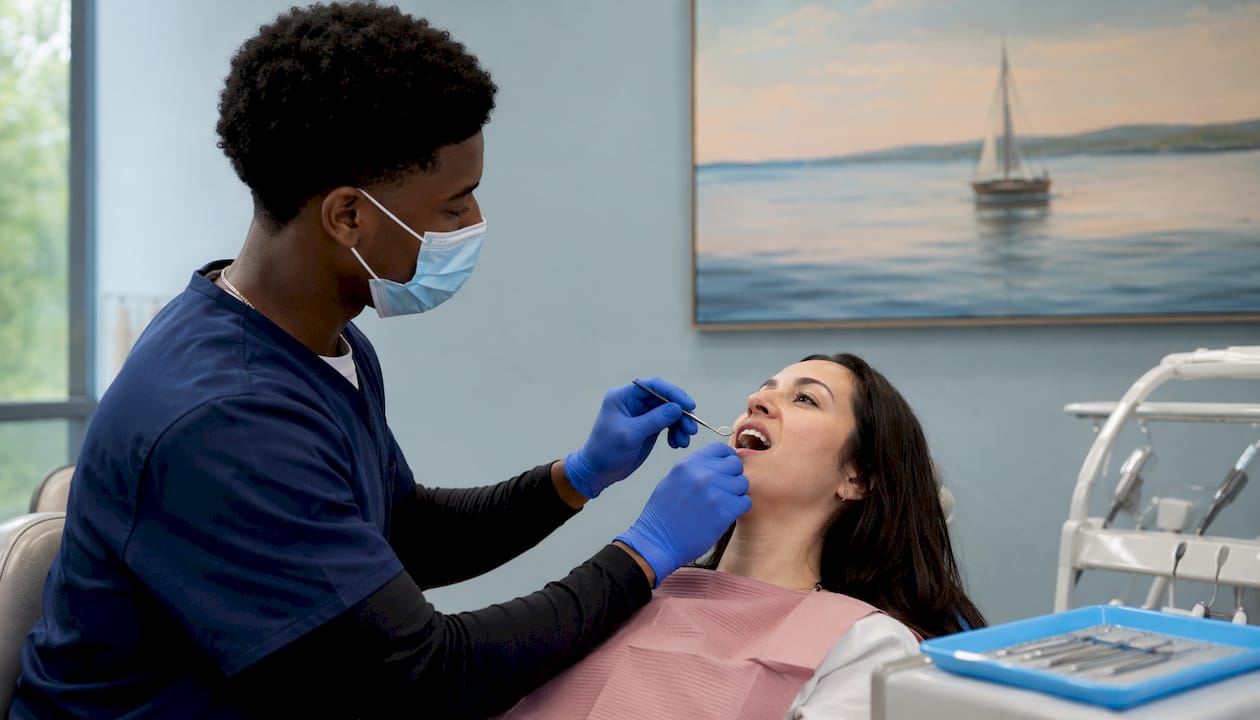
Some academic dental centers report patients paying 50%–70% less than private-practice rates, and many offer financing options like CareCredit alongside their reduced fees.
Common services available:
- Preventive care: cleanings, X-rays, fluoride treatments
- Restorative work: fillings, extractions, root canals, crowns
- Some specialty care: orthodontics, periodontics, oral surgery (varies by school)
Trade-offs to expect:
- Appointments run longer than at a private practice (often 2–3 hours for a single procedure)
- Some schools require a referral or a separate intake exam before treatment begins
- Scheduling can take 2–6 weeks for non-emergency work
To book: Call the dental school's patient clinic directly, ask whether a referral is required, and bring a photo ID, proof of income if you want to discuss reduced fees, and any relevant medical records.
How do FQHCs and sliding-fee clinics work for uninsured patients?
Federally Qualified Health Centers are federally funded clinics that, by law, must offer sliding-fee scales based on household income and family size. HRSA designation is the key marker: it signals federal oversight, quality standards, and the legal obligation to serve patients regardless of ability to pay. Nonprofit free and charitable clinics operate similarly — the National Association of Free & Charitable Clinics maintains a searchable directory of member clinics that provide dental services at no charge or a nominal fee.
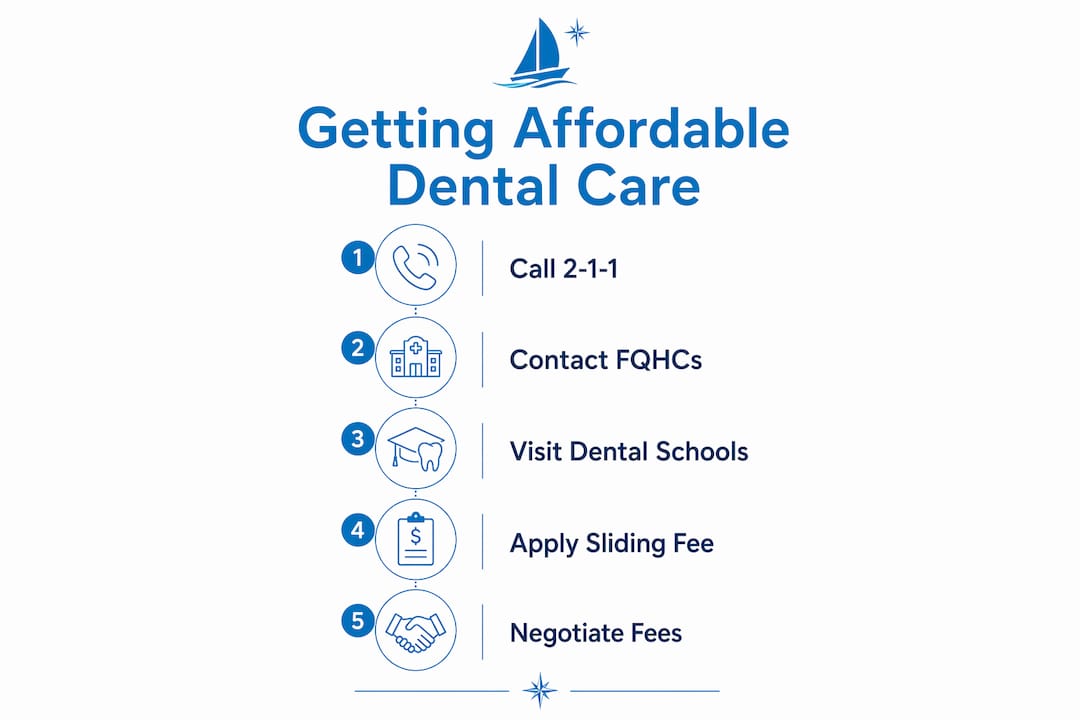
To qualify for a sliding-fee discount, you typically need to bring proof of income (recent pay stubs, tax returns, or a benefits letter) and documentation of household size. The clinic calculates your fee tier from there. Some clinics have waiting lists of several weeks; calling early in the morning or asking to be placed on a cancellation list can shorten that wait significantly.
What are your best options for dental discounts without insurance?
Dental discount plans (also called dental savings plans) are membership programs, not insurance. You pay an annual or monthly fee and receive 20%–50% discounts on services at participating providers, with no waiting periods and no claims to file. The catch: you pay the discounted fee directly to the dentist at the time of service. The plan does not pay anything on your behalf.
CareCredit is the most widely accepted third-party dental financing option. It offers interest-free promotional periods (typically 6–18 months) for qualifying balances, with longer-term financed options available. Before applying, ask the provider for the total cost of treatment, confirm whether the interest-free period covers the full balance, and check what the standard APR is if you carry a balance past the promo period.
Pitfalls to avoid:
- Assuming a discount plan pays the dentist. It does not. Budget for the full discounted amount upfront.
- Signing up for a discount plan without confirming your chosen clinic accepts it.
- Using CareCredit for a balance you cannot realistically pay within the interest-free window.
Discount plans work best as supplements — for example, after you have hit an insurance annual maximum, or as a standalone tool when you have no coverage at all. They cannot be applied to the same procedure as insurance simultaneously.
Pro Tip: Before enrolling in any discount plan, call your preferred clinic and ask: "Do you accept this plan, and what is the exact fee for the procedure I need?" Get the answer in writing or via email.
For a deeper look at how financing fits into a dental treatment plan, phased care can spread costs across multiple visits without requiring a large upfront payment.
How do you negotiate costs with a private dentist when you have no coverage?
Walking into a private dental office without insurance does not mean paying the full posted rate, especially at a practice like Dentist Tukwila, WA | Lance Timmerman, DMD, which offers patient-friendly financing and payment options. Most practices have a self-pay discount they will offer if you simply ask. A few questions that get results:
Propose paying promptly in exchange for a discount — many offices will reduce fees by 10%–20% for patients who pay in full at the time of service. Ask for a written estimate before agreeing to anything. If a provider refuses to give you an itemized estimate or pressures you into expensive same-day treatment without explaining alternatives, that is a red flag worth taking seriously.
Red flags: no verifiable state dental board license, no itemized estimate offered, high-pressure upselling of procedures you did not ask about.
What do common procedures cost, and how long will you wait?
Ranges are general estimates for self-pay patients; actual fees vary by location and provider.
Typical wait times:
- FQHC / sliding-fee clinic: 1–6 weeks for a new patient appointment; same-day for emergencies at some locations
- Dental school clinic: 2–6 weeks for routine care; faster for urgent extractions
- Private self-pay (with financing): same-day to 1 week in most markets
A tele-dentistry consultation can compress your triage timeline to hours, helping you decide which track to pursue before you spend time on hold. Bring proof of income, a photo ID, and any prior dental X-rays to your first appointment. Having records ready can eliminate an extra intake visit entirely.
Your practical 30-day plan to get dental care without coverage
Week 1 — Triage Call 2-1-1 and ask for dental resources in your county. If you have pain, swelling, or a broken tooth, contact an urgent-care dental clinic or use a tele-dentistry service the same day. Review common dental procedures so you can describe your symptoms clearly.
Week 2 — Research and documents Contact two or three FQHCs and one dental school clinic. Ask about sliding-fee eligibility and gather your proof of income and household size. Compare one or two dental discount plans and confirm they are accepted at your shortlisted providers. Check whether CareCredit or in-office financing is available as a backup.
Weeks 3–4 — Schedule and confirm Book your appointment. Confirm the payment arrangement in writing before you arrive. Bring your medical history, a list of current medications, and any treatment consent forms the clinic sent in advance. If phased treatment was discussed, get the full treatment timeline in writing so there are no surprises.
Starboarddental makes uninsured care straightforward in Kennebunk
Navigating a patchwork of programs is exhausting. Starboarddental offers a direct alternative: same-day appointments, in-office dental financing payment plans, and a full range of general and restorative services under one roof in Kennebunk, ME. Uninsured patients can discuss phased treatment schedules and transparent, itemized estimates before any work begins.
Whether you need a routine cleaning, a filling, or more involved restorative work, the team at Starboarddental will walk you through your options and costs before you commit. Call the office or book online to get a no-surprise estimate and find out which payment plan fits your situation.
Key Takeaways
Uninsured patients have real and accessible options: FQHCs, dental schools, and private practices with financing can all deliver quality care at manageable costs.
| Point | Details |
|---|---|
| Start with 2-1-1 or HRSA | Call 2-1-1 or use the HRSA Health Center Finder to locate sliding-fee clinics near you within 24 hours. |
| Dental schools save 25%–50% | Student and residency clinics offer significant discounts with faculty supervision; expect longer appointments. |
| Discount plans are not insurance | You pay the discounted fee directly; confirm provider acceptance and exact savings before enrolling. |
| Negotiate with private dentists | Ask for a self-pay discount, a written itemized estimate, and phased treatment to control costs. |
| Starboarddental for local care | Starboarddental offers same-day appointments, in-office financing, and transparent pricing for uninsured patients in Kennebunk. |
A note on access and care
Getting dental care without coverage can feel like a bureaucratic maze, but the options are real and the quality is often better than people expect. At Starboarddental, we see uninsured patients regularly and we will help you sort through the paperwork, the payment options, and the treatment priorities without pressure. Call us for a no-surprise estimate or ask about our payment plans — we would rather help you get the care you need now than watch a small problem become a big one.
Useful resources to search locally
- HRSA Health Center Finder — Search by ZIP code for federally designated sliding-fee clinics; the most reliable national database for FQHCs.
- NIDCR — Finding Dental Care — Federal guidance on locating low-cost dental services, including links to state and local health department directories.
- 2-1-1 — Call or text from anywhere in the U.S. to reach a local health and human services navigator who can identify community dental programs by county.
- National Association of Free & Charitable Clinics — Use the "Find a Clinic" tool to locate nonprofit dental clinics near you that serve uninsured patients at no charge or nominal cost.
- CareCredit — Widely accepted dental financing with interest-free promotional options; confirm terms before applying.
- Cigna — Dental Savings Plans — Clear explanation of how discount plans work versus insurance, including typical savings ranges.
- State dental school directories — Search "[your state] dental school patient clinic" to find the nearest academic clinic and its current eligibility rules; pages update frequently with new openings and hours.
- State and local health department websites — Maintain county-level directories of community dental programs, often more current than national databases.
This article is general information, not professional dental or medical advice. Confirm current program eligibility, fees, and provider availability with each organization directly before scheduling care.