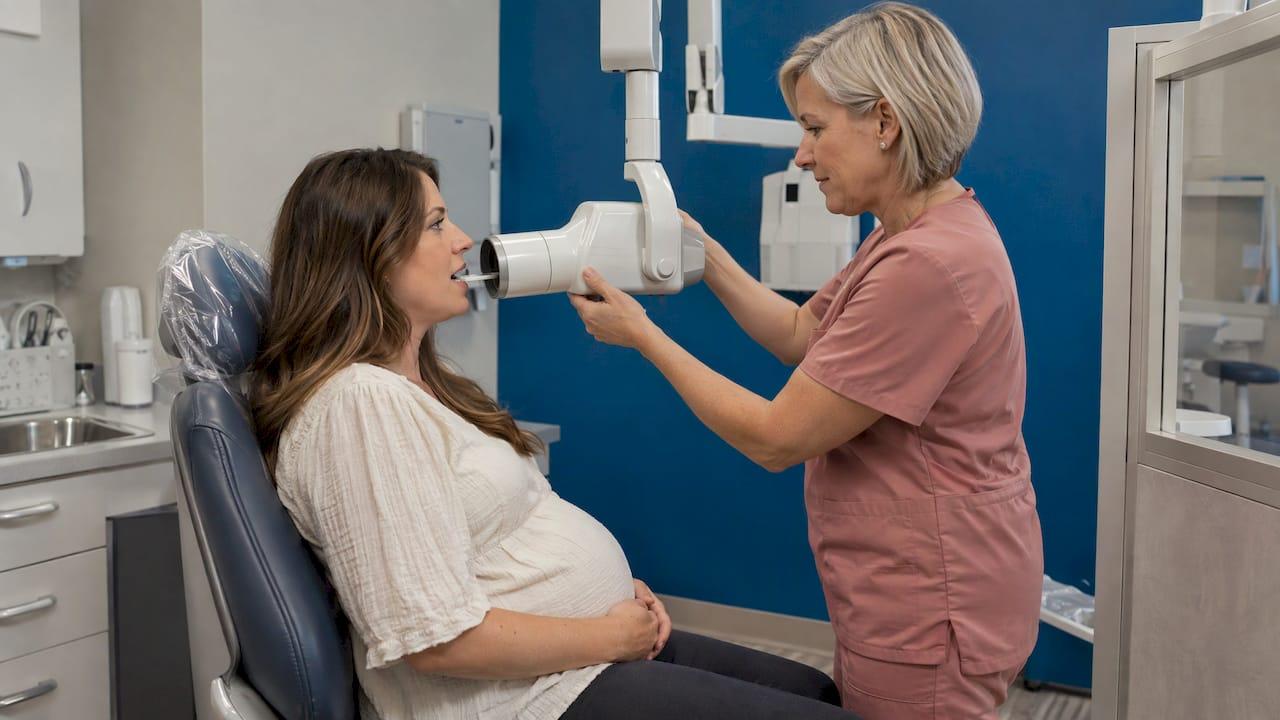
Yes, dental X-rays are considered safe at any stage of pregnancy when your dentist has a clinical reason to take them. The American Dental Association (ADA) says radiographs are safe for the pregnant patient at any stage, and the dose that reaches a baby from a routine dental image is tiny compared with the levels that cause harm. If you are pregnant and live near Kennebunk, Maine, you can keep your dental care on schedule, and our team at Starboard Dental can take any X-rays your exam calls for.
Below you will find the real numbers, what the current shielding guidance says (it changed recently), when X-rays are actually needed, and what to do if you had one before you knew you were expecting.
TL;DR
- A dental X-ray delivers a fetal dose of less than 10 microgray (µGy), according to the American Academy of Oral and Maxillofacial Radiology (AAOMR), far below any level linked to harm.
- The ADA says X-rays are safe in every trimester, and that abdominal or thyroid shielding is no longer recommended.
- Dentists take X-rays only when the results will affect your care, so a healthy checkup may not need new images at all.
- Urgent problems such as pain, infection or a broken tooth should not wait for delivery.
- If you had an X-ray before you knew you were pregnant, the dose is far below the level that raises the risk of birth defects or miscarriage.
Table of Contents
- How much radiation reaches the baby
- What U.S. dental and medical groups say
- The lead apron question
- Does the trimester matter?
- When you actually need X-rays during pregnancy
- What a pregnancy-friendly dental visit looks like
- If you had an X-ray before you knew you were pregnant
- Why skipping the dentist can backfire
- Our perspective
- Book your exam in Kennebunk
- FAQ
- Sources
How much radiation reaches the baby
A dental X-ray is aimed at your teeth and jaw, and the beam is small. Very little reaches your abdomen, and the part that does is scattered radiation.
The numbers back this up:
- The International Atomic Energy Agency (IAEA) states that the fetal dose from a dental X-ray exam, including cone beam CT, has been estimated between 0.009 and 7.97 µSv. That is usually less than the dose a fetus receives from natural background radiation in a single day.
- A 2024 systematic review reports that the estimated fetal dose from a standard single intraoral digital exam is approximately 6 to 7 µGy.
- The AAOMR says the fetal dose is less than 10 µGy in all X-ray exams of the teeth and jaws, including cone beam CT, and that there is no evidence conventional dental imaging poses a risk to a fetus.
Microgray and microsievert are tiny units, one millionth of a gray or sievert. For a sense of scale, the same AAOMR brochure lists thresholds of 100 milligray (mGy) for prenatal death, microcephaly and growth retardation, and 300 mGy for intellectual disability. The fetal dose from dental imaging is roughly 10,000 to 30,000 times lower than those thresholds.
A pediatric radiation specialist, Dr. Robert Brent, reached a similar conclusion in an academic paper on counseling pregnant patients: the threshold for fetal growth retardation from direct radiation is 200 to 300 times higher than the exposure from dental radiography. The IAEA adds that the cancer risk to an unborn child from a 10 µSv dose is several thousand times smaller than the ordinary background risk of childhood cancer.
What U.S. dental and medical groups say
The guidance is consistent across the organizations dentists follow:
- ADA: radiographs are considered safe at any stage of pregnancy.
- American Academy of Pediatric Dentistry (AAPD): its policy says no single diagnostic radiograph has a dose large enough to cause adverse effects in a developing embryo or fetus, and that when an exam is done properly the radiation reaching your abdomen is negligible.
- American College of Radiology and ACOG (the American College of Obstetricians and Gynecologists): the Academy of General Dentistry reports that both have said a single diagnostic radiograph does not provide enough radiation to harm an embryo or fetus.
The Illinois Department of Public Health, to take one state example, says routine dental care including radiography is safe and acceptable during all trimesters when clinically indicated.
The AAPD adds a sensible point: radiation effects accumulate over time, so the decision to image rests on your history and clinical exam, not on pregnancy status alone. Pregnancy is not a reason to refuse an X-ray, and it is not a reason to take one you do not need.
The lead apron question
If you remember being draped in a lead apron and a thyroid collar, you may wonder why that is changing. Current guidance has moved away from it.

The ADA states that abdominal or thyroid shielding is no longer recommended for pregnant patients. The AAOMR says leaded aprons and thyroid shields are not recommended for X-rays of the teeth and jaws regardless of pregnancy status. A 2024 ADA expert panel recommended that customary abdominal and thyroid shielding be discontinued for all patients.
The reasoning is practical:
- The dose to the abdomen is already extremely low, and the AAOMR explains that an apron provides no decrease in scattered radiation absorbed outside the primary beam.
- Shields can block the primary beam or hide anatomy, which leads to retakes. The ADA notes that thyroid collars can cause exactly that, and a retake means a second exposure.
The AAOMR also says that federal, state and local regulations should be followed until they are updated. So you may still be offered an apron at some offices. That is not a sign anything is wrong, only that practices are at different points in adopting the newer guidance.
One group still uses protection: pregnant dental staff. The ADA says pregnant team members who take radiographs should follow the facility's shielding procedures and always wear dosimeters, which monitor exposure. If you are a dental professional and pregnant, tell your employer in writing as soon as you know. The ADA lists a limit of 0.5 mSv per month for pregnant dental personnel, and the 2024 expert report notes that the average dental worker receives only about 6% of the monitoring threshold in a year.
Does the trimester matter?
For dental X-rays, no. The ADA says radiographs are safe at any stage, and Illinois guidance says the same for all trimesters.
You may read elsewhere that the first trimester is the time to be most cautious. It is true that the developing embryo is more sensitive to high radiation doses early in pregnancy. The doses at issue, though, are those measured in whole milligray, thousands of times above anything a dental image delivers. Many people feel better putting non-urgent care off until the second trimester, which is often the most comfortable time to sit in the chair. That is a comfort choice, not a safety requirement.
When you actually need X-rays during pregnancy
Good dentists do not take X-rays by habit. The U.S. Food and Drug Administration says dentists should order radiographs only when they expect the additional information to affect patient care, and then follow ALARA (as low as reasonably achievable) to keep exposure down. The 2024 ADA expert panel report on radiation safety requires a comprehensive clinical exam before any radiographic exam.
In practice, that means X-rays make sense when:
- You have tooth pain, swelling or a suspected infection that cannot be diagnosed by looking.
- A tooth has broken, or a filling or crown has failed.
- You are a new patient with no recent images and the exam shows signs of decay or gum disease below the surface.
- A planned treatment needs images to be done safely.
They may not be needed when your last set is recent, you have no symptoms, and the exam shows healthy teeth and gums.
The 2024 systematic review concludes that imaging for pregnant women should not be restricted if clinically indicated. It recommends keeping exams as low in dose as diagnostically acceptable, tied to a clear indication and specific to the patient.
Urgent problems should not wait
The ADA and ACOG agree that emergency treatments such as extractions, root canals or restorations can be safely performed during pregnancy, and that delaying treatment may lead to more complex problems. A toothache or abscess rarely improves on its own, and an untreated infection is a bigger concern for you than the image that finds it. If something hurts, see our guide to emergency dental care, or call us. We offer same-day and walk-in appointments.
For medication questions, such as which pain relievers or antibiotics suit you, talk with your obstetrician or midwife as well as your dentist. They know your pregnancy history.
What a pregnancy-friendly dental visit looks like
Here is how a visit typically goes, and what to do at each step.
- Tell us you are pregnant when you book. Mention your due date, any complications and the medications you take. This shapes the appointment, not whether you can come.
- Have a clinical exam first. The exam, not the calendar, decides whether X-rays are needed. If you have had recent images elsewhere, bring or request the records so you are not imaged twice.
- Ask which images are planned and why. One or two small intraoral images are the usual pattern for a focused problem. Each one has a stated purpose.
- Get comfortable. Lying flat on your back late in pregnancy can make you dizzy. Tell the team, and ask to be propped on your side or semi-reclined. Short breaks are fine.
- Plan follow-up. If treatment is needed, such as a filling or gum therapy, it can usually be done during pregnancy. Delaying can mean a bigger problem later.
At Starboard Dental, we know that many patients feel anxious in the chair, and pregnancy can add to that. Our office has ceiling-mounted TVs for entertainment during procedures and personalized comfort items, and we use digital scanners for precision.
If you had an X-ray before you knew you were pregnant
This happens often, and the answer is reassuring. Dr. Brent's counseling paper states that when a woman has a diagnostic X-ray before knowing she is pregnant and the calculated fetal dose is below 0.1 Gy, her risks for birth defects and miscarriage have not increased, because the threshold for those effects is 0.2 Gy or higher.
A dental image delivers a dose measured in millionths of a gray, so it sits many thousands of times below that line. The IAEA goes further and says patient doses in normal dental radiology practice would never warrant considering a termination of pregnancy.
If you are still worried, mention it at your next prenatal visit. Your obstetrician can answer questions about your own pregnancy.
Why skipping the dentist can backfire
Pregnancy changes your gums. Hormone shifts make them more reactive to plaque, and bleeding or swelling is common. That is a reason to keep your cleanings, not to cancel them. We explain the connection in our post on bleeding gums in pregnancy, and our guide to gingivitis treatment covers how early gum inflammation is reversed.
If gum disease has advanced beyond gingivitis, our periodontal therapy and scaling and root planing address it. The ADA's position that delayed treatment can turn into more complex problems applies here as well.
For a plain-language overview of how X-ray doses compare to everyday sources, see our article on dental X-ray safety.
Our perspective
Most of the questions we hear from expecting patients come down to one worry: will this hurt my baby? The research gives a clear answer for dental X-rays, and we think patients deserve to hear it plainly instead of being told to wait nine months out of caution.
What we care about is the reason behind each image. An X-ray should answer a question about your teeth or gums that we cannot answer by looking. When it does, taking it protects you, and a healthy mouth is part of a healthy pregnancy. When it does not, we do not take it.
We also know that dental anxiety is real, and pregnancy adds discomfort on top of it. That is why we built our practice around a warm, welcoming atmosphere, comfort items and ceiling-mounted TVs, and why we offer same-day appointments. If you have a question about your own situation, ask us before your visit. We would rather explain than have you stay home with a toothache.
Alex
Book your exam in Kennebunk
Starboard Dental provides general dentistry for patients of all ages, including exams, cleanings and dental X-rays, in a technologically advanced office in Kennebunk, Maine. We offer same-day and walk-in appointments, so a pregnancy-related gum problem or a sudden toothache does not have to wait.

See our general dentistry services for checkups and cleanings, or visit starboarddental.com to learn about dental X-rays and book a visit.
FAQ
Are dental X-rays safe when you are pregnant?
Yes. The ADA considers radiographs safe at any stage of pregnancy. The fetal dose from a routine dental exam is under 10 µGy, according to the AAOMR, thousands of times below levels linked to harm. Dentists still take them only when they will affect your care.
Do I need a lead apron for dental X-rays while pregnant?
No. The ADA says abdominal and thyroid shielding is no longer recommended, because an apron does not reduce scatter and can cause retakes. Some offices still use one while regulations catch up, which is not harmful.
Can I put off dental X-rays until after the baby is born?
If you have no symptoms and recent images exist, routine X-rays can often wait for a later visit, and your dentist will tell you so after your exam. If you have pain, swelling or a suspected infection, do not delay. The ADA warns that waiting can lead to more complex problems.
What happens if I had a dental X-ray and did not know I was pregnant?
The risk is not increased. Fetal doses below 0.1 Gy do not raise the risk of birth defects or miscarriage, and a dental X-ray is far below that. Mention it at your next prenatal visit if you want reassurance.
Is a cone beam CT scan safe during pregnancy?
The IAEA's estimated fetal dose range of 0.009 to 7.97 µSv includes cone beam CT, and the AAOMR puts the fetal dose under 10 µGy for all tooth and jaw exams, including CBCT. As with any image, it is taken only when there is a clinical reason.
Sources
- American Dental Association: Pregnancy
- American Dental Association: X-Rays/Radiographs
- AAOMR: Apron shielding brochure (2025)
- AAOMR: Apron shielding brochure (2024)
- IAEA: Radiation protection of pregnant women in dental radiology
- Gamba et al., 2024: Impact of dental imaging on pregnant women (PMC)
- Brent: Saving lives and changing family histories
- AAPD: Oral Health Care for the Pregnant Pediatric Dental Patient
- Academy of General Dentistry: Caring for Two
- FDA: Selection of Patients for Dental Radiographic Examinations
- ADA expert panel report: Optimizing radiation safety in dentistry (JADA, 2024)
- Illinois Department of Public Health: Guidelines for oral health providers treating pregnant women