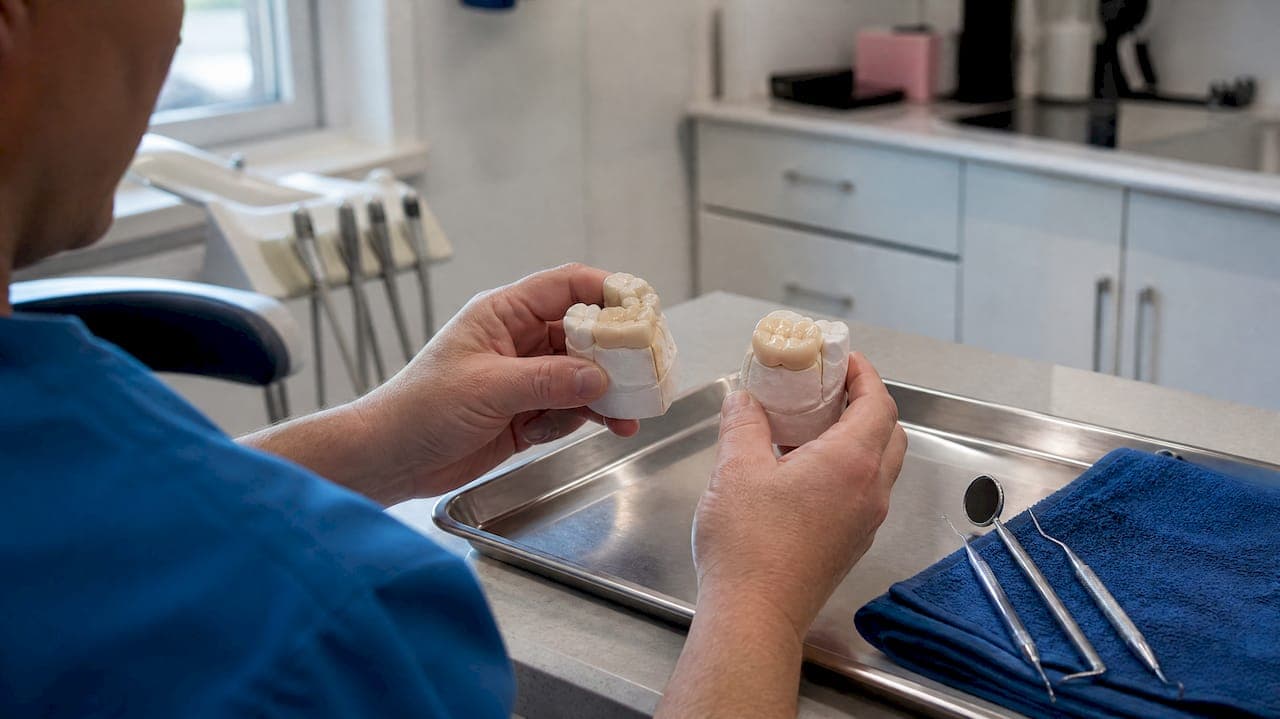
If enough healthy tooth remains, an onlay preserves more of your natural structure and handles moderate damage well. When a tooth is largely broken down or has had certain root canal treatments, a crown usually becomes the safer long-term choice. Both options hold up well: short-to-medium-term survival rates for both restorations commonly exceed 90%. Below, we walk through the practical differences, what to ask your dentist, and what each option costs.
TL;DR:
- Onlays are preferable when enough healthy tooth structure remains, as they preserve more enamel and can be easier to repair later.
- Crowns are the safer long-term choice for severely broken teeth or after root canal treatment, offering full protection and stability.
- Both options have survival rates exceeding 90% in short to medium term, with onlays possibly lasting slightly less but remaining comparable.
- Material choice affects longevity, with ceramics and hybrid composites generally outperforming resin, though costs and repairability vary.
- Insurance coverage often favors crowns, making upfront planning and pre-treatment estimates essential to avoid surprises.
Table of Contents
- What Are Onlays and Crowns, and How Do They Differ?
- Onlay vs Crown: Comparing Coverage, Durability, and Wear
- When to Choose an Onlay vs a Crown
- What Happens During the Procedure, Step by Step
- Materials and Longevity: What the Evidence Shows
- What Onlays and Crowns Cost, and How Insurance Handles Them
- Our Take: Why Conservative-First Matters More Than It Gets Credit For
- Talk to Us About Your Restoration Options
- FAQ
- Sources
What Are Onlays and Crowns, and How Do They Differ?
An onlay covers the chewing surface of a tooth and extends over one or more cusps, replacing damaged structure while leaving most of the healthy tooth untouched. A crown covers the entire tooth above the gumline, wrapping it completely for full protection. The two sit on a spectrum with inlays (which fit inside the grooves without covering cusps) and overlays (a broader version of an onlay) in between.
Dentists make these restorations two ways: a direct technique, where the material is shaped right in the mouth, or an indirect technique, where a lab or an in-office CAD/CAM mill produces the piece from a scan or impression. CAD/CAM systems allow some onlays and crowns to be designed, milled, and cemented in a single visit.
- Onlays conserve tooth structure and distribute bite forces more naturally across the remaining enamel.
- Crowns offer maximum protection when a tooth lacks the structural support to hold a smaller restoration.
Onlay vs Crown: Comparing Coverage, Durability, and Wear
The core trade-off is simple: more coverage means more protection but more tooth removal. An onlay typically preserves cusps and surrounding walls, while a crown requires shaving down the entire tooth to create a uniform shape for the cap. That difference matters for a concept called ferrule, the band of remaining tooth structure that helps a restoration resist fracture; onlays rely on the tooth's own walls for support, while crowns create their own.
One study found onlay survival rates slightly lower but comparable to crowns over similar follow-up periods, a gap narrow enough that either option can be a reasonable long-term choice depending on the case, according to systematic review data.
- Coverage: Onlays protect the biting surface and cusps; crowns protect the whole visible tooth.
- Structure conservation: Onlays remove less healthy enamel and dentin.
- Esthetics: Both can be made tooth-colored in ceramic, though crowns allow more control over overall tooth shape.
- Wear on opposing teeth: Depends more on material than restoration type.
- Repairability: A damaged onlay is often easier to replace without affecting a large portion of the tooth; a failed crown sometimes signals deeper problems underneath, as explored in this guide on cavities under a crown.
When to Choose an Onlay vs a Crown
A few clinical signals tend to point one direction or the other, though your dentist will look at your specific tooth, bite, and history before recommending either option.
- Favor an onlay when decay or an old filling has damaged part of the tooth but the cusps and walls remain intact.
- Favor a crown when a tooth has extensive breakdown, a vertical crack, or has had a root canal that leaves thin, brittle walls, as explained in cracked tooth repair recommendations.
- Factor in bite force if you grind or clench heavily, since a crown sometimes offers more predictable protection against fracture.
- Factor in cosmetic goals if you want to reshape the visible tooth, which a crown can do more completely than an onlay.
Three questions worth asking at a consult: What percentage of my tooth structure remains? Would an onlay or crown change my bite? What happens if I choose the more conservative option and it needs to be redone later? A red flag worth noticing: a recommendation for a full crown with no explanation of why a smaller restoration wouldn't work. For context on when a crown becomes the clear answer, see our guide on whether you need a crown.
Pro Tip: Bring a list of your symptoms (sensitivity, pain while chewing, visible cracks) to your appointment so your dentist can match the restoration to what's actually happening in the tooth, not just what shows up on an X-ray.
What Happens During the Procedure, Step by Step
Both restorations follow a similar rhythm, with crowns requiring more tooth reduction along the way.
- Onlay visit one: The dentist removes decay or old filling material, shapes the remaining tooth minimally, and takes a digital scan or impression.
- Onlay visit two (or same day with CAD/CAM): A temporary may be placed between visits; the final onlay is fitted and bonded.
- Crown visit one: More tooth structure is reduced on all sides to create room for full coverage, followed by a scan or impression and a temporary crown.
- Crown visit two: The permanent crown is cemented once it returns from the lab, typically one to two weeks later.
- Single-visit CAD/CAM: Available for many onlays and crowns at practices with in-office milling, cutting the process down to one appointment.
Expect mild sensitivity to temperature for a few days after cementation, and avoid sticky or very hard foods until that settles.
Materials and Longevity: What the Evidence Shows
Material choice shapes how long a restoration lasts and how it behaves in the mouth. Common options include lithium disilicate and other ceramics, hybrid composites, traditional composite resin, and gold.
Ceramics and hybrid materials generally show higher survival rates than composite resin in pooled analyses, a pattern consistent across multiple reviews of onlay performance, per research on ceramic, hybrid, and composite onlays. Gold remains durable and kind to opposing teeth but is used less often today for esthetic reasons. Composite is more affordable and easier to repair chairside, though it tends to wear faster than ceramic.

For a deeper look at how material choice affects crown lifespan specifically, see our breakdown of crown types and our notes on how long crowns typically last. The practical takeaway: no single material wins every case, and the right choice depends on the tooth's location, your bite, and your budget.
What Onlays and Crowns Cost, and How Insurance Handles Them
Costs vary widely based on material, lab fees, and which tooth is involved, with patient-facing cost summaries noting that both restorations usually require more than one visit unless CAD/CAM single-visit treatment is available.
- Insurance sometimes classifies onlays under a different code than fillings or crowns, which can lead to confusion about what's covered.
- Some insurers favor crowns because they're a more established, clearly defined procedure, even when an onlay would preserve more tooth structure.
- Preserving healthy tooth structure now can reduce the odds of needing a more invasive procedure later.
- Ask your dental office for an itemized treatment plan with codes before scheduling, so you can check coverage directly with your insurer.
Our Take: Why Conservative-First Matters More Than It Gets Credit For
A lot of patients assume a crown is simply the "stronger" choice, the safe default when in doubt. That instinct is understandable but often backward. Removing more healthy tooth structure than necessary doesn't just affect this restoration, it affects every future one, because each subsequent repair chips away at the same limited supply of enamel and dentin.
The honest nuance is that neither restoration is universally better. A crown placed too readily on a tooth that only needed an onlay trades long-term flexibility for short-term certainty. An onlay placed on a tooth with inadequate remaining structure risks early failure and a redo that costs more time and money than doing it right the first time. The real skill in restorative dentistry isn't picking the fancier-sounding option, it's matching the restoration to what the tooth actually has left to work with.
— Alex
Talk to Us About Your Restoration Options
We offer onlays and crowns as part of our restorative dentistry services, and we start every recommendation by looking at how much healthy tooth structure you have left before deciding what fits.

- We use digital scanners to plan onlays and crowns with precision.
- Our team can walk through treatment options and insurance coverage to help you understand what your insurance plan is likely to cover.
Ready to find out which restoration your tooth actually needs? Schedule a consult through our restorative dentistry page and we'll give you a straight answer.
This article is general information, not a substitute for advice from a qualified doctor. Consult a qualified healthcare professional about your own circumstances before acting on anything here.
FAQ
Do dentists still do onlays?
Yes, onlays remain a standard part of restorative dentistry, especially as adhesive materials and CAD/CAM manufacturing have improved. Many dentists now reserve crowns for teeth that lack enough structure to support a smaller restoration, per systematic review findings.
Why doesn't insurance cover onlays the same way?
Insurance plans sometimes code onlays differently than fillings or crowns, which can create coverage gaps even though the procedure is well established. Checking your specific plan's coding and getting a pre-treatment estimate helps avoid surprises.
Can you eat normally with an onlay?
Most patients return to normal eating within a few days, though it's wise to avoid very hard or sticky foods right after cementation while any sensitivity settles. Onlays are designed to handle normal chewing forces once fully bonded.
What are the disadvantages of onlays?
Onlays require a tooth with enough remaining healthy structure to support them, so they aren't suitable for severely broken or heavily decayed teeth. They can also be slightly more technique-sensitive to place than a crown, and insurance coverage is sometimes less straightforward.
Is an onlay or crown better after a root canal?
For many root canal treated posterior teeth, a crown is commonly recommended because thinned tooth walls are more prone to fracture, and delaying a definitive restoration significantly raises failure risk. An onlay may still work if enough sound structure remains, which your dentist can assess directly.
Sources
- Clinical behavior of ceramic, hybrid and composite onlays. A systematic review and meta-analysis - PMC
- AAE: Cracked teeth — treat or not to treat