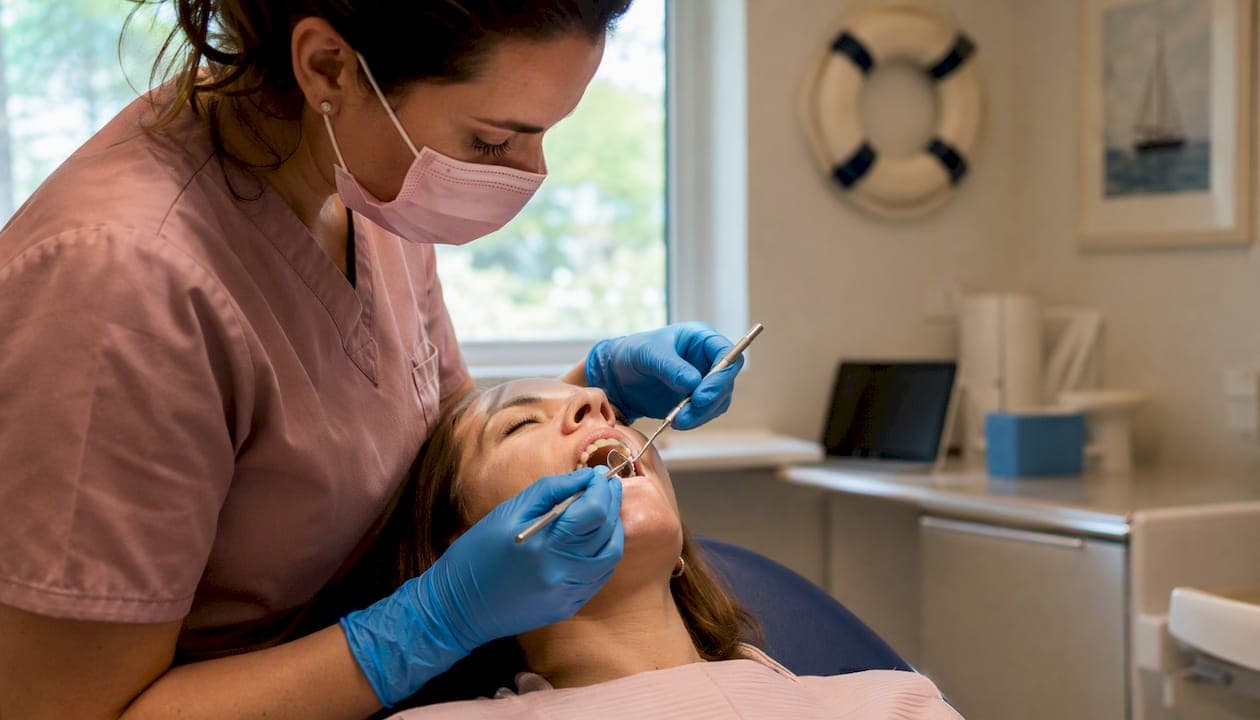
Most permanent crowns last 10 to 15 years, and a well-maintained gold or zirconia crown can push past 20 to 30 years. Temporary crowns are a different story entirely: they're built to last 2 to 3 weeks, sometimes stretching to a few months in complex cases before the permanent restoration goes in.
The median lifespan for a permanent crown is typically about a decade or more, according to clinical data compiled by Dental. Temporary crowns generally hold up for a few weeks, according to the American Association of Endodontists.
Three things move those numbers more than anything else:
- The crown material you choose
- Whether you grind your teeth at night
- How consistently you brush, floss, and show up for checkups
Key Takeaways
Crown lifespan depends far more on material choice, bruxism management, and daily hygiene than on any single brand or lab.
| Point | Details |
|---|---|
| Permanent crown median | Most permanent crowns last 10 to 15 years, with gold and zirconia often exceeding 20 years. |
| Temporary crowns are short-term | Temporaries typically last 2 to 3 weeks and use intentionally weak cement. |
| Night guards add years | A custom night guard can add an estimated 5 to 10 years for patients with severe grinding. |
| Watch for early warning signs | Sensitivity, biting pain, cracks, or a loose crown all call for a prompt dental exam. |
| Starboard Dental crown evaluations | Starboard Dental pairs exams and X-rays with material guidance and same-day milling options in Kennebunk. |
This article is general information, not a substitute for advice from a qualified doctor. Consult a qualified healthcare professional about your own circumstances before acting on anything here.
Table of Contents
- What Is a Dental Crown, and How Long Does the Process Take?
- How Does Crown Material Affect Dental Crown Longevity?
- Why Do the "10 to 15 Year" Averages Vary So Much?
- What Shortens or Extends How Long a Crown Lasts?
- What Are the Signs a Crown Is Failing?
- How Do You Extend a Crown's Lifespan?
- How Starboard Dental Helps You Get the Longest-Lasting Crown
- Sources
What Is a Dental Crown, and How Long Does the Process Take?
A crown is a cap that covers a damaged tooth, restoring its shape, strength, and bite function after decay, a fracture, a large filling that's failed, or a root canal that left the tooth structurally weak; learn more about implant-supported crowns in our complete guide. Your dentist shapes the tooth, then covers it with either a same-day milled crown or a temporary while a lab builds the final one.
Temporaries exist purely as placeholders. They're cemented with intentionally weak, temporary adhesive so they can be removed without damaging the tooth underneath, which is exactly why they sometimes pop loose during the wait.
The typical timeline runs like this:
- Tooth preparation and impression or digital scan (day one)
- Temporary crown placement while the lab fabricates the permanent one, or same-day milling if your clinic offers it
- Final cementation of the permanent crown, usually 1 to 3 weeks later
If a temporary crown falls off, don't reach for super glue or any household adhesive. A small dab of over-the-counter dental adhesive can hold it in place short-term, but you still need your dentist to re-seat it properly, according to guidance from South Kensington Medical & Dental.
How Does Crown Material Affect Dental Crown Longevity?
Material is the single biggest lever on dental crown lifespan, and the trade-offs are real: what lasts longest often looks the least like a natural tooth.
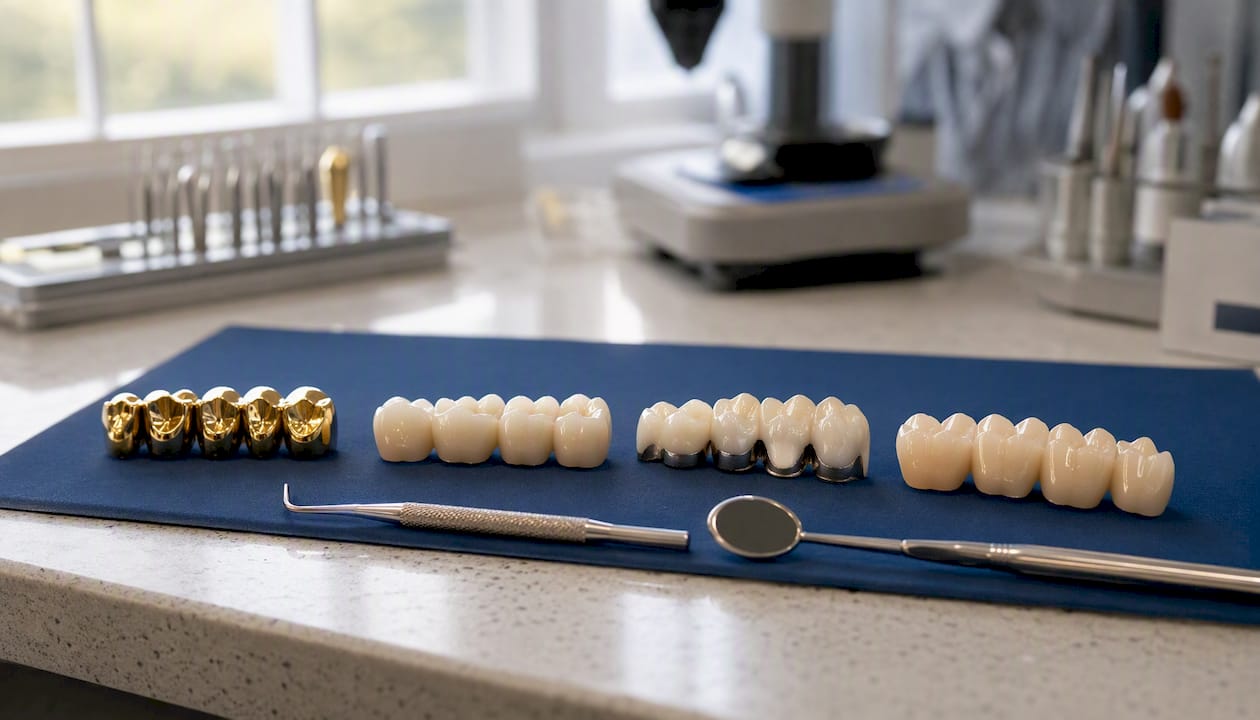
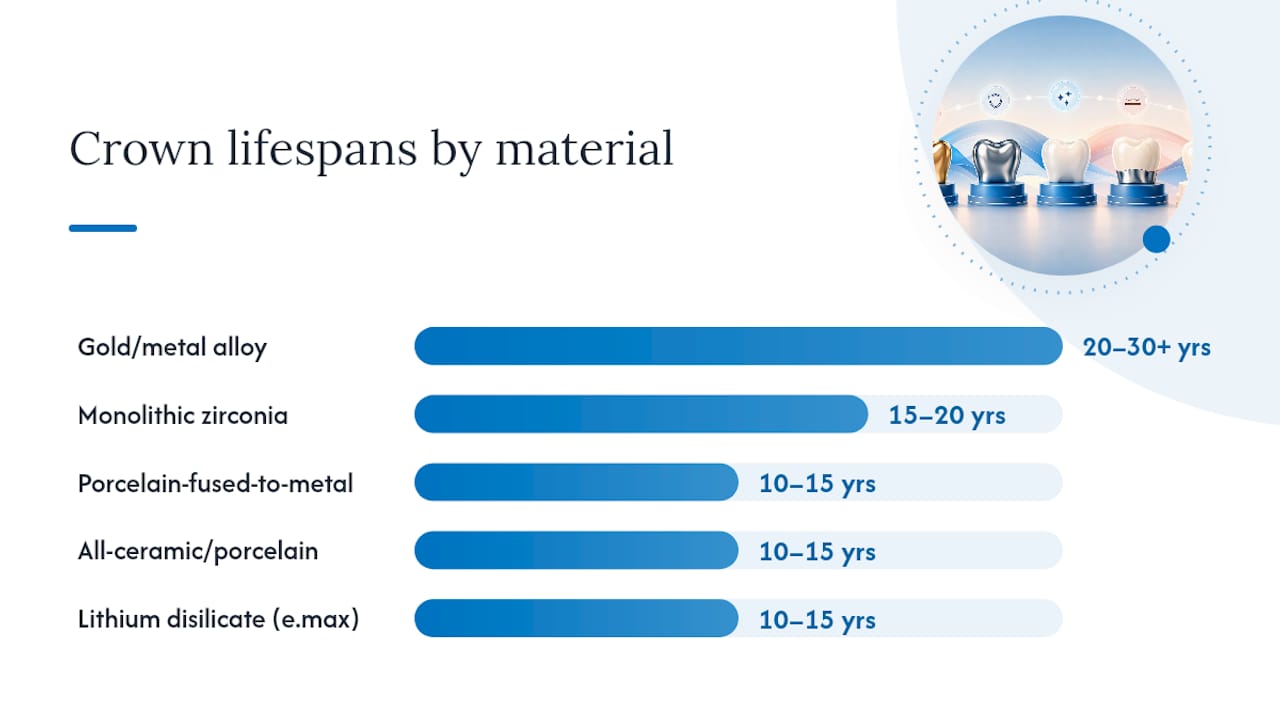
Gold and other metal alloys remain the durability benchmark. They flex slightly under bite pressure the way natural enamel does, which produces a tighter marginal seal and dramatically lowers fracture risk. Clinical reports from Willow Family Dentistry put gold crowns commonly in the 20 to 30+ year range. The catch is cosmetic. Almost nobody wants a gold molar showing, let alone a gold front tooth.
Monolithic zirconia has closed much of that durability gap while looking like a real tooth. Well-made zirconia crowns often reach around 15 to 20 years in practice, per the same Willow Family Dentistry data, though margin decay and cement failure are still the long-term risks to watch. Porcelain-fused-to-metal (PFM) splits the difference: a metal substructure for strength topped with porcelain for looks, typically lasting 10 to 15 years, though the porcelain layer can chip at the edges over time. All-ceramic and lithium disilicate (e.max) crowns give you the best cosmetic match for front teeth but trade some fracture resistance, making them a stronger fit for lower-bite-force areas than for a heavy-grinding molar.
| Material | Typical Lifespan | Best Use | Fracture Resistance | Cosmetic Appearance | Approximate Cost |
|---|---|---|---|---|---|
| Gold/metal alloy | 20 to 30+ years | Molars, hidden teeth | Very high | Low (metallic) | Higher |
| Monolithic zirconia | 15 to 20+ years | Molars, high-bite-force areas | High | Good | Moderate to higher |
| Porcelain-fused-to-metal | 10 to 15 years | Molars and premolars | Moderate to high | Good | Moderate |
| All-ceramic/porcelain | 10 to 15 years | Front teeth | Moderate | Excellent | Moderate to higher |
| Lithium disilicate (e.max) | 10 to 15 years | Front teeth, premolars | Moderate | Excellent | Moderate to higher |
| Resin/composite (temporary) | 2 to 3 weeks | Placeholder only | Low | Fair | Low |
A quick way to think about it: match the material to the job. Molars take the brunt of chewing force, so durability usually wins there. Front teeth show when you smile, so esthetics often take priority since the bite forces are lighter.
Why Do the "10 to 15 Year" Averages Vary So Much?
That commonly cited range is a median, not a countdown clock. Half the crowns studied outlast it, sometimes by a decade or more, and some fail earlier.
Peer-reviewed clinical reviews on PMC treat crown survival the way epidemiologists treat life expectancy: as a statistical estimate shaped by material, tooth position, and how long researchers followed patients. A study that tracks patients for five years will report different numbers than one tracking for twenty, even using the same crown.
Crowns that fail early usually fail for specific, identifiable reasons. Decay sneaking in at the margin where the crown meets the tooth is the most common culprit, followed by cement breaking down and outright fracture from an unexpected bite force. Crowns that blow past the average tend to share the opposite traits: a tight margin fit from day one, a patient who doesn't grind, and consistent hygiene that keeps decay from ever starting.
What Shortens or Extends How Long a Crown Lasts?
Some of this is in your hands. Some of it isn't.
On the patient side, a handful of habits do most of the damage:
- Nighttime teeth grinding (bruxism), which puts repeated stress on the crown and the cement seal
- Skipping brushing or flossing around the crown margin, letting decay start underneath
- Chewing ice, hard candy, or using teeth as tools
- Smoking, which is linked to higher rates of gum disease around restored teeth
- Untreated cavities or gum disease elsewhere in the mouth
On the clinical side, outcomes hinge on preparation quality, how precisely the crown margin fits the tooth, the cementation technique used, and whether your bite was properly adjusted afterward. A crown seated slightly high will take extra force every time you bite down, and that adds up over years.
Molars absorb far more bite force than front teeth, so a crown placed there faces a tougher job by default. Health conditions matter too: diabetes and chronic dry mouth both raise decay risk around a crown's margin, according to Healthline's summary of crown longevity factors.
Pro Tip: If you grind your teeth at night, a custom night guard is one of the highest-leverage habits available. Willow Family Dentistry estimates protected crowns can gain 5 to 10 additional years compared with unprotected ones in patients with severe bruxism.
What Are the Signs a Crown Is Failing?
Catching a problem early usually means a simple fix. Waiting usually means a bigger one.
Watch for these warning signs:
- New or worsening sensitivity to hot, cold, or sweet foods
- Sharp pain when you bite down
- A visible crack, chip, or rough edge
- A dark line appearing at the gumline where the crown meets the tooth
- Looseness, or the crown coming off entirely
- Recurrent decay spotted on an X-ray at a routine checkup
If you notice any of these, call your dental office for an exam rather than waiting for your next scheduled cleaning. If a temporary crown comes off between appointments, save the piece, skip the household glue, and call your dentist the same day.
How Do You Extend a Crown's Lifespan?
Daily habits matter more than most people assume, and none of them require special equipment.
Brush around the crown margin with a soft-bristle brush twice a day, and floss carefully rather than snapping the floss down hard, which can loosen the seal over time. Floss threaders or interdental brushes help clean tight spots between crowned teeth without dragging the floss against the margin.
Keep your regular cleanings and checkups on schedule. That's when your dentist checks the margin, tests your bite, and catches early decay before it undermines the crown from below. Beyond hygiene, a few behavioral choices go a long way: skip the ice chewing, be cautious with sticky candy or caramel that can tug at a crown, and get a night guard fitted if you clench or grind.
Pro Tip: Not every crown problem means starting over. A loose crown with a healthy tooth underneath can often be re-cemented in a single office visit, a far simpler fix than a full restorative dentistry rebuild.
What Does the Clinical Evidence Say About Crown Survival?
Long-term studies estimate median survival rather than assigning crowns a fixed expiration date, because failure risk depends on material, tooth position, and how long patients are followed after placement.
That framing, drawn from clinical reviews on PMC, lines up with ADA MouthHealthy's own position: lifespan tracks material and patient habits, not the crown brand. Many well-maintained crowns exceed 20 years, per Dental.me.
A Clinician's Take on Realistic Expectations
Most patients ask for a single number, and the honest answer is a range that depends heavily on two things they control: hygiene and bruxism. Address grinding early, keep up with cleanings, and a crown's timeline becomes predictable rather than a guessing game.
How Starboard Dental Helps You Get the Longest-Lasting Crown
There are ways to stack the odds in your favor before a crown is even placed, and that starts with the evaluation itself. Starboard Dental in Kennebunk builds every crown plan around a full exam and X-rays, a conversation about which material fits your bite and budget, and same-day milling where it's the right fit, so you're not guessing at costs or waiting weeks longer than necessary.

If grinding is part of your picture, a custom night guard gets discussed at that same visit, not tacked on later as an afterthought. And if you're dealing with a cracked filling, an old crown that's loosening, or a tooth that just needs a second opinion, the crown options page walks through what Starboard Dental offers before you ever sit in the chair. Same-day appointments are available for patients dealing with a crown emergency right now.
Ready to get a clear answer for your specific tooth? Schedule a restorative dentistry consultation with Starboard Dental and get a real timeline instead of a guess.