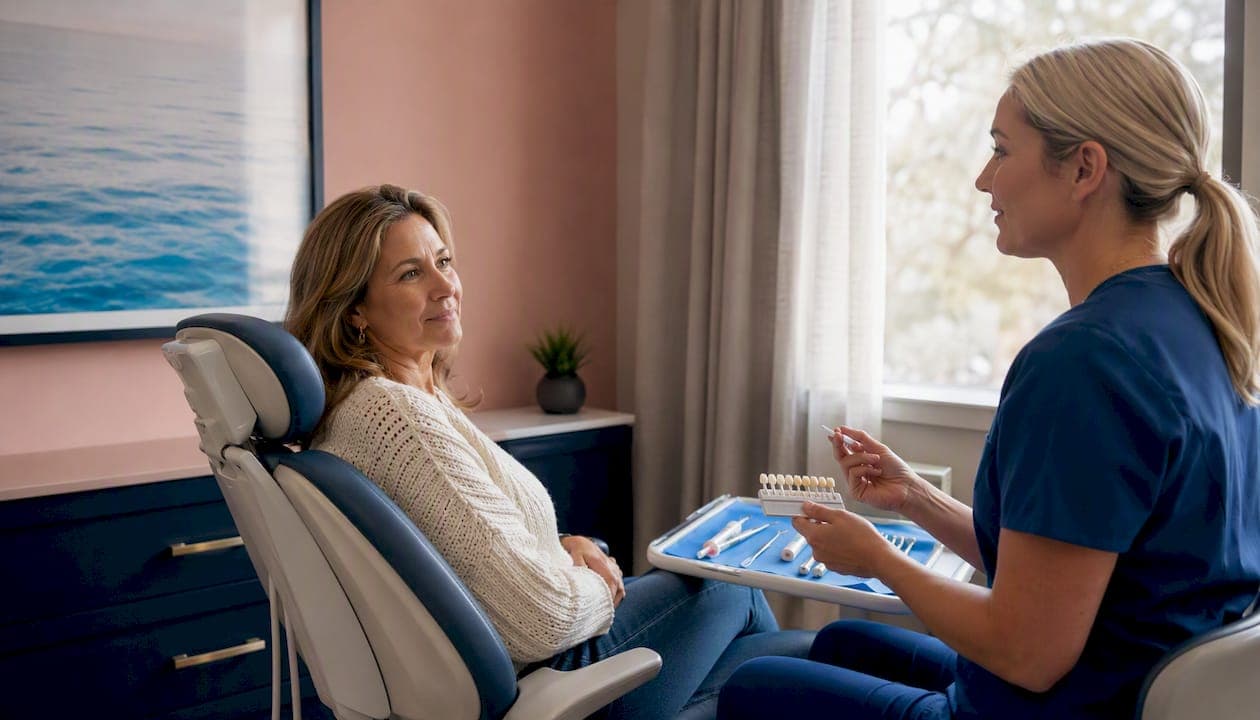
Professional teeth whitening in the U.S. runs from whitening toothpastes at very low cost up to in-office sessions that can cost several hundred dollars, so the range alone doesn't tell you much. Here's what actually matters: in-office whitening costs $300–$1,000 per session (averaging around $450–$500 nationally), dentist-provided custom take-home trays run $150–$600, and over-the-counter strips and kits fall between $20 and $300. If you need results before a wedding or event, in-office is the call. If you want the best long-term value and have a few weeks to spare, custom trays from your dentist win on cost-per-shade over time. OTC strips work for mild surface staining on a tight budget, but they won't match professional results. Starboarddental in Kennebunk offers both in-office and dentist-provided take-home options, so patients can choose based on timeline and budget rather than settling for one-size-fits-all.
Quick cost snapshot: Professional gels use 25–40% peroxide concentrations versus under 10% in OTC products, which is why a single clinic visit can deliver 5–10 shades of improvement while strips typically manage 1–4 shades over several weeks.
Table of Contents
- How much does in-office professional whitening cost?
- Are dentist-provided take-home trays worth the cost?
- What do OTC whitening products actually cost and deliver?
- What factors change the price you'll pay?
- Does insurance cover whitening, and what are your payment options?
- When whitening won't work: alternatives to consider
- What are the safety risks and how do you manage sensitivity?
- How to choose the right whitening option for your situation
- Research snapshot: shade improvements, speed, and cost compared
- Key Takeaways
- The case for spending more on dentist-supervised whitening
- Starboarddental's whitening services in Kennebunk
- Sources and further reading
How much does in-office professional whitening cost?
In-office whitening is the fastest route to a visibly brighter smile, and the price reflects that speed. A single session typically runs $300–$1,000, with the national average clustering around $450–$500. Major metros like New York or Los Angeles push toward the top of that range; a general dentist in a mid-size city often charges closer to $300–$400.
The procedure itself takes about 60–90 minutes. Your dentist isolates your gums with a protective barrier, applies a high-concentration hydrogen peroxide gel (usually 25–40%), and may use a light or laser to accelerate the reaction. Most patients see results immediately after one session, often 5–10 shades lighter.
What drives the price up:
- Geographic location (metro practices carry higher overhead)
- Whether a light-activation system is used
- The number of arches treated (upper only vs. upper and lower)
- Whether a take-home maintenance kit is bundled in
- The practice's specialization (cosmetic-focused clinics vs. general dentists)
Pros and cons at a glance:
- Pros: Same-day results, supervised application, highest peroxide concentration, immediate shade change you can see before you leave
- Cons: Higher per-session cost, temporary tooth sensitivity is common, results still require maintenance to last
Results from a single in-office session typically last 6 months to 2 years depending on diet and oral hygiene habits. Coffee, red wine, and tobacco are the fastest ways to shorten that window.
Zoom whitening is one of the most recognized in-office systems, using a specific LED light-activation protocol. It falls within the same $300–$1,000 price range as other in-office methods and doesn't reliably outperform other professional systems on long-term shade retention.
Are dentist-provided take-home trays worth the cost?
Custom take-home trays from a dentist are the sleeper option most patients overlook. The upfront cost is lower than in-office treatment, typically $150–$600, and the long-term math is even better because the trays are reusable. When your results fade, you only need gel refills, which run $20–$80 per round.
The process starts with impressions or a digital scan of your teeth. Your dentist fabricates custom-fitted trays that hold the professional-strength gel snugly against each tooth surface, which matters more than most people realize. Ill-fitting OTC trays let gel pool unevenly, reducing contact time and increasing gum irritation. Custom trays eliminate that problem.
You wear the trays for 30–60 minutes daily (or overnight with lower-concentration gels) for 1–3 weeks. Results are comparable to in-office treatment over that timeframe, just slower to appear. The shade improvement is real, and because you control the pace, sensitivity is usually easier to manage.
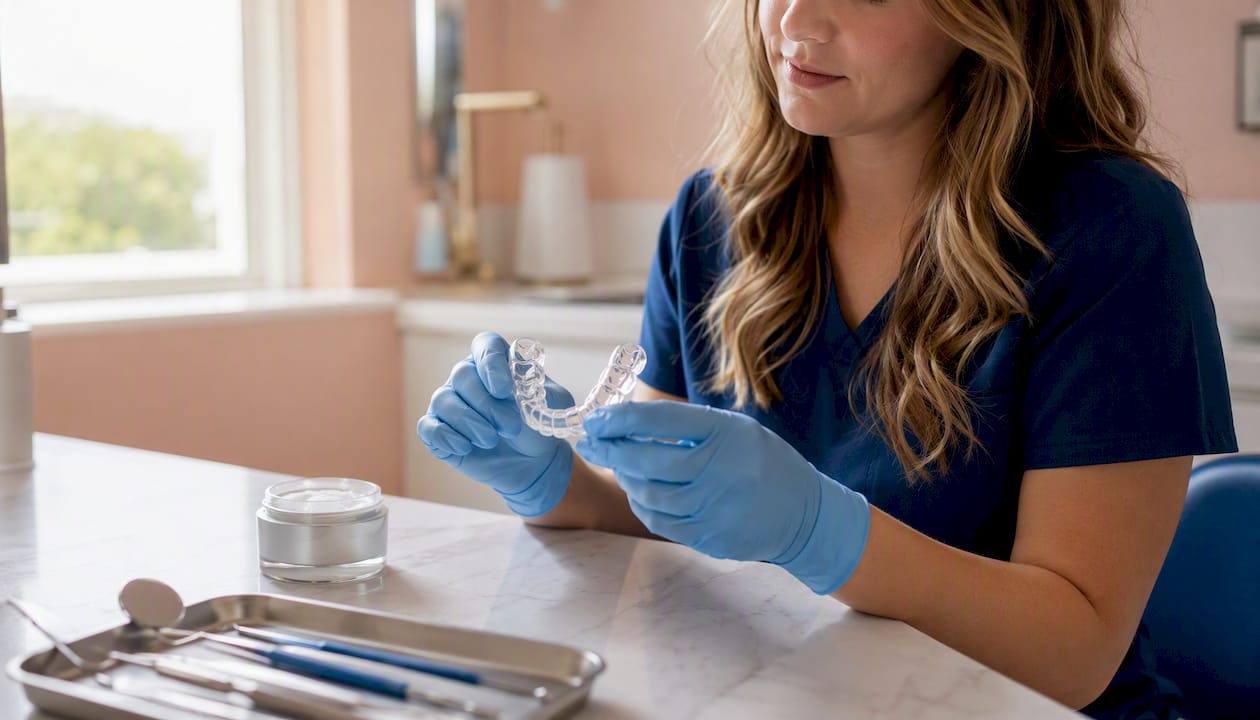
Pro Tip: Ask your dentist about a combined approach: one in-office session to jump-start the shade change, followed by custom trays for maintenance. You get the immediate visual payoff of in-office whitening without paying for repeated clinic visits every time results fade.
Custom trays make the most sense when you have no hard deadline, want to manage sensitivity at your own pace, or plan to maintain results long-term. For anyone who whitens more than once every two years, the reusable tray system almost always costs less over time than repeated in-office sessions.
What do OTC whitening products actually cost and deliver?
Over-the-counter options cover a wide range, and so do their results. Whitening strips run $20–$70, LED kits $30–$300, and whitening toothpaste $5–$15. The price gap between a drugstore strip kit and a professional treatment reflects a real difference in what you get.
OTC products are limited to under 10% peroxide by regulation, compared to the 25–40% used in professional gels. That gap translates directly to shade improvement: strips typically deliver 1–4 shades over several weeks, while professional options can achieve 5–10 shades in a single visit. OTC products also use one-size trays or flexible strips that don't conform perfectly to every tooth, so coverage is uneven and some surfaces get less contact time than others.
Where OTC products make sense:
- Mild extrinsic staining from coffee or tea with no underlying sensitivity issues
- Maintenance between professional treatments
- Budget under $50 with no event deadline
Where they fall short:
- Moderate to heavy staining that needs more than 2–3 shades of improvement
- Any intrinsic discoloration (tetracycline, fluorosis, old trauma)
- Patients with existing sensitivity, as lower-quality trays can increase gum irritation
Whitening toothpaste is worth a separate note: it works primarily through mild abrasives and surface-level chemistry, not peroxide bleaching. It can help maintain results after professional treatment, but it won't produce a meaningful shade change on its own.
What factors change the price you'll pay?
The price range for in-office whitening varies considerably. Several specific variables explain why two patients in different cities can pay dramatically different amounts for the same protocol.

Geographic location is the biggest single driver. High-end cosmetic practices in major metros often charge $600–$1,200 for the same in-office protocol that runs $300–$400 in mid-size cities. Rent, staff costs, and local market expectations all feed into that gap. A national average near $400 is a useful benchmark, but it smooths over real regional variation.
Type and severity of staining affects both the method you need and the number of sessions. Extrinsic stains from food and tobacco respond well to standard bleaching. Intrinsic stains from medications or developmental issues may require multiple sessions, specialized protocols, or entirely different treatments. A dentist who identifies intrinsic staining early saves you money by steering you away from whitening that won't work.
Practice type matters too. A cosmetic-focused clinic with dedicated whitening suites, premium light systems, and a specialist on staff will charge more than a general dentist offering whitening as one of many services. Neither is automatically better for every patient, but the price difference is real. Understanding the difference between cosmetic and general dentists helps you know what you're paying for.
Package structure also shifts the total cost. Some practices bundle an in-office session with take-home trays, a pre-treatment cleaning, and a follow-up check. That bundle may cost more upfront but often delivers better long-term value than paying for each component separately.
Does insurance cover whitening, and what are your payment options?
The short answer: no. Dental insurance classifies whitening as a cosmetic, elective procedure and does not cover it. FSA and HSA funds are also generally off the table for cosmetic whitening under IRS rules, since the treatment isn't medically necessary. There are narrow exceptions (whitening prescribed as part of a documented medical treatment), but they're uncommon.
That leaves out-of-pocket payment as the default. Here's how most patients handle it:
- CareCredit: A healthcare credit card with promotional 0% APR periods, widely accepted at dental practices. Useful for spreading typical whitening treatment costs over several months.
- In-office payment plans: Many practices offer their own installment options, sometimes interest-free for short terms.
- Credit cards with rewards: If you're paying out-of-pocket anyway, a cash-back or travel card can capture some value.
- Promotional bundles: Some practices offer "new patient whitening" deals that bundle a cleaning, exam, and whitening at a reduced combined price. Read the fine print on what's actually included.
For patients without insurance, dental financing options in Kennebunk and similar local resources can make professional whitening more accessible. The per-shade math also helps: if a $500 in-office treatment produces 8 shades of improvement, that's $62.50 per shade. A $400 custom tray kit that produces 7 shades and lasts two years with $40 refills is considerably cheaper per shade over time.
When whitening won't work: alternatives to consider
Peroxide bleaching works on extrinsic stains. It does not work reliably on intrinsic discoloration from tetracycline, fluorosis, or trauma. These stains sit inside the tooth structure itself, and no amount of surface-applied peroxide will reach them effectively.
Tetracycline staining is particularly resistant. The antibiotic bonds to developing tooth enamel and dentin, creating gray or brown banding that bleaching can lighten only slightly. Fluorosis creates white spots or brown patches from excess fluoride during tooth development. Old root-canal-treated teeth sometimes darken from internal breakdown products.
For these cases, the realistic alternatives are:
- Porcelain veneers: Thin shells bonded to the front of teeth, covering discoloration entirely. Effective but expensive, typically $900–$2,500 per tooth.
- Dental bonding: Composite resin applied and shaped over discolored areas. Less expensive than veneers, though less durable long-term. Dental bonding is a practical option for isolated spots.
- Internal bleaching: For single darkened root-canal-treated teeth, a dentist can place bleaching agent inside the tooth. This is a specialized procedure not available everywhere.
- Specialized multi-appointment protocols: For tetracycline cases, systems like KöR Whitening use extended, multi-visit protocols with specialized gel handling and can produce partial improvement in otherwise resistant staining. These cost more than standard whitening because of the additional visits and materials.
Pro Tip: If you're unsure whether your staining is extrinsic or intrinsic, a consultation before any whitening purchase saves you money. A dentist can identify the cause in a single exam and tell you whether bleaching will actually work for your specific situation.
What are the safety risks and how do you manage sensitivity?
The most common side effect of whitening is temporary tooth sensitivity, and it's directly tied to peroxide concentration. Higher concentrations produce faster results and more sensitivity. Most patients experience it as a brief, sharp sensation when teeth contact cold air or liquids, typically resolving within 24–48 hours after treatment.
Gingival (gum) irritation is the second most common issue, usually from gel contact with soft tissue rather than the peroxide itself. Custom-fitted trays minimize this significantly compared to generic OTC trays.
Practical ways to manage sensitivity:
- Use a desensitizing toothpaste (potassium nitrate or stannous fluoride) for 1–2 weeks before whitening
- Ask your dentist about a professional desensitizing agent applied before or after treatment
- Stagger treatment sessions rather than whitening consecutive days
- Choose a lower-concentration gel for a longer treatment period if sensitivity is a known issue
Whitening is generally safe when performed or supervised by a dental professional, and the American Dental Association supports its use for appropriate candidates. The key phrase is "appropriate candidates." Active decay, cracked enamel, or significant gum disease should be addressed before any whitening treatment. Bleaching over untreated decay can cause real damage.
Pro Tip: If sensitivity persists beyond 48 hours or you notice white spots on your gums after whitening, contact your dentist. These are usually minor and resolve quickly, but they warrant a check rather than continuing treatment.
How to choose the right whitening option for your situation
The right choice depends on four variables: how fast you need results, your budget, your sensitivity history, and what type of staining you have. Here's a practical decision path:
- Identify your staining type first. Extrinsic stains (coffee, wine, tobacco) respond to bleaching. Intrinsic stains often don't. If you're not sure, a dental consultation answers this before you spend anything.
- Set your timeline. Need results in 1–2 days? In-office is the only reliable option. Have 2–4 weeks? Custom trays deliver comparable results at lower cost.
- Assess your sensitivity history. If you've had sensitivity issues before, custom trays with lower-concentration gel and a slower schedule are safer than a single high-concentration in-office session.
- Calculate long-term cost, not just upfront cost. If you plan to maintain results, custom trays with $20–$80 refills beat repeated in-office sessions over any multi-year horizon.
- Check your oral health first. Active decay or gum disease should be treated before whitening. A pre-whitening exam isn't an upsell; it's how you avoid wasting money on treatment that won't work or could cause harm.
Questions to ask your dentist at a consultation:
- What peroxide concentration will you use, and why?
- How many shades of improvement should I realistically expect?
- Do I need a cleaning or any other treatment before whitening?
- What are the follow-up or maintenance costs after the initial treatment?
- Is my staining extrinsic, intrinsic, or mixed?
Red flags to watch for: Any provider who guarantees a specific number of shades without examining your teeth, skips an oral health check entirely, or pushes one product as the only effective option is worth questioning. Whitening outcomes vary by individual, and no ethical provider promises a specific result without an exam.
Research snapshot: shade improvements, speed, and cost compared
The data on whitening outcomes is consistent across multiple studies: professional methods outperform OTC on both speed and magnitude of shade change, and the peroxide concentration gap explains most of that difference.
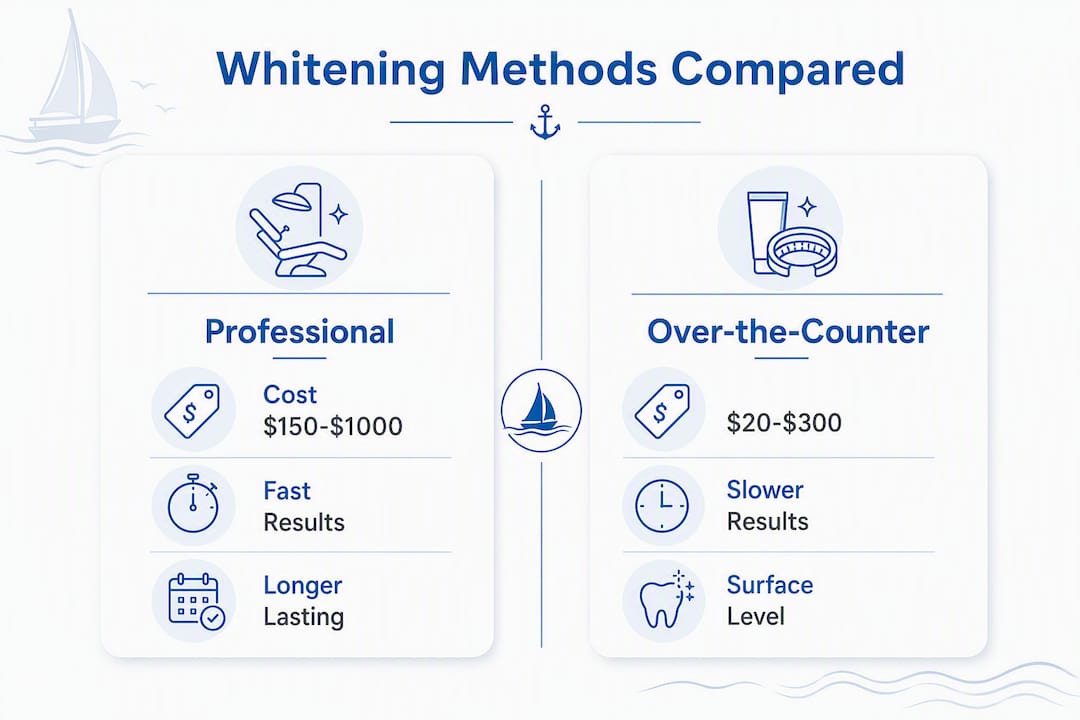
| Method | Typical cost range | Approximate shade improvement | Time to result | Longevity |
|---|---|---|---|---|
| In-office professional | $300–$1,000/session | 5–10 shades | 1 visit (60–90 min) | 6 months–2 years |
| Dentist take-home trays | $150–$600 upfront | 4–8 shades | 1–3 weeks | 1–2+ years (with refills) |
| OTC strips/LED kits | $20–$300 | 1–4 shades | 2–6 weeks | 3–6 months |
| Whitening toothpaste | $5–$15 | Minimal (surface only) | Ongoing | Maintenance only |
Professional gels at 25–40% peroxide versus OTC products at under 10% explains the speed and magnitude gap. The longevity difference comes down to concentration, application precision, and whether maintenance is built into the plan. A combined in-office plus take-home tray approach often produces the best result per dollar over a multi-year period.
Key Takeaways
Professional whitening costs $150–$1,000 depending on method, with custom dentist trays offering the best long-term value and in-office treatment delivering the fastest single-visit results.
| Point | Details |
|---|---|
| In-office cost range | Expect $300–$1,000 per session nationally, averaging around $450–$500. |
| Custom trays beat in-office long-term | Upfront $150–$600, then $20–$80 refills; reusable trays lower the cost of every future touch-up. |
| OTC products have real limits | Strips and LED kits deliver 1–4 shades at $20–$300 but can't match professional peroxide concentrations. |
| Insurance won't cover it | Whitening is cosmetic; dental insurance, FSA, and HSA funds are generally not applicable. |
| Starboarddental's approach | Starboarddental in Kennebunk offers both in-office and custom take-home whitening, with a consultation to match the right method to your staining type and timeline. |
The case for spending more on dentist-supervised whitening
Most whitening articles frame this as a simple cost comparison: in-office is expensive, strips are cheap, pick based on budget. That framing misses the more important variable, which is whether the treatment you choose will actually work for your specific teeth.
The patients who waste the most money on whitening are the ones who spend $150 on OTC products for staining that was never going to respond to 6% peroxide, or who do three in-office sessions when a $400 custom tray kit would have produced the same result over six weeks at a third of the ongoing cost. The consultation isn't a formality. It's the step that tells you which category you're in.
There's also a sensitivity argument that rarely gets made clearly: a dentist can prescribe a desensitizing protocol before treatment, use a lower concentration gel with a longer schedule, and monitor your response in a way that no strip kit can replicate. For patients with a history of sensitivity, that supervision is worth real money in avoided discomfort and wasted product.
The scenario where in-office whitening is genuinely worth the premium is narrow but real: you have a hard deadline, your staining is extrinsic, and your oral health is already in good shape. Outside that scenario, custom trays from a dentist almost always win on value. The key is knowing which scenario you're actually in before you pay for anything.
Starboarddental's whitening services in Kennebunk
Patients in the Kennebunk area have a straightforward path to professional whitening without the guesswork. Starboarddental offers both in-office whitening and dentist-provided custom take-home trays, and the process starts with a consultation that identifies your staining type, checks your oral health, and recommends the method that fits your timeline and budget.
The practice uses digital scanners for custom tray fabrication, which means better-fitting trays and more even gel coverage than generic alternatives. Comfort features like ceiling-mounted TVs and personalized amenities make the appointment itself less of an ordeal. Same-day appointments are available for patients who need to move quickly.
Whether you're looking for a single in-office session before an event or a long-term maintenance plan with custom trays, the cosmetic dentistry services at Starboarddental cover both. Book a consultation to get an accurate local quote and a clear recommendation based on your actual teeth, not a generic price estimate.
Sources and further reading
Pricing figures and clinical guidance in this article draw from the following sources. Local pricing varies, and the most accurate quote for teeth whitening cost in Kennebunk comes from a direct consultation with Starboarddental.
- Teeth Whitening Cost 2026: In-Office vs At-Home vs OTC — RealDentalCosts: Core cost ranges for in-office, custom trays, and OTC products.
- How Much Does Teeth Whitening Cost? — CostWhale: National average cost benchmarks and geographic variation.
- FSA Eligibility List: Teeth Whitening — FSAstore: FSA/HSA eligibility rules for cosmetic whitening.
- Whitening — American Dental Association: ADA guidance on whitening safety, indications, and professional oversight.
- Teeth Whitening — MouthHealthy (ADA): Patient-facing ADA resource on whitening methods and safety.
This article is general information, not professional dental advice. Consult a licensed dentist to confirm whether whitening is appropriate for your oral health situation and to get accurate local pricing.