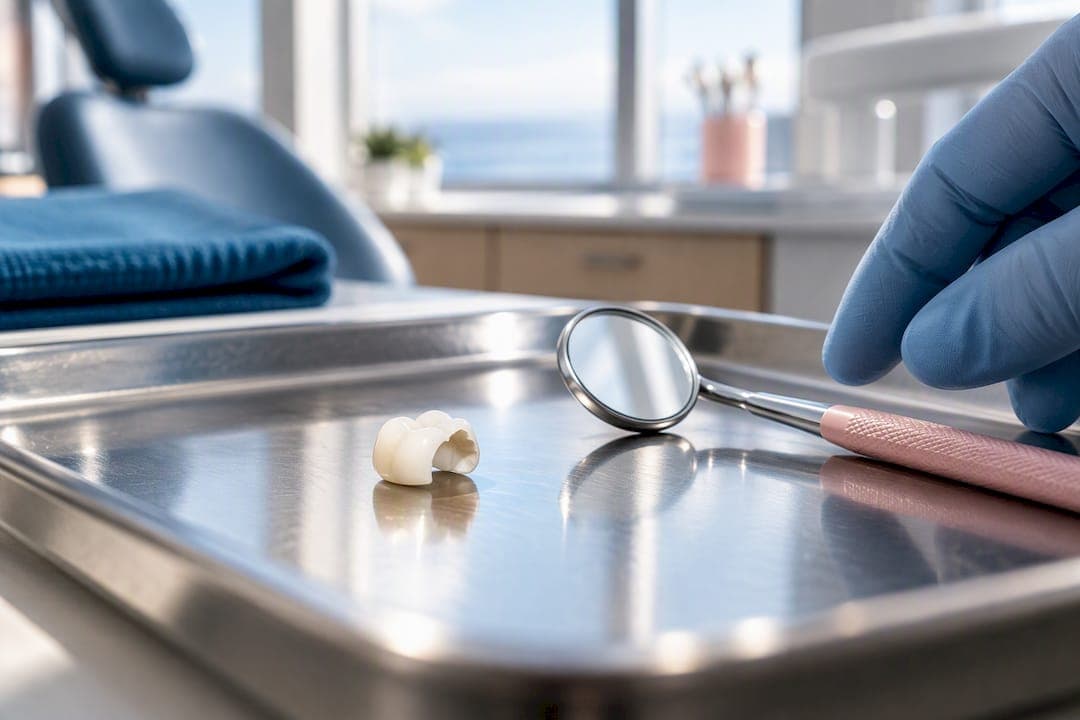
If your temporary crown came off, retrieve it, rinse it, and keep it safe. Avoid chewing on that side to protect the exposed tooth, and call your dentist as soon as you can. Most cases get handled within 24 to 48 hours as long as you're not dealing with severe pain, swelling, or bleeding.
TL;DR:
- Most temporary crowns can be reattached or replaced within 24 to 48 hours unless you experience severe pain, swelling, bleeding, or signs of trauma.
- Using household glue or nail products to fix a crown is unsafe, and at-home cement kits are the most reliable temporary solutions if the crown fits naturally and is undamaged.
- Preventing further damage requires avoiding sticky, hard, or extreme-temperature foods, chewing on the opposite side, and handling the exposed tooth gently.
- If the crown is swallowed and you have no difficulty swallowing or breathing, it usually passes without issue, but you should inform your dentist.
- A same-day dental appointment is recommended to assess and refit the crown if it remains loose or damaged, especially if symptoms like pain or swelling develop.
Table of Contents
- Temporary Crown Came Off: What to Do in the First 10 to 30 Minutes
- Safe Temporary Fixes You Can Try at Home
- When Does a Lost Crown Become a Dental Emergency?
- Protecting the Exposed Tooth Until Your Appointment
- What to Bring to Your Dental Appointment
- How Starboarddental Handles a Lost Temporary Crown
- What This Situation Actually Calls For
- How Starboard Dental Gets You Back on Track Fast
- Where This Guidance Comes From
- Sources
- FAQ
Temporary Crown Came Off: What to Do in the First 10 to 30 Minutes
The first half hour matters more than anything else you'll do before your dental visit. Here's the order that actually protects your tooth and keeps your options open.
- Find the crown before you do anything else. Check your mouth, the sink, your napkin, or wherever you were when it happened. If you think you swallowed it and you're breathing and swallowing normally, it will likely pass through without issue, though you should still mention it to your dentist.
- Rinse it under warm water, don't scrub it. A soft touch is all it needs. Scrubbing or picking at it with a fingernail or toothpick can chip the edges, and a chipped temp won't seat right even if you get it back to the office.
- Inspect it for cracks or a broken edge. A crown that's fully intact has a much better shot at being re-cemented. One that's cracked, thinned, or missing a chunk usually needs to be remade, according to Healthline's guidance on what to do if a crown falls out.
- Store it in a small container or a zip bag. Don't wrap it in a tissue and toss it in your pocket. That's how temp crowns end up in the laundry.
- Never use household glue, superglue, or nail products to stick it back on. These adhesives are not made for the mouth, can be toxic if swallowed, and often make the crown impossible to remove cleanly later, a point Woodbridge Dental Centre and most clinic guidance agree on.
- Manage discomfort with OTC ibuprofen or acetaminophen and a warm salt water rinse. Swish gently rather than aggressively, especially near the exposed tooth.
Pro Tip: Keep the crown in the container you're bringing to your appointment, not a random drawer. People lose temp crowns twice, once when they fall out and again when they get misplaced at home.
Safe Temporary Fixes You Can Try at Home
At-home reattachment makes sense only under specific conditions: the crown is undamaged, you're not in significant pain, and the crown seats fully into place without you forcing it. If it doesn't slide on naturally, stop. Forcing a crown that doesn't fit can crack it, push it too far onto the gum, or set you up for a worse office visit.
OTC temporary crown cement kits, sold at most pharmacies, are the most reliable at-home option:
- Dry the crown and the tooth as best you can with a tissue or cotton ball.
- Apply a small dab of cement inside the crown, not a filled cavity's worth.
- Seat the crown firmly with your finger and bite down gently on a piece of gauze to hold it in place for a minute.
- Wipe away any excess cement before it hardens.
If you don't have a cement kit, dental wax, denture adhesive, or even sugar-free gum pressed gently over the tooth can offer short-term protection. None of these are meant to last more than a few hours at a stretch, and they need to be replaced regularly since saliva breaks them down and food debris gets trapped underneath. Pharmacy fact sheets on lost crowns describe similar bridging options when a same-day dental visit isn't possible, while still stressing that a dentist should assess the tooth as soon as reasonably possible.
Pro Tip: Whatever you use, treat it as a bridge, not a fix. A temp crown reglued at your kitchen table is still a temp crown, and it's still buying you time, not solving the underlying problem.
When Does a Lost Crown Become a Dental Emergency?
Most lost temporary crowns are inconvenient, not dangerous. A shortlist of symptoms changes that calculation completely, and any one of them means you shouldn't wait for a routine appointment slot:
- Pain that's severe, getting worse, or waking you up at night
- Swelling in the face or gums, a fever, or drainage near the tooth
- Difficulty breathing or swallowing, uncontrolled bleeding, or trauma to the face or jaw
- A visibly broken tooth underneath, or a sharp edge cutting into your tongue or cheek
- Repeated failed attempts at reattachment, or a bite that feels high and won't settle
The American Dental Association frames urgent evaluation around exactly this combination of severe pain, uncontrolled bleeding, swelling, fever, or trauma. A missing temp crown alone rarely qualifies as a true emergency. Add any of the signs above and it does.
Protecting the Exposed Tooth Until Your Appointment
The tooth under that missing crown has been filed down and is more sensitive than you're used to. Treat it gently for the next day or two.
- Stick to soft foods: eggs, pasta, soup, yogurt. Skip anything sticky, hard, crunchy, or extreme in temperature.
- Chew on the opposite side of your mouth whenever possible.
- Brush gently around the area, and rinse with warm salt water instead of aggressive flossing right against the prepared tooth.
- Avoid clenching or grinding, and swap out any wax or adhesive every few hours rather than leaving it in overnight.
What to Bring to Your Dental Appointment
Showing up prepared shortens the visit considerably. Bring the crown itself in a clean, sealed container, and be ready to tell the office a few key details.
- When it came off and whether you tried any at-home fix
- Which office originally placed the crown, if it wasn't Starboarddental
- Roughly when your permanent crown is expected
- Any pain, sensitivity, or bite changes you've noticed since it fell off
Expect the dentist to check the fit, clean both surfaces, and either re-cement the original crown or fabricate a new provisional if it's cracked or worn. Many offices can turn this around in a short visit, sometimes 15 to 30 minutes when the crown is in good shape.
How Starboarddental Handles a Lost Temporary Crown
Our first move is almost always to check whether your original crown can go back on. An intact temp that seats cleanly gets re-cemented on the spot after we check your bite. If it's cracked, worn thin, or doesn't seat right anymore, we'll take a quick scan and make you a new provisional, sometimes offering a same-day path toward the permanent restoration. When you call, just tell us the crown fell off and roughly when. Bring the crown with you if you have it.

What This Situation Actually Calls For

Most advice about lost crowns focuses on the wrong worry. People fixate on whether they can glue it back themselves, when the real variable that decides urgency is the condition of the tooth underneath, not the missing crown. A crown that's off but a tooth that's calm and comfortable is a 24 to 48 hour problem. A tooth that's throbbing, swollen, or has a sharp broken edge is a same-day problem, regardless of what the crown looks like.
The other thing overlooked advice gets backwards: at-home fixes aren't a failure mode you should feel bad about reaching for. Temporary cement is deliberately weak so it can be removed without damaging the tooth, which means crowns are supposed to come off sometimes. Wax, denture adhesive, or a pharmacy cement kit used correctly is smart triage, not a workaround. What matters is not stretching that bridge past a day or two, since a prepared tooth left uncovered can shift just enough to complicate how your final crown seats later.
— Alex
How Starboard Dental Gets You Back on Track Fast
A lost temporary crown doesn't have to mean a week of soft foods and crossed fingers. Starboarddental offers same-day appointments specifically for situations like this, so a crown that came off on a Tuesday morning doesn't have to wait until next week to get handled.

When you call, tell the front desk your temporary crown came off, roughly when it happened, and whether you've tried anything at home. Bring the crown itself in a small container if you still have it. Our restorative dentistry team will check the fit, clean the tooth, and either re-cement your existing crown or build a new provisional chairside, all in a practice designed around reducing dental anxiety rather than adding to it, with comfort amenities and personalized care for every age group. If your visit uncovers something more, like decay under the margin, we'll walk you through it before doing any work. Start by booking a general dentistry appointment and let us take the guesswork out of what happens next.
Where This Guidance Comes From
- American Dental Association — Dental emergencies guidance
- ADA — Dry socket information
- Healthline — What to do if a crown falls out
- Scruggs Dentistry — What happens if a temporary crown falls off?
Sources
- American Dental Association — Dental emergencies guidance
- ADA — Dry socket information
- Healthline — What to do if a crown falls out
- Scruggs Dentistry — What happens if a temporary crown falls off?
FAQ
How Long Can You Go Without a Temporary Crown?
Aim to see a dentist within 24 to 48 hours, which is the window most clinician guidance points to for avoiding tooth shifting that could affect your final crown's fit. If you have severe pain, swelling, or fever, don't wait that long, call for a same-day appointment instead.
Can I Brush My Teeth if My Temporary Crown Fell Off?
Yes, but brush gently around the exposed tooth rather than scrubbing it directly. A soft-bristle brush and a light touch, followed by a warm salt water rinse, keeps the area clean without irritating the sensitive tooth underneath.
Can I Stick a Temporary Crown Back On Myself?
You can, using an over-the-counter temporary crown cement kit, dental wax, or denture adhesive, but only if the crown is undamaged and seats into place without force. Never use superglue or household adhesive, and treat any at-home fix as a short bridge until you see your dentist, not a permanent solution.
What Causes a Temporary Crown to Fall Off?
The most common causes are the cement itself, which is intentionally weak so the crown can be removed later, plus habits like chewing sticky or hard foods on that side. A poor initial fit or a crack from grinding can also cause it to loosen or pop off entirely.
What Should I Do if I Swallowed My Temporary Crown?
If you're breathing and swallowing normally with no choking or pain, it will typically pass through your system without a problem, though it's still worth mentioning to your dentist at your next call. If you develop any respiratory symptoms or chest discomfort, seek medical attention right away, according to general consumer dental guidance.