Clear aligners are a widely used, effective option for many adults with mild-to-moderate alignment issues, and success depends far less on the tray than on whether a qualified provider supervises the case. Predictable results require professional monitoring, proper oral-health clearance, and wearing your trays 20 to 22 hours a day. If you're weighing the decision, the smartest first move is booking a consultation with a provider like Starboard Dental to get an honest read on your specific case.
TL;DR:
- Clear aligners work best when supervised by a qualified provider who monitors progress and ensures proper oral health before starting treatment.
- Worn for 20 to 22 hours daily, aligners are effective mainly for mild-to-moderate gaps, crowding, and minor bite issues, but not for severe jaw misalignment or skeletal discrepancies.
- Treatment duration generally ranges from several months to over a year, depending on case complexity, with adherence to wear schedules being critical for timely results.
- Costs vary from $3,000 to $8,000 depending on case complexity, with insurance, HSA/FSA plans, and in-house financing options affecting affordability.
- For complex cases or severe bite issues, provider-supervised aligners and traditional braces are more appropriate than mail-order kits, which are suited only for very mild problems.
Table of Contents
- How do aligners work for adults?
- Are you a good candidate for clear aligners?
- What does the aligner treatment process look like?
- What do aligners cost, and how do you pay for them?
- Supervised aligners vs. braces vs. at-home kits: which fits your case?
- What should you actually expect during treatment?
- How do you choose the right aligner provider?
- A dentist's-eye view on adult aligner treatment
- Ready to start? What working with Starboard Dental looks like
- Sources
How do aligners work for adults?
A clear aligner is a thin, custom-molded plastic tray that nudges your teeth a fraction of a millimeter at a time. Your provider starts with a 3D digital scan of your mouth, maps out where your teeth need to go, and generates a series of trays that each handle one small leg of that journey. Most patients switch trays approximately every one to two weeks, and each new set picks up the movement where the last one left off, according to the American Association of Orthodontists.
The daily commitment matters more than people expect. Trays need to be worn most of the day to be effective, with only limited time allowed for eating, brushing, and flossing. That's not a suggestion. Take them out more than that, and the teeth simply don't move the way the digital plan predicted.
Aligners handle a specific range of problems well:
- Gaps between teeth (diastemas)
- Mild-to-moderate crowding
- Minor bite issues, including some overbite and underbite cases
- Relapse after previous orthodontic work
They're a poor match for severe bite discrepancies, significant jaw misalignment, or cases that ultimately need surgical correction, per AAO guidance. For trickier movements like rotating a canine or extruding a tooth, providers often bond small tooth-colored composite bumps called attachments onto the enamel. Aligners grip these to apply more directed pressure, which is why a fully "invisible" claim doesn't hold for every adult case. Our guide to aligner attachments breaks down what to expect if your plan includes them.
Are you a good candidate for clear aligners?
Age isn't the gatekeeper here. Oral health and follow-through are. A 60-year-old with healthy gums and disciplined wear habits is often a better candidate than a 28-year-old with untreated gum disease.
Signs you're likely a good fit:
- Healthy gums with no active periodontal disease
- No untreated cavities or decay
- Mild-to-moderate crowding, spacing, or bite issues
- Orthodontic relapse (teeth shifted back after old braces)
- Realistic expectations about wear time and check-ins
Red flags that mean you should address other issues first:
- Active gum disease or bone loss
- Severe bite discrepancies that may require jaw surgery
- Multiple untreated cavities, cracked teeth, or missing restorations
- Significant jaw joint (TMJ/TMD) pain that hasn't been evaluated
If restorative or periodontal work is pending, get it handled before your scans, not after. Starting aligner treatment on top of an unresolved cavity or inflamed gums almost always causes complications mid-treatment. Our overview of common procedures for new patients walks through what that groundwork typically involves.
What does the aligner treatment process look like?
The path from first visit to finished smile follows a fairly consistent sequence, though the pace varies by case.
- Initial consultation. Your provider examines your teeth and gums, takes X-rays, and confirms you're cleared for aligner treatment rather than needing restorative work first.
- Digital scan and treatment plan. A 3D scanner captures your bite, and software maps the staged movements tray by tray. You'll typically see a preview of your projected end result before committing.
- First trays and attachment placement. You receive your initial sets, and if your case needs them, attachments get bonded on. The first week often brings some soreness and a slight lisp as your tongue adjusts.
- Ongoing check-ins. Expect periodic visits, sometimes supplemented by remote photo check-ins, so your provider can confirm the teeth are tracking with the plan.
- Retention. Once active movement wraps up, you'll transition to a retainer, worn nightly, to hold the result.
Adult treatment timelines commonly range from several months to over a year depending on case complexity, depending on how much movement is needed and how consistently you wear your trays. Minor gap closures can finish closer to the short end; more involved crowding or bite correction pushes toward the longer end, or beyond it if a rescan is needed.
Pro Tip: Set a phone alarm for tray changes and cleanings rather than relying on memory. The adults who finish on schedule are usually the ones who treat wear time like a medication schedule, not a suggestion.
What do aligners cost, and how do you pay for them?
Provider-supervised clear aligner treatment in the U.S. typically runs about $3,000 to $8,000, with case complexity, geographic location, and the provider's experience level driving most of the spread. A simple gap closure sits at the lower end; a longer case involving attachments and multiple rescans climbs toward the top.
A few practical notes on paying for it:
- Insurance. Many dental plans that cover orthodontics treat clear aligners the same as traditional braces, but coverage varies widely by plan, so confirm your specific benefits before committing.
- HSA/FSA funds. Orthodontic treatment, including aligners, generally qualifies as an eligible expense under most health savings and flexible spending accounts.
- In-house financing. Many practices offer monthly payment plans that spread the cost over the length of treatment.
- Written estimates. Before you sign anything, get the total in writing, including what happens if you need a rescan, new trays, or a retainer replacement down the road.
At-home, mail-order aligners are usually cheaper upfront, but they trade away in-person diagnostics and monitoring. That trade-off is riskier if there's any chance of an undiagnosed bite or gum issue underneath the crowding you're trying to fix. Our breakdown of aligner costs and payment options covers the line items worth asking about at your consult.
Supervised aligners vs. braces vs. at-home kits: which fits your case?
Not every adult needs the same level of oversight, and the right route depends on how complex your case actually is.
- Provider-supervised aligners give you in-person diagnostics, the option for attachments on harder movements, and a professional watching for tracking problems before they become bigger delays. This is generally the best fit for gaps, crowding, and mild-to-moderate bite issues.
- Traditional braces still win out for severe skeletal discrepancies or complex bite corrections that need forces aligners can't deliver. They're more visible and demand more careful brushing and flossing around brackets and wires.
- At-home or mail-order aligners cost less and skip the office visits, but consumer health guidance generally recommends them only for very mild cases, since there's no clinician catching a bite problem or gum issue before it worsens.
The decision comes down to complexity and how much oversight you want. Straightforward spacing with a healthy mouth can tolerate more of a hands-off approach. Anything involving your bite, jaw comfort, or existing dental work deserves an in-person provider from day one. Our comparison of aligners and overbite correction digs deeper into where the line falls.
What should you actually expect during treatment?
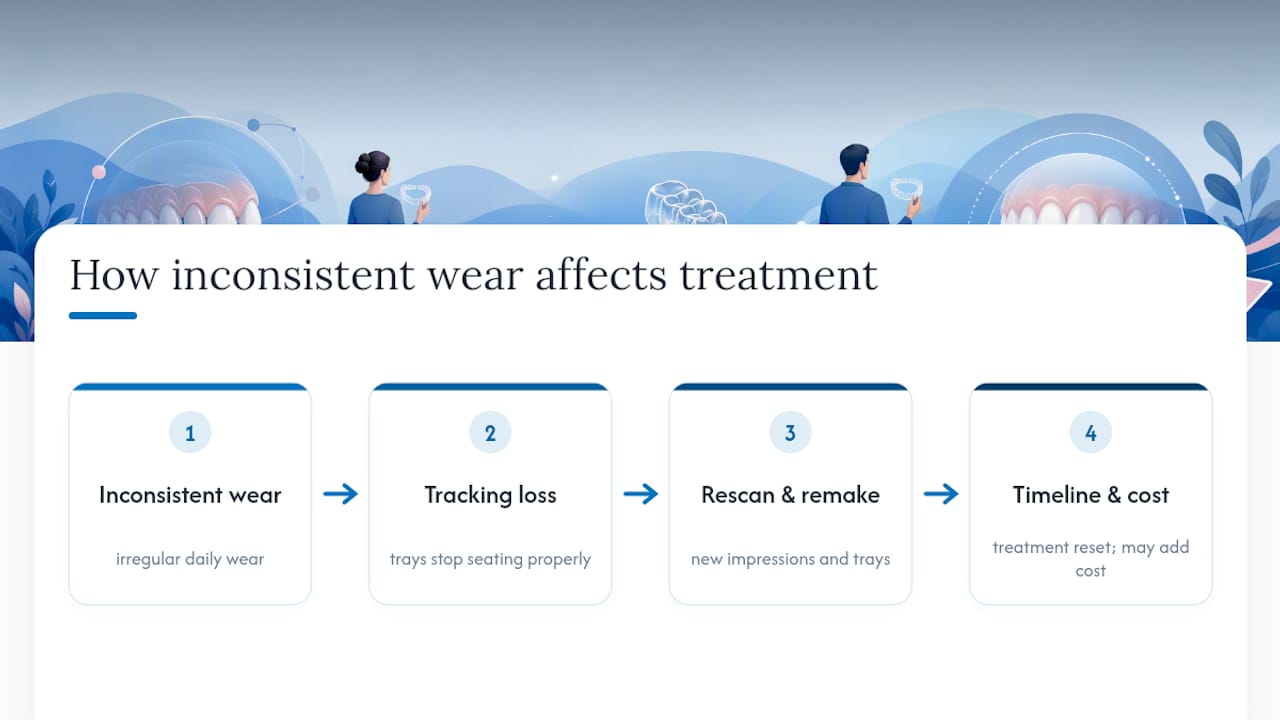
Compliance is the single biggest predictor of finishing on schedule. Inconsistent wear commonly causes trays to stop tracking properly, which often means a rescan and a fresh set of trays, resetting your timeline and adding cost.
Attachments will feel like small bumps on certain teeth, and your tongue will notice them for the first few days before it stops registering them entirely. Clean your aligners with lukewarm water and a soft brush, avoid hot drinks while they're in (heat can warp the plastic), and keep flossing daily even though it takes an extra minute with trays in the picture.

Pro Tip: If a tray suddenly feels loose or won't seat fully after a few days, that's tracking loss, not something to wait out. Call your provider before you pop in the next tray in the sequence.
Persistent pain beyond normal pressure, a broken attachment, or trays that won't seat right are all reasons to call your provider rather than push through on your own.
How do you choose the right aligner provider?
A quick checklist before you commit to a treatment plan:
- Credentials and experience. Ask how many adult aligner cases the provider has managed and whether they handle attachment placement in-house.
- In-office scanning. Digital scanners produce more accurate impressions than old-style putty molds and let you preview your projected result.
- Monitoring plan. Confirm whether check-ins happen in person, remotely, or both, and how often.
- Retreatment policy. Ask upfront what happens, and what it costs, if your case needs a rescan or extra trays.
- Trust signals. Before-and-after photos, patient reviews, and clinic resources that explain attachments and pricing openly are good indicators of a transparent practice.
Starboard Dental checks these boxes with in-house digital scanning, transparent cost conversations at consultation, and a monitoring plan built around your case rather than a one-size template.
A dentist's-eye view on adult aligner treatment
Adults chase aligners for the same reason they avoided braces at 15: they want a result without rearranging their whole life around it. That's a reasonable goal, but it only works if you respect the mechanics behind it. Wear time isn't a formality. It's the entire mechanism.
What gets underrated is how individualized adult cases are. Two patients with similar crowding can need completely different attachment strategies based on root shape and bite history. Ask hard questions, plan for a possible rescan, and treat your consult as a diagnostic conversation, not a sales pitch. Book a consult and get a plan built around your mouth, not a stock case.
— Alex
Ready to start? What working with Starboard Dental looks like
Starboard Dental gives adults in Kennebunk, York, and Saco a supervised alternative to guessing your way through a mail-order aligner kit. Every case starts with a digital scan on our in-office scanners, so you see your projected outcome before you commit to anything, and same-day appointments mean you're not waiting weeks just to get answers about whether you're a candidate.

We walk through insurance benefits, HSA/FSA eligibility, and in-house financing at your very first visit, so there are no surprise line items halfway through treatment. If restorative or periodontal work needs to happen first, our general dentistry team handles that under one roof rather than sending you elsewhere and restarting the clock. New patients can browse our clear aligner services or head straight to our new patient page to schedule a consultation and find out exactly what your case would involve.
This article is general information, not a substitute for advice from a qualified doctor. Consult a qualified healthcare professional about your own circumstances before acting on anything here.
Sources
- Straighten your smile discreetly with clear aligners — AAO
- What do Invisalign braces cost? Are they worth it? — Colgate
- 4 best invisible braces and teeth aligners for adults — Healthline