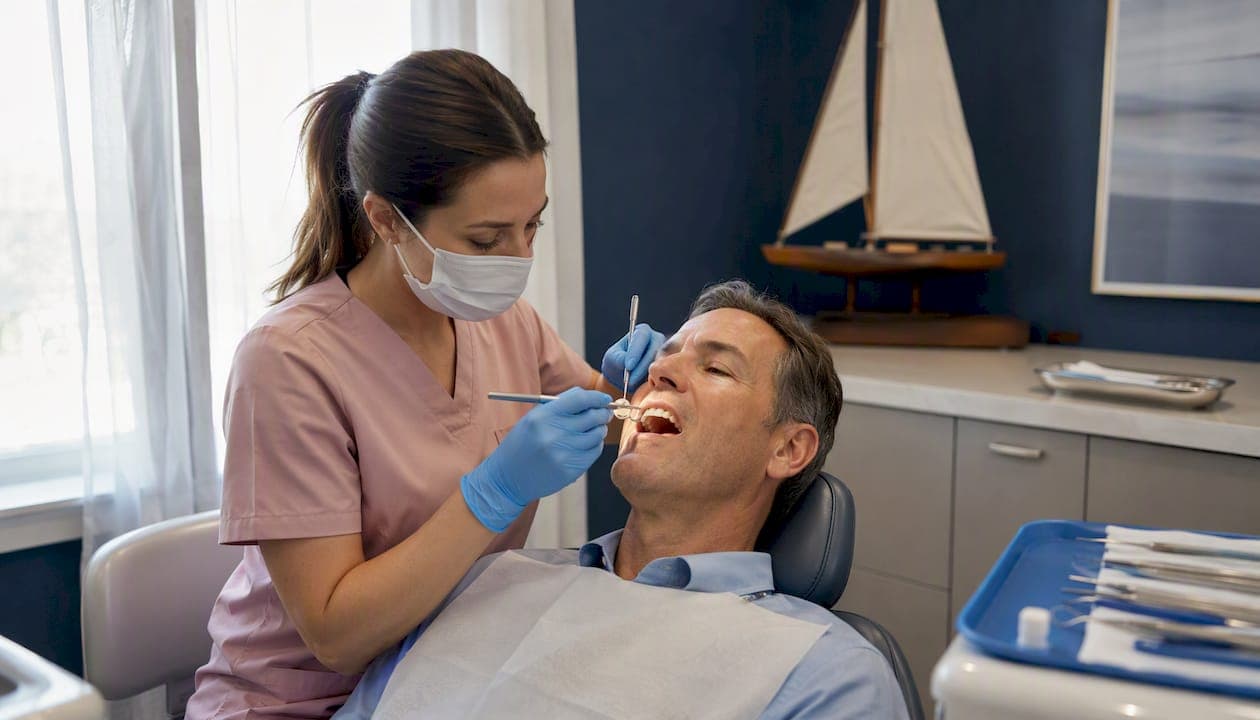
Scaling and root planing (SRP) typically has widely varying prices per quadrant without insurance, with full-mouth treatment costs reflecting the sum of those quadrants before any coverage kicks in. With a dental plan that covers periodontal services, your out-of-pocket share usually represents a portion of those costs, depending on your coinsurance rate, deductible, and annual maximum. That means a four-quadrant deep cleaning could cost significantly less after insurance in a typical PPO scenario.
A few quick numbers to anchor your expectations:
- Per quadrant (D4341, 4+ teeth): $220–$570 nationally in 2026, with most patients seeing prices between $250–$400 per quadrant
- Per quadrant (D4342, 1–3 teeth): $150–$300
- Full-mouth SRP (4 quadrants): $800–$1,500 before insurance in most U.S. markets
- With insurance (50–80% coverage): Out-of-pocket amounts depend on your plan
- Routine prophylaxis (D1110) for comparison: Costs can vary nationally
Before you accept a full-mouth quote, ask the office for your periodontal chart, recent X-rays, and the specific ADA billing codes they plan to submit. If the provider cannot show documented pocket depths and bone loss supporting every quadrant billed, that is a red flag worth addressing before treatment begins.
Table of Contents
- How much does deep cleaning cost per quadrant and full mouth?
- Why is a deep cleaning recommended instead of a routine cleaning?
- What actually happens during a deep cleaning appointment?
- What should you expect after a deep cleaning?
- What are the risks and benefits of deep cleaning?
- What factors drive how much your deep cleaning will cost?
- How does insurance cover deep cleaning, and what are your payment options?
- Where can you safely lower the cost of deep cleaning in the U.S.?
- Key Takeaways
- The cost conversation most patients never have
- Starboarddental's approach to periodontal care in Kennebunk
- Useful sources and further reading
How much does deep cleaning cost per quadrant and full mouth?
The per-quadrant model is how dental offices actually price SRP, so understanding the math protects you from sticker shock on a full estimate.
D4341 and D4342 are the two ADA codes used for scaling and root planing. D4341 applies when four or more teeth in a quadrant need treatment; D4342 covers one to three teeth. The distinction matters because insurers reimburse them at different rates, and some offices bill D4341 across all four quadrants even when only a few teeth per quadrant show disease.
| Scenario | Quadrants Treated | Typical Cost (No Insurance) | Typical Cost (With 50–80% Coverage) |
|---|---|---|---|
| Localized disease | 1 quadrant | $220–$570 | — |
| Two quadrants | 2 quadrants | — | — |
| Full-mouth SRP | 4 quadrants | $800–$1,500 | — |
| D4342 (1–3 teeth) | 1 quadrant | $150–$300 | — |
Regional costs shift these numbers meaningfully. A quadrant of SRP in rural Maine or the Midwest might run $220–$280, while the same procedure in Boston, New York, or San Francisco can reach $450–$570. A routine dental visit with exam, cleaning, and X-rays already runs $200–$450 in many markets without insurance, so SRP costs layered on top can feel steep.
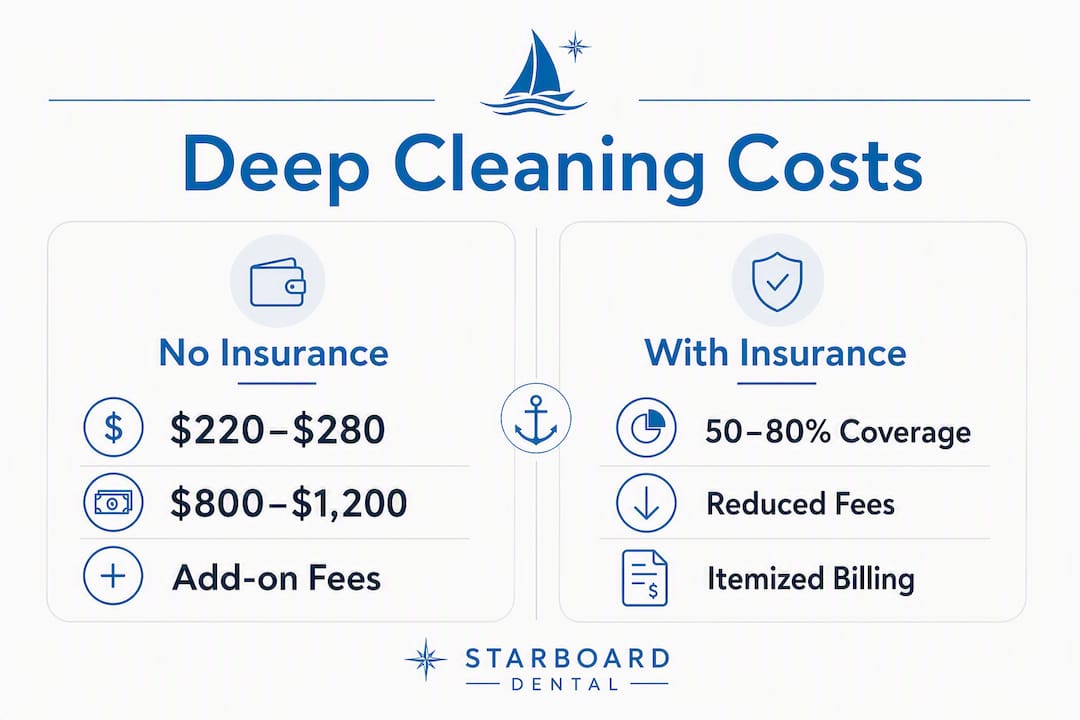
Common add-on fees that appear on SRP estimates include local anesthesia, localized antibiotics such as Arestin, periodontal exams/charting, full-mouth X-rays, and gross debridement, with costs varying by provider and region.
Pro Tip: Ask the office to itemize every line code before treatment. A quote that lists only "deep cleaning: $1,200" tells you nothing about whether two quadrants or four are planned, or whether Arestin is included. Knowing the codes lets you call your insurer for a benefits check before you sit in the chair.
Why is a deep cleaning recommended instead of a routine cleaning?
SRP is a therapeutic procedure, not a more thorough version of your twice-yearly cleaning. The clinical trigger is active periodontitis: pocket depths of 4mm or more on probing, bleeding on probing, and radiographic evidence of bone loss. A routine prophylaxis (D1110) cleans above and just below the gumline; SRP goes several millimeters deeper to remove calculus from root surfaces and smooth the root to discourage bacterial reattachment.
Localized disease means only one or two quadrants show those clinical signs. Generalized disease affects three or four quadrants. That distinction directly determines how many D4341 codes your dentist can legitimately bill.
The stakes of leaving periodontitis untreated go beyond your mouth. Research links uncontrolled gum disease to harder-to-manage blood sugar in people with diabetes, as well as elevated cardiovascular risk. Bone loss around teeth is irreversible once it occurs, and the cost of replacing a lost tooth with an implant or bridge far exceeds the cost of SRP done at the right time.
Roughly half of American adults 30 and older have some form of periodontal disease, according to the ADA's Mouth Healthy resource — which means SRP is one of the most commonly performed therapeutic dental procedures in the country.
What actually happens during a deep cleaning appointment?
The appointment follows a predictable sequence, and knowing it helps you match each step to the line items on your estimate.
- Root planing — The root surface is smoothed to remove residual toxins and create a cleaner surface for gum tissue to reattach.
Most offices treat one or two quadrants per appointment, with each session running 45–90 minutes. A full-mouth SRP typically spans two appointments scheduled one to two weeks apart. Some practices complete all four quadrants in a single extended visit, though that is less common.
What should you expect after a deep cleaning?
The first 24–48 hours bring the most noticeable discomfort. Numbness from anesthesia fades within a few hours; mild soreness and sensitivity to cold are normal for several days. Gums may look slightly more receded as swelling resolves, which is normal and not a sign of damage.
Home care during recovery matters. Gentle brushing with a soft-bristle brush, warm salt-water rinses, and avoiding hard or crunchy foods for a day or two keeps the treated area clean without irritating healing tissue. A guide on cleaning teeth with active gum disease covers the specific techniques that support healing between appointments.
Contact the office if you experience increasing pain after 48 hours, significant swelling, fever, or pus around any treated tooth. Those signs suggest infection and need prompt attention.
The follow-up appointment matters as much as the procedure itself. About four to six weeks after SRP, the provider re-probes pocket depths to measure the tissue response. If pockets have reduced to 3mm or less, the disease is under control. Persistent deeper pockets may require a referral to a periodontist.
After that re-evaluation, most patients transition to periodontal maintenance (D4910) every three to four months rather than returning to routine prophylaxis. Maintenance visits typically cost $100–$200 each, and insurance covers them at a lower rate than a standard cleaning, so budget for three to four of these per year going forward.
What are the risks and benefits of deep cleaning?
The benefits are concrete and well-documented. SRP reduces pocket depths, controls active infection, and slows or stops bone loss. For patients with diabetes, controlling periodontal inflammation can support better blood sugar management. Preserving natural teeth avoids the far higher cost of implants, bridges, or dentures down the line.
The risks are real but mostly short-term. Temporary sensitivity to temperature is the most common complaint and usually resolves within two to four weeks. Some patients experience minor bleeding during and after the procedure. Infection following SRP is rare when proper home care is followed. Root surface exposure after gum tissue heals can increase sensitivity long-term in a small number of cases.
The financial math strongly favors treatment. A single dental implant to replace one lost tooth typically costs $3,000–$5,000. SRP on the quadrant that could have saved that tooth costs a fraction of that, even without insurance.
What factors drive how much your deep cleaning will cost?
Several variables explain why two patients can receive identical diagnoses and walk out with very different bills.
Number of quadrants and disease severity are the biggest cost drivers. A patient with localized disease in one quadrant pays roughly a quarter of what a patient with full-mouth disease pays. Documented probing depths and bone loss determine how many quadrants are legitimately billable.

Provider type shifts the price significantly. A general dentist's hygienist performing SRP typically charges less than a periodontist's office. Periodontists see more complex cases and carry higher overhead, so their per-quadrant fees often run 20–40% above general practice rates.
Geographic location compounds everything. High cost-of-living metros like San Francisco, New York, and Boston consistently show per-quadrant fees at the upper end of the national range. Smaller cities and rural areas tend to cluster near the lower end.
Add-on services can quietly double a base estimate. Arestin placed at multiple sites, a full-mouth X-ray series, a comprehensive periodontal exam, and local anesthesia all appear as separate codes. None of them are inherently unnecessary, but you should know what each one costs before agreeing.
Insurance classification matters more than most patients realize. Some plans classify SRP under "basic" services at 70–80% coverage; others put it under "periodontal" or "major" services at 50%. That difference on a $1,200 bill is $120 to $360 out of pocket.
How does insurance cover deep cleaning, and what are your payment options?
Most dental PPO plans cover SRP at 50–80% after the deductible, subject to the annual maximum. Here is how that plays out in practice:
- Uninsured, full-mouth SRP: $800–$1,500 total
- After 80% coverage (no deductible remaining): $160–$300 out of pocket
- After 50% coverage with $100 deductible remaining: $400–$850 out of pocket
- Annual maximum exhausted: 100% of remaining treatment cost falls to you
The ADA codes matter because insurers process D4341 and D4342 differently than D1110 (routine prophylaxis). A claim submitted as D1110 when SRP was performed is a coding error that can trigger a denial or a recoupment request later. Always confirm the codes before treatment.
FSA and HSA funds apply to SRP out-of-pocket costs, which effectively gives you a pre-tax discount equal to your marginal tax rate. If you are in the 22% federal bracket, a $500 out-of-pocket SRP bill costs you roughly $390 in real dollars when paid through an FSA or HSA.
Pro Tip: For multi-quadrant treatment, ask the office to submit a preauthorization before scheduling. Attach the periodontal chart and X-rays to the submission. Insurers are far more likely to process the claim correctly when documentation arrives with the request rather than after a denial.
Practical checklist before accepting a multi-quadrant estimate:
- Request a copy of your periodontal chart showing probing depths
- Ask which ADA codes will be billed for each line item
- Confirm whether Arestin or other add-ons are included or optional
- Submit a preauthorization if two or more quadrants are involved
- Check whether your plan has a frequency limitation on SRP (many allow it once per quadrant every 24 months)
- Ask about in-office financing or payment plans if the out-of-pocket total is significant
Where can you safely lower the cost of deep cleaning in the U.S.?
Three legitimate routes exist for patients who need SRP but face a significant out-of-pocket burden.
Dental school periodontic clinics offer the steepest discounts, commonly 50–65% below private-practice rates, with treatment performed by supervised graduate students or residents. Faculty oversee every procedure. The trade-off is time: appointments run longer, scheduling can take weeks, and the documentation process is thorough. For patients without insurance facing a $1,200 full-mouth bill, a dental school might bring that to $420–$600.
Federally Qualified Health Centers (FQHCs) provide dental services on a sliding-scale fee based on household income and family size. Eligibility is not limited to low-income patients; the sliding scale simply adjusts your cost to what you can reasonably pay. The Health Resources and Services Administration's HRSA Find a Health Center tool locates the nearest FQHC. Not every FQHC offers periodontal services, so call ahead to confirm SRP is available.
In-office membership plans are a practical middle ground for patients without dental insurance. These annual plans typically cost $150–$350 per year and include two preventive cleanings plus a discount of 15–25% on other procedures including SRP. They are not insurance, so there are no deductibles, annual maximums, or waiting periods. The preventive vs. restorative care framework helps clarify which services fall under each category when evaluating a membership plan's value.
For patients who want specialist-level periodontal care, a periodontist's perspective on SRP and gum disease treatment can help set expectations before committing to a treatment plan.
One caution on lower-cost settings: if your case involves significant bone loss, multiple deep pockets, or a complex medical history, a periodontist's higher fee may be worth it. General-practice SRP is appropriate for mild to moderate disease; advanced cases benefit from specialist involvement.
Key Takeaways
A full-mouth deep cleaning costs vary without insurance in U.S. markets, billed per quadrant with a wide range of prices, and insurance coverage percentages also vary after deductibles and annual maximums.
| Point | Details |
|---|---|
| Per-quadrant billing drives total cost | Confirm how many quadrants show documented disease before accepting a full-mouth quote. |
| SRP uses different codes than routine cleaning | D4341/D4342 are billed at lower coverage levels than D1110; expect coinsurance and deductibles to apply. |
| Documentation protects you | Request your perio chart and X-rays; they are your best defense against overbilling and insurance denials. |
| Cost-saving options exist | Dental schools and FQHCs can reduce SRP costs by 50–65% for eligible patients compared to private-practice rates. |
| Starboarddental offers SRP with transparent billing | Starboarddental documents pocket depths and provides itemized ADA codes so patients know exactly what they are paying for. |
The cost conversation most patients never have
Most dental cost guides stop at the price ranges. What they skip is the conversation you should have before treatment starts, and it is the one that actually determines whether you pay a fair price.
Periodontal disease is often localized. A patient with two affected quadrants who gets billed for four is not getting better care; they are getting a larger bill. The clinical documentation, specifically the periodontal chart with probing depths at every tooth, is the only objective record that justifies each quadrant billed. Patients who ask for that chart before agreeing to treatment are not being difficult. They are doing exactly what their insurer requires and what any well-run dental office should already be providing.
The other thing worth saying plainly: SRP is not a procedure to delay for financial reasons when the diagnosis is real. The bone you lose while waiting does not come back. The cost of one implant to replace a tooth lost to untreated periodontitis will exceed the cost of treating the disease by a factor of three to five. Prevention is cheaper, but when prevention has already failed, timely treatment is the more affordable path.
If you are uncertain whether your diagnosis warrants SRP, ask for the probing depths in writing and consider a second opinion. A good clinician will not be offended by that request. A practice that resists it is telling you something.
Starboarddental's approach to periodontal care in Kennebunk
If you have been quoted a deep cleaning and want a clear picture of what you actually need, Starboarddental in Kennebunk offers scaling and root planing with full periodontal charting, digital X-rays, and itemized ADA billing codes provided before treatment begins. You will know exactly which quadrants are being treated, why, and what each line item costs.

The practice serves patients in Kennebunk, York, and Saco, ME, and works with most major dental insurance plans. For patients managing out-of-pocket costs, in-office payment options are available. The team also reviews your coverage before your appointment so there are no surprises on the day of treatment.
To schedule a periodontal evaluation or request a cost estimate with itemized codes, visit Starboarddental's services page or call the Kennebunk office directly. Bring your most recent dental X-rays if you have them; it saves time and often reduces the cost of your first visit.
Useful sources and further reading
- ADA coding guidance for D4341 and D4342 — official ADA descriptions for scaling and root planing codes and documentation requirements
- Mouth Healthy: Scaling and Root Planing — ADA patient-facing overview of the procedure and what to expect
- HRSA Find a Health Center — locates Federally Qualified Health Centers offering sliding-scale dental services near you
- CMS FQHC resource guide — federal overview of FQHC eligibility and services
- healthinsurance.org: dental insurance vs. discount plans — explains the difference between traditional dental insurance and membership/discount plans
This article provides general information about dental procedures and costs in the United States. It is not a substitute for professional dental or financial advice. Confirm current pricing, coverage details, and treatment recommendations with a licensed dental provider and your insurance carrier.