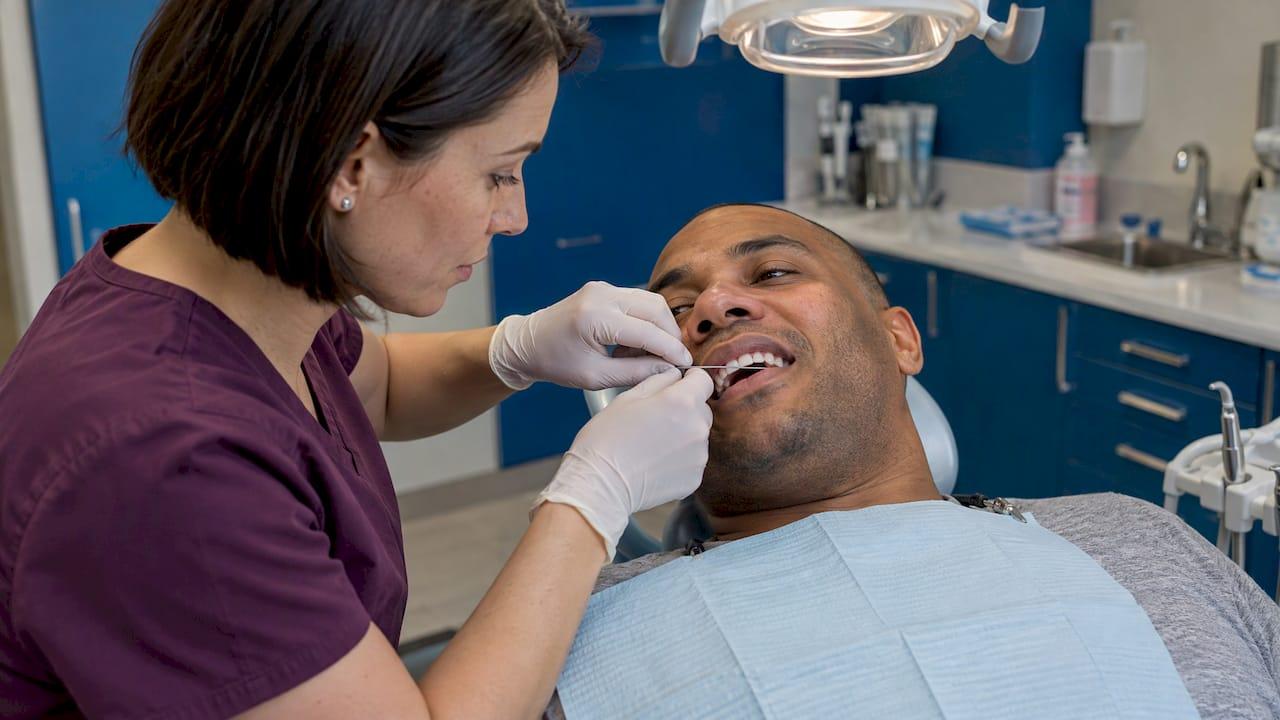
IPR, short for interproximal reduction, is the removal of a very small amount of enamel from the sides of teeth where they touch. With clear aligners, it is a common way to create a little room so crowded teeth can line up, or to reshape teeth that are slightly too wide. Done carefully and in small amounts, it is considered a relatively safe procedure. It is also permanent, which is why you should understand the plan before you agree to it.
This guide covers what IPR feels like, how much is typical, when it is a poor fit, and what to discuss at your consultation.
TL;DR
- IPR removes a thin layer of enamel between teeth to make space or improve tooth shape. It is a normal part of many aligner plans, though not every plan needs it.
- Dentists aim to remove as little as possible. Cleveland Clinic describes usually no more than half a millimeter per tooth, and many clinicians plan far less.
- Enamel has no nerves, so IPR shouldn't hurt. You may feel pressure or vibration.
- It can't be undone, so you should see the plan, the amounts and the alternatives before you consent.
- You can ask about options such as expansion or other ways of gaining space, but they won't suit every mouth.
Table of Contents
- What aligner IPR actually is
- Why your plan might include it
- Is IPR normal with aligners?
- How much enamel is removed, and is 0.5 mm too much?
- Is IPR safe?
- What IPR feels like
- When IPR happens during treatment
- Can you refuse IPR?
- Questions to bring to your consultation
- Caring for your teeth after IPR
- Our perspective
- Thinking about aligners in Kennebunk?
- FAQ
- Sources
What aligner IPR actually is
Enamel is the hard outer layer of your teeth. Where two teeth touch, the contact surfaces are called proximal surfaces. IPR polishes a fraction of a millimeter off those surfaces. According to Cleveland Clinic, it is used to create space before orthodontic treatment, including braces and clear aligners, and it can also improve tooth shape and bite.
You may hear other names for the same idea: air rotor stripping, interdental stripping, slenderizing or keystoning. A 2025 scoping review notes that IPR is an umbrella term covering these techniques.
It is not a filling or a drilling procedure in the way most people picture. Nothing is added, and no cavity is prepared. The goal is a slightly narrower tooth, with the surface left smooth.
Why your plan might include it
Clear aligner treatment is planned digitally. Software maps where each tooth should end up, and sometimes the arch simply has no room for all the teeth in their ideal places. Your dentist then has a few ways to find space. IPR is one of them.
The common reasons:
- Mild to moderate crowding. A 2024 critical review says crowding of roughly 4 to 8 mm is the main reason IPR is used in adults, especially in the front teeth.
- Tooth size differences. If upper and lower teeth are not proportionally matched, a little reshaping helps them fit together.
- Tooth shape and esthetics. The scoping review above lists reshaping teeth and reducing open gingival embrasures, the small dark triangles near the gumline, among the purposes.
- Stability. The same review says flattening contact points may help keep teeth stable after treatment.
A study of 330 digital treatment plans found that the most common site for prescribed IPR was the lower front teeth. That matches what many patients experience: lower front crowding is among the most frequent aligner complaints. If that is you, our article on crowded lower teeth and digital setups explains how the planning works.
Is IPR normal with aligners?
Yes, it is common, though it is not universal. The AJODO study above calls IPR a common adjunct to modern orthodontic treatment, and it found that almost 40% of the contact points prescribed IPR were in refinement phases, meaning follow-up aligners after the first set. So you may be told about IPR at the start, or it may come up later if teeth need fine adjustment.
That said, a scoping review points out that its role varies with the individual case and goals. A mild case with spacing, for example, may need none. Treat IPR as one tool in a plan, not a required step.
How much enamel is removed, and is 0.5 mm too much?
The figures you will see in your plan are usually per contact, meaning the spot where two neighboring teeth meet. The software records IPR for each contact area, not for individual teeth, so 0.3 mm at a contact is shared between two teeth.
Here is what the published guidance says:
| Source | What it says about amounts |
|---|---|
| Cleveland Clinic (2024) | Dentists remove as little as possible, usually no more than a half-millimeter on each tooth |
| Critical review (2024) | With aligners, the prescribed amount is usually 0.2 to 0.5 mm per contact area |
| New York State Dental Journal guidelines (2024) | About 50% of proximal enamel can be removed without dental or periodontal risk; roughly 0.25 mm in the front and 0.8 mm per surface in back teeth is a safe rule of thumb |
| Expert consensus (2025) | Limit the maximum to 0.25 mm on the proximal surface of each tooth, and use IPR to supplement other methods rather than as the main way to gain space |
So a plan that calls for 0.5 mm at one contact is within what these sources describe, especially when it is split across two teeth. The more useful questions are how many contacts are involved, the total amount, and whether it is spread across several appointments. A conservative plan keeps the total modest and uses IPR alongside other space-gaining methods.
Is IPR safe?
For most people with healthy teeth, carefully done IPR is considered safe. Two reviews, one from 2014 and one from 2022, found it does not significantly increase the risk of cavities. The 2025 expert consensus adds that removing no more than half the enamel thickness generally does not raise caries risk, and recommends fluoride after the procedure.
The caveats are real, and they are all about technique and selection:
- It is permanent. Cleveland Clinic states that IPR is irreversible, and removing too much enamel can weaken teeth. That is the reason for conservative amounts.
- Technique matters. The scoping review warns that improperly performed IPR can cause uneven reduction, plaque buildup and damage to neighboring teeth.
- Possible side effects. The New York guidelines list temperature sensitivity, increased plaque accumulation, residual furrows and soft-tissue irritation among the potential effects of poorly controlled IPR.
- Heat control. When a rotating instrument is used, the same guidelines say it should be water- or air-cooled to protect the pulp of the tooth.
Who may not be a good candidate
The 2024 critical review lists several situations where IPR is generally avoided: poor oral hygiene, active gum disease, sensitive teeth, enamel hypoplasia, naturally small teeth, square or rectangular tooth shapes, and large pulp chambers, particularly in younger patients. Heavy crowding or rotation that blocks access to the contact is another reason to hold off.

This is why a thorough exam comes before an aligner plan. If you have gum disease, for instance, it needs to be treated first. Our periodontal care comes first for patients in that situation, so aligners start on a healthy foundation.
What IPR feels like
Most people describe it as unremarkable. Cleveland Clinic explains that enamel has no nerves, so IPR shouldn't hurt, most people don't need local anesthesia, and you might feel slight vibration from the instrument. The aligners themselves are a different story: pressure from a new set is normal, and our guide to aligner pain and relief covers what to expect in the first two days.
The procedure is usually quick. The dentist uses a thin flexible abrasive strip or a rotating hand instrument, then checks the gap with a thin gauge. A manufacturer's training guide describes, for a 0.1 mm reduction on a front tooth, about 8 to 12 sawing motions with a diamond strip, followed by checking with a 0.1 mm gauge. Larger amounts take proportionally longer.
When IPR happens during treatment
Timing is part of good planning. Professional guidance recommends that teeth be aligned first, since rotated or crowded teeth make it easy to reduce the wrong surfaces. The 2024 critical review likewise says it is advisable to perform IPR once the teeth are already aligned.
So you may not have any IPR on day one. It is often done in stages at appointments scheduled around specific aligner steps. Once it is in your plan, it matters that it gets done on schedule: a clinical article points out that skipping prescribed IPR can cause aligners to stop tracking, because the space the next movement needs isn't there. If your aligners suddenly feel loose or don't seat, mention it at your next visit. If you want the full picture of how the movement works, see our step-by-step look at how clear aligners move teeth.
Can you refuse IPR?
Yes. It is a procedure that requires your informed consent. Orthodontic guidance says that because IPR is irreversible, patients must be informed of risks, benefits, alternatives and the option of no treatment, and consent signed before it begins. Risk-management resources for orthodontic practices include a dedicated IPR consent form describing the use of a metal strip or drill to remove enamel to gain space.
Declining is your right, but be aware of the trade-off. If the plan relies on IPR for space, skipping it may mean a different approach, such as a longer treatment, a different end position, or a different way of gaining room. The 2024 review notes that the amount of IPR can be traded against changes in arch width or incisor inclination, and that combining IPR with distalization can reduce how far teeth must be moved back. The right balance depends on your teeth, your bite and your goals.
Questions to bring to your consultation
- Which contacts will be reduced, and how many millimeters in total?
- Is IPR the main way of making space in my plan, or one of several?
- Will it be done all at once or in stages?
- Do my gums and teeth need any treatment first?
- What will be done afterward to protect the surfaces, such as polishing and fluoride? Professional protocols include polishing the surfaces and applying topical fluoride.
- What happens to my timeline if I decide against it?
The New York State Dental Journal guidelines stress that IPR should be planned only when necessary, based on a thorough space analysis. A good plan can answer these questions with numbers.
Caring for your teeth after IPR
After IPR, keep up with brushing and flossing, and wear aligners as directed. Fluoride is part of standard practice: the 2025 consensus recommends fluoride application after IPR. Your dentist may suggest a fluoride rinse for home use. If you notice lasting sensitivity to hot or cold, or a rough spot you can feel with your tongue, tell your dental team.
What about the cost? IPR is usually part of the overall aligner treatment rather than a separate line, but it depends on the plan. Our guide to clear aligner cost and payment options walks through what to budget.
Our perspective
We think IPR is best understood as a precision tool, not a default. The right amount is the smallest amount that makes your plan work, and sometimes that is none.
That is why we lean on digital scanning. A precise scan of your teeth lets the plan show exactly where space is needed, how much, and at what stage, so you can see the numbers before anything is done. It also means you can talk about options with a clear picture in front of you.
Aligners work best when the basics are in place: healthy gums, sound teeth and a plan you understand. Our care is built for patients of all ages, with comfort in mind, including a relaxed atmosphere for anyone who gets nervous in the chair. If you are weighing aligners, we would rather you arrive with questions than with assumptions.
Alex
Thinking about aligners in Kennebunk?
If you live near Kennebunk and want to know whether aligners, and whether IPR, would be part of your plan, we can look at your teeth and talk it through. We offer clear aligners alongside general, restorative and cosmetic care, so your exam, your gum health and your aligner plan can be handled in one place.

If you also have a small gap or a chipped edge, we may be able to discuss options like composite bonding for small gaps or tooth contouring as part of your smile goals. Contact our office to schedule a visit.
FAQ
Is IPR normal for Invisalign and other clear aligners?
It is common. A review of 330 digital treatment plans found IPR prescribed at many contacts, often in the lower front teeth, including in follow-up refinement phases. Not every patient needs it, so it depends on how much space your teeth require.
Is 0.5 mm of IPR too much?
Not necessarily. Guidance describes no more than about half a millimeter per tooth as the usual ceiling, and a 0.5 mm figure in a plan normally refers to one contact shared by two teeth. Some expert groups suggest limiting it to 0.25 mm per tooth surface, so ask for the total across all contacts.
Does IPR hurt?
It shouldn't. Enamel has no nerves, so most people don't need numbing, though you may notice vibration or pressure. If a tooth is already sensitive, tell your dentist beforehand.
Does IPR cause cavities?
Research reviews say that carefully performed IPR does not significantly increase caries risk. Smooth finishing, fluoride and good home care are what keep the surfaces healthy afterward.
Can IPR be reversed?
No. Enamel does not grow back, which is why the procedure is described as irreversible and why informed consent comes first.
Sources
- Interproximal Reduction (IPR): Purpose & Benefits, Cleveland Clinic
- The Role of Interproximal Reduction (IPR) in Clear Aligner Treatment, PMC
- Interproximal reduction with clear aligner therapy: scoping review, ScienceDirect
- Interproximal reduction in the refinement phase of Invisalign treatment, ScienceDirect
- Expert consensus on clinical strategies for orthodontic treatment with clear aligners, PMC
- Guidelines for Interproximal Enamel Reduction (IPR), New York State Dental Journal
- Aligner IPR Protocol and Tips for Safe Tooth Space Reduction, IA Ortho
- Interproximal reduction: optimising clear aligner treatment, Dentistry.co.uk
- Onboarding Guide, Straumann
- Risk management: supplemental informed consent documents, Orthodontic Practice US