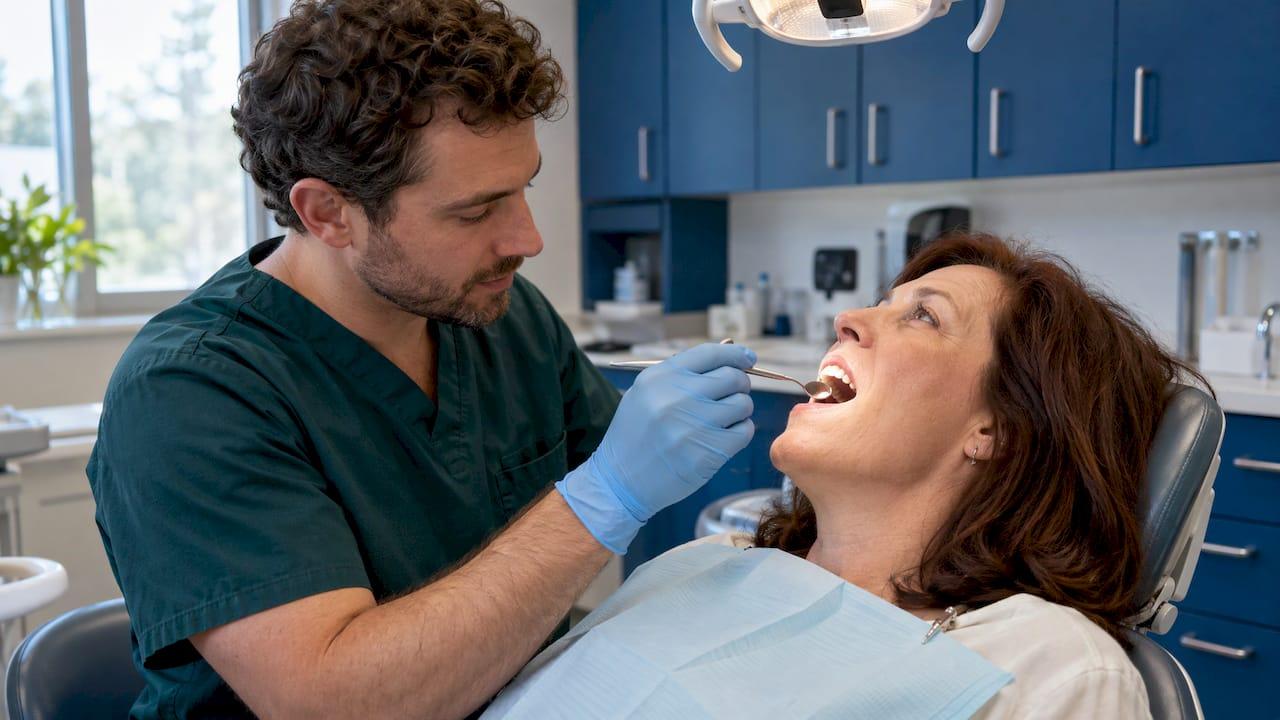
A chipped tooth is a piece of enamel that has broken off. A cracked tooth is a line running through the tooth, often from the chewing surface down toward the root, and the tooth is still in one piece. A chip is usually easy to see and easy to repair. A crack can be invisible, can hurt only now and then, and gets worse without treatment. If you are near Kennebunk and are not sure which one you have, we can examine the tooth and take X-rays, and same-day and walk-in appointments are available at Starboard Dental.
TL;DR
- A chip is a missing piece of tooth. A crack is a fracture line in a tooth that is still whole, and it may not show on the surface.
- Pain that comes and goes when you bite, or when you release a bite, or with hot and cold, points to a crack, not a simple chip.
- Rinse with warm water, use a cold compress for swelling and see a dentist as soon as possible. Do not put aspirin on the tooth.
- Most chips are repaired with bonding or a crown. Cracks need a closer look, and early treatment gives the tooth its best chance.
- A cracked tooth does not heal on its own, so waiting for the pain to go away is not a plan.
Table of Contents
- Chipped vs. cracked: the difference at a glance
- What a chipped tooth looks and feels like
- What a cracked tooth looks and feels like
- Why teeth chip and crack
- What to do right after you chip or crack a tooth
- How dentists treat chipped and cracked teeth
- Can a cracked tooth be saved?
- What about a cracked filling or a loose crown?
- How to lower your risk
- Seen at Starboard Dental in Kennebunk
- Our perspective
- FAQ
- Sources
Chipped vs. cracked: the difference at a glance
People use the words interchangeably, but dentists treat them as different problems. The table below sums up how they differ.
| Chipped tooth | Cracked tooth | |
|---|---|---|
| What happened | A piece of enamel or tooth has broken off | A fracture line runs through the tooth, which is still in one piece |
| Can you see it? | Usually yes, or you feel a rough edge with your tongue | Often not, especially if the crack is small or below the surface |
| Typical pain | Often none, or sensitivity at the spot | Erratic pain when chewing, on release of a bite, or with hot and cold |
| Main risk | Sharp edge, more breakage, decay in the exposed area | Spreading crack, damaged pulp, infection, tooth loss |
| Typical repair | Reattached piece, bonding or a crown | Depends on depth: crown, root canal plus crown, or extraction |
The American Association of Endodontists (AAE) describes a cracked tooth as a crack extending vertically from the chewing surface toward the root, where the tooth has not yet separated into pieces, though the crack may gradually spread. That detail is what separates it from a chip: the damage is not a missing piece, it is a fracture that keeps working its way deeper.
What a chipped tooth looks and feels like
A chip is the more obvious of the two. You bite something hard, or take a knock to the mouth, and you notice a gap or a rough spot with your tongue. Some chips hurt. Many do not.
The typical signs:
- A visible notch, or a missing corner on a front tooth
- A rough or sharp edge that catches your tongue, lip or cheek
- Mild sensitivity to cold or sweets at the chipped spot
- A piece of tooth you found in your mouth or on your plate
A small chip on a back tooth may be nothing more than a rough edge. A larger one can expose the softer layers beneath the enamel, and that is when sensitivity shows up. Painless does not mean harmless: the exposed area can wear and decay faster than the intact enamel around it, and a chip can be a sign that the tooth underneath has also cracked.
If you want a closer look at repair options for this kind of damage, our guide to chipped tooth repair walks through what to do now and how treatment goes.
What a cracked tooth looks and feels like
Cracks are harder to pin down. There may be nothing to see, and the symptoms are inconsistent, which is why people put off the visit. According to the AAE, cracked teeth may cause erratic pain when chewing, sometimes when you release the bite, or pain with temperature extremes. The pain can come and go, and it can be hard even for the dentist to find which tooth is causing it.
Watch for:
- A sharp zing when you bite down on a certain spot
- Pain when you let go of the bite, not while biting
- Sensitivity to hot or cold that lingers or shows up unpredictably
- Gum swelling near one tooth
- A tooth that felt fine for weeks and now hurts without a clear reason
The pain pattern has a mechanical explanation. The AAE notes that when the hard outer tissues of a tooth are cracked, chewing can move the pieces and irritate the pulp, the soft tissue inside the tooth. Over time the pulp can be damaged beyond its ability to heal, and extensive cracks can lead to an infection that spreads to the surrounding bone and gum.
If biting is what hurts, our article on the bite-and-release test that can reveal a crack explains what that pattern means and what to do next.
Cracked, broken and split are not the same
Searchers often ask how a cracked tooth differs from a broken one. In everyday speech, a broken tooth is one where a larger piece has come off, so it overlaps with a serious chip. A split tooth is a crack that has progressed until the tooth separates. The AAE says that more serious split teeth may require extraction. The label matters less than the depth of the damage, and only an exam shows that.
Why teeth chip and crack
The causes overlap, which is one reason the two get mixed up. The AAE says a crack can come from injury or general wear and tear caused by grinding or clenching. In practice that includes:
- Biting ice, unpopped popcorn kernels, hard candy or pens
- A fall, sports hit or accident
- Heavy grinding or clenching, often at night
- A large old filling that leaves the remaining tooth walls thin
- Everyday wear over many years
If you wake up with sore jaws or a dull headache, grinding may be behind repeated chips. We offer night guards and TMD care, and our page on teeth grinding in Kennebunk explains how it is handled.
What to do right after you chip or crack a tooth
The first hour is mostly about comfort and protection. The ADA's MouthHealthy site advises to rinse the mouth right away with warm water, apply cold compresses to the face to reduce swelling, and see a dentist as soon as possible.
A practical sequence:
- Rinse gently with warm water. Do not scrub the tooth.
- Save any piece you can find and bring it with you. Sometimes a fragment can be reattached.
- Use a cold compress on the cheek if there is swelling.
- Cover sharp edges only with something soft if they are cutting your tongue or cheek, and avoid chewing on that side.
- Call a dentist the same day. Describe the pain, the swelling and what you bit or hit.
The AAE adds two cautions. If breathing through your mouth or drinking cold fluids hurts, bite on clean, moist gauze or cloth until you reach the dentist. And never use topical oral pain medication or place aspirin on the affected areas.
When it is urgent
Treat it as urgent, not as something for next week, when you have severe pain, bleeding, swelling or signs of infection. The AAE says that after dental trauma it is best to avoid the emergency room or urgent care and seek care right away from a dental specialist, and to contact one immediately for severe dental pain or infection symptoms such as bleeding or swelling. For a chip with a sharp edge cutting your mouth, the same-day call is also the right call. A cracked tooth that hurts when you chew is a hidden problem that deserves a prompt visit even when the pain fades.
For a fuller rundown of urgent situations, read our guide to a broken tooth emergency.
How dentists treat chipped and cracked teeth
Treatment follows the depth and location of the damage. Your dentist will look at the tooth, test your bite, and usually take X-rays to see what is going on beneath the surface.
Chipped teeth
The AAE states that most chipped teeth can be repaired by reattaching the broken enamel, or by bonding a tooth-colored filling or crown in place. Typical routes:
- Smoothing or contouring for a tiny rough edge
- Composite bonding to rebuild a small to moderate chip in one visit
- A porcelain veneer when the damage is on a visible front tooth and you want a longer-lasting cosmetic result
- A crown when a large part of the tooth is missing
We do all of these in house. Our cosmetic dentistry page covers bonding and veneers, and dental contouring is the gentle option for small rough edges. A crown for a larger break is covered under restorative dentistry.
Cracked teeth
Cracks are sorted by how deep they go. In the AAE's description, a crack that extends into the pulp may be treated with a root canal and a crown, while one that extends below the gum line cannot be saved and the tooth will need extraction. Back-tooth injuries such as fractured cusps or cracked teeth, the AAE says, require root canal treatment and a full-coverage crown if the crack extends into the root.
The general picture:
| Damage | Likely approach |
|---|---|
| Small chip, enamel only | Smoothing or bonding |
| Larger chip or missing corner | Bonding, veneer or crown |
| Crack in the crown of the tooth | Full-coverage crown to hold the tooth together |
| Crack reaching the pulp | Root canal treatment, then a crown |
| Crack below the gum line or a split tooth | Extraction, then a replacement |
If a tooth cannot be saved, replacement is the next question: a bridge or an implant. Our page on dental bridges explains one option, and implants are part of our restorative care. Planning for that cost is easier when you understand dental implants insurance coverage and what plans typically pay.
Can a cracked tooth be saved?
Often, yes, when it is found early. The AAE's 2025 review of the research reports that meta-analyses support preserving cracked teeth that receive root canal treatment and a crown at 90 percent or above. It cites one study with overall tooth survival of 84.1% at 60 months, and another with survival of 94.2 to 96.3% for cracked teeth after root canal treatment with full-crown restorations.
The same review stresses that early diagnosis matters. When a cracked tooth is caught while the pulp is still only irritated, more conservative treatment may be possible, such as placing an orthodontic band and then a crown without a root canal. It also reports that only one in five or fewer of those teeth may later need a root canal.
The flip side is the reason not to wait. The AAE is direct that, unlike a broken bone, a cracked tooth will not heal, and an untreated crack will progressively worsen and may be lost. A crown gives maximum protection without guaranteeing success, and most treated cracked teeth keep providing years of comfortable chewing.
The practical takeaway: a tooth that twinges when you bite is worth a visit this week, not after the pain stops.

What about a cracked filling or a loose crown?
Sometimes the damage is to dental work, not the tooth itself. A filling can crack or a crown can come loose, and the tooth underneath is then exposed. Our guides explain the timing: what to do about a cracked filling, what to do when a loose crown needs same-day care, and protecting your tooth after a temporary crown came off.
How to lower your risk
Cracked teeth are not completely preventable, but you can make them less likely. MouthHealthy recommends wearing a mouthguard for sports and recreation, avoiding chewing ice, popcorn kernels and hard candy, and using scissors instead of your teeth to cut things. The AAE adds that a protective mouthguard can mitigate damage from teeth grinding.
Two habits do the most good:
- Stop using teeth as tools. Opening packages, cracking nuts and biting pens are classic causes of chips.
- Protect against grinding. If you clench at night, a custom night guard spreads the force.
Regular exams help too. A checkup lets a dentist spot a hairline crack, a worn filling or a weak cusp before it fails. If you are new to a practice, our overview of common dental procedures for new patients shows what a first visit and typical treatments involve.
Seen at Starboard Dental in Kennebunk
If you have a chip, a crack or a tooth that hurts when you bite, we can look at it at our Kennebunk office. We use digital scanners for precision, we offer same-day and walk-in appointments, and our rooms have ceiling-mounted TVs and personalized comfort items for patients who get nervous in the chair. We treat patients of all ages, and we handle bonding, veneers, crowns, bridges, implants and night guards under one roof.

Start with our restorative dentistry or general dentistry page, or contact us through starboarddental.com to book.
Our perspective
The question we hear most is some version of "is it just a chip, or is it worse?" The honest answer is that you cannot always tell from the mirror at home. A chip on a front tooth is obvious. A crack that makes a molar twinge on certain bites may show nothing at all.
That is why we lean toward an early look. A quick exam, digital scans and X-rays tell us how deep the damage goes, and the earlier we know, the more options we can offer. A small chip might need only smoothing or bonding. A crack caught early gives the tooth its best chance of lasting for years.
We also know that many people put off a visit because they dread the chair. We built our office to make that easier: a warm welcome, ceiling TVs and comfort items, and same-day and walk-in appointments so a painful tooth does not have to wait. If grinding is behind your chips, we can talk about night guards and TMD care, so the same damage does not keep coming back.
Do not wait for the pain to settle. Come in, let us look, and we will walk you through the options in plain language.
Alex
FAQ
Should I see a dentist for a chipped tooth?
Yes. Even a painless chip leaves a rough edge and exposes tooth structure that can wear or decay faster. Most chips are repaired with bonding or a crown, and a dentist can also check that the tooth has not cracked underneath. Call the same day if you have pain, swelling or a sharp edge cutting your mouth.
Is a cracked tooth an emergency?
It can be. Severe pain, bleeding or swelling means you should contact a dentist right away. A crack that hurts only on some bites is less dramatic but still needs a prompt exam, because a cracked tooth does not heal and can spread over time.
Can a cracked tooth heal on its own?
No. According to the American Association of Endodontists, a cracked tooth does not heal the way a broken bone does. The pain may come and go, which makes it feel like the problem is gone, but the crack stays. Early treatment gives you more choices.
How is a cracked tooth different from a broken tooth?
A cracked tooth is still in one piece, with a fracture line running through it. A broken tooth has lost a larger piece, and a split tooth has a crack that has separated the tooth. Your dentist sorts out which one you have with an exam and X-rays, and that decides whether you need a filling, a crown, a root canal or an extraction.
Sources
- Cracked Teeth, American Association of Endodontists
- Traumatic Dental Injuries FAQ, American Association of Endodontists
- Cracked, Not Condemned: Saving Treatable Teeth, American Association of Endodontists
- Matters of Head, Heart and Oral Health, American Association of Endodontists
- Dental Emergency: What if I Break a Tooth, ADA MouthHealthy