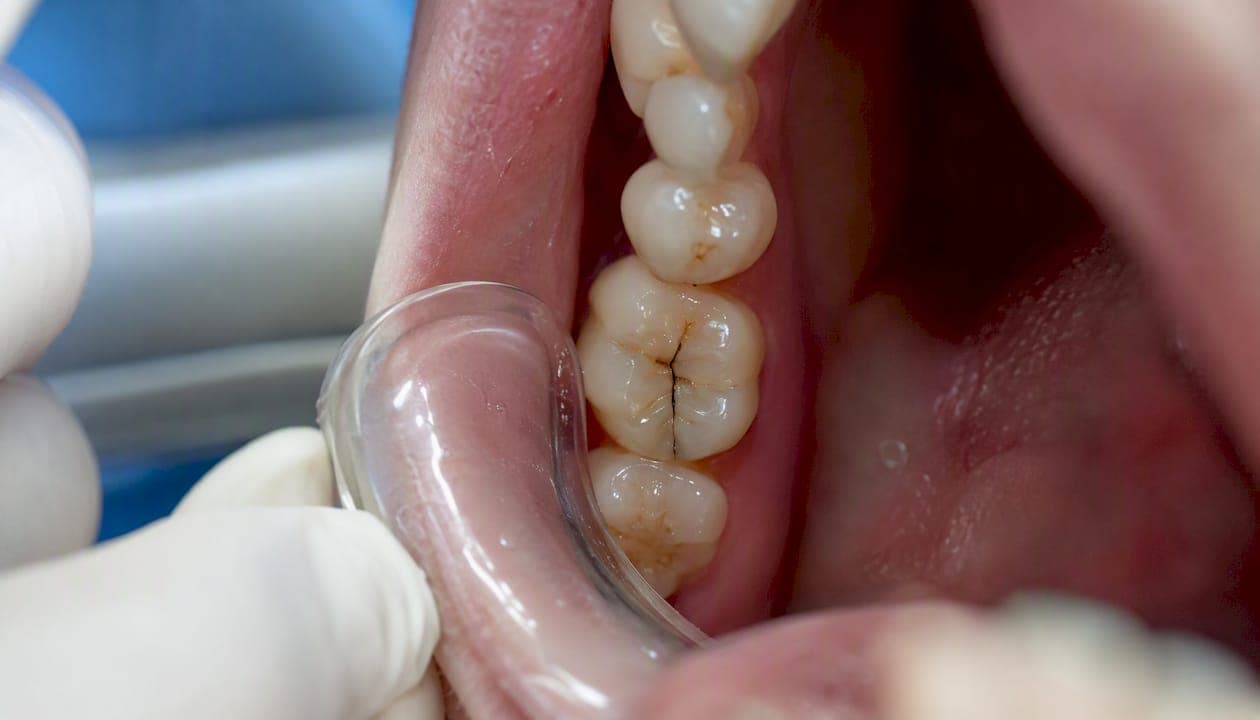
Most cracked teeth can be repaired, and the sooner you act, the better your odds of keeping the tooth. The type and depth of the crack determines everything: a hairline craze line on the enamel surface is rarely urgent, while a fracture that extends toward the root can threaten the tooth's survival within days. According to the Cleveland Clinic, home measures won't repair structural damage, but they can manage symptoms while you arrange care.
Before you see a dentist, here's what to do right now:
- Manage pain: Take an over-the-counter NSAID (ibuprofen or naproxen) and apply an ice pack to the outside of your cheek in 20-minute intervals.
- Rinse gently: A warm saltwater rinse reduces bacterial load and soothes irritated tissue.
- Avoid chewing on that side: Every bite can deepen the crack. Stick to soft foods and chew on the opposite side until you're seen.
- Preserve any fragment: If a piece broke off, keep it in milk or saliva and bring it to your appointment. Reattachment is sometimes possible.
The likely treatment range runs from simple dental bonding for minor chips, to an onlay or full crown for moderate fractures, to root canal therapy plus a crown when the pulp is involved, to extraction in rare cases where the crack has split the root. Most patients land somewhere in the middle of that spectrum.
Key Takeaways
Most cracked teeth can be saved with prompt diagnosis and timely placement of a full-coverage crown, with survival rates of roughly 82%–96% reported in endodontic literature when treatment follows appropriate protocols.
| Point | Details |
|---|---|
| Act quickly | Delaying treatment allows cracks to propagate; same-day stabilization improves outcomes. |
| Crown is the most common fix | National Dental PBRN data show 61% of restored cracked teeth received a full-coverage crown. |
| Root involvement changes everything | Cracks extending below the gum line or into the root carry a poor prognosis and may require extraction. |
| Survival rates are favorable | Treated cracked teeth show generally high survival in some series; one-year rates in reviewed studies are encouraging but evidence certainty is very low. |
| Starboarddental offers same-day care | The Kennebunk practice provides stabilization, crowns, bonding, and specialist coordination for cracked teeth. |
Table of Contents
- What are the different types of cracked teeth?
- What symptoms and causes should you know about?
- How do dentists diagnose a cracked tooth?
- What treatment options are available for a cracked tooth?
- What is the prognosis for a cracked tooth?
- How can you reduce the risk of cracked teeth?
- What should you expect at your dental visit?
- A perspective on saving cracked teeth
- Cracked tooth repair at Starboarddental in Kennebunk
- Sources
What are the different types of cracked teeth?
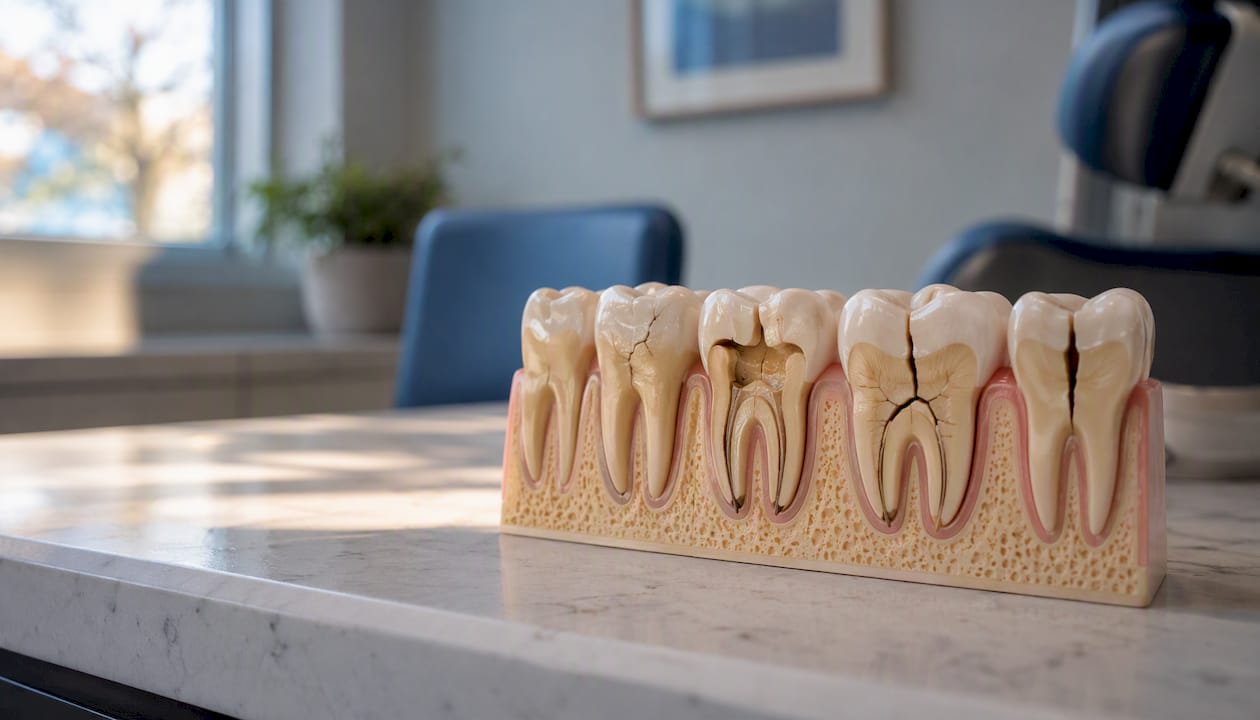
A "cracked tooth" is the informal term for any fracture in tooth structure, but clinicians recognize five distinct categories, and the type you have shapes every decision that follows.
- Craze lines: Superficial cracks in the outer enamel only. Common in adults, usually painless, and rarely require treatment beyond monitoring.
- Fractured cusp: A cusp (the pointed chewing surface) breaks away, often around a large filling. Usually doesn't involve the pulp, so a crown or onlay typically resolves it without root canal therapy.
- Cracked tooth (incomplete fracture): A crack that runs from the chewing surface toward the root but hasn't split the tooth in two. The most clinically complex category. Symptoms can be intermittent and diagnosis is often difficult.
- Split tooth: The crack has propagated completely, dividing the tooth into two segments. Saving the whole tooth is rarely possible, though one root may sometimes be preserved.
- Vertical root fracture: Starts at the root and travels upward. Often discovered late because symptoms are subtle. Prognosis is generally poor, and extraction is frequently the outcome.
Pro Tip: Ask your dentist specifically which category your crack falls into. The answer tells you more about urgency and likely cost than any general description of "a crack."
The clinical significance of each type is real. Craze lines sit at one end of the spectrum, cosmetic and rarely urgent. Vertical root fractures sit at the other, often requiring extraction regardless of how otherwise healthy the tooth appears. Everything in between depends on how far the crack has traveled and whether the pulp is involved.
What symptoms and causes should you know about?
Symptoms that signal a crack
- Sharp pain when biting down, especially when releasing pressure (the classic "rebound" pain)
- Sensitivity to cold that lingers longer than a few seconds
- Spontaneous aching or throbbing with no obvious trigger
- Swelling of the gum near the affected tooth
- A visible chip, rough edge you can feel with your tongue, or a change in how your bite feels
The Cleveland Clinic notes that some superficial craze lines cause no symptoms at all, while deeper cracks can produce intermittent pain that's easy to dismiss until it becomes severe.
Common causes and risk factors
- Bruxism (teeth grinding): Repeated occlusal stress is one of the leading causes, particularly for cracks in molars.
- Large restorations: Teeth with extensive fillings have less natural structure to absorb force, making them more vulnerable.
- Trauma: A blow to the face, a fall, or biting down on an unexpected hard object (a popcorn kernel, an olive pit) can fracture a tooth instantly.
- Age-related wear: Enamel becomes more brittle over time. Cracks are more common after age 40.
- Acidic diet: Acid softens enamel, reducing its fracture resistance over time.
- Occlusal stress: A misaligned bite concentrates force on specific teeth.
When to seek emergency dental care
Go to a dentist the same day if you have uncontrolled pain that NSAIDs don't touch, visible swelling suggesting infection, a large mobile fragment, or bleeding that won't stop. These are not "wait and see" situations. Emergency dental care for a cracked tooth can prevent an abscess from forming.
How do dentists diagnose a cracked tooth?
Cracks are notoriously difficult to confirm. Many don't show on standard X-rays, and symptoms can mimic other conditions. Here's the typical diagnostic sequence:
- Patient history: When did pain start? Is it triggered by biting, temperature, or spontaneous? Has there been recent trauma or dental work?
- Visual exam: The dentist inspects the tooth under magnification, looking for visible fracture lines, discoloration, or gum changes.
- Bite test (tooth slooth): You bite down on a small plastic device, one cusp at a time. Sharp pain on release is a strong indicator of a crack.
- Transillumination: A bright light shone through the tooth can reveal fracture lines that are otherwise invisible.
- Periodontal probing: A narrow probe traces the gum line. A deep, isolated pocket can indicate a vertical root fracture.
- Periapical radiographs: Standard X-rays rule out bone loss and root pathology, though the crack itself is often not visible.
- CBCT (cone beam CT): Reserved for complex or ambiguous cases. Provides a 3D view that can reveal radicular extension not visible on flat films.
- Pulp vitality testing: Cold or electric pulp testing determines whether the nerve is still alive, which directly affects treatment planning.
One limitation worth knowing: even with all these tools, some cracks are only fully visible once the old restoration is removed and the tooth is examined under a dental microscope. StatPearls guidance emphasizes that crack extent and position must be fully assessed before a treatment plan is finalized.
Pro Tip: Before your appointment, photograph the tooth if you can see the crack, note exactly when pain occurs (biting, cold, heat, spontaneous), and bring any broken fragment in a small container of milk. That information cuts diagnostic time significantly.
What treatment options are available for a cracked tooth?
Treatment follows the crack's severity. The goal at every stage is the same: stop the crack from propagating, seal out bacteria, and restore the tooth's ability to function. From a biomechanical standpoint, reducing cuspal flexure through a crown, onlay, or bonded composite is central to long-term success.
- Monitoring: For asymptomatic craze lines with no pulp involvement, watchful waiting with regular checkups is appropriate.
- Occlusal adjustment: Reducing a high bite point takes stress off the cracked tooth and can slow propagation.
- Orthodontic band or provisional crown: A temporary band placed around the tooth for 1–2 weeks stabilizes it while the dentist assesses pulp response before committing to a definitive restoration.
- Direct composite bonding: Composite resin can splint a minor crack and restore a chipped surface. Effective for anterior (front) teeth and small fractures. Dental bonding is often completed in a single visit.
- Onlay or partial-coverage restoration: For a fractured cusp or moderate crack, an onlay covers the damaged cusps without requiring full crown preparation. A systematic review found that single-stage indirect restorations and onlays may improve pulp success for symptomatic vital cracked teeth compared with staged approaches, though evidence certainty is graded very low.
- Full-coverage crown: The most common definitive treatment. National Dental PBRN data from 2,858 patients found that when clinicians restored cracked teeth, 61% chose a complete crown. A dental crown encircles the entire tooth, preventing the cusps from flexing and the crack from widening.
- Root canal therapy plus crown: When the crack has reached the pulp, root canal therapy removes the infected or inflamed nerve tissue before the crown is placed. Penn Dental Medicine notes that root canal therapy is indicated when the pulp is exposed or irreversibly inflamed. Understanding the root canal procedure helps patients know what to expect.
- Extraction and replacement: When the crack extends below the gum line or splits the root, extraction is the only option. Replacement with a dental bridge or implant restores function and prevents neighboring teeth from shifting.
When does a cracked tooth need a specialist?
Referral to an endodontist is likely when pulp involvement is suspected or confirmed, when symptoms persist after initial treatment, or when the crack's depth is unclear. A periodontist may be involved when the crack has caused significant bone loss or when the fracture extends subgingivally.
Typical cost ranges in the United States
Costs vary by tooth location, geographic area, and insurance coverage. The figures below reflect general US market ranges and are not guarantees.
Insurance typically covers a portion of crowns and root canals, though annual maximums often apply. If cost is a concern, options for dental care without insurance are worth reviewing before your appointment.
What is the prognosis for a cracked tooth?
The honest answer: most cracked teeth can be saved, but outcomes depend heavily on how far the crack has traveled and how quickly treatment begins.
The American Association of Endodontists reports that modern endodontic and restorative protocols show favorable survival rates of roughly 82%–96% in some series for cracked teeth, including cases that previously would have been considered hopeless. The same source stresses that prompt coronal coverage after endodontic treatment significantly improves survival and reduces the risk of crack propagation.
Factors that predict a better outcome:
- Crack confined to the crown (above the gum line)
- Pulp still vital and reversibly inflamed, not necrotic
- No caries undermining the remaining tooth structure
- Timely placement of a full-coverage crown
- Absence of biting pain before treatment (suggests less pulp involvement)
- Favorable occlusion that doesn't concentrate force on the restored tooth
Factors that predict a worse outcome:
- Crack extending below the gum line or into the root
- Pulp necrosis or periapical infection at presentation
- Deep isolated periodontal pocket (suggests vertical root fracture)
- Delayed restoration after root canal therapy
The National Dental PBRN cohort found that caries, biting pain, and radiographic evidence of a crack were the strongest predictors for recommending restorative treatment. When those three factors are present together, monitoring alone is rarely appropriate.
A systematic review reported one-year tooth survival rates of 96.1%–100% across reviewed studies, though evidence certainty was graded very low due to study heterogeneity. Treat those figures as encouraging rather than definitive.
Follow-up after treatment typically occurs at 2 months and again at 1 year, per NCBI guidance on tooth fractures, to assess pulp health and restoration integrity.
How can you reduce the risk of cracked teeth?
Prevention is straightforward once you know the main risk factors. These steps address the most common causes:
- Wear a nightguard if you grind: A custom-fitted guard from your dentist distributes occlusal force and protects enamel from the sustained pressure of bruxism.
- Replace large, aging restorations on time: Old amalgam fillings expand and contract with temperature changes, wedging the surrounding tooth structure apart over years. Don't wait for symptoms.
- Avoid hard foods and objects: Ice, hard candies, popcorn kernels, and using your teeth as tools are among the most common causes of acute fractures.
- Manage your diet's acid load: Frequent exposure to acidic beverages softens enamel and reduces its fracture resistance. Diet's role in tooth decay is worth understanding if you consume a lot of citrus or carbonated drinks.
- Keep regular dental checkups: Early detection of craze lines or weakened cusps allows preventive intervention before a full fracture occurs.
Safe home care while you wait for your appointment
- Do: Take ibuprofen or acetaminophen for pain, rinse with warm salt water, apply a cold pack to your cheek.
- Don't: Attempt to glue a fragment back yourself, bite down on the affected side, or apply topical numbing agents directly to the gum tissue repeatedly.
- Fragment care: If a piece broke off, store it in a small container of milk or saliva. Dry storage damages the cells and reduces the chance of reattachment. Bring it to your appointment.
What should you expect at your dental visit?
Knowing the appointment flow reduces anxiety and helps you get more out of the visit.
The dentist will start with a brief history, then move to a visual exam and the bite test. Depending on what those reveal, they may take periapical X-rays, use transillumination, or order a CBCT scan. If the tooth is symptomatic and the crack is confirmed, same-day stabilization (an orthodontic band, a provisional crown, or composite bonding) is often possible. A treatment plan and cost estimate follow before any definitive work begins.
Questions worth asking before you leave:
- "Does the crack reach the root?"
- "Is the pulp affected, and if so, is it reversibly or irreversibly inflamed?"
- "What are my restoration options, and what's the timeline for each?"
- "Will I need a referral to an endodontist or periodontist?"
- "What will this cost, and what portion does my insurance cover?"
- "What happens if I delay treatment by a few weeks?"
Common dental procedures explained can help you prepare if this is your first time dealing with a restorative issue. Pain management during the appointment is handled with local anesthetic, and most patients find the procedure far less uncomfortable than the crack itself.
A perspective on saving cracked teeth
The conventional wisdom used to be that a deeply cracked molar was a lost cause. That's changed. What the evidence actually shows is that the outcome depends less on the crack itself and more on two things: how quickly a definitive restoration is placed, and whether the crack has reached the root.
The teeth that fail after treatment almost always share one of two histories: the crown was delayed too long after root canal therapy, or the crack was already subgingival at diagnosis. Neither of those is inevitable. The first is entirely within a patient's control. The second is why early diagnosis matters so much.
What I find underappreciated in most patient-facing discussions is the role of the provisional period. A 1–2 week orthodontic band or temporary crown isn't just a placeholder. It's a diagnostic tool. If symptoms resolve during that window, the pulp is likely responding favorably and root canal therapy may not be needed. If pain persists or worsens, the decision to proceed with endodontics is clearer. That short interim period can prevent an unnecessary root canal or, equally, prevent a dentist from placing a permanent crown on a tooth that's already heading toward failure.
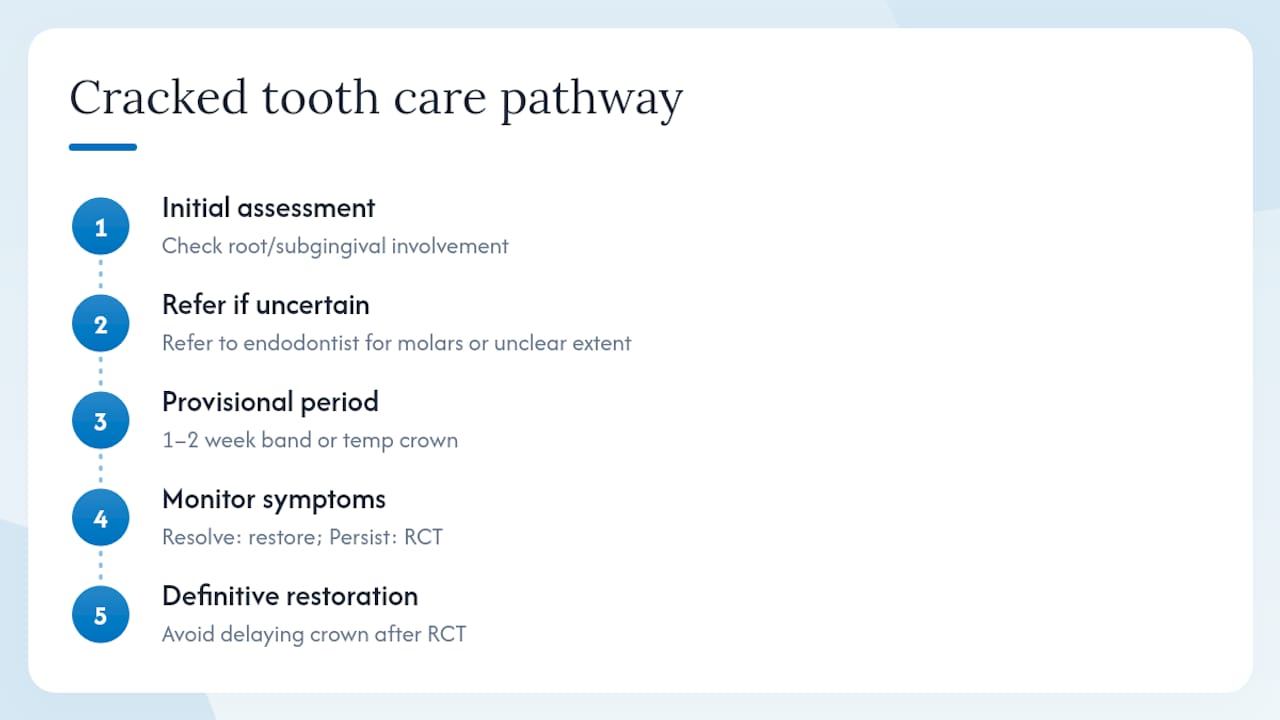
The other thing worth saying plainly: cracked molar treatment in posterior teeth is more complex than in anterior teeth, not because the biology is different, but because molars bear the most occlusal force and are harder to isolate and visualize. If your crack is in a molar and your general dentist seems uncertain about the extent, asking for a referral to an endodontist for a second opinion is reasonable and often welcomed.
Cracked tooth repair at Starboarddental in Kennebunk
A cracked tooth that gets same-day attention has a meaningfully better prognosis than one that waits two weeks. Starboarddental offers same-day stabilization appointments for patients in Kennebunk and the surrounding area, with restorative dentistry services that cover the full range: composite bonding, onlays, crowns, and coordination with endodontic specialists when root canal therapy is needed.

The practice uses digital scanners for precise crown preparation, and the team will walk you through your treatment options and cost estimate before any work begins. Bring your insurance card, any broken fragment (stored in milk), and photos of the tooth if you have them. Insurance coverage and out-of-pocket costs are discussed transparently at the visit.
Book a same-day or next-available appointment through Starboarddental's general dentistry page or call the Kennebunk office directly.
Sources
These are the primary sources used throughout this article. Each represents a different tier of evidence: clinical guidance, specialty society position, practice-based cohort data, and systematic review.
- Fractured tooth (cracked tooth) — Cleveland Clinic
- The effect of single versus multiple-stage restorative approaches on the pulp outcomes of symptomatic vital cracked teeth: a systematic review and meta-analysis — ScienceDirect
- Cracked teeth: To treat or not to treat? — American Association of Endodontists
- Recommended treatment of cracked teeth: Results from the National Dental Practice-Based Research Network — PMC
- Cracked Tooth Syndrome - StatPearls - NCBI Bookshelf
- Chipped, broken or cracked tooth — NHS
- How to Fix a Chipped Tooth: Five Possible Ways — Penn Dental Medicine
This article is general information, not a substitute for advice from a qualified doctor. Consult a qualified healthcare professional about your own circumstances before acting on anything here.