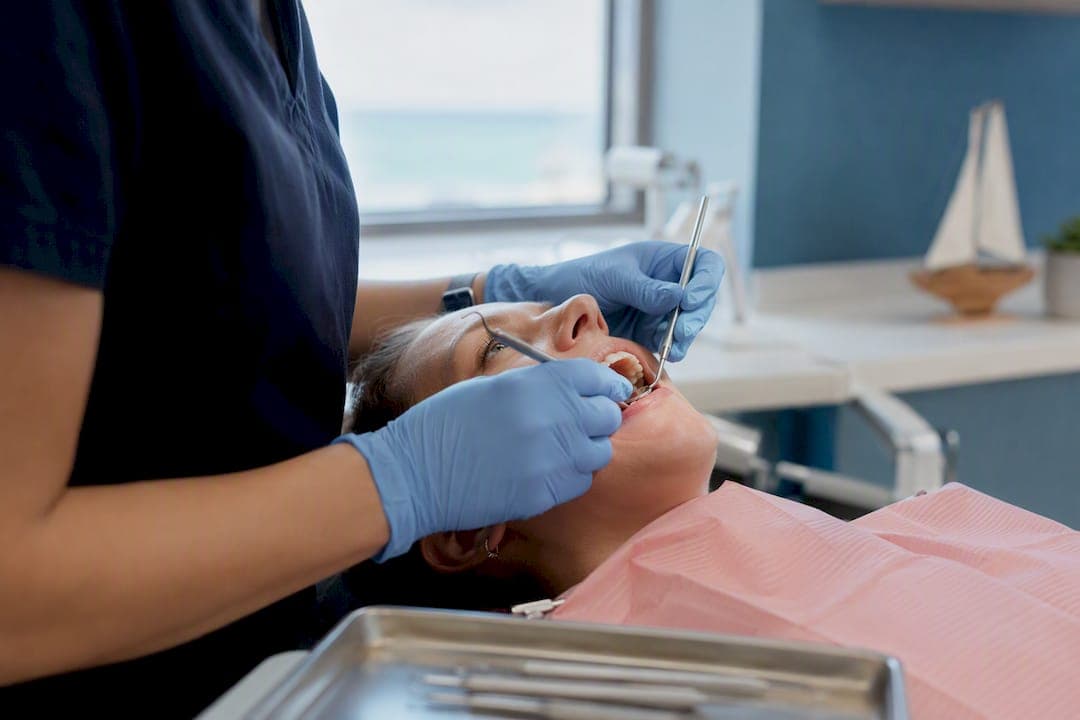
Most people should book a professional cleaning roughly twice a year, but that frequency is a starting point, not a strict rule. The American Dental Association and Cochrane's review of recall intervals both back individualized scheduling over a one-size-fits-all calendar. Someone with healthy gums and no cavity history might do fine at nine or twelve months; someone managing gum disease often needs a visit every three.
TL;DR:
- People with active gum disease, diabetes, smoking habits, or compromised immunity should consider more frequent cleanings every three to four months.
- Routine cleanings focus on tartar removal, early cavity detection, and monitoring restorations, with six months being a general starting point.
- Research indicates that for low-risk adults, fixed six-month interval cleanings are not significantly more effective than personalized schedules based on individual risk factors.
- Dentists determine recall timing based on clinical signs such as probing depths, caries risk, systemic health, home hygiene, and existing restorations.
- Special cases like periodontal maintenance after gum treatment require three-month visits, while pediatric and older adults may need tailored intervals depending on their specific risk factors.
Table of Contents
- What most dentists recommend and why
- Who actually needs cleanings more often than twice a year
- What actually happens during a professional cleaning
- What the research says about recall intervals
- How your dentist actually sets your recall schedule
- Why periodontal maintenance runs on a different clock
- Scheduling for kids, older adults, and other special cases
- Your quick checklist for the right cleaning schedule
- Why we treat every recall schedule as a starting point, not a verdict
- Book a cleaning that fits your actual risk, not just the calendar
- Sources
What most dentists recommend and why
Twice a year became the default recommendation decades ago, largely because it strikes a workable balance: frequent enough to catch problems early, infrequent enough that most patients actually stick with it. The routine has stuck because it works for a broad slice of the population, not because six months is some biological magic number.
A cleaning does more than polish your teeth. It interrupts a process that brushing alone can't stop.
- Tartar removal. Plaque hardens into calculus within days, and once it does, only a dental instrument can remove it, according to guidance from the National Institute of Dental and Craniofacial Research.
- Early detection. Dentists catch small cavities, cracked fillings, and early gum recession before they turn into root canals or extractions.
- Restoration monitoring. Crowns, bridges, and fillings get checked for wear or leakage that you'd never notice at home.
Cleveland Clinic's guidance on dental checkups treats the six-month interval as a common, sensible baseline, then immediately notes it should flex based on your personal risk profile. That's the framing worth remembering: six months is where you start, not where you're stuck.
Who actually needs cleanings more often than twice a year
Certain conditions push the plaque-to-tartar timeline into overdrive, and for those patients, waiting six months means giving bacteria a five- or six-week head start they never had a chance to lose.
- Active or treated gum disease. Periodontal pockets harbor bacteria that reform biofilm faster than healthy gum tissue does.
- Diabetes. Elevated blood sugar feeds oral bacteria and slows healing, which is part of why the connection between diabetes and gum disease runs both directions.
- Smoking or vaping. Tobacco use reduces blood flow to the gums, masking inflammation while still letting damage progress.
- Compromised immunity. Chemotherapy, autoimmune conditions, and certain medications all reduce your mouth's ability to fight bacterial buildup.
- Heavy restorative work or implants. Crowns, bridges, and implants create tiny ledges where plaque hides, out of reach of a toothbrush.
Plaque begins mineralizing into calculus in as little as a day or two, so patients in these categories typically get moved to a three or four-month recall instead of six. If your dentist mentioned "periodontal maintenance" at your last visit, that's the clinical term for this tighter schedule, and it's worth reading up on how cleaning routines change once gum disease enters the picture.
Pro Tip: If you've had a joint replacement, take immunosuppressants, or manage uncontrolled diabetes, ask your dentist directly whether your recall interval should be shorter. Don't wait for them to bring it up.
What actually happens during a professional cleaning
A standard cleaning follows a fairly consistent sequence, and knowing the steps helps you understand why skipping one for too long lets problems compound.
- Assessment. The hygienist checks your gums, visually screens for decay, and often measures pocket depth around each tooth.
- Scaling. This is the therapeutic core of the visit: removing calculus above the gumline (supragingival) and, when needed, just below it (subgingival).
- Polishing. A gritty paste buffs away surface stains, which is the cosmetic part most people picture when they think "cleaning."
- Flossing and fluoride. The hygienist flosses between every tooth, and may apply fluoride varnish or sealants for patients at higher cavity risk.
The whole visit typically runs 30 to 60 minutes, longer if a dentist's exam and X-rays are bundled in. Scaling is the piece that actually prevents periodontal disease; polishing just makes things look nice. If you're curious how those early problems get flagged in the first place, a closer look at how dentists spot early decay walks through the diagnostic side in more detail.
What the research says about recall intervals
A Cochrane review comparing six-month, risk-based, and longer recall intervals found little to no difference in outcomes like cavities and gum bleeding for many adults, regardless of which schedule they followed. Separate trials on routine scale-and-polish treatments back this up, showing small reductions in calculus but minimal differences in gingivitis or pocket depth for low-risk adults tracked over two to three years, per the Cochrane review on scaling and polishing.
The evidence doesn't say cleanings don't matter. It says that for low-risk adults, rigid six-month scheduling isn't measurably better than a schedule tailored to actual risk, and that trial populations and follow-up windows still leave real gaps in what researchers can confirm.
That's a nuanced finding, not a green light to skip appointments. The trials that produced these results mostly measured cavities and gum bleeding over a few years, not longer-term outcomes like tooth loss or the psychological value of catching a problem early. Read correctly, this evidence supports letting your dentist personalize your schedule. It doesn't support guessing your own interval and hoping you land somewhere safe.
How your dentist actually sets your recall schedule
Dentists don't pull recall intervals out of thin air. They weigh a specific set of clinical signals every time you're in the chair.
- Probing depths and bleeding on probing, which flag active gum inflammation.
- Caries risk, based on your cavity history, diet, and saliva flow.
- Systemic health factors, especially diabetes control and immune status.
- Smoking status and home hygiene habits, which affect how fast plaque reaccumulates.
- Existing restorations, since crowns and fillings need periodic checks for wear.
If your dentist recommends a shorter interval, ask what specifically triggered it, what would need to change to extend it back out, and what you can do at home to speed that up.
Why periodontal maintenance runs on a different clock
Periodontal maintenance isn't a routine cleaning with a different name. It's a distinct phase of care that follows active treatment for gum disease, aimed at keeping bacterial colonies from rebuilding below the gumline.
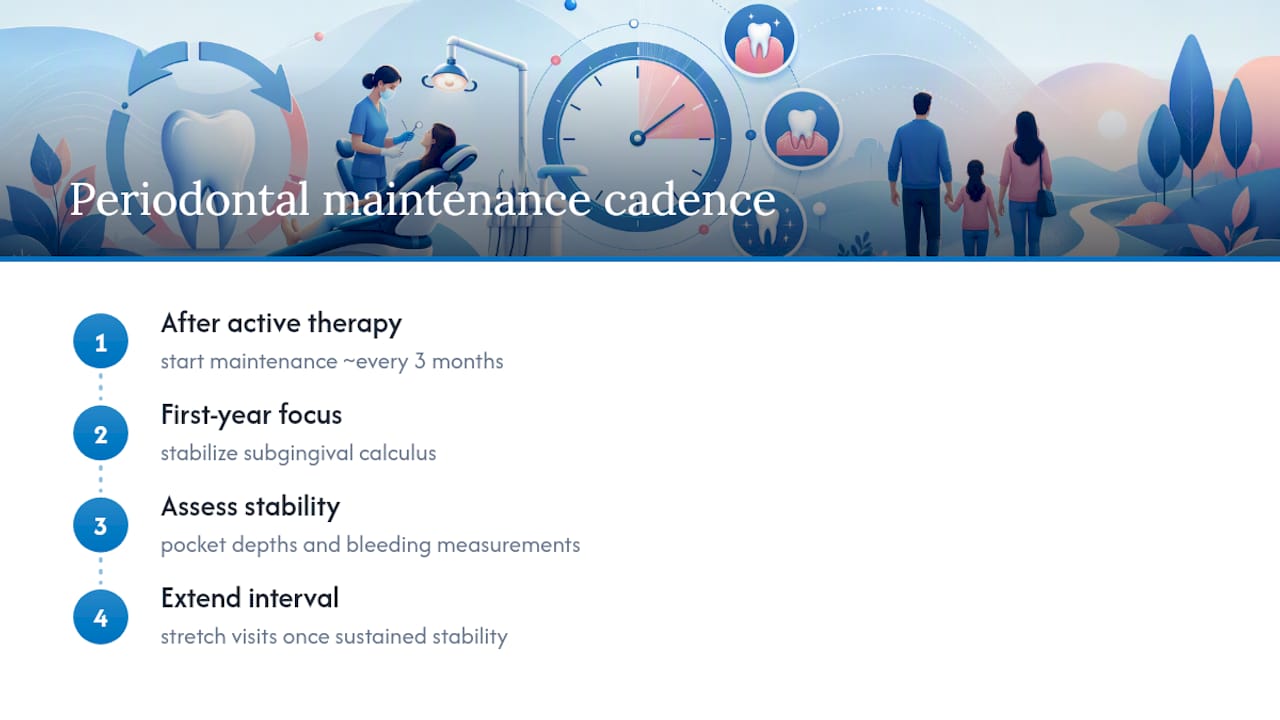
After active periodontal therapy, dental research supports an initial maintenance interval of roughly every three months, continuing until pocket depths and bleeding measurements show sustained stability. Only then does a dentist typically stretch the interval back out. The target is subgingival calculus, the tartar that forms below the gumline where a toothbrush never reaches, and stabilizing that in the first year after treatment is what determines whether the gains hold. For a deeper look at how this cadence gets adjusted over time, Starboarddental's periodontal maintenance resource breaks down the long-term goals.
Scheduling for kids, older adults, and other special cases
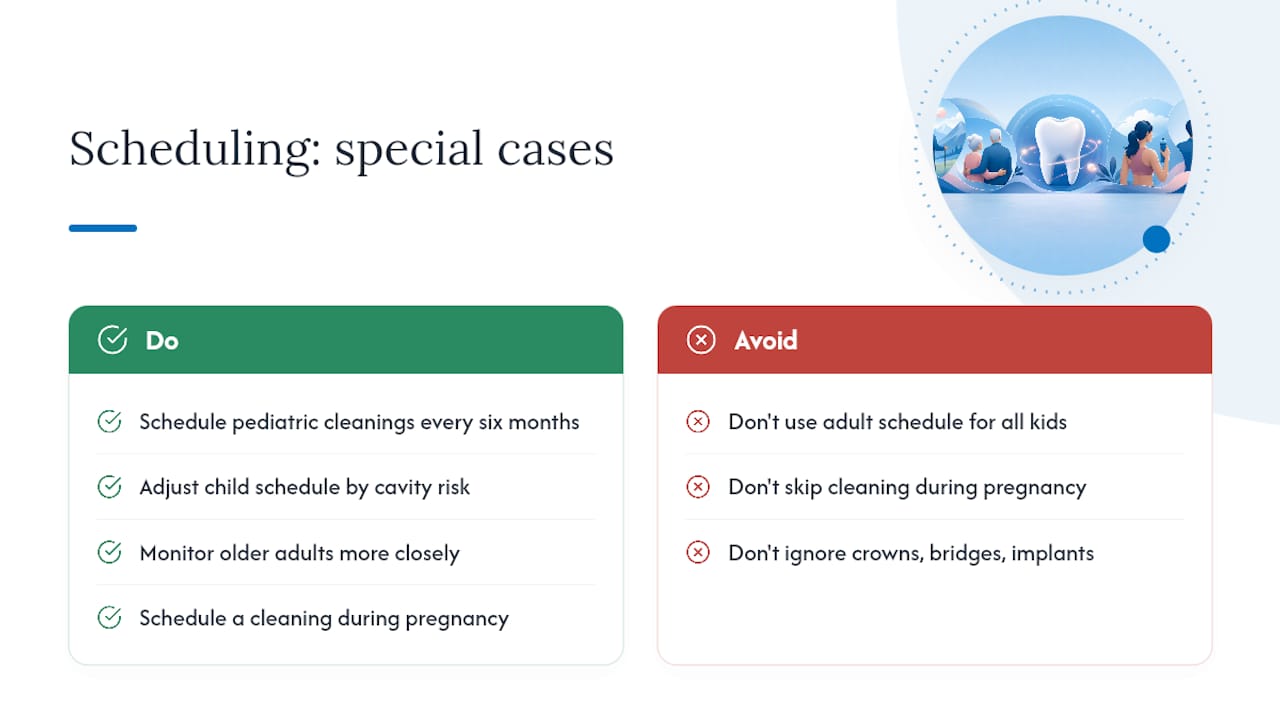
Pediatric cleaning evidence is thinner than the adult research, so most pediatric dentists default to six-month visits and adjust based on cavity risk and how well a child brushes. Starboarddental's guide to pediatric dental care covers age-specific scheduling in more depth.
Older adults and anyone with extensive restorative work often need closer monitoring, since crowns, bridges, and implants create hard-to-clean niches for bacteria that accumulate faster with age. Pregnancy raises separate concerns: hormonal shifts increase the risk of pregnancy gingivitis, which is why many providers recommend a cleaning during pregnancy even if it falls outside the usual six-month window.
Your quick checklist for the right cleaning schedule
Start at six months, then adjust from there based on what your dentist actually finds in your mouth, not on habit alone.
- Ask your dentist to name your specific risk factors at every visit.
- Ask what would trigger a shorter interval, and what would let it extend.
- Don't skip the annual comprehensive exam even if you feel fine, since many adults already skip regular dental care entirely, and small problems compound while unaddressed.
- Confirm your insurance's covered frequency so cost never becomes the reason you delay.
Why we treat every recall schedule as a starting point, not a verdict
The six-month rule persists because it's a reasonable default, not because it's precise. What frustrates me about how this topic usually gets covered is the false choice it presents: either follow the calendar exactly or assume you can wing it based on how your mouth feels. Neither is right. Pain and visible tartar show up long after the biology that actually matters, plaque maturing into calculus, pockets deepening, bone quietly receding, has already started.
The Cochrane findings get misread constantly. People see "little difference between intervals" and hear "cleanings don't matter much." What the research actually supports is more specific: a rigid universal schedule isn't better than one built around your actual risk profile. That's not permission to guess. It's an argument for better assessment, not less care. At Starboarddental, digital scanners let us track subtle changes in your gum tissue and bite over time, which is exactly the kind of data that should drive a recall interval, not a generic rule of thumb. If you want to see how that plays out for your own mouth, our general dentistry team can walk you through it at your next visit.
— Alex
Book a cleaning that fits your actual risk, not just the calendar
Skip the guesswork on whether you're due for a three-month recall or a six-month checkup. Starboarddental's team in Kennebunk uses digital scanners and a full risk assessment, gum measurements, restoration checks, medical history, to build a schedule around your mouth specifically, not a generic default.

Same-day appointments are available for new and returning patients, and most major dental insurance plans are accepted. Ceiling-mounted TVs and personalized comfort items make the visit easier if dental anxiety has kept you from staying on schedule in the past. If you're not sure where your gums or restorations currently stand, that uncertainty is exactly what a checkup answers. Book a checkup and cleaning and leave with a schedule that's actually built for you, not just the next available slot six months out.
Sources
Cleveland Clinic on dental checkups, Cochrane's recall interval review, NIDCR oral hygiene guidance, and periodontal maintenance research on PubMed informed the recommendations above. For additional context on recall reasoning, see 24x7 Dental Suite's explainer on checkup frequency.
This article is general information, not a substitute for advice from a qualified doctor. Consult a qualified healthcare professional about your own circumstances before acting on anything here.
- How Dental Cleanings Work - Cleveland Clinic
- How often should you see your dentist for a check-up? | Cochrane
- NIDCR – Oral hygiene information
- PubMed: periodontal maintenance standard-of-care