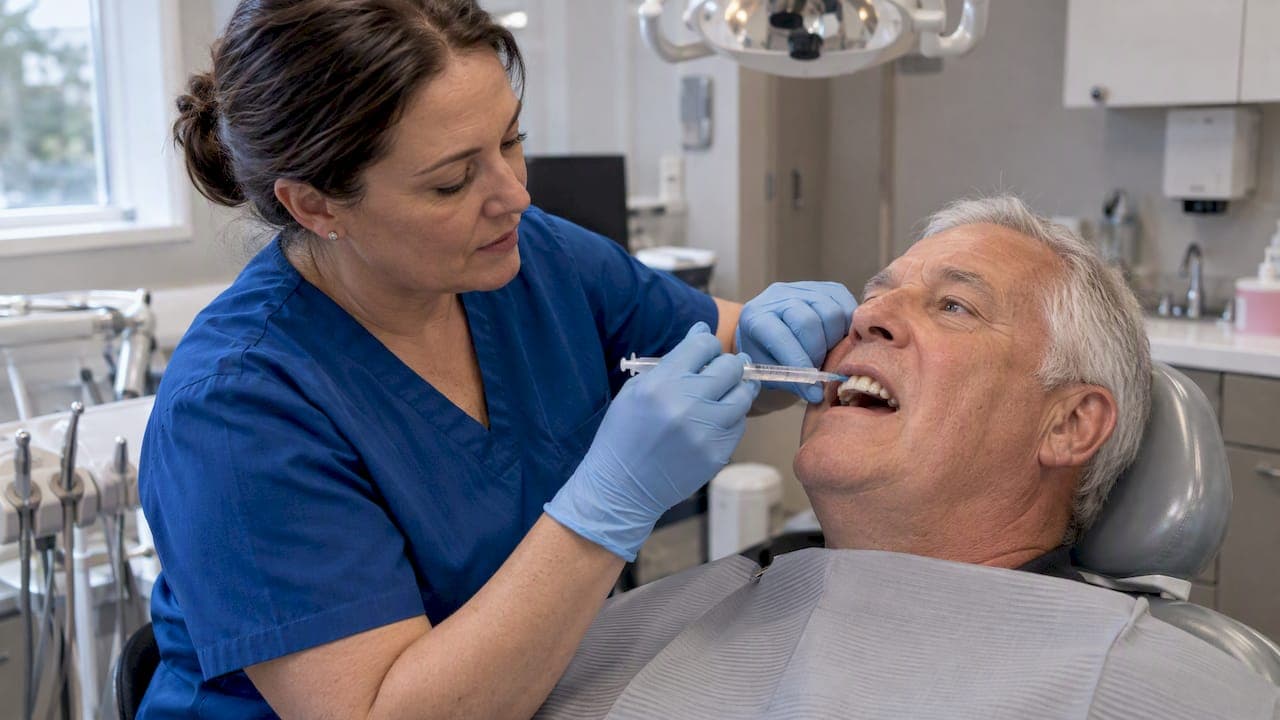
Yes, smokers can whiten their teeth, and the color change can be dramatic. The catch is that tobacco keeps staining, so results fade faster than they do for non-smokers. The best plan is a professional cleaning first, then dentist-supervised whitening, then a maintenance routine you can actually keep up. This guide explains each step, what to expect from the process, and when whitening alone is not the right answer.
TL;DR
- Smokers respond to whitening well at first. In a multicenter clinical trial, color change at one week was equivalent in smokers and non-smokers, but it was not maintained at one month.
- Start with a professional cleaning. Tartar and tar deposits block whitening gel from reaching the enamel.
- Crowns, veneers, bridges and fillings do not whiten, so a dentist should check your existing work before you start.
- Plan on touch-ups. Smokers often need to repeat professional treatment more often than non-smokers.
- Quitting is the only way to make results last. Maine offers free help through Maine QuitLink.
Table of Contents
- Why smoking turns teeth yellow and brown
- Do smoker's teeth whiten as well as other people's?
- Step one: get a professional cleaning before you whiten
- Your whitening options, compared
- What about home remedies?
- What about the restorations in your mouth?
- Sensitivity: what is normal
- How long results last when you smoke
- Perspective: what we tell smokers in the chair
- Quitting: the one thing that protects your smile long term
- Whitening at Starboard Dental in Kennebunk
- FAQ
- Sources
Why smoking turns teeth yellow and brown
Tobacco smoke carries tar and nicotine. Both leave pigmented residue on teeth. Nicotine is nearly colorless until it mixes with oxygen, and then it turns yellow. Tar is dark from the start. Enamel is not smooth like glass. It has microscopic pits and ridges, and these hold the residue. Over months and years the stain builds in layers, going from pale yellow to amber to brown.
There are two kinds of stain, and the difference matters for whitening:
- Extrinsic stains sit on the surface of the enamel. Tobacco, coffee, tea and red wine cause most of these.
- Intrinsic stains sit deeper in the tooth structure. Long-term tobacco use can contribute to these as pigments work their way into the enamel.
The American Dental Association notes that whitening treatments can work on both extrinsic and intrinsic staining. That is the good news for smokers. Whitening is not limited to light surface stains.
Tartar adds to the problem. Plaque that hardens into calculus is porous and picks up tobacco pigment like a sponge. That stain cannot be brushed off, and it sits between your whitening agent and your enamel. This is why the order of treatment matters so much.
Do smoker's teeth whiten as well as other people's?
At first, yes. A multicenter clinical trial of at-home bleaching in smokers found the color change at one week was equivalent between smokers and non-smokers. At one month, that equivalence was no longer there, and the smokers' teeth drifted back toward darker shades.
A 2022 systematic review looked at the wider evidence. It found limited evidence that whitening works about as well in smokers as in non-smokers, and that sensitivity does not seem to differ with smoking. The reviewers also graded the certainty of that evidence as low, so treat it as encouraging, not settled.
Here is what that means for you in practice:
- Do not assume you are a poor candidate because you smoke.
- Do not expect the result to hold at the same level for years.
- Expect the early gain to be the easy part and the maintenance to be the real work.
Any honest dentist will say the same thing. Whitening treats the stain you have today. It does not stop tomorrow's stain. Dentists consistently tell patients that lifestyle changes, above all quitting smoking, are what keep color stable over time.
Step one: get a professional cleaning before you whiten
If you do only one thing from this article, make it this. A professional cleaning removes the tartar and heavy surface deposits that bleaching agents struggle to penetrate. Skip it and the gel sits on top of a layer of stain and calculus instead of on enamel. You get patchy, weaker results and you pay for a treatment that could have done more.
A cleaning visit also gives the dentist a chance to look at things whitening cannot fix:
- Gum inflammation or periodontal disease, which is more common in smokers
- Cavities, which should be treated before bleaching
- Worn or cracked enamel that could make you more sensitive
- An oral cancer screening, which matters for anyone who uses tobacco
If your gums are in poor shape, whitening gel can irritate them further. In that case we treat the gums first. Our guide on cleaning teeth when you have gum disease explains what that looks like day to day.
Your whitening options, compared
There are three main routes. They differ in speed, supervision and how well they handle heavy stain.
| Option | How it works | Speed | Best for | Watch out for |
|---|---|---|---|---|
| In-office whitening | Dentist applies a high-strength peroxide gel under controlled conditions | One visit | Moderate to heavy stain, a deadline such as a wedding | Temporary sensitivity |
| Dentist-supervised take-home trays | Custom-fitted trays with a professional-strength gel, worn at home | Days to a couple of weeks | Gradual, even results and easy touch-ups | Needs consistent wear |
| Over-the-counter products | Whitening toothpaste, strips, rinses | Slow and modest | Light surface stain and maintenance | Uneven results, no supervision |
In-office whitening
Chairside whitening uses a stronger gel than anything you can buy, applied by a dentist who protects your gums and monitors your comfort. It gives the quickest visible change, which is useful when stain is heavy. For smokers, it works best after a cleaning, and it is a good place to start if you want a visible jump quickly.
Custom take-home trays
Trays are made from an impression or a digital scan of your teeth, so gel sits evenly against every surface and stays off your gums. This is the option we like for smokers who want to maintain results. You keep the trays, and a small syringe of gel every so often refreshes your color without a full appointment. The 2014 trial mentioned above used this kind of dentist-supervised at-home protocol.

Over-the-counter products
Whitening toothpastes and strips can lift light surface stain. The ADA points out that these products lack the clinical supervision that helps manage sensitivity and uneven bleaching, particularly where there is existing dental work. For a long-term smoker, store-bought options are better as a maintenance tool after professional treatment than as the main event. Look for the ADA Seal of Acceptance on any product you buy.
What about home remedies?
Baking soda pastes, oil pulling and similar tricks come up in nearly every search for how to remove nicotine stains from teeth. Here is the fair assessment. Mild abrasives can polish away some fresh surface stain, and brushing well does help. But abrasive pastes used too often can wear enamel, and enamel does not grow back. None of these home methods can reach stain that has set into the tooth. If you want to try something at home, a gentle ADA-accepted whitening toothpaste is a safer choice than a kitchen paste.
What about the restorations in your mouth?
This is the part most smokers do not hear until after they have whitened. The ADA is clear that only natural teeth can be whitened, not tooth-colored restorations. Crowns, bridges, veneers, bonding and many fillings stay the shade they were made.
Imagine bleaching your natural teeth three shades lighter while an old front crown stays at its original, darker shade. The mismatch is obvious. So we plan in this order:
- Clean and examine the teeth.
- Whiten the natural teeth to the shade you want.
- Wait for the color to settle, then replace or refresh any restoration that no longer matches.
That last step is the reason for doing it in this order. A new crown or filling is matched to your whitened shade, not your old one. If your teeth have lost their color to the point where bleaching will not give you what you want, porcelain veneers are an option, and composite bonding can mask isolated discolored spots. Dentists also point to veneers as a route for long-time smokers with severe staining.
If you have had a root canal and a single tooth has turned gray, the cause is different from tobacco. Internal bleaching treats that tooth from the inside.
Sensitivity: what is normal
Temporary sensitivity is the most common side effect of any bleaching. The ADA reports that mild to moderate sensitivity affects up to two-thirds of users early in treatment, usually showing up in the first few days and fading soon after. Lower-concentration peroxide can reduce it while still giving a clear color change.
A few things help:
- Tell your dentist if you already have sensitive teeth before you start. We can choose a gentler gel or a slower schedule.
- Use a desensitizing toothpaste for a couple of weeks before and during treatment.
- Avoid very hot and very cold drinks for a day or two after a session.
We have written separately on whitening with sensitive teeth and on tips for people with sensitive teeth. If sharp pain lingers beyond a few days, call your dentist rather than waiting it out, because that can point to a cavity or a cracked tooth.
How long results last when you smoke
The honest answer: not as long as they would otherwise. Because tobacco keeps depositing pigment, smokers often need to repeat professional treatment more frequently, often about once a year, to hold the same level of brightness. That is a general pattern, not a promise. Your own timeline depends on how much you smoke, your enamel, your hygiene and your diet.
To stretch your results:
- Clean on schedule. Regular professional cleanings act as a reset by removing the plaque and tartar that trap tobacco particles.
- Brush twice a day and clean between teeth daily. Plaque holds stain.
- Wait before you smoke after whitening. Fresh bleached enamel is more porous. Different clinics suggest anywhere from 24 to 48 hours as a minimum. Ask your dentist for the window they recommend for you, and longer is better.
- Rinse with water after coffee, tea, or red wine. These stack on top of tobacco stain.
- Use touch-up gel from your take-home trays only as directed.
Drinks matter too. If coffee is part of your routine, our post on coffee-stained teeth covers what to look for in a stain-fighting toothpaste.
Perspective: what we tell smokers in the chair
We do not lecture. Many of the people who come to us about stained teeth are already thinking about quitting, and a brighter smile can be real motivation. A clinical trial of nicotine replacement gum during a smoking cessation program was built around exactly this idea: that visible stain reduction may help people stay motivated to quit.
What we do say plainly is this. Whitening is a cosmetic step. It is not a health treatment, and it does not undo what tobacco does to gums and the rest of the mouth. So our approach is to start with the foundation: a thorough exam, a cleaning, and an oral cancer screening. Then we look at your gums, your existing restorations and your sensitivity, and only then pick the whitening method that fits.

We would rather set expectations at the start than disappoint you at month three. If you smoke, you should know the color will creep back. If you are cutting down or quitting, we will time whitening so your results get the best chance to last. And we use digital scanning for precision when custom trays or restorations are part of the plan, so the fit is right the first time.
Our office is built for people who are not fond of dental visits. Ceiling-mounted TVs, comfort items and a warm team help take the edge off, and we offer same-day appointments for when you are ready to act.
— Alex
Quitting: the one thing that protects your smile long term
Nothing in this article beats this point. Whitening can reset your color, and quitting can keep it. It also protects your gums, your breath, your taste and your overall health.
If you live in Maine, free help is available. The Maine QuitLink offers free phone coaching from a trained quit coach at 1-800-QUIT-NOW, and it covers cigarettes, vaping and smokeless products. Everything on this page applies to vapers and chewing tobacco users too, since all of them can stain teeth.
If you are talking with your doctor about quitting, mention your dentist as part of the team. We can monitor your gums and mouth as things change.
Whitening at Starboard Dental in Kennebunk
If you are near Kennebunk, York or Saco, we can build a plan around where your teeth are today. A typical path looks like this:
- Exam and cleaning. We check teeth and gums, screen for oral cancer and remove tartar. Start with our general dentistry team.
- Shade and restoration review. We note any crowns, bridges or fillings that will not change color.
- Whitening. You choose among the options we offer on our teeth whitening page.
- Maintenance plan. We set a cleaning schedule and touch-up plan that suits how you live.
For a sense of how pricing generally works before you call, see our teeth whitening cost guide. If you want to understand the chemistry first, read what dental bleaching is. To book, visit starboarddental.com and ask about a same-day or walk-in visit.
FAQ
Can you whiten a smoker's teeth?
Yes. Professional whitening works on both surface and deeper stains, and a clinical trial found smokers' early results matched non-smokers' at one week. The results tend to fade faster if you keep smoking, so a maintenance plan is part of the deal.
What is the best teeth whitening for smokers?
For most smokers, a professional cleaning followed by in-office whitening or custom take-home trays gives the most reliable results. Over-the-counter products suit light stain and upkeep. Your dentist can match the method to your stain level, gum health and sensitivity.
How do I get rid of yellow teeth as a smoker?
Start with a professional cleaning to remove tartar and surface tar, then whiten under a dentist's supervision. Brush twice daily, clean between teeth and avoid smoking for as long as possible after treatment. Stopping smoking is what keeps the color from returning.
Can smoker's teeth be reversed?
Stains can often be lightened, and gum inflammation from early disease can improve with good care. Some damage, such as lost bone or worn enamel, does not come back on its own. A dental exam will show what can be reversed in your case.
How often do smokers need to whiten their teeth?
Many practitioners suggest smokers may need professional treatment about once a year, compared with less often for non-smokers. The right schedule depends on how heavily you smoke and how well you maintain your teeth between visits.
Sources
- Bleaching effectiveness and tooth sensitivity with at-home bleaching in smokers: a multicenter clinical trial
- Influence of smoking on the effectiveness of tooth whitening: a systematic review
- Whitening | American Dental Association
- Diving into teeth whitening options | American Dental Association
- Smokers' Teeth: How to Remove Smoking Stains from Teeth | Dentaly
- How to Remove Nicotine Stains from Teeth | Healthline
- Randomized controlled trial of tooth stain reduction with nicotine replacement gum | PubMed
- Maine QuitLink | MaineHealth