Expect to pay roughly $150–$700 per tooth for dental bonding. CareCredit reports a national average of about $431 per tooth, with a commonly cited range of $288–$915 depending on case complexity and location. Most patients pay out of pocket because cosmetic bonding is rarely covered by insurance.
A few things push your quote up or down:
- Complexity of the repair: A hairline chip costs far less than rebuilding a full tooth surface or closing a gap between two teeth.
- Location: Dentists in major metro areas charge more than practices in smaller markets.
- Provider experience: A cosmetic specialist typically charges a premium over a general dentist.
- Number of teeth: Treating several teeth in one visit can lower the per-tooth price.
Bonding is the most affordable entry-level cosmetic option. It requires no enamel removal in most cases, takes a single visit, and is reversible. The trade-off is durability: composite resin lasts roughly 5–10 years and stains more easily than porcelain veneers.
Key Takeaways
Dental bonding costs $150–$700 per tooth for most U.S. patients, with a national average near $431, and the final price depends on repair complexity, provider experience, and whether your case qualifies as restorative or cosmetic for insurance purposes.
| Point | Details |
|---|---|
| Typical per-tooth range | Most patients pay $150–$700 per tooth; the national average is about $431. |
| Insurance coverage rule | Restorative bonding (fracture repair) may be partially covered; cosmetic bonding is usually fully out of pocket. |
| Longevity to budget for | Bonding lasts roughly 5–10 years; plan for touch-ups or full replacement within that window. |
| Pre-procedure costs | Exam and cleaning can add $50–$350 and are often not covered when bonding is elective. |
| Starboarddental next step | Book a consultation at Starboarddental in Kennebunk for a written, itemized per-tooth estimate. |
Table of Contents
- How much does tooth bonding cost by repair type?
- How tooth-bonding prices vary by state
- What actually drives the price up or down
- What happens during a bonding appointment
- How long bonding lasts and what maintenance costs
- Does insurance cover bonding, and what are your payment options?
- Bonding vs. veneers vs. crowns: which makes sense for your budget?
- How to choose the right dentist for bonding
- Does the bonding material affect the cost?
- Ready to get an estimate for bonding at Starboard Dental?
- Sources
How much does tooth bonding cost by repair type?
The per-tooth price shifts significantly based on how much work the dentist actually needs to do. A tiny chip on a front tooth is a 30-minute fix. Rebuilding a worn or broken surface takes longer, uses more material, and demands more artistic skill from the dentist.
| Repair type | Low estimate | Typical | High estimate |
|---|---|---|---|
| Minor chip or crack | $150 | ~$300 | $400 |
| Moderate reshaping | ~$300 | $400 | $600 |
| Full-surface rebuild | $400 | ~$380 | $700 |
| Gap closure (per tooth) | $300 | ~$431 | ~$915 |
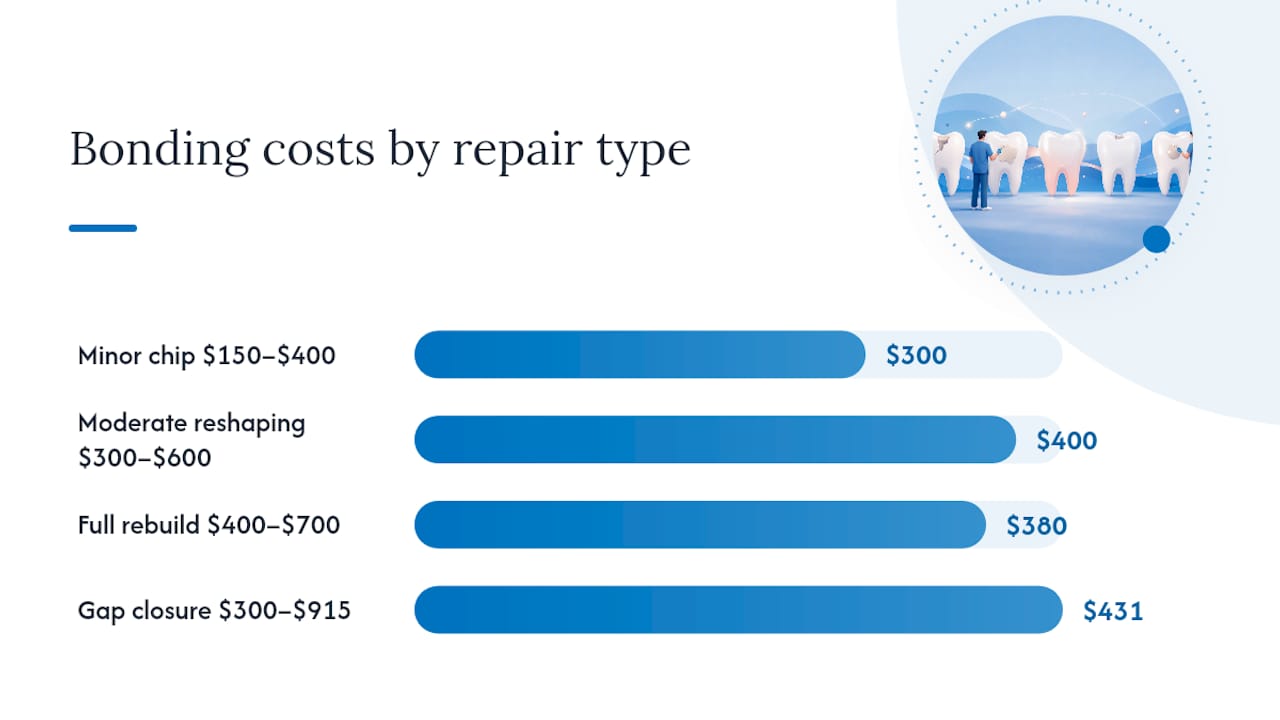
Gap closures are priced per tooth, so closing a gap between two front teeth means two separate fees. Full-surface rebuilds take the most chair time and the most composite resin, which is why they sit at the top of the range.
Pre-procedure costs are easy to overlook. Many dentists require an exam and professional cleaning before cosmetic bonding, adding $50–$350 to your total budget. Factor those in before you compare quotes.
Pro Tip: If you plan to whiten your teeth, do it before bonding. Composite resin cannot be whitened after placement, so your dentist will match the resin to your post-whitening shade. Skipping this step means your bonded tooth may look noticeably darker after whitening. In-office whitening typically adds $300–$600 to the total.
How tooth-bonding prices vary by state
Geography moves the needle more than most patients expect. A procedure that costs $300 in a rural Midwestern town can run $650 or more in a major coastal city. The drivers are straightforward: higher overhead, higher cost of living, and more competition for cosmetic specialists.
Consumer-facing dental cost aggregators show state averages ranging from roughly $300–$380 in lower-cost markets to above $600 in higher-cost states. The table below gives a representative sample.
| State | Estimated average per tooth |
|---|---|
| Alabama | ~$300 |
| Texas | ~$380 |
| Florida | ~$400 |
| Illinois | ~$431 |
| New York | ~$600 |
| California | ~$600 |
| Maine | ~$380 |
These figures are ballpark estimates from national aggregator data. Your actual quote will depend on the specific practice, the dentist's experience level, and the complexity of your case.
A few practical ways to use state averages:
- Use them as a sanity check when you receive a quote. A number well above the state average warrants a question about what's driving the cost.
- If you live near a state border, it may be worth comparing quotes across markets.
- Metro practices in any state will generally sit above the state average; suburban and rural practices often come in below it.
What actually drives the price up or down
Understanding the specific levers helps you predict where your quote will land before you walk into a consultation.
Provider-side factors:
- Cosmetic training and experience: Dentists with dedicated cosmetic training charge more, but they typically deliver better shade matching and more natural-looking contours. That trade-off is worth weighing when final appearance matters as much as cost.
- Practice location: Urban and suburban practices carry higher overhead, and that gets passed to patients.
- General dentist vs. cosmetic specialist: A general dentist can perform bonding competently for straightforward cases; a cosmetic specialist makes sense for complex or highly visible front-tooth work.
Procedure-side factors:
- Number of teeth treated: Treating multiple teeth in one visit often lowers the per-tooth cost because setup and shade-matching time is shared across the session.
- Front vs. back tooth: Front teeth are more visible and demand more precise color matching, which takes longer and costs more.
- Anesthesia: Most bonding requires no anesthesia, but if the tooth is near a nerve or the patient has sensitivity, a local injection adds a small fee.
- Composite grade: Higher-end composite resins offer better translucency and color stability. Some practices charge a premium for premium materials.
Pre- and post-procedure factors:
- Exam and cleaning fees if required before treatment.
- Whitening if you want to match a brighter shade.
- Touch-ups or repairs in the years after placement.
Pro Tip: Ask your dentist upfront whether the bonding will be billed as restorative or cosmetic. If you chipped a tooth in an accident or have a fracture, the procedure may qualify as restorative, which opens the door to partial insurance coverage. A chipped tooth repair billed under a restorative code is a very different financial situation than elective gap closure.
What happens during a bonding appointment
Dental bonding is typically completed in one visit of about 30–60 minutes per tooth, which is a big part of why it costs less than veneers or crowns. Here is what that appointment looks like, step by step:
- Shade selection: The dentist uses a shade guide to match the composite resin to your natural tooth color. This step takes only a few minutes but matters enormously for the final result.
- Surface preparation: The tooth surface is lightly roughened and a conditioning liquid is applied. This helps the resin bond securely. No significant enamel removal is required in most cases, which is one reason bonding is considered reversible.
- Resin application: The dentist applies the putty-like composite resin, then shapes and molds it to match the tooth's natural contour.
- Curing: A UV light hardens the resin in about 30–60 seconds per layer.
- Shaping and polishing: The dentist trims any excess, refines the shape, and polishes the surface until it matches the sheen of surrounding teeth.
When multiple teeth are treated in one session, the dentist typically completes each tooth sequentially. The total chair time scales roughly with the number of teeth, though shared setup time makes multi-tooth sessions more efficient than booking separate appointments.
Local anesthesia is occasionally needed if the tooth is sensitive or the repair extends near the gumline. That adds a few minutes and a small fee but is not the norm for straightforward bonding.
How long bonding lasts and what maintenance costs
Dental bonding typically lasts 5–10 years before it needs repair or replacement. Where it falls in that range depends mostly on where the bonded tooth is, how you use it, and how well you maintain it.
Front teeth used for biting into hard foods tend to chip or wear faster. Back teeth that absorb chewing forces can also stress the bond over time. Habits like nail biting, chewing ice, or using your teeth to open packaging shorten the lifespan noticeably.
Maintenance steps that extend bonding life:
- Avoid biting directly into very hard foods (hard candy, ice, crusty bread) with the bonded tooth.
- Use a non-abrasive toothpaste. Gritty whitening pastes scratch composite resin and accelerate staining.
- Schedule regular checkups so your dentist can catch early wear or edge chipping before it becomes a full repair.
- If you grind your teeth at night, a night guard protects bonding from the forces that crack it fastest.
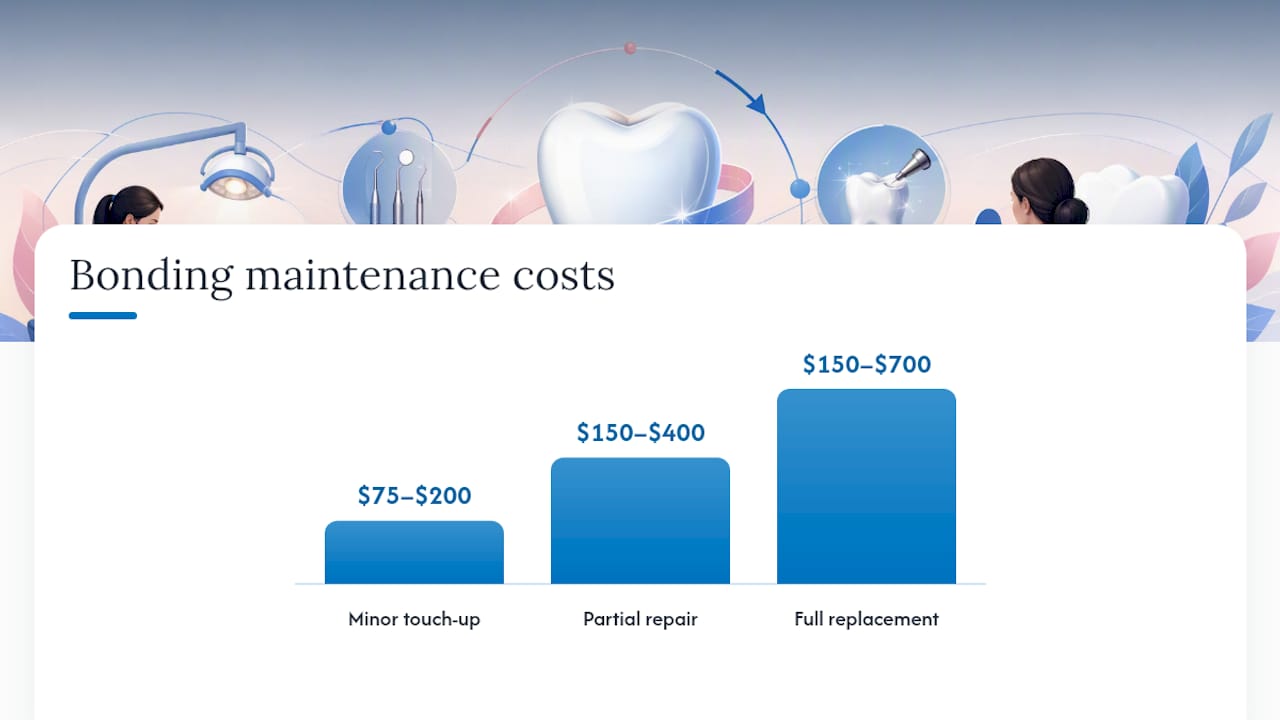
Estimated costs for common maintenance events:
- Minor touch-up (small chip or surface polish): $75–$200
- Partial repair (edge fracture, moderate wear): $150–$400
- Full replacement of a bonded tooth: $150–$700, essentially the same as the original procedure
Pro Tip: Composite resin stains from coffee, tea, red wine, and tobacco over time. You cannot whiten bonded resin the way you whiten natural enamel. Rinsing with water after staining beverages and scheduling a professional polish once or twice a year keeps the color closer to the original match for longer.
Does insurance cover bonding, and what are your payment options?
The short answer: insurance may pay when bonding repairs a fractured or medically necessary tooth; elective cosmetic bonding is typically not covered. The distinction comes down to how the procedure is coded and why it is being done.
How to check your coverage before the appointment:
- Call your insurer and ask whether procedure code D2335 (resin-based composite, four or more surfaces) or D2330 (one surface, anterior) is covered under your plan.
- Ask your dentist's office to submit a pre-authorization request. This is not a guarantee of payment, but it gives you a written estimate of what the plan will cover.
- Review your dental insurance plan's annual maximum. Even when bonding is partially covered, hitting your annual cap means you pay the rest.
Payment options when insurance doesn't cover it:
- CareCredit: A healthcare credit card that offers promotional financing periods. Patients use it to spread bonding costs over several months without interest if paid within the promotional window. CareCredit is accepted at many dental practices and is worth asking about at your consultation.
- In-office payment plans: Many practices offer their own installment arrangements, particularly for multi-tooth cases.
- Multi-tooth discounts: Treating several teeth in one session sometimes comes with a reduced per-tooth rate. Ask directly.
- Dental savings plans: Not insurance, but membership-style discount programs that reduce fees at participating practices.
If you need care but have no coverage, getting dental care without insurance is more feasible than most patients assume, especially for a single-visit procedure like bonding.
Pro Tip: Always request an itemized pre-treatment estimate in writing before any cosmetic procedure. It lists each service, its code, and the fee. You can submit it to your insurer yourself to check coverage, and it protects you from surprise charges on the day of treatment.
Bonding vs. veneers vs. crowns: which makes sense for your budget?
Bonding is the lowest-cost option, but cost is only one dimension. Here is how the three main cosmetic and restorative options compare across the factors that matter most for budgeting and long-term planning.
The trade-offs are real. Bonding costs a fraction of veneers and requires no permanent enamel reduction, which means it is reversible. That makes it the right first call for minor chips, small gaps, and discoloration on otherwise healthy teeth. Veneers make more sense when you want a long-term cosmetic result across multiple front teeth and are willing to pay for durability and stain resistance. Crowns are restorative tools first, used when a tooth is structurally compromised.
When to choose bonding:
- The repair is minor and on a single tooth.
- You want to test a cosmetic change before committing to veneers.
- Budget is the primary constraint.
- The tooth is healthy and does not need structural reinforcement.
How to choose the right dentist for bonding
The dentist's skill matters more for bonding than for almost any other cosmetic procedure. Composite resin is sculpted freehand, which means the final shape and color match depend entirely on the clinician's eye and technique.
What to look for before you book:
- A portfolio of before-and-after photos for bonding cases specifically, not just general cosmetic work.
- Evidence of cosmetic training or continuing education in composite artistry.
- Digital shade-matching tools or imaging that lets you preview the result.
- A willingness to do a consultation before committing to treatment.
- Clear, itemized pricing provided in writing.
Questions worth asking at the consultation:
- What composite brand and grade do you use, and why?
- How many bonding cases do you complete per month?
- What is your policy if the bonding chips or fails within the first year?
- Can I see long-term follow-up photos from patients you treated two or more years ago?
- Will you provide a written estimate that includes all associated fees?
Choosing a dentist based on the lowest quote alone is one of the most common mistakes in cosmetic dentistry. A $50 difference in per-tooth price means nothing if the shade match is off or the resin chips within six months. Ask for the portfolio first, then discuss the price.
Starboarddental uses digital scanning and shade-matching technology to improve accuracy on composite cases. You can review the clinic's dental bonding and cosmetic dentistry service pages to understand the approach before booking a consultation.
Pro Tip: Ask specifically for photos taken 12–24 months after bonding, not just immediately post-procedure. Fresh bonding always looks good. Long-term photos reveal how the color held, whether the edges chipped, and how well the contour aged.
Does the bonding material affect the cost?
Yes, and the difference is more than cosmetic. Composite resin is not a single product. Practices use different grades, and the material choice affects both the price and the long-term result.
Standard composite resin is the baseline. It bonds reliably, matches most tooth shades adequately, and is what most general dentists use for routine bonding. It sits at the lower end of the per-tooth price range.
Nano-hybrid and nano-filled composites use smaller filler particles, which allows for a smoother surface finish and better light reflection. They mimic the translucency of natural enamel more closely. Cosmetic specialists often use these for front-tooth work where appearance is the priority. Expect a modest price premium, typically $50–$150 more per tooth.
Flowable composites are lower-viscosity materials used for very small repairs or to fill in tight spaces before a thicker layer is applied. They are not typically a standalone option for visible cosmetic work.
The material cost itself is not large. What you are really paying for with premium composites is the dentist's ability to use them well. A highly skilled dentist using a nano-hybrid resin can produce a result that is nearly indistinguishable from a natural tooth. The same material in less experienced hands may not look better than standard composite. Material grade and provider skill are inseparable when it comes to the final result.
What bonding actually delivers for most patients
Bonding has a reputation as a "quick fix," and that framing undersells it. For the right case, a single 45-minute appointment can correct a chip, close a small gap, or reshape a tooth that has bothered a patient for years. The cost is accessible, the procedure is conservative, and the result is immediate.
Where patients run into trouble is with unrealistic expectations about longevity and color stability. Composite resin is not porcelain. It will stain gradually, and it will eventually need replacement. Patients who go in knowing that tend to be satisfied. Patients who expect a 20-year result from a $300 procedure are usually disappointed.
The honest consultation matters more than the procedure itself. A dentist who tells you upfront what bonding can and cannot do, shows you realistic before-and-after examples, and gives you a written estimate is the one worth booking. Transparent pricing and candid clinical guidance are what separate a good bonding experience from a frustrating one.
Ready to get an estimate for bonding at Starboard Dental?
Starboarddental offers dental bonding as part of a full range of cosmetic dentistry services in Kennebunk, ME. The practice uses digital scanning and shade-matching tools to improve accuracy on composite cases, and same-day appointments are available for patients who want to move quickly.

Getting a written, itemized estimate before committing to treatment is the single most useful step you can take. Starboarddental provides transparent pricing at consultation so you know exactly what each service costs before any work begins. Call the practice directly or book online to schedule your consultation and get a per-tooth estimate tailored to your specific case.
Sources
The sources below are worth checking directly if you want to verify cost figures, understand insurance rules, or learn more about the clinical procedure.
- How Much Does Dental Bonding Cost? | Humana
- How Much Does Teeth Bonding Cost? Price and Procedure Guide | CareCredit
- Dental Bonding Cost 2026: Per Tooth, Insurance & vs Veneers | RealDentalCosts
- What Is Dental Bonding and How Does It Work? | WebMD
- Teeth Bonding Cost Per Tooth (2026) | MySpecialtyDentist
Always confirm current pricing with your dentist directly. State averages and national figures are useful for planning, but an itemized written estimate from your provider is the only number you can actually budget from.
This article is general information, not a substitute for advice from a qualified doctor. Consult a qualified healthcare professional about your own circumstances before acting on anything here.