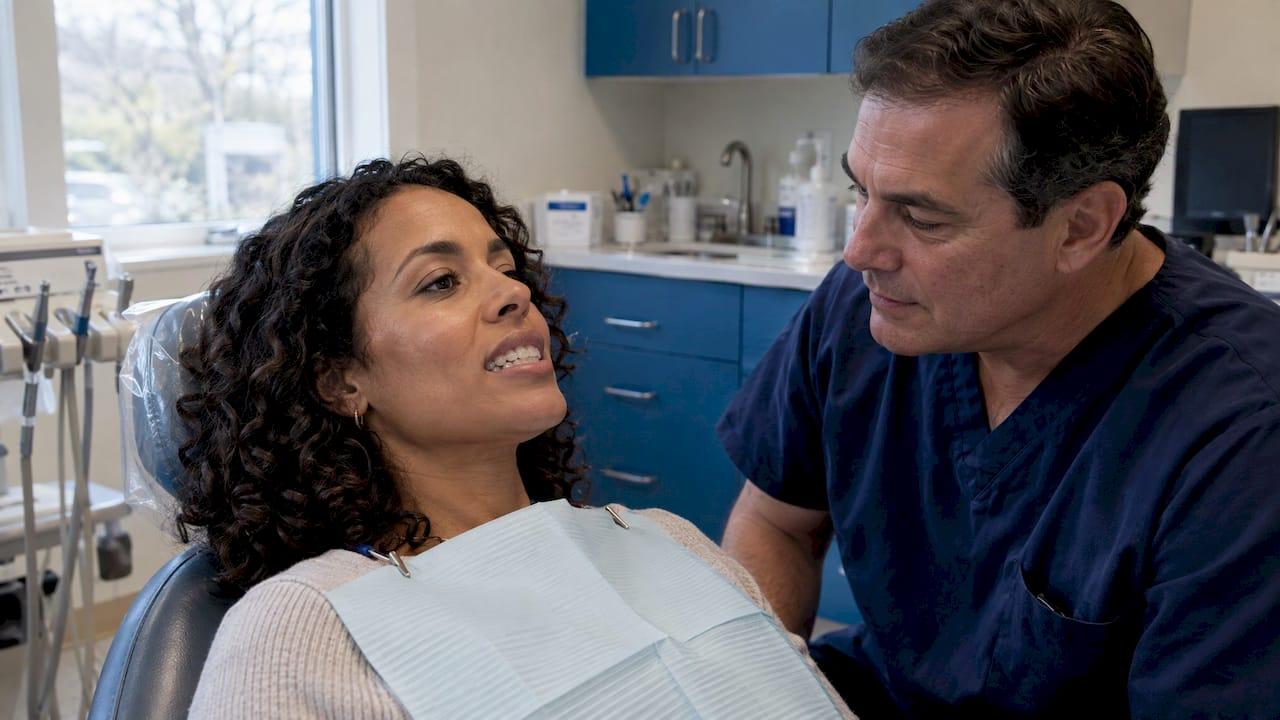
Clear aligners can straighten crowded teeth, and they work best when the crowding is mild to moderate. The FDA says clear aligners are commonly used for mild to moderate orthodontic problems, including crowding, while more complex cases may need braces or other treatment. How much room your teeth are missing decides which group you fall into, and that takes an in-person exam. If you live near Kennebunk, we can start with a digital scan at Starboard Dental and tell you where you stand.
TL;DR
- Aligners handle mild and moderate crowding well. Severe crowding is harder and sometimes calls for extractions or braces.
- Crowding is measured in millimeters of missing space. Under about 6 mm is the comfortable range for aligners.
- Expect roughly 13 to 18 months in published research, depending on severity.
- Aligners are prescription devices in the US. A dentist should examine your teeth, bite and X-rays first.
- A retainer after the last aligner is what keeps teeth from crowding again.
Table of Contents
- What crowding actually means
- How well aligners work, by severity
- How aligners make room for crowded teeth
- When braces or extractions may be the better route
- How long treatment takes
- What your first visit should cover
- Safe use: what to know before you start
- Retainers: the part that keeps crowding from returning
- What it costs
- Our perspective
- Starting aligners for crowding in Kennebunk
- FAQ
- Sources
What crowding actually means
Crowding means your teeth don't have enough room in the jaw. They overlap, twist or sit in front of or behind their neighbors. Dentists describe it as a space shortage: the width of all your teeth minus the length of the arch they have to fit in. A shortage of 2 mm is a slight overlap on the lower front teeth. A shortage of 9 mm is a canine pushed completely out of line.
That number is what decides whether aligners are a good fit. Crowded lower front teeth are one of the most common versions, and we explain how they are planned in our piece on crowded lower teeth and digital setups.
How well aligners work, by severity
The best evidence is how orthodontists themselves feel about it. In a survey of 160 American Association of Orthodontists members in the US and Canada, 98.8% were confident treating mild crowding (under 6 mm), 82.5% were confident with moderate crowding, and only 40% with severe crowding over 8 mm.
| Crowding | Typical space shortage | What to expect with aligners |
|---|---|---|
| Mild | Under about 3 to 6 mm | Usually a strong candidate |
| Moderate | About 4 to 8 mm | Often workable, planning matters more |
| Severe | Over about 8 mm | May need extractions, braces or a combined approach |
The ranges overlap because researchers draw the lines in slightly different places. A 2022 review states that mild (1 to 3 mm) and moderate (4 to 6 mm) crowding can be treated with aligners without extraction. A 2023 review of 33 studies found aligners effective at resolving mild to moderate crowding, with tipping of teeth the most predictable movement and rotation the least.
That last point matters for you. A tooth that is simply leaning is easy. A tooth that is badly twisted takes more planning and often extra tools such as attachments, the small tooth-colored bumps that give aligners something to grip. We cover them in what every patient should know about aligner attachments.

How aligners make room for crowded teeth
Teeth can't move into space that isn't there, so the plan always starts with creating room. There are three main ways.
- Interproximal reduction (IPR). The dentist polishes a hair-thin amount of enamel from between teeth. A 2026 review describes about 0.1 to 0.2 mm per contact for mild crowding, and up to 0.3 mm per contact when combined with arch expansion in mild-to-moderate cases.
- Arch expansion. The same review lists expansion of up to 2 mm per quadrant for mild-to-moderate cases. The arch widens slightly, within the limits of the bone and gums.
- Tilting front teeth forward. This gives a little length but has limits. A review of staging aligners reports that non-extraction treatment of crowding over 6 mm led to excessive forward tilting of the incisors.
Most plans mix these. The right mix depends on your tooth shapes, gum health and bite, which is why a photo can't tell you much and why a 3D scan can.
When braces or extractions may be the better route
Some crowding is beyond what aligners alone do well. The same staging review notes that moderate-to-severe crowding with blocked-out canines, or a discrepancy over 8 mm, may be better resolved with extraction therapy. A 2025 expert consensus grades cases by difficulty: easy cases are mild crowding handled with expansion and IPR, while difficult cases involve severe crowding needing extractions, anchorage or even surgery.
Two more things can change the answer:
- Bite problems. Crowding often comes with an overbite or crossbite. We explain what aligners can do there in can clear aligners fix an overbite.
- Severely rotated or heavily tilted teeth. A 2019 systematic review found aligner results less accurate than fixed braces, with derotation and vertical movement the hard parts.
A good plan says so plainly when a case needs something different, and sometimes the answer is aligners combined with other steps.
How long treatment takes
The 2019 systematic review reported average aligner treatment of 13.4 months for mild crowding, 15.9 months for moderate and 17.9 months for severe, with wide variation between patients (roughly plus or minus 4 to 5 months). Cleveland Clinic says a few slightly crooked teeth may need up to nine months, with more serious problems taking several more.
What moves your timeline:
- Wear time. The FDA describes wearing each set for one to two weeks, at least 20 hours a day. Trays left in the case slow everything down.
- Severity and tooth type. Rotations and root movements take longer than simple tipping.
- Check-ins. Progress is monitored periodically, and the plan is adjusted if teeth lag behind.
For a visit-by-visit view, see our clear aligner timeline from scan to retainer.
What your first visit should cover
The FDA says a dentist or orthodontist should examine your teeth, bite and dental history, may take X-rays, and use digital scans or impressions to build a 3D model and treatment plan. It also notes that in-person evaluation helps determine suitability. Clear aligners are available only by prescription from a licensed dentist or orthodontist, and the FDA has not authorized aligners sold directly to consumers without professional supervision.
So the visit has a few jobs:
- Check gum health and look for decay first. Aligners move teeth, and the teeth need to be healthy to move.
- Take X-rays to see roots and bone.
- Scan your teeth and measure how much space is missing.
- Show you the plan, the likely number of aligners and whether IPR or attachments are involved.
If you are weighing the approach for adult teeth specifically, our dentist's view is in aligners for adults.
Safe use: what to know before you start
The FDA lists possible downsides: lost or damaged aligners, temporary speech changes, irritation or allergic reaction to the materials, and treatment stalling if trays aren't worn as directed. Existing crowns, fillings or implants can also loosen or dislodge. Tell your dentist about any restorations before planning. Sore teeth are normal early in each tray, and we describe what helps in our guide to aligner pain and relief.

A few habits make treatment smoother. Take trays out to eat, which our article on eating with aligners walks through. Clean the trays and brush before putting them back in. If you have gum disease, get it treated first. A 2021 clinical article in Dimensions of Dental Hygiene notes that wearing the appliance about 20 hours a day prevents delays from wear problems.
Retainers: the part that keeps crowding from returning
Crowding is the most common thing that comes back. The 2025 consensus concludes that retainers plus correcting oral habits are the most effective measures against relapse. The FDA also lists a retainer after the final aligner as part of treatment. If you want to understand how a retainer differs from the aligners themselves, read retainers vs. aligners.
What it costs
Cost depends on how many aligners your case needs, whether IPR or attachments are used, and what your dental plan covers for orthodontics. Many plans have a separate orthodontic benefit with a lifetime maximum, so ask your insurer before the consult. We bill patients or their dental insurance for each treatment, and we give you a quote once your scan and exam show what your case involves. We don't publish a flat price because crowding varies so much from mouth to mouth.
Our perspective
When someone says "my teeth are crowded," the first thing we want to know is how many millimeters. That one number tells us more than any photo.
At Starboard Dental we work with digital scanners, so you can see your own teeth in 3D at the first visit and we can plan with precision. Many of our patients arrive anxious about dental work, and we've built the office around making visits comfortable, with ceiling-mounted TVs and personalized comfort items.
Because we also provide general, restorative, periodontal and cosmetic care for all ages, we can look at the whole picture: healthy gums, existing fillings or crowns, and the bite. Aligners for crowding work best when those pieces are in order.
Our advice is simple. Get scanned, get the measurement, and decide with a clear plan in front of you.
Alex
Starting aligners for crowding in Kennebunk
Starboard Dental offers clear aligners for patients in Kennebunk, York and Saco. We also offer same-day and walk-in appointments, so you don't have to wait weeks to find out whether your crowding is a good fit.

If your teeth need a cleaning or checkup first, our general dentistry team can handle that, and gum treatment is available through periodontal therapy. If you'd like to finish with a polished look afterward, ask about cosmetic options.
FAQ
Can clear aligners fix severely crowded teeth?
Sometimes, but it is harder. Only 40% of surveyed orthodontists felt confident with crowding over 8 mm in aligners alone. Severe cases may involve extractions or another approach, and a scan tells us which path fits you.
How long do aligners take to fix crowding?
Published averages run from about 13 months for mild crowding to about 18 months for severe crowding. Individual timelines vary with how closely trays are worn and how much rotation is needed.
Do I need teeth removed or filed down for aligners?
Not always. Many mild and moderate cases create room with small amounts of enamel polishing (IPR) and slight arch widening instead of extractions. Your dentist decides after measuring your space and examining your bite.
Will my teeth get crowded again afterward?
They can if you skip your retainer. Wearing a retainer as directed after the last aligner is the main way to keep your results.
Sources
- Clear Dental Aligners, FDA
- Insight into clear aligner therapy protocols (AAO member survey), PMC
- Clear Aligners: where are we today, Journal of International Oral Health
- Effectiveness and predictability of treatment with clear aligners, PubMed
- Clear Aligner Therapy: A Review of Materials, Current Trends in Dentistry
- Staging Orthodontic Aligners for Complex Orthodontic Tooth Movement, PMC
- Expert consensus on clinical strategies for orthodontic aligners, PMC
- A systematic review of the accuracy and efficiency of aligners, PMC
- Clear Aligners: Purpose & Types, Cleveland Clinic
- A Closer Look at Clear Aligner Therapy, Dimensions of Dental Hygiene