Most clear aligner treatment takes somewhere between six and 18 months, and the FDA gives that same range for total treatment time. Where you land in that range depends on how far your teeth have to travel, how consistently you wear your trays and whether anything else in your mouth needs attention first. If you live near Kennebunk and want a realistic plan for your own smile, we map it out at your first visit with a digital scan, so you see the path before you commit to it.
TL;DR
- Expect roughly 6 to 18 months of active aligner wear. Mild cases sit at the short end, complex bite problems at the long end.
- Trays are worn about 20 to 22 hours a day and swapped on a schedule your dentist sets, commonly every one to two weeks.
- Most of your time is spent wearing trays, plus a few check-ins. Any needed dental work comes first.
- No safe shortcut exists. Teeth that move too fast can be damaged, so steady wear is what keeps you on time.
- Retainers are part of the timeline. Plan on wearing them long term to keep the result.
Table of Contents
- How long clear aligners take overall
- Timeline by case type
- The full timeline, stage by stage
- How many hours a day, and how often to change trays
- What can make treatment take longer
- Why you cannot safely speed it up
- After the last tray: retainers
- A sample timeline you can plan around
- Start your aligner plan in Kennebunk
- Our perspective on aligner timelines
- FAQ
- Sources
How long clear aligners take overall
The honest answer is a range, not a single number. The FDA says total treatment with clear dental aligners can take anywhere from six to 18 months. Cleveland Clinic describes it in terms of severity: a few slightly crooked teeth may need aligners for up to nine months, and more serious issues take several months longer. The American Association of Orthodontists (AAO) puts adults with mild misalignment at around eight to twelve months, with more complex cases taking longer.
Those figures differ a little because the sources measure slightly different things and different patients. What they agree on is the shape: small movements are quick, large movements are slow, and the plan for your teeth is what turns a range into a date.
Timeline by case type
Use this as a rough guide for the conversation with your dentist, not as a promise. The ranges come from the sources above.
| Case type | What it usually looks like | Typical active treatment |
|---|---|---|
| Mild | A few slightly crooked teeth, minor spacing or mild crowding | Up to about 9 months (Cleveland Clinic); 8 to 12 months for adults (AAO) |
| Moderate | More crowding or spacing, some bite adjustment | Toward the middle of the 6 to 18 month range (FDA) |
| Complex | Bite problems, larger movements, sometimes added elastics or other appliances | Longer, in some cases a couple of years (AAO) |
The AAO notes that some plans combine aligners with elastics or other appliances to reach the desired result. That is a design choice made for your bite, and it is one reason two people with similar-looking smiles can have different timelines. If your concern is how your upper and lower teeth meet, our guide on whether clear aligners can fix an overbite goes through what the plan involves. Crowding in the lower front teeth has its own planning logic, covered in why digital setups decide treatment for crowded lower teeth.
The full timeline, stage by stage

Before the first tray: exam, cleaning and any dental work
The clock does not start the day you decide to straighten your teeth. The AAO advises a visit to your family dentist for a cleaning and check-up first, and says any dental work should be finished before you are scanned. A cavity under a tray or inflamed gums will slow things down later, so it is faster to settle them at the start.
This stage can take a single visit or several, depending on what the exam finds. At Starboard Dental it all happens under one roof: general dentistry for the exam and cleaning, fillings and restorative work if you need them, and periodontal therapy when gums need care before teeth move. We offer same-day appointments, which helps keep this preparation from stretching out.
The scan and the plan
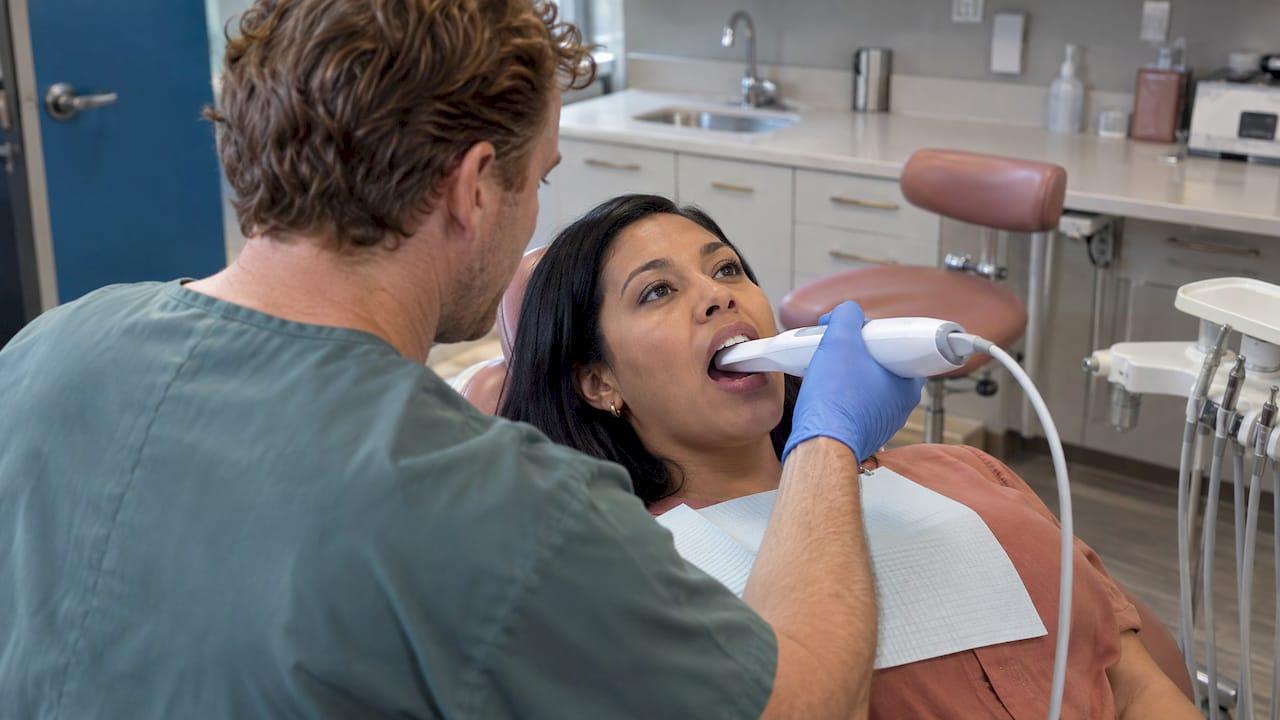
Next comes a digital scan of your teeth, which replaces messy impression trays. The scan becomes a 3D plan that maps each small movement from where your teeth are now to where they should end up. This is also where your estimated number of trays and months comes from. Ask to see the projected end position, because it makes the whole timeline concrete. For the mechanics behind the plan, our clinician checklist on how clear aligners move teeth walks through it.
Waiting for your trays
Aligners are not usually made in the dental office. The AAO states that delivery from the manufacturer can take four to six weeks, and that this period is combined with the initial scans, placing attachments and teaching you how to use the trays. Build that window into your expectations so you are not surprised that treatment does not begin the day of the scan.
Attachments are small tooth-colored bumps that give the trays something to grip. If you are curious what they are and how they come off, read what every patient should know about aligner attachments.
Week one: the adjustment period
The AAO says to expect an adjustment period of about a week after getting aligners, with mild discomfort common for the first few days. Speech may feel a little different and your teeth may feel snug. This usually settles as you get used to the routine, and each new tray can bring a short return of pressure.
Months one through three: the quiet phase
In the early weeks you may not see much in the mirror. Each aligner moves teeth only a fraction of a millimeter at a time, according to the AAO. The movement is real, and it adds up across many trays. Many people notice small changes in how their teeth line up somewhere in the first few months, though photos taken in the same light every few weeks show progress better than a quick look.
The middle stretch
This is where consistency matters most. You will swap trays on schedule, attend periodic check-ins, and your teeth will gradually move into the planned positions. The AAO says orthodontic visits are typically scheduled every six to eight weeks to monitor progress, and elsewhere gives a range of six to ten weeks for picking up new aligners or adjusting appliances. At those visits the team checks tooth movement along with the health of your teeth and gums.
The finish
The last aligner is not the end of the journey. After active treatment, you move into retention, which we cover below. Plan on a visit to confirm the final position and take a scan for your retainer.
How many hours a day, and how often to change trays
Wear time is the biggest factor in your control. Sources give slightly different numbers, so follow the figure your dentist prescribes:
- The AAO says aligners only work if you wear them as prescribed, usually 20 to 22 hours a day.
- Cleveland Clinic says to wear them 22 to 23 hours every day, except for meals and when you brush and floss, and that trays are generally replaced every two weeks.
- The AAO's aligner page describes each aligner being worn for one week at a time, at least 22 hours a day.
The pattern is the same in all of them: aligners come out to eat and clean your teeth, and they go back in right away. The FDA reminds aligner wearers to brush and floss after eating and says your dentist may recommend more frequent cleanings while you are in treatment.
A practical way to protect your hours: keep a case in your bag and pocket, set a phone reminder after meals, and drink only water with trays in. Every hour out is an hour your teeth are not moving, and missed hours add up to weeks.
What can make treatment take longer
Most delays come from a handful of causes, and almost all of them are avoidable.
- Not wearing trays enough. The AAO says treatment stays on schedule when you wear aligners or elastics as prescribed and keep your appointments.
- Lost or broken trays. The AAO lists a lost aligner as something that can set treatment back. Tell your dentist right away so you can get back on track, and keep your previous tray as a fallback.
- New dental problems. According to the AAO, cavities or gum problems that come up mid-treatment can slow things down. This is why the starting exam and cleaning matter, and why regular cleanings continue during treatment.
- Missed check-ins. Visits are how your dentist confirms that teeth are tracking the plan. Skipping them lets small deviations go unnoticed.
- A complex starting point. Larger movements and bite corrections need more trays by design. That is a longer plan, not a setback.
If you want to compare how aligner care for adults works in practice, our piece on aligners for adults, from a dentist's perspective covers what to expect when you are managing treatment around work and family.
Why you cannot safely speed it up
It is tempting to wear a new tray early or double up. Don't. The FDA states that if tooth movement is too rapid, tooth loss or a breakdown of the bone can occur, and that there is really no faster method of straightening teeth. Teeth move through bone, and bone needs time to remodel. The tray schedule your dentist sets already reflects what your teeth can handle.
The best way to finish on time is the unglamorous one: wear the trays the full prescribed hours, change them when told, and show up for check-ins.
After the last tray: retainers
Retention belongs in any honest clear aligner timeline. The AAO explains that after active treatment, your orthodontist or dentist takes a mold or digital scan to create a retainer. You may be told to wear it full-time during a settling-in period and later switch to nights only. The AAO adds that patients will likely wear retainers for the rest of their lives, because bone remodeling keeps nudging teeth, and that skipping retainers even for a few days can allow teeth to shift significantly.
Healthline likewise notes that you will likely wear a retainer for years, for some part of the day, to keep teeth in their new positions. Think of it as the final stage of treatment that happens to last the longest, and the one that protects everything you invested in.
If you ever lose your retainer, move quickly. We explain the steps in what to do about a lost retainer within 24 to 72 hours. And if you are unsure whether you need aligners, a retainer or both, see retainers vs aligners.

A sample timeline you can plan around
Here is how a mild to moderate case might unfold for an adult, using the ranges above. Your own plan will differ.
| Phase | Approximate length | What happens |
|---|---|---|
| Exam, cleaning, any dental work | One to several visits | Teeth and gums are made ready for movement |
| Scan and planning | One visit | Digital scan, projected end position, tray count |
| Tray fabrication | About 4 to 6 weeks (AAO) | Trays are made and attachments planned |
| Adjustment | About 1 week (AAO) | Getting used to wearing trays |
| Active treatment | About 6 to 18 months (FDA) | Tray changes on schedule, check-ins every 6 to 10 weeks (AAO) |
| Retention | Long term | Retainer fitted, then worn as directed |
Budgeting time is half the picture, and the other half is money. Our guide to clear aligner cost and how to pay explains what to budget.
Start your aligner plan in Kennebunk
If you want a timeline built around your teeth rather than an average, our clear aligners page is the place to begin. We use digital scanners for precision, we see patients of all ages, and we offer same-day and walk-in appointments, so getting the preparation visit done does not have to wait. Our ceiling-mounted TVs and personalized comfort items are there to make longer visits easier, especially if dental appointments make you nervous.

Book a visit and we will go over your exam, your goals and what your treatment path looks like, all in one place. You can reach us through the Starboard Dental site.
Our perspective on aligner timelines
Patients often ask us for one number, and we understand why. A date makes a commitment feel manageable. But the most useful answer is a plan: a scan, a projected end position and a clear sense of what you control.
The part of the timeline you control is bigger than most people think. Wear time, tray changes, check-ins and good hygiene all decide whether you finish near the short or long end of your range. We build that into the conversation from the first visit, because a well-prepared mouth moves more predictably.
We also like to treat the whole mouth as one project. Healthy gums, sound teeth and a comfortable bite make aligner treatment smoother, and our practice covers general, restorative, periodontal and cosmetic care along with clear aligners. That means the preparation work and the straightening can happen with the same team, in a calm setting that is designed to reduce dental anxiety.
And we always talk about retainers on day one. The smile you finish with is worth protecting, and a simple nightly habit does that.
Alex
FAQ
How long do clear aligners take for most people?
Most people finish active treatment in about six to 18 months, according to the FDA. Mild cases tend to land near the shorter end, while bite corrections and larger movements take longer. Your scan and treatment plan give the most reliable estimate for your own teeth.
When will I start to see results?
Teeth begin moving right away, but each tray shifts them only a fraction of a millimeter. Many people notice small changes within the first few months, with clearer results as treatment continues. Taking a photo in the same light every few weeks makes progress easier to see.
How many hours a day do I need to wear my aligners?
The AAO says usually 20 to 22 hours a day, and Cleveland Clinic says 22 to 23. Follow the number your dentist gives you. Trays come out for eating, brushing and flossing, and go back in right afterward.
Can I finish faster by switching trays early?
No. The FDA warns that moving teeth too quickly can lead to tooth loss or breakdown of the bone, and says no faster method of straightening exists. Following the schedule your dentist sets is the safe way to stay on track.
Do I need a retainer after clear aligners?
Yes. The AAO says patients will likely wear retainers for life, usually full-time at first and then at night, because teeth keep shifting over time. Your retainer is fitted at the end of active treatment, so it is part of your plan from the beginning.
Sources
- FDA: Braces Have Changed, What to Know about Traditional Braces and Clear Aligner Options
- AAO: Am I too old for orthodontic treatment?
- AAO: Clear Aligners
- AAO: What to Expect During Orthodontic Treatment
- AAO: Will My Teeth Keep Moving Post Treatment?
- Cleveland Clinic: Clear Aligners, Purpose and Types
- Healthline: Invisible Braces and Teeth Aligners for Adults