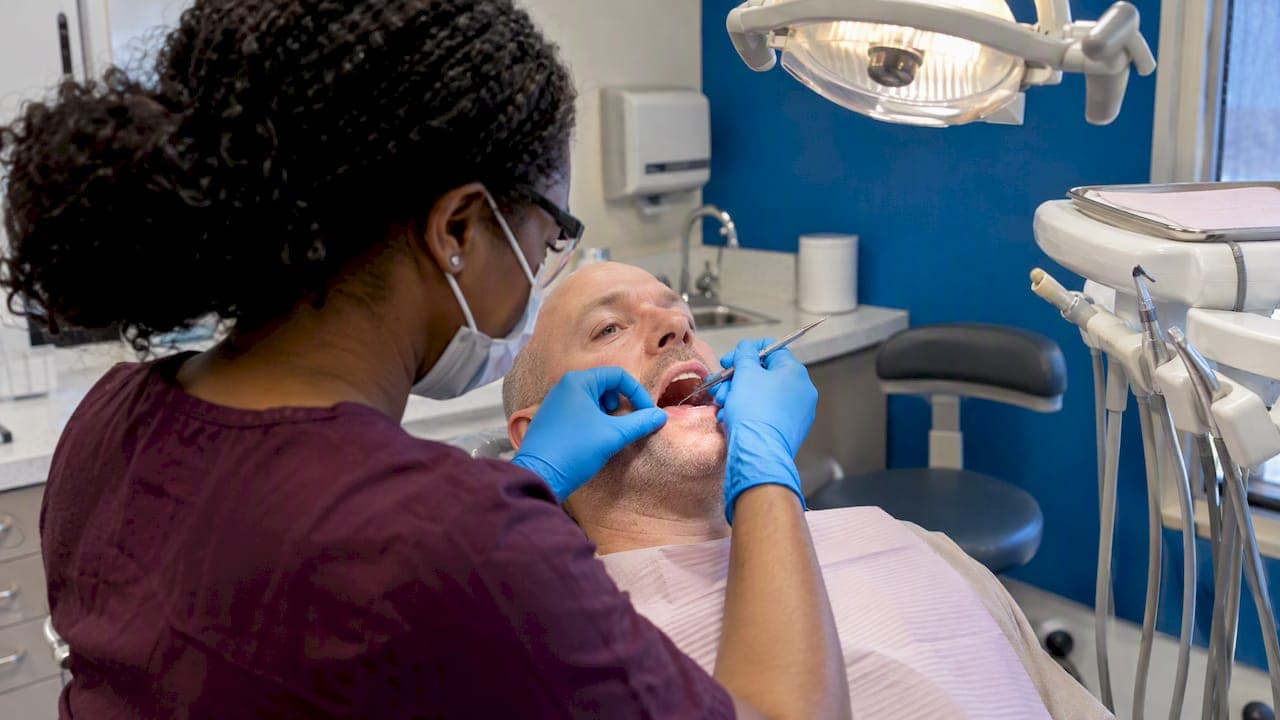
A regular dental cleaning is preventive maintenance for a mouth with healthy gums. A deep cleaning, called scaling and root planing (SRP), is a treatment for gum disease that has already started to damage the tissue around your teeth. The first removes plaque and tartar you can reach above the gumline. The second cleans below it, where brushing and floss cannot go. Which one you need depends on what your dentist finds when measuring your gums, not on how long it has been since your last visit.
TL;DR
- A regular cleaning (prophylaxis) prevents problems. A deep cleaning treats gum disease that is already there.
- A deep cleaning removes plaque and tartar above and below the gumline, then smooths the tooth roots so the gums can reattach. It often involves numbing and may take more than one visit.
- Your dentist decides based on gum measurements, X-rays and signs like bleeding or recession, not on preference or schedule.
- A dental exam and a cleaning are two different parts of the same checkup. The exam is the evaluation, the cleaning is the hands-on removal of buildup.
- If you live near Kennebunk, our periodontal team can measure your gums and tell you which one you need.
Table of Contents
- The short version: prevention vs. treatment
- What happens in a regular cleaning
- Dental exam vs. cleaning: they are not the same thing
- What a deep cleaning actually involves
- Do you need a deep cleaning?
- A worked example
- After a deep cleaning: the follow-up that matters
- What does a deep cleaning cost?
- Perspective: why we measure first
- Where intraoral scanners fit in
- Book a gum health check in Kennebunk
- Frequently asked questions
- Sources
The short version: prevention vs. treatment
Think of the two procedures as maintenance versus repair. A routine cleaning assumes your gums are healthy, or only mildly inflamed, and the goal is to keep them that way. A deep cleaning assumes there is an infection under the gumline that routine care cannot reach.
The American Dental Association (ADA) describes scaling and root planing as a way to treat gum disease by removing plaque and tartar above and below the gumline and smoothing the tooth roots. That is a different job from polishing and scraping the visible surfaces of your teeth.
| Regular cleaning | Deep cleaning (SRP) | |
|---|---|---|
| Purpose | Prevent cavities and gum disease | Treat existing gum disease |
| Who it's for | Patients with healthy gums or mild gingivitis | Patients with gum pockets and bone or tissue damage |
| Where it works | Tooth surfaces at and just below the gumline | Deep along the roots, beneath the gumline |
| Numbing | Rarely needed | Often used, depending on comfort and depth |
| Visits | One | Often split over more than one visit, by section of the mouth |
| Afterward | Return in about six months, or as advised | Closer follow-up, then ongoing periodontal maintenance |
What happens in a regular cleaning
A routine cleaning is usually part of a checkup visit. A hygienist uses small instruments to remove plaque and hardened tartar from your tooth surfaces, then polishes the teeth to remove surface stains and leave them smooth. MedlinePlus describes professional cleaning as including scaling and polishing.
This matters because tartar (calculus) cannot be brushed off. Once plaque hardens, only a professional can remove it. Left in place, it irritates the gums and gives bacteria a surface to cling to.
Most people feel pressure and a little scraping, and some sensitivity if their gums are inflamed. A cleaning in a healthy mouth typically takes a single appointment.
How often should you get one?
The CDC recommends regular professional cleanings and a dental checkup at least once a year, or more often if a healthcare provider recommends it. MedlinePlus notes that many dentists recommend a professional cleaning every six months, and that visits every three to four months may be needed when the gums are unhealthy.
So the right interval is personal. Someone with healthy gums and few cavities may be fine on a longer schedule, while someone with a history of gum trouble benefits from more frequent visits. We go deeper on this in our guide to how often you really need a professional cleaning.
Dental exam vs. cleaning: they are not the same thing
Many people use the words checkup and cleaning interchangeably, and they usually happen at the same appointment. But they do different things.
- The exam is the evaluation. The dentist looks for cavities, worn or cracked teeth, old fillings that are failing, signs of oral cancer and gum problems. MedlinePlus notes that routine exams may include dental X-rays, and that exams help dentists detect problems early.
- The cleaning is the hands-on removal of plaque and tartar, followed by polishing.
The two connect in an important way. The exam, including gum measurements, is what tells the dentist whether a regular cleaning is enough or whether you need something more. A cleaning on its own, with no evaluation, can miss early disease. You can read about how a dentist checks gum health in more detail.
At our practice, checkups, cleanings, X-rays and oral cancer screenings are part of general dentistry.
What a deep cleaning actually involves
A deep cleaning has two parts, and the names describe them well.
- Scaling removes plaque and tartar from the tooth surface, both above the gumline and in the space below it.
- Root planing smooths the tooth roots. The ADA explains that this helps the gums reattach to the teeth, closing off the pockets where bacteria collect.
Per the ADA, the procedure may require a local anesthetic and may take more than one visit. Many practices treat one or two sections of the mouth at a time so the numbing is manageable and you can still eat and talk comfortably afterward.
What it feels like
With numbing, most patients feel pressure and vibration rather than pain. Your gums and teeth can be tender for a few days, and gums may bleed a little when you brush. Some sensitivity to hot and cold is common as the gums tighten. Good home care in the first few days helps healing. Our deep cleaning aftercare guide walks through the first 72 hours and the longer healing period.
What it is not
A deep cleaning is not a more thorough version of the same cleaning that you can request because your teeth feel dirty. It is a periodontal treatment, billed and documented as one, and it is meant for specific findings. If your gums are healthy, a deep cleaning will not give you additional benefit.
Do you need a deep cleaning?
Only your dentist can answer that after examining you, but the decision is not mysterious. It rests on a few measurable things.
Pocket depth
Healthy gums hug each tooth tightly. When plaque inflames the gums, they can pull away from the teeth and form pockets. The ADA explains that plaque trapped in deep pockets cannot be removed by regular brushing, and that pockets that are too deep may require scaling and root planing. Your dentist measures these with a small probe at several points around each tooth, which is why you hear numbers called out during an exam. Our article on gum pocket depth explains what those numbers mean.
Bleeding, recession and bone loss
Bleeding gums, persistent bad breath, gums that look swollen or have receded, and teeth that feel loose can all point toward gum disease. X-rays help show bone levels around the teeth. The CDC distinguishes gingivitis, which is gum inflammation that is largely preventable and treatable with routine oral hygiene and professional cleanings, from periodontitis, which includes bone loss and requires professional management.
That distinction is the heart of the deep cleaning vs. regular cleaning question:
- Gingivitis: inflamed gums without bone loss. The ADA says early gum disease without damage below the gumline may respond to professional cleaning. Better brushing, flossing and a regular cleaning can reverse it. See our guide to gingivitis treatment.
- Periodontitis: damage to the supporting tissue and bone. This is where scaling and root planing comes in. The CDC says treatment might include the nonsurgical procedure commonly called SRP or deep cleaning of affected teeth and root surfaces.
How common is this?
More common than most people think. The CDC reported in 2024 that 42% of U.S. adults age 30 and older have periodontitis, and about 8% have severe periodontitis. Gum disease is often painless in its early stages, so many people have it without knowing.
Is a deep cleaning ever really necessary?
When periodontitis is present, yes. The ADA's chairside guide for clinicians recommends considering SRP without adjuncts as the initial treatment for patients with chronic periodontitis. A regular cleaning cannot reach the bacteria and tartar below the gumline, so the disease keeps progressing. If your dentist recommends it and your gums are healthy, ask to see your measurements and X-rays. A good dentist will be glad to walk you through them.
A worked example
Here is how two patients with the same six-month recall could go very different ways. These are illustrative scenarios, not real patients.

Patient A has pink, firm gums. Measurements are small and even, with little bleeding. X-rays show stable bone. The hygienist performs a regular cleaning, the dentist completes the exam, and the patient is told to return in about six months.
Patient B hasn't been to a dentist in several years. Gums bleed easily on probing, and several areas measure deeper than the rest. X-rays show bone loss around some back teeth. A regular cleaning would leave bacteria behind in those pockets. The dentist recommends scaling and root planing, usually one or two sections of the mouth per visit, and a follow-up visit to re-measure.
The difference is not the amount of tartar. It is what is happening below the gumline.
After a deep cleaning: the follow-up that matters
A deep cleaning is the start of periodontal care, not the end. After healing, your dentist re-measures your gums to see whether the pockets have tightened. Many patients then move to a periodontal maintenance schedule, often with cleanings every three to four months, because the bacteria that cause gum disease return quickly if they are not controlled. MedlinePlus notes that visits every three to four months may be needed when gums are unhealthy.
Daily habits carry the rest of the load. A soft brush, careful cleaning along the gumline twice a day, and daily cleaning between the teeth keep the new, tighter tissue healthy. Our guide on how to clean teeth with gum disease covers the technique, and our page on preventing cavities and gum disease covers the broader routine.
The bacteria in your mouth also shape gum health more than most people realize. If you want to understand why a healthy mouth microbiome matters beyond your teeth, that is a good place to start.

What does a deep cleaning cost?
We don't publish a fixed price for deep cleanings, because the cost depends on how many sections of the mouth need treatment and on your dental insurance. Insurance plans often treat SRP differently from a routine cleaning, so it helps to ask for a treatment estimate and a benefits check before you begin. Our article on what patients should expect to pay for a deep cleaning explains the factors that move the number.
Perspective: why we measure first
Patients sometimes arrive asking for a deep cleaning because a friend had one, or because their teeth feel rough. Other patients dread hearing the words, because they assume it means they did something wrong. We try to reframe both.
We think the most useful thing a dental office can do is show you your own numbers. When we measure your gums, we want you to see what the dentist sees, so the recommendation is based on evidence and not on a sales pitch. If your gums are healthy, a regular cleaning is the right call and we will say so. If you have pockets and bone loss, then scaling and root planing is the treatment that works, and waiting generally lets the problem grow.
We also know that many people avoid care because of anxiety. That is why we focus on a calm, welcoming setting, with ceiling-mounted TVs and personalized comfort items, so a longer appointment feels manageable. And because we offer same-day appointments, a gum concern does not have to sit unresolved for weeks.
One more habit we are proud of: technology that makes care more precise. Digital scanners, for instance, replace the gooey trays many people remember, which matters if you later need a crown, night guard or clear aligners.
— Alex
Where intraoral scanners fit in
Some readers ask about scanners, so here is the honest picture. Intraoral scanners take digital impressions of your teeth. According to ADA News, they are used for crowns, inlays, onlays, fixed partial dentures, aligners, occlusal devices and implant surgical guides, and they may be faster and more comfortable than traditional impressions. Users also reported better outcomes and improved efficiency. The same article notes that some complete-arch and denture scans may be less accurate than conventional methods, so a dentist still has to choose the right tool for the case.
The ADA's Professional Product Review adds that digital impressions can eliminate tray selection and impression material, reduce clinical and laboratory steps, and support faster restoration turnaround, while requiring appropriate protection of digital data.
Scanners are not part of a cleaning or a deep cleaning itself. They matter for the restorative and cosmetic work that sometimes follows, such as a crown on a tooth weakened by decay, or a night guard if you grind your teeth.
Book a gum health check in Kennebunk
If you are not sure whether you need a regular cleaning or something more, the first step is an exam with gum measurements. At Starboard Dental, we see patients of all ages and offer general dentistry checkups and cleanings, and periodontal therapy including scaling and root planing when it is needed. Same-day appointments are available, so you do not have to wait weeks to find out where you stand.

If you already know you have gum trouble, you can read about our periodontics services or contact the practice through our website to schedule a visit.
Frequently asked questions
Is a deep cleaning more painful than a regular cleaning?
It can feel more intense because the work happens below the gumline, which is why a local anesthetic is often used. With numbing, most patients feel pressure rather than pain. Your gums may be sore for a few days afterward, which usually responds to gentle brushing and the aftercare your dentist gives you.
Can I just ask for a deep cleaning instead of a regular one?
Not as a preference. A deep cleaning is a treatment for gum disease, so it is recommended when measurements, X-rays and signs of inflammation show it is needed. If your gums are healthy, the ADA notes that professional cleaning may be enough for early gum disease without damage below the gumline.
Does a deep cleaning fix gum disease permanently?
It treats the infection and gives your gums the chance to tighten and reattach, but gum disease can return if plaque builds up again. That is why follow-up visits, often every three to four months, and consistent home care are part of treatment.
How is a dental exam different from a cleaning?
The exam is the dentist's evaluation of your teeth, gums and mouth, and may include X-rays. The cleaning is the hands-on removal of plaque and tartar by a hygienist, followed by polishing. They usually happen in the same visit, and the exam findings determine whether a regular cleaning is enough.
Is tartar removal part of a regular cleaning?
Yes. Scaling away tartar from tooth surfaces is a core part of a routine cleaning. What a regular cleaning does not do is clean deep pockets below the gumline, which is the job of a deep cleaning.
Sources
- Scaling and Root Planing for Gum Disease, ADA MouthHealthy
- About Periodontal (Gum) Disease, CDC
- Gum Disease Facts, CDC
- Dental care - adult, MedlinePlus
- Chairside Guide for Nonsurgical Treatment of Periodontitis, ADA
- Digital dentistry: What to know about a few popular technologies, ADA News
- Professional Product Review Vol. 11 No. 3, ADA