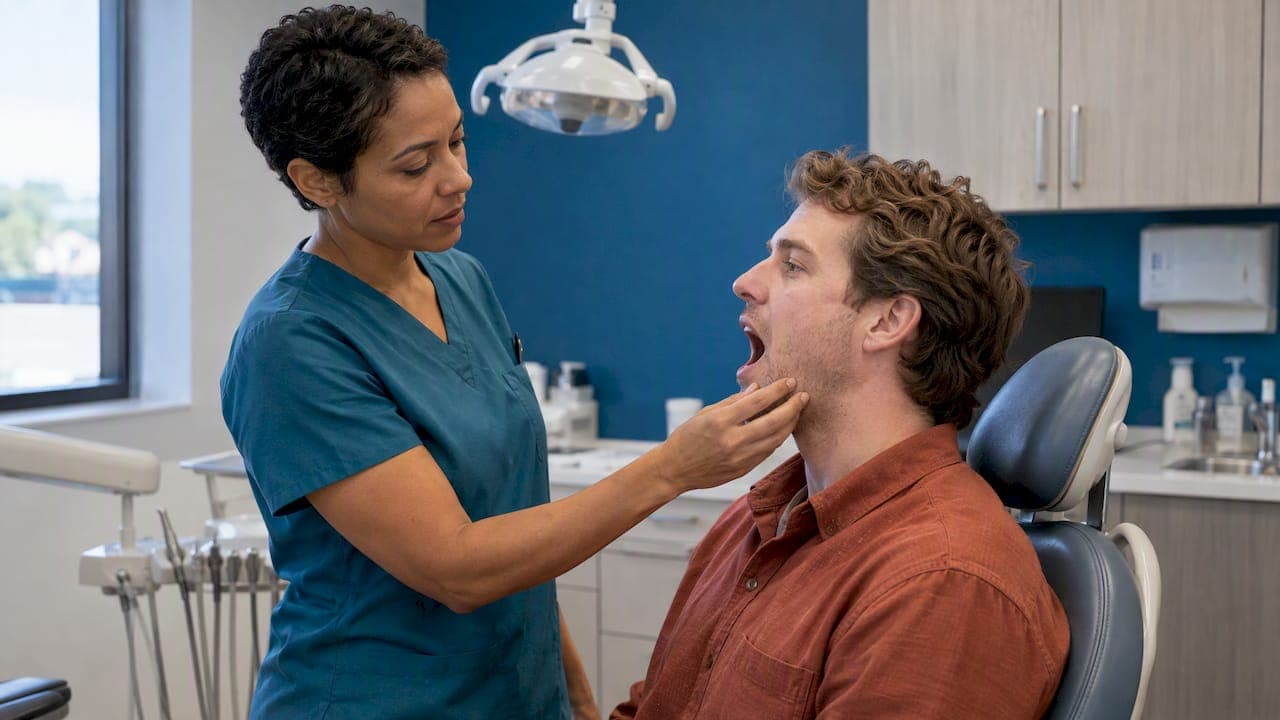
For most people with jaw pain, either one is a reasonable first stop. The National Institute of Dental and Craniofacial Research says you may consult a dentist or a doctor about a suspected temporomandibular disorder (TMD). In practice, a dentist is often the better first call, because the exam looks at your teeth, bite, jaw muscles and joints together. A doctor becomes the right call when the pain looks like it is coming from somewhere else, such as the ear, the nerves or a body-wide condition. This guide explains how to choose, what the visit involves, and when to ask for a specialist.
TL;DR
- Start with a dentist if your jaw hurts when you chew, clicks painfully, locks, or you wake up with a sore jaw. Start with your primary care doctor if you have fever, swelling, injury, or pain that does not seem tied to chewing or the jaw.
- There is no single test for TMD. Diagnosis rests on your history, a hands-on exam of the head, neck and jaw, and sometimes imaging.
- Begin with conservative care. Federal guidance advises against treatments that permanently change your teeth, bite or joints, and suggests a second opinion from an orofacial pain specialist before anything irreversible.
- Painless clicking or popping is considered normal and does not need treatment. Trouble eating or opening your mouth needs a call to your provider right away.
- We evaluate and treat TMD at our Kennebunk, ME practice, including night guards and, when appropriate, Botox for TMD.
Table of Contents
- Dentist or doctor: how to decide
- Why a dentist is often the practical first stop
- When a doctor should come first
- What counts as a TMJ specialist
- What to tell the clinician
- What happens during a TMD evaluation
- Treatment: start gentle, stay reversible
- If you are pregnant
- When not to wait
- Our perspective
- See us for a jaw evaluation in Kennebunk
- FAQ
- Sources
Dentist or doctor: how to decide
TMD is an umbrella term for problems with the jaw joints and the chewing muscles around them. Because the symptoms overlap with ear problems, headaches, tooth pain and nerve conditions, people land in many different offices. A National Academies report summarized by the National Library of Medicine describes a fragmented care pathway in the U.S.: patients enter through primary care physicians or general dentists, and there is no standard pattern for referring on. That lack of a clear "home" for TMD is a common source of frustration.
That is the reason to choose your first stop on purpose. Here is a practical way to do it.
| Your situation | Best first call | Why |
|---|---|---|
| Jaw ache when chewing, sore jaw on waking, worn or chipped teeth | Dentist | Dentists see tooth wear and bite patterns and can examine the joint at the same visit |
| Painful clicking, popping or catching in the jaw | Dentist | A bite and joint exam can show whether the joint or the muscles are the source |
| Jaw feels stuck, locks open or closed | Dentist or doctor, promptly | Locking and limited opening should be looked at soon |
| Ear pain, ringing or dizziness with no ear infection signs | Dentist first, doctor if the exam is unrevealing | TMD can cause these, but so can ear and nerve conditions |
| Fever, facial swelling, recent injury or a hit to the jaw | Doctor, urgent care or emergency room | These are not typical TMD patterns |
| Headaches as the main complaint | Doctor, with a dental exam alongside | Headache has many causes and TMD may be only one of them |
| Pain in many joints plus the jaw | Primary care doctor | A body-wide cause such as arthritis needs a medical workup |
If you are unsure, go with the clinician you can see soonest. A good dentist will tell you when the problem looks medical, and a good doctor will tell you when a dental exam would help.
Why a dentist is often the practical first stop
Three things point to a dental visit first.
The exam covers the parts that matter. A TMD evaluation involves a detailed history and a physical exam of the head, neck, face and jaw to check for tenderness or movement problems, as NIDCR describes. Dentists already do much of this during a routine exam, and they can look at how your teeth meet, which a general physician usually does not.
Dentists see the evidence of clenching. Flattened chewing surfaces, chips, and sore muscles often show up before you notice a problem. Many people grind or clench without knowing it. Our own list of bruxism causes dentists check before recommending a night guard is a good read if that sounds like you.
Dentists can start reversible care right away. That includes guidance on self-care, a custom night guard, and a plan for follow-up. If your case turns out to be complex, your dentist can refer you onward.
When a doctor should come first
See a physician first, or at the same time, if any of these apply:
- You had a blow to the face or jaw, or you cannot bring your teeth together the way you used to after an injury.
- You have fever, swelling, or redness around the jaw or ear.
- Your pain is severe, sudden and not related to chewing or opening your mouth.
- Your jaw symptoms come with joint pain or swelling elsewhere in the body.
- Headaches are the main problem and they are new, severe, or getting worse.
The reason is simple. There is no standardized, widely accepted test for TMD, and its symptoms often overlap with other conditions. Ruling out other causes is part of a good evaluation, and a doctor is the right person to do that for anything that does not fit a jaw problem.
What counts as a TMJ specialist
People search for a "TMJ specialist" and find many titles. Some are general dentists with extra training, some are oral surgeons, some are orthodontists. One recognized credential to know is orofacial pain. The American Dental Association's certifying board council lists the American Board of Orofacial Pain among its recognized certifying boards. Orofacial pain specialists are sometimes described as something like neurologists of the face, and they often bill medical insurance rather than dental insurance for pain-focused care.
You do not need a specialist for every case. Most jaw pain is muscle-related and responds to simple steps. A referral makes sense when:
- Your pain has not improved after a reasonable trial of conservative care.
- Your symptoms are complex, with widespread pain, headaches and jaw problems together.
- Someone has proposed an irreversible treatment such as surgery or changing your bite permanently. NIDCR suggests a second opinion from an orofacial pain specialist before that step.
- A systemic cause is suspected. In that case an orofacial pain specialist typically works alongside a rheumatologist, neurologist or pain management physician, according to an interview reported by Mirage News.
Ask your insurer whether TMD care falls under your dental plan, your medical plan, or both. The answer varies by plan and by the treatment.
What to tell the clinician
Come with notes. The more precise you are, the faster the exam goes. NIDCR and MedlinePlus list the symptoms worth mentioning:
- Pain in the chewing muscles or in front of the ear
- Jaw stiffness, limited movement, or locking
- Painful clicking or popping
- Ringing in the ears or dizziness
- A feeling that your teeth no longer fit together the way they used to
- Headaches, which are often associated with TMD
It also helps to write down when the pain is worst (morning, after meals, during stress), what you chew, whether you clench during the day, and what you have already tried. Our guide to recognizing TMJ symptoms goes through each sign in more detail, and our article on TMJ ear pain explains why a jaw problem can feel like an earache.
One reassurance: clicking or popping without pain is considered normal and does not need treatment. If that is all you have, our piece on jaw clicking without pain covers home care and the signs of locking to watch for.
What happens during a TMD evaluation
Expect a conversation first, then a hands-on exam. A typical visit includes:
- A history. Your symptoms, injuries, habits, stress, sleep, and medical conditions.
- A look at the joints and muscles. The clinician checks for tenderness, listens for sounds, and watches how far and how smoothly your jaw opens.
- A dental exam. Your teeth, gums and bite are checked for wear and signs of grinding.
- Imaging if needed. X-rays, CT or MRI may be used to look at the joint and surrounding bone and tissue. Not everyone needs them.
Because no single test settles the question, a good clinician will explain what they found and what they ruled out. If you hear a diagnosis with no explanation, ask for one.
Treatment: start gentle, stay reversible
The federal guidance is consistent on the order of care. Start with self-care: soft foods, heat or cold, and gentle jaw exercises. If those do not help, a dentist or doctor may suggest intermediate options, such as behavioral approaches (cognitive behavioral therapy or biofeedback), physical therapy, or an oral appliance. Surgery, including implants, sits at the far end as a last resort, and ideally only after a second opinion. NIDCR recommends conservative treatments and avoiding anything that permanently changes the joints, teeth or bite.
What that looks like in an office like ours:
- Self-care coaching. Chewing changes, heat and cold, stretching, and ways to catch daytime clenching. Our step-by-step TMJ pain treatment guide lays out a self-care-first plan.
- Night guards. A custom-fitted guard protects teeth and can reduce the load on tired muscles. A drugstore guard may not fit well, and a dentist can check the fit and your bite.
- Botox for TMD. For some patients with muscle-driven pain, injections into the chewing muscles are an option. We cover the evidence on Botox for TMJ, side effects and red flags and aftercare on our blog. Not every jaw problem is a Botox problem. Patients curious about the cosmetic and clinical angle of masseter Botox for teeth grinding should know it works on muscle tension, not on a joint that is mechanically damaged, and it is best reserved for cases where simpler steps have not been enough.
- Referral. If your case needs a physician, physical therapist, behavioral health clinician or orofacial pain specialist, we say so.
For a Kennebunk-specific overview of what to expect, see our TMJ treatment options page.
If you are pregnant
Jaw pain can appear or worsen during pregnancy. One consumer health source notes that hormonal changes and added physical and emotional stress may play a part, and that mild cases often need little treatment, with exercises, warm or cold compresses and soft foods as common first steps. It lists your dentist, primary care doctor, physical therapist and a pain management specialist as sources of support.
The practical advice: tell the dental office you are pregnant when you book, and tell your obstetric provider about the jaw pain. Check with your obstetric provider before taking any medication for it. Elective cosmetic injections are a conversation to have after pregnancy, not during it. Gentle self-care and a conversation with both clinicians are a safe place to start.
When not to wait
Contact your provider right away if you have trouble eating or opening your mouth. Do the same for a jaw that locks, for swelling or fever with jaw pain, or after an injury. If you have chest pain, pain spreading down the arm, or shortness of breath with jaw pain, call 911: that can be a heart problem, not a jaw one.

Our perspective
We see the same pattern often. Someone has had jaw pain for months, has been to two or three offices, and has been told something different each time. The problem is rarely that anyone was careless. TMD sits between dentistry and medicine, and nobody owns it by default.

So we try to be the office that owns it for the first visit. We take the history seriously, we examine the joints and muscles rather than only the teeth, and we start with the least invasive option that could work. We use digital scanners for precise impressions, which matters when a night guard has to fit your bite accurately. Our rooms have ceiling-mounted TVs and comfort items because a tense, anxious patient also tends to clench, and a calmer exam is a better exam.
We also say plainly when something is outside what we should handle. If your symptoms point to a medical cause, or your case is complicated enough for an orofacial pain specialist, we will tell you and help you take the next step. Anyone who proposes permanent changes to your bite as a first move deserves a second opinion, and that includes us.
— Alex
See us for a jaw evaluation in Kennebunk
If your jaw hurts, clicks painfully, or wakes you up at night, our team offers TMD evaluation and care, along with custom night guards, for patients of all ages. We offer same-day appointments, so you do not have to live with the pain while you wait. Learn more on our TMD care page, or see our TMJ disorders page for Kennebunk.

We bill patients or their dental insurance for treatment. Call the office before your visit to ask how your plan handles TMD care. Our night guards and other services are also listed online.
FAQ
What type of dentist is best for TMJ?
A general dentist who regularly evaluates the jaw and bite is a good starting point for most people. If your case is complex or has not improved with conservative care, an orofacial pain specialist is the next step. Ask any dentist how often they treat TMD and what they try first.
Should I see my regular doctor or a dentist for jaw pain?
Either can start the process. See a dentist if the pain is tied to chewing, clenching or your bite. See a doctor first if you have fever, swelling, an injury, pain in other joints, or headaches that are new or severe.
Do I need an MRI or X-ray for TMJ?
Not always. Imaging such as X-rays, CT or MRI may be used, but there is no single standardized test for TMD, so the history and hands-on exam carry most of the weight. Your clinician will tell you if images would change the plan.
Can TMJ go away on its own?
Many cases settle with simple care like soft foods, heat or cold, and gentle jaw exercises. Painless clicking does not need treatment at all. If pain lasts or you have trouble opening your mouth, get it checked.
Is TMJ treatment covered by dental or medical insurance?
It depends on your plan and the treatment. Some pain-focused care from orofacial pain specialists is billed to medical insurance, while night guards are often handled through dental benefits. Call your insurer and the office before your visit.
Sources
- TMD | NIDCR
- Summary of Treatment for Temporomandibular Disorders (TMDs) | NIDCR
- TMJ disorders: MedlinePlus Medical Encyclopedia
- Improving TMD Health Care: Practice, Education, Access, and Awareness | NCBI
- 2026 Certifying Board Annual Report | NCRDSCB
- What is an orofacial pain specialist? | Dental Economics
- Know Your TMJ: Why It Deserves Your Attention | Mirage News
- TMJ Pain When You're Pregnant | Healthline
- Masseter Botox for Teeth Grinding