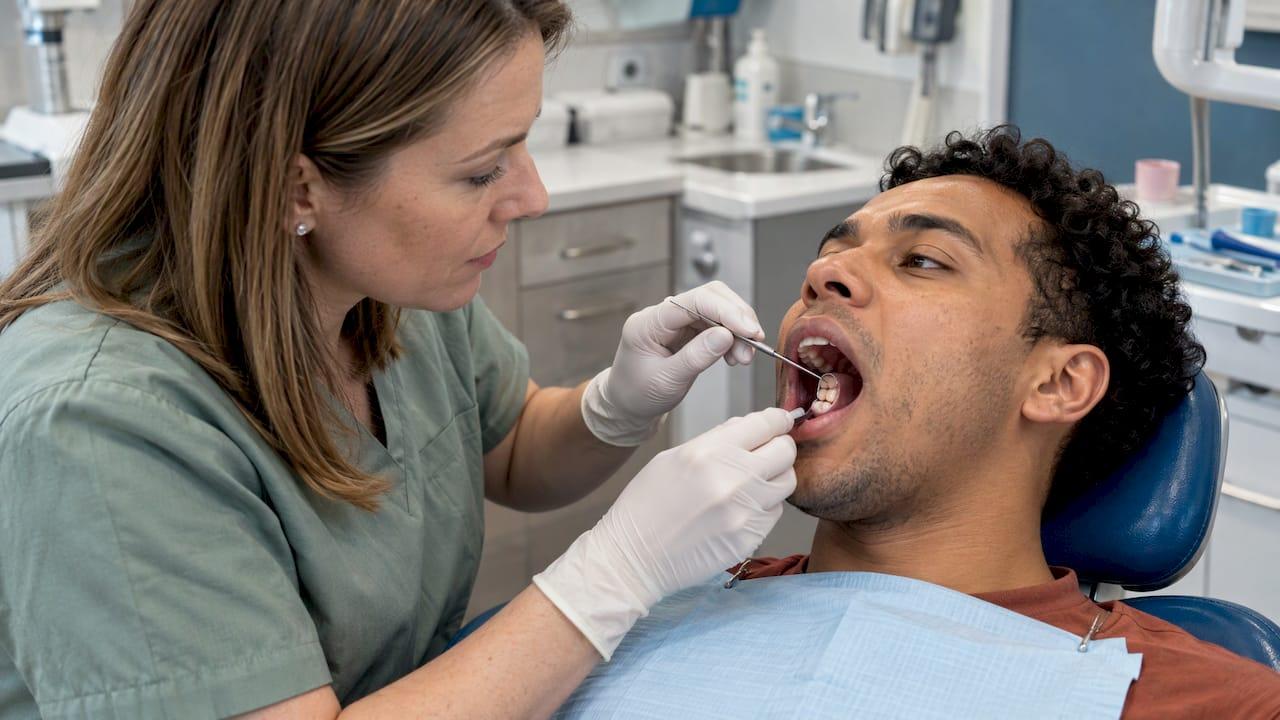
Wisdom tooth pain usually comes from a back molar that is trying to come in, is stuck under the gum, or has irritated gum tissue around it. A warm salt water rinse and a cold pack on the outside of your cheek can ease it for a day or two. Pain that keeps building, swelling, a bad taste, trouble opening your mouth, or a fever means it is time to have a dentist look at it. This guide explains what is going on, what you can safely do tonight, and what to expect at the visit.
TL;DR
- Wisdom tooth pain most often comes from a tooth that is partly through the gum or trapped beneath it, and from inflamed gum tissue around it (pericoronitis).
- For short-term relief, rinse with warm salt water and hold a cold pack against your cheek for 10 to 20 minutes at a time.
- Swelling, pus, fever, a bad taste, or trouble opening your jaw point to infection. Call a dentist promptly, and call 911 if you have trouble breathing.
- A pain that fades is not always a problem solved. Gum swelling can settle and return, and recurring episodes usually mean the tooth itself needs attention.
- At Starboard Dental in Kennebunk, we offer same-day and walk-in appointments so you do not have to wait out a painful tooth.
Table of Contents
- Why wisdom teeth hurt
- Symptoms of an impacted or troublesome wisdom tooth
- Pericoronitis: the usual reason a wisdom tooth suddenly flares up
- How to relieve wisdom tooth pain at home
- How long does wisdom tooth pain last?
- Warning signs: when to call a dentist or seek emergency care
- What happens at a dental visit for wisdom tooth pain
- Our perspective
- See us for wisdom tooth pain in Kennebunk
- Keeping wisdom teeth from causing trouble
- Frequently asked questions
- Sources
Why wisdom teeth hurt
Wisdom teeth are the third molars at the very back of your mouth. They usually arrive last, often in the late teens or twenties, and there is often not enough room for them. That is where most of the trouble starts.
According to Kaiser Permanente's patient guide, a wisdom tooth can hurt when it is coming in but cannot break through the gum, or when it is only partway in and extra gum tissue has formed around it. Those are the two most common situations behind a sore back jaw.
Common causes
- A tooth pushing through the gum. Eruption can cause a dull ache and tenderness at the back of the jaw, much like teething does in children.
- An impacted tooth. The tooth is stuck in the gum or bone and cannot fully come in. It can press on neighboring teeth or irritate surrounding tissue.
- Gum flap inflammation. A partly erupted tooth often has a flap of gum over it. Food and bacteria collect underneath, and the tissue becomes sore and swollen. This is called pericoronitis.
- Decay. Wisdom teeth are hard to reach with a toothbrush and floss, so cavities develop there, or in the tooth in front of them.
- Nerve irritation. If a wisdom tooth sits close to a nerve, it can cause sharp or radiating pain.
Not every wisdom tooth hurts. The MedlinePlus encyclopedia notes that a fully impacted tooth can cause no symptoms at all, even while it stays stuck in gum tissue or bone. A painless wisdom tooth is not necessarily a problem tooth, and a painful one is not necessarily a crisis. The details of the pain matter.
Symptoms of an impacted or troublesome wisdom tooth
People describe wisdom tooth trouble in a handful of recurring ways:
- Red, swollen, or tender gums at the back of the mouth
- Gums that bleed when you brush or eat
- Jaw pain or stiffness
- Swelling around the jaw or cheek
- Bad breath
- An unpleasant taste in your mouth
- Difficulty opening your mouth fully
The sensation of a tooth that seems to come in, then retreat, and then return is common. MedlinePlus explains that this is often caused by the gum over an impacted tooth swelling and then tightening, not by the tooth literally moving back and forth.
Pericoronitis: the usual reason a wisdom tooth suddenly flares up
If your pain started quickly and your gum looks puffy over a back tooth, pericoronitis is a likely explanation. The Merck Manual describes it as inflammation and infection of the tissue between a tooth and the gum flap covering it, usually around an erupting wisdom tooth and almost always a lower one.
The same source lists the typical signs: constant dull pain, inflammation around the lower wisdom tooth, drainage of pus, and trismus, which is the inability to open your mouth fully. Trismus is a useful clue. It is common with lower molar infections like pericoronitis and less common with other dental problems.
How it differs from a cavity
A cavity in a back tooth tends to behave differently. According to the Merck Manual, decay-related sensitivity is usually confined to one tooth and shows up when something stimulates it: heat, cold, sweets, brushing, or chewing. Pericoronitis is more likely to cause a constant, dull ache with gum swelling, and it can bring on a bad taste or pus.

If your pain gets worse when you bite, a crack may be involved instead. Our article on tooth pain when you bite explains a simple way to tell.
When it is the jaw joint, not the tooth
Back-of-jaw pain with limited opening can also come from the jaw joint. The Scottish Dental Clinical Effectiveness Programme's guidance on acute pericoronitis stresses the need to tell pericoronitis apart from temporomandibular disorder (TMD), because both can produce pain and restricted opening. If you also notice clicking, ear pain, or a jaw that tires when you chew, read about TMJ symptoms and what jaw pain means and why TMJ can cause ear pain. A dental exam sorts out which problem you have.
How to relieve wisdom tooth pain at home
Home care can take the edge off while you arrange to be seen. It does not remove the cause, so treat it as a bridge, not a fix.
A short, safe routine
- Rinse with warm salt water. Kaiser Permanente recommends rinsing every two hours. The amount used in its guidance is 1 teaspoon of salt in 8 ounces of water.
- Use a cold pack on the outside of your cheek. Apply it for 10 to 20 minutes at a time, with a cloth between the pack and your skin.
- Ask about pain medicine. The same Kaiser guide advises asking a doctor whether you can take an over-the-counter pain reliever, and following the label. Medication choice depends on your health, other medicines, and allergies, so a doctor or pharmacist should confirm what is right for you.
- Keep the area clean. Improved oral hygiene, including brushing with toothpaste, cleaning between teeth, or using a chlorhexidine mouthwash, can reverse the symptoms of acute pericoronitis, according to a review of problems with erupting wisdom teeth. Chlorhexidine is a prescription or professional recommendation in many cases, so ask your dentist before using it.
- Eat gently. Choose soft, cool foods and chew on the opposite side. Avoid anything that could lodge under the gum flap, like popcorn hulls or seeds.
If the pain is worst at night, our guide to stopping a toothache at night covers positioning, a cold pack, and when same-day care makes sense.
What not to do
Do not place aspirin or any pain pill directly against the gum. Do not try to cut or lance a swollen flap yourself. Do not ignore a worsening problem because the first day of rinsing helped. Swelling that comes back is a signal, not a fluke.
How long does wisdom tooth pain last?
The same review in PubMed Central says acute pericoronitis is usually a single event lasting 3 to 4 days, and that better hygiene or a chlorhexidine rinse can reverse symptoms. That is the reassuring part.
The less comfortable part: it can come back. Frimley Health's hospital guideline notes that pericoronitis can recur and need repeated treatment unless the underlying cause, such as the tooth itself, is dealt with. The review adds that chronic, recurrent pericoronitis is preferably handled with early extraction.
A practical rule: one mild flare that settles with good cleaning is worth mentioning at your next checkup. A second flare, or a first one that is severe, deserves a dental visit soon.
Warning signs: when to call a dentist or seek emergency care
The Kaiser Permanente guidance says to contact a dentist or doctor promptly if you have increased pain, swelling, warmth, redness, pus draining from the area, or a fever. It also says to call 911 if you have trouble breathing.
There is a reason these signs matter. Frimley Health's guideline explains that severe pericoronitis may lead to a pericoronal abscess, which can stay local or spread into the deeper spaces of the face and neck. Swelling that makes it hard to swallow, open your mouth, or breathe is an emergency.
| What you notice | What it may mean | What to do |
|---|---|---|
| Dull ache at the back of the jaw, mild gum tenderness | Eruption or mild gum irritation | Salt water rinses, careful cleaning, cold pack. Book an exam. |
| Constant ache, swollen gum flap, bad taste | Possible pericoronitis | Call a dentist for a visit within a day or two. |
| Pus, swelling in the cheek, fever | Likely infection | Call a dentist promptly. Same-day care is appropriate. |
| Trouble opening your mouth | Trismus, often with lower molar infection | See a dentist promptly. |
| Trouble breathing or swallowing | Possible spreading infection | Call 911. |
| Pain only with hot, cold, or sweets in one tooth | More like decay or sensitivity | Book an exam. |
For a broader view of what counts as a dental emergency and how to prepare, see our emergency dental care guide.
What happens at a dental visit for wisdom tooth pain
A visit for wisdom tooth pain is more straightforward than most people expect. According to the Merck Manual, the evaluation includes a clinical examination and usually dental X-rays. The dentist looks at the gum over the tooth, checks for swelling and drainage, tests how far you can open, and examines the neighboring teeth. An X-ray shows the position of the tooth, whether it is angled or trapped, and whether there is decay.
The Merck Manual also says that when infection is present, a dentist may treat it by removing the source. Depending on the situation, that can mean extraction or other procedures aimed at the source of infection. For pericoronitis, the cleaning and irrigation of the area are common first steps, and the longer-term decision is about whether the tooth can function and be cleaned, or whether it keeps causing trouble.

The California Academy of General Dentistry's overview of third molar management notes that a symptomatic pericoronitis case can often be helped by a general dentist even before a specialist is involved, especially when immediate oral surgery access is limited. That is useful to know if you are in pain today and cannot wait for a specialist appointment.
Questions worth asking
- Is the pain coming from the wisdom tooth, the tooth in front of it, or the jaw joint?
- Is there an infection now, and what is the plan to clear it?
- Is this tooth likely to keep flaring up?
- If the tooth should come out, what are the next steps and the timing?
- What can I do to keep the area clean in the meantime?
If you are new to a practice, our overview of common dental procedures for new patients explains what the exam and X-rays involve.
Our perspective
Most people who come to us with wisdom tooth pain have waited longer than they wanted to. They hoped it would calm down, and sometimes it does. But the patients who feel better fastest are usually the ones who let us look at it early.
We think the best first step is a proper exam with digital imaging. Our digital scanners and X-rays give us a precise picture of what is happening at the back of your mouth, so we can tell you whether it is gum inflammation, decay, or something involving the jaw, instead of guessing. Because we treat patients of all ages and handle both routine and specialty concerns like TMD, we can look at the whole picture, including whether jaw tension is part of what you feel.
Dental anxiety is real, and a throbbing tooth makes it worse. That is why we built our office around comfort: a warm, welcoming team, ceiling-mounted TVs, and personalized comfort items. We offer same-day and walk-in appointments, because pain does not keep a schedule.
If your pain is gone tomorrow, still book a checkup. A quiet wisdom tooth is the best time to learn where you stand.
Alex
See us for wisdom tooth pain in Kennebunk
If you are near Kennebunk and your back tooth hurts, we would rather see you early than late. Starboard Dental offers general dentistry, including exams, X-rays, and oral cancer screenings, in a technologically advanced office, with same-day and walk-in appointments available for patients of all ages.

Start on our general dentistry page to learn about exams and checkups, or contact the office through starboarddental.com to be seen. If you have jaw pain along with the tooth pain, our TMD care is also available, and night guards may be discussed if clenching is part of the picture.
Keeping wisdom teeth from causing trouble
You cannot always prevent a wisdom tooth from coming in at an awkward angle. You can lower the odds of painful flare-ups.
- Clean the back of your mouth deliberately. Use a small-headed brush and angle it toward the last tooth. Clean between teeth daily.
- Rinse after meals if a partly erupted tooth traps food.
- Keep up with checkups. Routine X-rays let a dentist watch a wisdom tooth over time and spot changes before they hurt. Our general dentistry visits include exams and cleanings.
- Treat gum disease early. Inflamed gums around back teeth can make a bad situation worse. Our periodontal therapy addresses gum problems.
- Do not wait out recurring flares. A tooth that has caused pericoronitis more than once rarely settles for good on its own.
A note on removing teeth that do not hurt
Whether to remove a symptom-free wisdom tooth is a decision to make with your dentist, based on your X-rays, your gums, and your history. The 2016 review points out that guidance in the UK discouraged removing wisdom teeth as a preventive measure, and that some patients later had problems as a result. In other words, the decision is individual. A dentist who knows your mouth is the right person to weigh it.
Frequently asked questions
Can wisdom tooth pain go away on its own?
Sometimes. An acute flare of pericoronitis is usually a single episode lasting about 3 to 4 days, and good cleaning can reverse it. But when the tooth stays partly covered by gum, the pain can return. If it comes back, have a dentist examine the tooth.
What is the 3-3-3 rule for a toothache?
It is a rough rule of thumb some people repeat, not an official medical standard, and we would not rely on it. Use the warning signs instead: increasing pain, swelling, warmth, redness, pus, or fever means calling a dentist promptly. Trouble breathing means calling 911.
What are the symptoms of impacted wisdom teeth?
Common signs include red or swollen gums, tender or bleeding gums, jaw pain, swelling around the jaw, bad breath, and an unpleasant taste. Some impacted teeth cause no symptoms at all, so an X-ray at a checkup is the reliable way to know what is below the gum.
How can I tell wisdom tooth pain from an infection?
Pain that is constant, comes with a swollen gum flap, a bad taste, pus, fever, or trouble opening your mouth suggests infection. Pain that appears only with heat, cold, or sweets in one tooth is more typical of decay. A dentist can tell the two apart with an exam and X-rays.
Is it safe to wait if the pain is mild?
A mild ache with no swelling can be managed with salt water rinses and careful cleaning for a short time, but book an exam so the cause is known. If swelling, pus, fever, or trouble opening your mouth appears, do not wait.
Sources
- Impacted tooth: MedlinePlus Medical Encyclopedia
- Toothache and Infection: Merck Manual Professional Version
- Tooth and Gum Pain: Care Instructions, Kaiser Permanente
- Acute pericoronitis, Scottish Dental Clinical Effectiveness Programme
- Problems with erupting wisdom teeth: signs, symptoms, and management
- Acute Pericoronitis, Frimley Health Guidelines
- Surgical and Non-Surgical Management of Third Molars, California Academy of General Dentistry