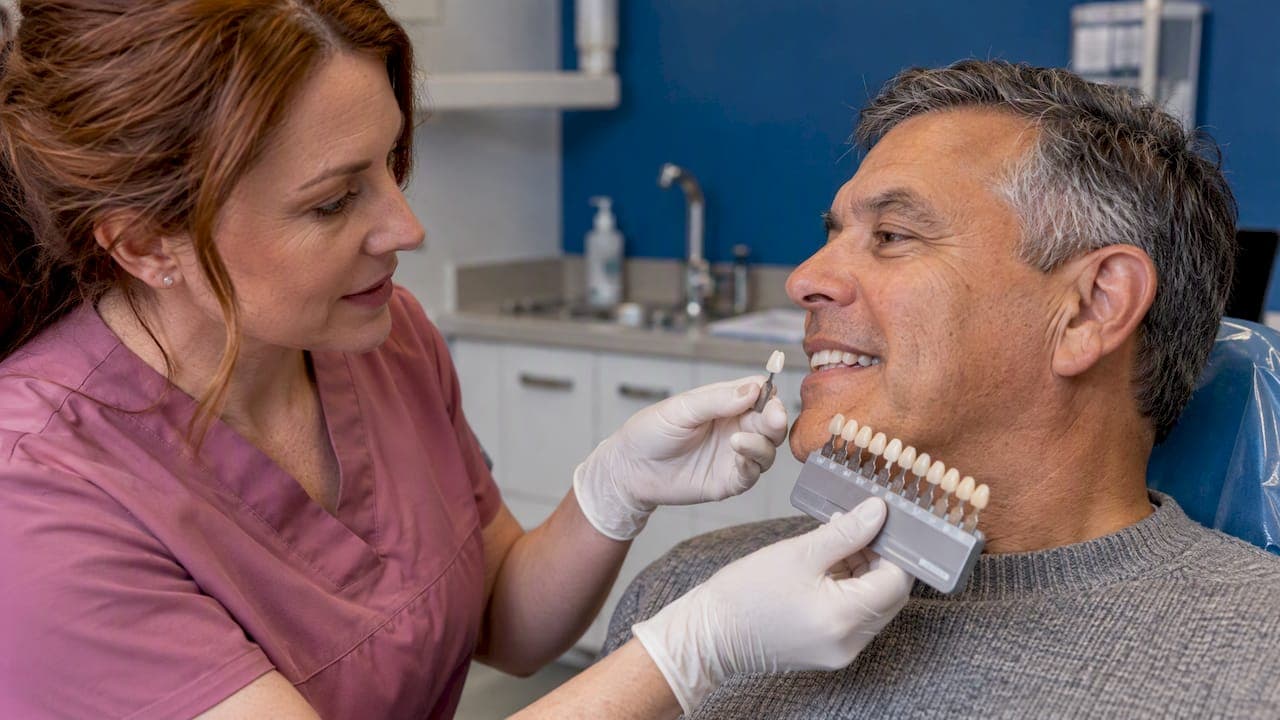
No, you can't whiten a crown. Bleaching gel brightens natural tooth enamel, and a crown is made of porcelain, ceramic or zirconia, which doesn't respond to it. The American Dental Association states that only natural teeth can be whitened, not tooth-colored restorations.
That doesn't leave you stuck. You can still whiten the natural teeth around a crown, and you can fix a mismatch in a few ways. The order you do things in matters more than any product you buy. This guide covers why crowns resist whitening, what to do if your crown looks darker than your smile, how to plan whitening before a new crown, and what to do about bonded teeth and "caps" in general.
TL;DR
- Whitening gel changes natural enamel only. Crowns, veneers, bridges, and tooth-colored fillings keep their shade.
- Whitening your natural teeth next to a crown is safe, but it can make the crown look darker by comparison, especially on a front tooth.
- Planning a new crown? Whiten first, then let your dentist pick the crown shade at least two weeks later.
- Bonded teeth behave like crowns: bleaching won't lighten the resin, so a mismatch usually means polishing, replacing the bonding, or a veneer.
- Bleeding, floss shredding, or food trapping around a crown deserves an exam, whatever the shade.
Table of Contents
- Why whitening gel can't change a crown
- What happens if you whiten teeth next to a crown
- Planning whitening before a new crown
- Fixing a crown that no longer matches
- Can you whiten bonded teeth?
- When the crown needs a check, not a color change
- Our perspective at Starboard Dental
- Plan your whitening and crown work in Kennebunk
- Related questions about whitening and restorations
- FAQ
- Sources
Why whitening gel can't change a crown
Whitening products use hydrogen peroxide or carbamide peroxide. These are the most common active ingredients in professional and over-the-counter treatments. The peroxide works its way into the tiny pores of enamel and breaks apart the stain molecules held there.
A crown has no such pores. Colgate's guidance on crowns explains that crown materials are non-porous, so bleaching agents have nothing to work on. The Oral Health Foundation makes the same point: whitening does not work on dentures, crowns, white fillings, or bridges.

This is why the search results for this question all agree. The shade of a crown is built into the material when the lab makes it. Nothing you apply later reaches inside.
What counts as a "cap"
Many people say "cap" when they mean a crown. Some mean a veneer, which is a thin shell on the front of a tooth. The rule is the same for all of them. A porcelain crown, a zirconia crown, a veneer, and a bridge tooth all keep their original color. The same goes for an implant crown, which sits on a post in the jaw and has no natural enamel at all.
What you can safely try, and what you can't
Strips, trays, whitening toothpaste, and in-office bleaching will not harm a well-fitted crown in the sense of changing its surface or color. They simply won't do anything to it. The practical risk is the one in the next section: your natural teeth change and the crown doesn't.
Do-it-yourself shortcuts are a different matter. The University of Rochester Medicine notes that DIY methods may not whiten teeth effectively and can damage teeth. Abrasive pastes made of baking soda or charcoal scrub at surfaces. On a crown, that can dull the glaze. On enamel, it can wear the tooth.
What happens if you whiten teeth next to a crown
You can whiten natural teeth when you have crowns. The catch is the contrast. Your teeth get lighter, and the crown stays exactly as it was. According to Colgate, the mismatch is much more noticeable on front teeth than on back teeth.
Here is how it tends to play out:
| Crown location | What you'll likely see after whitening | Typical next step |
|---|---|---|
| Back molar | Little visible difference in normal conversation | Usually nothing |
| Premolar (visible when you smile wide) | A slight contrast in bright light | Watch it, or ask your dentist to compare shades |
| Front tooth | Crown can look gray or yellow next to brighter neighbors | Consider replacing the crown to match |
A crown that looked perfect five years ago may suddenly look dark. The crown didn't change. Your neighbors did.
Is it the crown, or is it something else?
Before you decide the crown is the problem, check three things.
- Gum line. A dark edge near the gum can come from receding gums showing the crown's base, or from an old metal liner showing through. Whitening wouldn't help either.
- Surface film. Coffee, tea, red wine, and tobacco leave a layer of stain on a crown just as they do on enamel. A professional cleaning can remove that film. If the crown looks brighter after a polish, that was the cause.
- Neighboring teeth. If the teeth beside the crown have yellowed with age, the crown may simply be the same as it was.
Our teeth whitening for smokers guide covers how tobacco stain builds up and why it returns quickly. If you smoke, it also helps to read about what cigarettes do to your mouth, since gum irritation around a crown is one of the first places it shows.
Planning whitening before a new crown
If you need a crown and you want a brighter smile, the order is simple: whiten first, crown second.
The guidance from Colgate is to whiten your natural teeth at least two weeks before the final crown shade is selected. Freshly bleached teeth settle in color over that time. If your dentist picks a shade too soon, the crown can end up lighter or darker than where your teeth finally land.
A workable sequence looks like this:
- Exam first. Confirm that the tooth needs a crown and that your gums and other teeth are healthy enough for whitening. If you're unsure whether you need one, see how to tell if you need a crown.
- Whiten. Use a dentist-supervised method so the result is predictable.
- Wait at least two weeks. Don't skip this.
- Choose the crown shade. Your dentist compares the shade in different lighting.
- Place the crown. Then keep up maintenance whitening only if your dentist agrees it still suits your smile.
The ADA lists in-office bleaching and dentist-supervised at-home options among the whitening treatments available. A dentist-guided plan is helpful here because shade matching depends on more than a color tab. It involves lighting, the shape of your tooth, and the restoration material.
A note on temporary crowns
Temporary crowns are acrylic and are not meant to be matched for a final result. If one comes off, don't try to glue it back with household products. Our guide on what to do when a temporary crown comes off walks through the steps to protect the tooth until you're seen.
Fixing a crown that no longer matches
If the mismatch bothers you, you have a few real choices. None involve bleaching the crown.
Option 1: Live with it, or ease the contrast
On a back tooth, nobody sees the difference. For a mild mismatch, some people choose to stop at a lighter shade rather than going as bright as possible. A natural look often reads better than a very white one, and a smaller gap means less contrast with your crowns.
Option 2: Replace the crown to match
For a visible front tooth, this is the most reliable fix. The new crown is made to match your teeth at their new, brighter shade. It helps to know the material options first. Our crown types explained article compares materials, uses, and lifespans. If you're replacing a crown anyway, because it's worn or the tooth has changed, it's the ideal time to fix the color.
Option 3: Cover or reshape with cosmetic work
Depending on the tooth, other cosmetic treatments can help blend the smile, such as contouring or bonding on neighboring teeth. A dentist can tell you which of these is realistic for your bite and your tooth. Our cosmetic dentistry page lists the options we offer, including composite bonding, porcelain veneers, and tooth contouring.
Option 4: Go the other way, with the natural teeth
If you haven't whitened yet, one smart move is to not whiten as far as the maximum. You can stop where your natural teeth and the crown look balanced. That avoids a replacement in many cases.
Can you whiten bonded teeth?
Bonded teeth work like crowns in this respect. Dental bonding uses a tooth-colored composite resin to repair, reshape, or fill a tooth. Colgate explains that the resin is non-porous and can't be lightened by traditional whitening treatments. Its advice is to whiten your natural teeth before bonding so your dentist can match the resin to your brightest smile. If you whiten after bonding, you will likely need to replace the bonding or cover it with a porcelain veneer to match the new shade.
That covers white fillings too. The Oral Health Foundation lists them with crowns as restorations that whitening doesn't affect.

Dental bonding aftercare to keep it looking its best
Bonding can't be bleached, but it can be protected. Colgate recommends good oral hygiene and limiting staining foods and drinks such as coffee, tea, red wine, and tomato-based sauces. Some practical habits:
- Brush twice a day and floss daily. Plaque holds stain against the edge of the bonding.
- Rinse with water after coffee, tea, or wine. It isn't perfect, but it reduces how long pigment sits on the surface.
- Keep your cleaning visits. A professional polish can lift surface stain from resin. Ask your hygienist to polish the bonding.
- Skip hard chewing on ice, pens, or fingernails. Resin can chip, and a chip can stain along the rough edge.
- Wear a night guard if you grind. Grinding wears down both bonding and crowns. Ask about our night guards.
If the bonding looks yellow or stained even after a cleaning, don't try to scrub it. Have it looked at. Often a polish or a small repair is enough, and if the bonding is old, a replacement may be the better answer.
When the crown needs a check, not a color change
Sometimes the issue isn't the shade. A crown covers the tooth, but the tooth underneath can still change, and the edge where the crown meets the tooth is a place where plaque collects.
Dentists point to a few signs that a crown margin needs checking. The American Dental Association's MouthHealthy resource covers sensitivity, and the clinical pattern is the same: floss that shreds, food that keeps getting trapped, or bleeding around the crown are signs the edge should be assessed for decay or gum inflammation. Don't treat them as minor annoyances.
Two of our articles are worth reading if you notice these:
- Cavity under a crown explains how decay can start beneath a crown and what the fixes look like.
- Same-day care for a loose crown covers what to do now if a crown has shifted or come loose.
A dark line at the gum, a bad taste, or a crown that feels different when you bite should prompt a call, not a whitening kit.
Our perspective at Starboard Dental
We see this situation often: someone whitens at home, loves the result, then notices a crown that now looks dull. Our view is that the problem is almost always a planning problem, not a product problem. That's why we want to talk about the whole smile before any whitening starts.
Here is how we approach it:
- We look at every restoration first. Crowns, bonding, fillings, and veneers all stay the shade they are. We want you to know which teeth will change and which won't before you begin.
- We use digital scanners for precision. Accurate scans help when a new crown has to fit and look right beside your natural teeth.
- We don't push the whitest shade. A smile should look like yours. Often the best result is a bright, balanced shade that keeps the crown and the natural teeth in harmony.
- We keep visits comfortable. Many people avoid the dentist because of anxiety. We offer ceiling-mounted TVs and personalized comfort items to make it easier to come in, and we offer same-day and walk-in appointments when something needs attention.
If you're considering a new crown and want to whiten first, tell us at the start. It changes the order of treatment, and that order is what protects the result.
— Alex
Plan your whitening and crown work in Kennebunk
If you have a crown and want to whiten, or you need a crown and want the shade to match your brightest smile, we can map out the right sequence with you. We offer teeth whitening and crowns and other restorative dentistry at our Kennebunk practice, for patients of all ages. Prices aren't published online, so call us and we'll talk through your options, and your dental insurance, at your visit. Start at starboarddental.com.
Related questions about whitening and restorations
A few more situations come up often enough to answer here.
What if my front crown is older and looks gray?
A gray cast can come from the crown's metal base showing through, from gum recession, or from a change in the tooth beneath. A cleaning will not fix any of these. An exam will tell you which one it is, and replacement is the usual solution.
What about whitening after braces or aligners?
If you've had orthodontic treatment, check for white spots before you whiten. Our guide on whitening teeth after braces covers the timeline. If you're considering straightening, our clear aligners page explains the option.
What if a tooth has darkened after a root canal?
A root-canal-treated tooth can darken from within, and that's a different problem from surface stain. A dentist can sometimes lighten it from inside. See internal tooth bleaching after a root canal for how that works. This applies to a natural tooth, not a crown.
Where do I start learning about whitening?
Our overview of dental bleaching explains in-office and at-home options in plain terms.
FAQ
Can you whiten crowns at all?
No. Crowns are made of non-porous materials such as porcelain, ceramic, or zirconia, and bleaching agents can't change their color. Only natural enamel responds to whitening. If a crown looks off, a professional polish may remove surface stain, and a replacement is the way to change its shade.
Can you whiten your teeth if you have crowns?
Yes, it's generally safe to whiten your natural teeth when you have crowns. Just expect the crowns to stay the same color while your teeth brighten. On front teeth the mismatch can be noticeable, so talk to your dentist before you begin.
Can you whiten bonded teeth?
No. The composite resin used in bonding is non-porous and doesn't lighten with whitening treatments. If you whiten after bonding, the bonding may need to be replaced or covered with a veneer to match. Whitening first, then bonding, avoids that.
How long should I wait to get a crown after whitening?
Wait at least two weeks after whitening before the final crown shade is chosen, so the color of your teeth has settled. Your dentist can then match the crown to your lighter shade.
Sources
- Whitening, American Dental Association
- Can You Whiten A Crown?, Colgate
- Whitening Bonded Teeth, Colgate
- Teeth Whitening: What Works and What's Safe, University of Rochester Medicine
- Tooth whitening policy, Oral Health Foundation
- Sensitive teeth, MouthHealthy